


✨ AI Summary
- This blog post explores the transition in the Web3 gaming industry from the play-to-earn to the play-and-own model, highlighting the flaws and failures of the former.
- From 2021 to 2026, play-to-earn games suffered significant economic collapses due to their dependence on continuous player growth and token inflation.
- In contrast, the play-and-own model, which emphasizes player ownership of tradable NFT assets, has proven to be sustainable and successful.
- Case studies, such as the MapleStory Universe and Off The Grid, illustrate this shift and its benefits.
- The post also provides practical advice for developing sustainable Web3 games, emphasizing the importance of engaging gameplay, strategic tokenomics, and optional blockchain integration.
The Web3 gaming industry learned an expensive lesson between 2021 and 2026: sustainable game economies require players to earn valuable assets, not inflationary tokens they immediately sell. Early Web3 game development largely revolved around play-to-earn mechanics, an experiment in aligning player incentives with token economics. The flaw: players earned tokens through gameplay, sold them to realize value, and expected prices to hold. When every participant is simultaneously buying and selling, the model only works if new players buy in faster than existing players sell out. When growth slowed, tokens collapsed.
The games are still running, and they have rebuilt their economies from scratch. Play-and-own is that model: players earn tradable NFT assets with utility, studios control scarcity and monetize via marketplaces, and token economies separate governance from utility to prevent death spirals.
What you’ll get to know:
- Why play-to-earn’s economics were structurally unsustainable
- How play-and-own decouples earnings from token inflation
- Case studies: MapleStory Universe, Off The Grid
- The 2026 blueprint & cost for building sustainable Web3 games
Are Blockchain Games Dead in 2026?
No, but most early blockchain games failed. The industry moved away from inflationary play-to-earn mechanics toward gameplay-first, ownership-driven models that prioritize sustainability over speculation.
“According to Bitget News, 93% of Web3 gaming projects launched between 2020 and 2026 are effectively dead. Over $12–15 billion in venture capital and token sales flowed into blockchain gaming, most of it completely written off. The collapse was systematic: play-to-earn’s economic model relied on infinite player growth to sustain token value, and when growth slowed, token prices crashed. The games still running rebuilt their economies around play-and-own, where players earn tradable NFT assets with utility, studios control scarcity through marketplaces, and token models separate governance from utility to avoid death spirals”.
So, why did play-to-earn collapse so dramatically? Let’s understand what went wrong in detail.
The Play-to-Earn Collapse: What Went Wrong
Play-to-earn games paid players in native tokens for in-game actions. Players sold those tokens to realize earnings. The challenge: every participant was simultaneously earning (inflationary pressure), selling (sell pressure), and expecting the token to maintain value.
GameFi’s investor mindshare collapsed from 3.72% (2024) to 1.30% (2025), displaced by AI and DeFi. The sector posted average losses of 75.2% across its top ten tokens, with devaluations ranging from 40.1% to 92.5%.
Source: Coingecko
Axie Infinity illustrates the pattern:
- Peak: 2.7 million daily active users (Q3 2021)
- Decline: 99,000 DAU (late 2025), some metrics show as low as 5,500
- Collapse: 96.5% user loss
Source: BlockEden.xyz
Other collapses:
- (HMSTR): Market cap crashed from $300M (Aug 2024) to $12M (Feb 2025), 96% user loss
Q1 2026 saw accelerated closures: Forgotten Runiverse (Jan 27), GensoKishi Online (April 30, operating at a 5x loss-to-revenue ratio), Pixiland, Bloktopia, and KTTY World.
The lesson: Economic models requiring infinite player growth don’t survive reality. Even during peak hype, only 12% of traditional gamers tried a blockchain game.
Discover how a gameplay-first economic model can future-proof your game.
How Play-and-Own Changes Web3 Game Development?
Play-and-own decouples player earnings from token inflation. Players earn NFT assets, characters, items, and land that other players want because they have in-game utility. Value comes from player-to-player markets, not continuous token minting.
Studios control asset drop rates and scarcity. Players monetize by acquiring rare assets and selling them to others who need them for progression or competitive play.
Economic flow comparison:
| Model | Player Earns | Studio Distributes | Value From | Sustainability |
|---|---|---|---|---|
| Play and Earn | Tokens | Continuous minting | New player buy-in | Requires infinite growth |
| Play-and-own | NFT assets | Controlled drops | Player demand + utility | Sustainable with utility |
The difference: Play-to-earn creates monetary inflation. Play-and-own controls the scarcity of useful assets. While reward-based mechanics initially fueled Web3 gaming adoption, the industry’s evolution toward ownership-first experiences reveals a bigger transformation ahead. To better understand how these economic models differ, explore the detailed comparison between Play-to-Earn and Play-to-Own in Web3 gaming.
What Sustainable Web3 Games Look Like in 2026
1. Case Study: MapleStory Universe – Dual-Token Model That Works
Developer: NEXPACE (Nexon’s Web3 division) Infrastructure: Henesys blockchain (Avalanche subnet) Launch: May 2025
First-Year Performance (May 2025 – May 2026):
- 3.82 million registered accounts
- 850,000 engaged wallets
- 150 million+ on-chain transactions
- 23.3% of total Avalanche network activity
- $46 million marketplace transaction volume
- $31 million NXPC consumed in-game for purchases/upgrades
- 8 million NXPC permanently removed from circulation
- Q1 2026 milestone: NXPC consumed > NXPC issued (first time utility exceeded rewards)
Source: Invenglobal
- Why it works: The game is fun, built on MapleStory franchise equity. Blockchain adds ownership without requiring crypto fluency. Automated burns link token supply to player activity, creating deflationary pressure.
2. Case Study: Off The Grid – Optional Blockchain, Mainstream Reach
Developer: Gunzilla Games (450-person studio, Neill Blomkamp) Platform: Epic Games Store #1 free-to-play (Oct 2024) Model: Optional blockchain, play without crypto, opt-in for ownership
Scale (Feb 2026):
- 740 million transactions processed
- 14 million wallets, zero downtime
- 2.5 million transactions in a single day (Jan 15, 2026, peak)
- 3,000 new players daily
- 100,000+ paid subscribers ($12/month OTG Pro)
Token (GUN):
- Circulating: 1.55B / 10B total
- Price: $0.027 (Feb 2026)
- Market cap: $43 million
Source: Phemex
- Why it works: The game topped charts before the token launch, proving player demand for core gameplay. An optional blockchain converts engaged players into traders without alienating mainstream gamers. Economy is player-generated; the studio never sells NFTs directly.
- Key insight: Build a great game first. Add ownership second. Make blockchain optional, not required.
Do Web3 Games Need Tokens?
Not always. Web3 games in 2026 use three models: dual-token (governance + utility), NFT-only (no tokens), or hybrid (optional blockchain). Many successful games now defer or skip token launches entirely. For games that do use tokens, the proven structure is dual-token economies:
1. Governance Token (capped supply):
- DAO voting, staking, revenue share
- Acquired via sale or market—not earned through gameplay
- Examples: $AXS (Axie), $MAGIC (Treasure DAO), NXPC (MapleStory Universe)
2. Utility Token (high emission, requires burn sinks):
- In-game purchases, upgrades, crafting, and marketplace fees
- Earned through gameplay
- Burned via upgrade costs, breeding fees, and marketplace taxes
- Stability requires: burn rate ≥ emission rate
Why it works: Governance holders align long-term and hold. Utility holders earn, spend, and the game burns. If emission-burn is balanced, the token doesn’t collapse.
Pro Tip!
Build the game first. Prove retention. Add tokens only after product-market fit. Off The Grid topped Epic charts before its token launched.
Retention Metrics: Non-Negotiable Benchmarks
Sustainable games hit traditional Web3 retention targets (Mavens 2026 report):
- D1: 35–45% (below 30% = fundamental issues)
- D7: 15–25%
- D30: 5–10%
High-value monetization example: Yield Guild Games’ LOL Land hit $4,263 ARPPAU (Oct 2025)—small, dedicated communities generate sustainable economics.
Source: Blockchaingamer.BIZ
How to Develop Sustainable Web3 Games in 2026
Sustainable Web3 games are built in phases, not through instant token launches. In 2026, successful ecosystems prioritize gameplay first, ownership second, and tokenization only when demand exists.
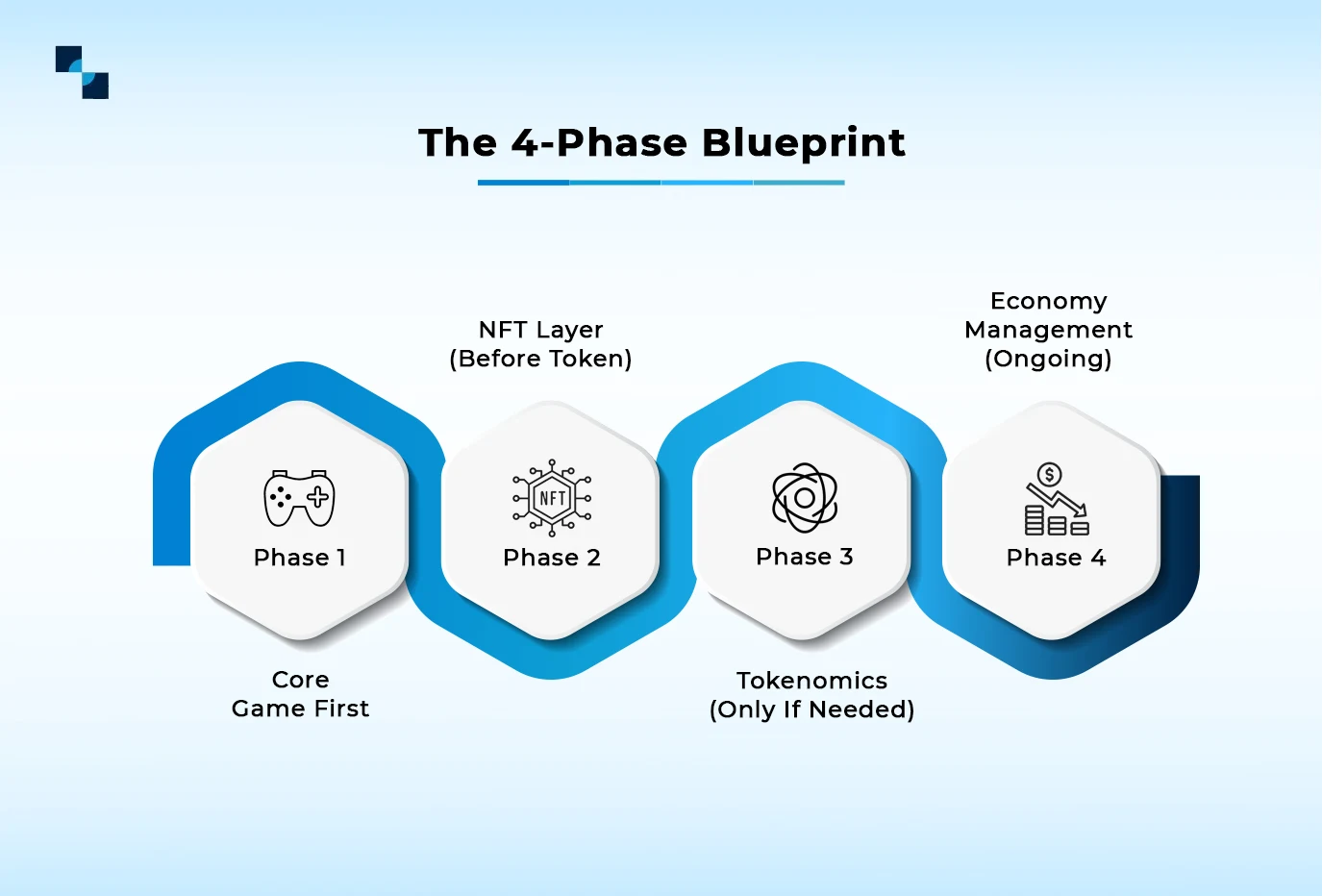
Phase 1: Core Game First: Build a game that’s engaging without blockchain. If players won’t play it without Web3, fix the game.
Phase 2: NFT Layer (Before Token): Design NFTs with utility, enforced scarcity, and tradability. Let players earn via skill. Make blockchain optional.
Phase 3: Tokenomics (Only If Needed): Launch a token only when:
- You have product-market fit and retention benchmarks
- Deflationary sinks balance emission
- Legitimate use case beyond speculation
Phase 4: Economy Management (Ongoing): Monitor emission, burn, NFT supply, and retention in real-time. MapleStory’s automated 20% revenue burn shows systematic supply management.
What to avoid:
- Launching tokens before proven retention
- Requiring crypto wallets to play
- Promising yield, needing exponential growth
- NFTs without gameplay utility
How Much Does it Cost to Build a Web3 Game?
The cost of Web3 game development depends on several critical factors, from gameplay complexity and blockchain integration to NFT systems and long-term scalability. Here are the major elements that influence overall development effort:
- Game Type & Overall Complexity – A simple casual game requires fewer resources than multiplayer RPGs, FPS titles, or immersive metaverse ecosystems with advanced mechanics.
- Blockchain Integration Requirements – Wallet connectivity, smart contracts, NFT functionality, marketplace logic, and blockchain selection directly affect development scope.
- NFT Utility & Ownership Design – Creating meaningful tradable assets, skins, characters, land, or collectibles with real in-game utility requires strategic planning.
- Tokenomics & Economic Structure – Governance systems, reward balancing, emission models, and utility sinks can significantly increase planning and development effort.
- Gameplay Quality & Visual Experience – Character design, animations, environments, storytelling, UI/UX, and polished gameplay loops shape production complexity.
- Security, Performance & Scalability – Smart contract audits, anti-cheat systems, backend stability, and infrastructure readiness are essential for long-term sustainability.
- Development Strategy & Rollout – A gameplay-first, phased development approach helps studios avoid expensive rebuilding and unnecessary token-related risks later.
Key Takeaways
- 93% of Web3 games launched between 2020 and 2026 collapsed, with $12–15 billion written off as funding dropped significantly from peak levels.
- Play-and-own decouples earnings from token inflation. Players earn NFT assets with real utility instead of inflationary tokens.
- Dual-token models work when emissions are balanced by burns. MapleStory Universe achieved utility consumption exceeding rewards in Q1 2026.
- Gameplay first, blockchain second. Off The Grid topped charts before its token launch, proving that optional blockchain improves adoption without alienating mainstream players.
- Web3 game development costs vary by scope and complexity. Factors like gameplay mechanics, NFT systems, blockchain integration, multiplayer features, and tokenomics significantly influence development efforts.
- Retention is non-negotiable. Sustainable games must target 35–45% D1, 15–25% D7, and 5–10% D30 retention, or long-term economics fail.
- Infrastructure is consolidating. Immutable and Polygon dominate blockchain gaming infrastructure, while Layer 2 networks reduce minting costs and improve scalability.
The shift from play-to-earn to play-and-own makes one thing clear: sustainable Web3 games are no longer built around speculation, but around engaging gameplay, player ownership, and balanced economies. Whether you are building a casual blockchain game, an immersive metaverse experience, or a scalable multiplayer ecosystem, success depends on getting the fundamentals right from day one.
That’s where Antier can help. From game design and NFT architecture to tokenomics, marketplace integration, and end-to-end Web3 game development, we help studios and founders build gameplay-first ecosystems designed for long-term sustainability, player retention, and real economic utility.
Request a Web3 Game Tokenomics Consultation
Frequently Asked Questions
01. Why did the play-to-earn model in Web3 gaming fail?
The play-to-earn model failed because it relied on continuous player growth to sustain token value. When growth slowed, the simultaneous earning and selling of tokens led to inflationary pressure and a collapse in token prices.
02. What is the play-and-own model in Web3 gaming?
The play-and-own model allows players to earn tradable NFT assets with utility, separating earnings from token inflation. This model emphasizes sustainability by controlling scarcity and monetizing through marketplaces.
03. Are blockchain games still viable in 2026?
Yes, while many early blockchain games failed, the industry has shifted towards sustainable gameplay-first models that prioritize ownership and utility over speculative inflationary mechanics.