


✨ AI Summary
- The blockchain gaming industry is booming and is poised to be worth $1,351.87 billion by 2034.
- However, successfully combining game development and blockchain development is a challenge.
- Many founders make the mistake of treating them as the same.
- Successful blockchain gaming requires sustainable tokenomics and engaging gameplay.
- Rising demand for immersive, asset-driven gaming experiences sees open-world blockchain games growing rapidly.
The biggest mistake founders make in blockchain gaming is assuming game development and blockchain development are the same thing. They are not.
A visually strong game without sustainable tokenomics struggles to retain users. A technically strong blockchain ecosystem without engaging gameplay struggles to survive. Winning in 2026 requires a renowned blockchain game development company that understands both sides of the equation. This guide explores the top companies in 2026, what each company actually brings to the table, and how founders, publishers, and gaming brands can evaluate the right blockchain game developer for long-term success.
The Blockchain Gaming Market in 2026: What the Numbers Actually Say
The global blockchain gaming market is valued at $279.10 billion in 2026 and is projected to reach $1,351.87 billion by 2034, growing at a CAGR of 21.80% (Fortune Business Insights). But market growth alone is not what makes this space impossible to ignore. What is equally important is where investor confidence is flowing.
According to the IMARC Group blockchain gaming market report, growth is accelerating across key segments of the industry. Role-playing blockchain games are projected to lead with a 62.4% CAGR, followed by the Asia-Pacific market (62.0%) and BNB Chain-based gaming ecosystems (61.2%). Open-world blockchain games are also expected to grow rapidly at 60.1%, reflecting rising demand for immersive, asset-driven gaming experiences.
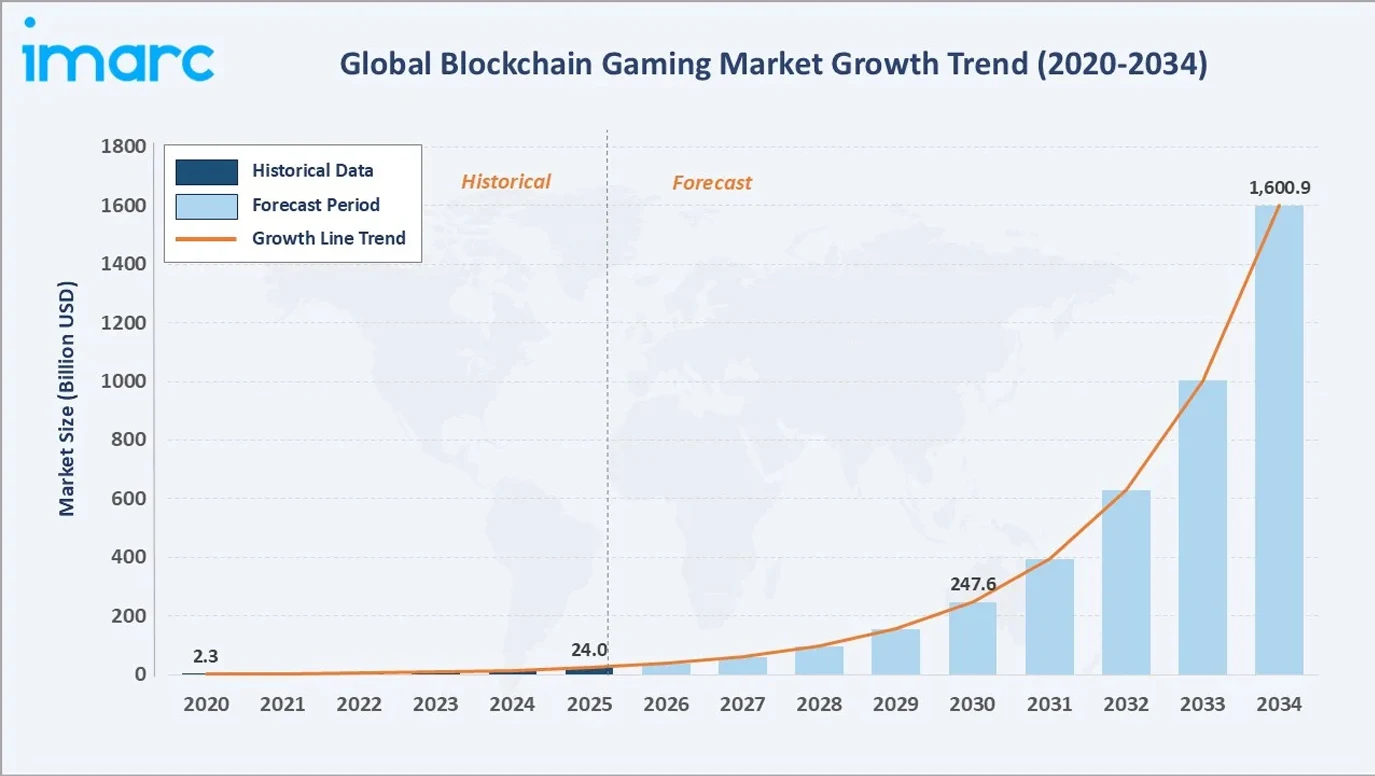
Source: IMARC Group
Investors poured capital into Web3 gaming throughout 2025 and into 2026. This sustained momentum signals growing institutional confidence in blockchain-powered gaming ecosystems. Double Jump. Tokyo raised over $10 million in Series D funding, led by SBI Investment and Sony Group. Indian studio SuperGaming closed a $15 million Series B at a $100 million valuation. Meanwhile, Laton Ventures launched with a dedicated $35 million fund specifically targeting game companies (BlockchainGamer.biz, 2026).
Taken together, these numbers point to a larger industry shift rather than a passing trend. The verdict from the market is clear: the window for first-mover advantage in blockchain gaming is open right now, and the studios that build with the right technical partner in 2026 are the ones that will be scaling in 2027 and beyond.
What Actually Separates a Great Blockchain Game Development Company From a Generic One
Before reviewing any company, understand the 5 technical and commercial criteria that define a genuinely capable blockchain game developer in 2026.
- Smart Contract Architecture and Audit Readiness: Game economies run on smart contracts. A company that writes contracts without audit-ready processes puts your entire token economy at risk. The best developers maintain internal audit pipelines and have verifiable experience with third-party auditors.
- Cross-Chain Compatibility: Games in 2026 do not live on a single chain. A capable development firm builds for Ethereum, BNB Chain, Polygon, and Solana simultaneously, with bridge infrastructure for asset portability.
- Tokenomics Design Capability: Writing game token contracts is technical work. Designing a token economy that retains players, resists inflation, and generates sustainable revenue is strategic work. The top companies do both.
- Game Engine Depth: Unity and Unreal Engine 5 are the standard for high-quality game production. A blockchain game developer without strong game engine capability produces games that work technically but fail commercially.
- Post-Launch Support and Scalability: On-chain games experience traffic spikes tied to market cycles. A development partner that disappears after launch is a liability. Long-term maintenance, node infrastructure management, and smart contract upgradeability are non-negotiable at scale.
Top 5 Blockchain Game Development Companies in 2026
1. Antier
- Headquarters: Mohali, Punjab, India
- Founded: 2011
- Team Size: 700+ members
- Experience: 15+ years in Blockchain Gaming
Antier is one of the most recognized names in global Web3 gaming infrastructure development, with gaming ecosystem capabilities built on a foundation that few pure-play game studios can match. Its core strength lies at the intersection of financial infrastructure and gaming, making it particularly relevant for projects focused on play-to-earn mechanics, in-game token economies, and GameFi ecosystems.
Gaming Capabilities:
- End-to-end blockchain game development focused on gaming ecosystems
- Wallet infrastructure and exchange integration for in-game economies
- Smart contract development for secure in-game transactions
- Game token design and NFT asset creation
- Cross-chain compatible game architecture for scalability
- Strong expertise in DeFi, stablecoins, rollups, and node infrastructure
- Institutional-grade understanding of security, compliance, and deployment
- Suitable for managing real financial value at scale
Choose the partner before the market chooses the winners.
2. Abhiwan Technology
- Headquarters: Delhi, India
- Founded: 2018
- Team Size: 51–200 professionals
Abhiwan Technology brings together game development and blockchain integration under one roof. The company demonstrates strength in multiplayer, environments, and visually intensive gameplay systems. Its focus on Unity3D and blockchain-supported gaming mechanics positions it well for projects looking to build interactive and experience-driven Web3 games.
Gaming Capabilities:
- Blockchain game development across multiplayer and mobile gaming
- NFT-based asset ownership within game environments
- Unity3D-powered game development
- Smart contract integration for gaming economies
- Multiplayer networking through Photon architecture
3. Accubits Technologies
- Headquarters: Vienna, Virginia, USA
- Founded: 2012
- Team Size: 501–1,000 employees
Accubits brings global delivery capabilities and enterprise-level engineering expertise into blockchain game development. With operations across multiple international regions and experience serving startups, enterprises, and government-backed projects, the company supports gaming ecosystems that require scalable backend architecture and strong governance practices.
Gaming Capabilities:
- Blockchain game architecture and backend engineering
- AI-integrated gaming ecosystem support
- Scalable infrastructure for global gaming deployments
- Enterprise-grade project delivery and governance support
4. Technoloader
- Headquarters: Jaipur, Rajasthan, India
- Founded: 2019
- Team Size: 11–50 employees
Technoloader is a blockchain-focused development company with experience in blockchain game development, smart contracts, wallet systems, and private blockchain infrastructure. Its broader blockchain expertise makes it suitable for Web3 gaming projects that require secure backend architecture and token-based ecosystems.
Gaming Capabilities:
- Blockchain game development
- Smart contract integration
- Infrastructure designed for mid-size gaming environments
5. Unicsoft
- Headquarters: EU-Focused Operations
- Team Size: 51–200 employees
- Track Record: 19 Years in Market
Unicsoft brings a strong engineering-first approach to blockchain game development, particularly for projects that require AI, analytics, and data-heavy ecosystems. Its experience across blockchain, fintech, and machine learning makes it a suitable choice for gaming platforms looking to build intelligent in-game economies and predictive systems around player behavior and digital assets.
Gaming Capabilities:
- Blockchain game development with AI and ML integration
- Smart game economy management systems
- Predictive analytics for player engagement and asset behavior
- Compliance-oriented blockchain architecture
Here’s a quick comparison of the leading blockchain game development companies to help you identify the right fit for your gaming vision.
| Company | Founded | Team Size | Gaming Specialization | Blockchain Depth | Best Suited For |
|---|---|---|---|---|---|
| Antier | 2011 | 700+ | GameFi, Token Ecosystems, Blockchain Gaming Infrastructure, Immersive Technologies | DeFi, Nodes, Rollups, Smart Accounts, AI/ML, P2E, Web3 | GameFi platforms, crypto-native publishers, scalable Web3 gaming ecosystems, and AI-driven game mechanics |
| Abhiwan Technology | 2018 | 51–200 | AR/VR, Multiplayer, Casino, FPS | NFT, DeFi, P2E, Smart Contracts | Immersive and multiplayer blockchain game development |
| Accubits Technologies | 2012 | 501–1,000 | Cross-platform, Enterprise Gaming Infrastructure | Blockchain, AI, Mobile Technologies | Enterprise gaming projects and international publishers |
| Technoloader | 2019 | 11–50 | Blockchain Game Development, Web3 Gaming | Smart Contracts, Wallets, Private Blockchain, Token Ecosystems | Web3 gaming startups and blockchain-first game projects |
| Unicsoft | ~2005 | 51–200 | AI-Integrated Game Economies | Blockchain, AI/ML, Data Analytics | AI-driven game mechanics and compliance-focused gaming ecosystems |
How to Evaluate a Development Firm Before You Sign
- Review security credibility: Ask for past smart contract audit reports.
- Check tokenomics expertise: Request a case study on token economy design and retention mechanics.
- Assess blockchain coverage: Ensure experience across multiple chains to avoid future technical limitations.
- Clarify post-launch support: Confirm ownership of nodes, upgrades, and NFT metadata management.
- Validate team balance: Choose a team with strong game developers and blockchain engineers for balanced execution.
A thoughtful evaluation today can save months of redevelopment costs and position your game for stronger market success.
Conclusion
Blockchain gaming is becoming one of the fastest-growing opportunities in Web3, supported by rising investments, expanding player demand, and rapid ecosystem growth. For founders and gaming businesses entering the space in 2026, success depends on choosing a blockchain game development company with strong expertise in game mechanics, tokenomics, scalable infrastructure, and post-launch support. The right development partner can help transform a game idea into an engaging, scalable, and revenue-driven ecosystem positioned for long-term growth.
Frequently Asked Questions
01. What is the biggest mistake founders make in blockchain gaming?
The biggest mistake founders make is assuming that game development and blockchain development are the same thing, which they are not.
02. What is the projected value of the global blockchain gaming market by 2034?
The global blockchain gaming market is projected to reach $1,351.87 billion by 2034, growing at a CAGR of 21.80%.
03. What factors contribute to the success of blockchain games in 2026?
Success in 2026 requires a balance of visually strong games with sustainable tokenomics and engaging gameplay, along with partnering with a renowned blockchain game development company.