



✨ AI Summary
- Institutional crypto trading has evolved beyond basic requirements, with liquidity, settlement speed, regulatory hygiene, and developer agility now forming the core investment criteria.
- One key part of this new trading infrastructure is embedded crypto wallets, which allow financial institutions, exchanges, and large enterprises to control trading flows while managing security and compliance.
- The wider embedded payments market was valued in the tens of billions in 2024 and is predicted to grow rapidly.
- This blog post serves as a guide for global investors interested in embedded wallets for trading.
- It offers a detailed technical checklist for evaluating Web3 trading products, including custody model, key management, settlement guarantees, auditability, and compliance automation.
“Custody is not a binary choice. It is a spectrum, and how you place your infrastructure along that spectrum determines whether you win or fail as a trading platform.”
Institutional crypto trading has moved beyond window-shopping. Liquidity, settlement speed, regulatory hygiene, and developer agility are now core investment criteria. Embedded crypto wallets, a wallet functionality integrated directly into an application or platform, are the infrastructure that lets financial institutions, exchanges, fintechs, and large enterprises keep trading flows inside their product while controlling security, compliance, and UX.
Embedded finance and payments are scaling fast; the broader embedded payments market was valued in the tens of billions in 2024 and is forecast to grow rapidly in the coming years. Investors evaluating Web3 trading products need a hard technical checklist: custody model, key management, settlement guarantees, auditability, compliance automation, and a defensible security posture. This guide is written for sophisticated global investors who want a technically rich, practical view of embedded wallets for trading and a clear sense of where the opportunity, the risks, and the returns lie.
What are embedded wallets?
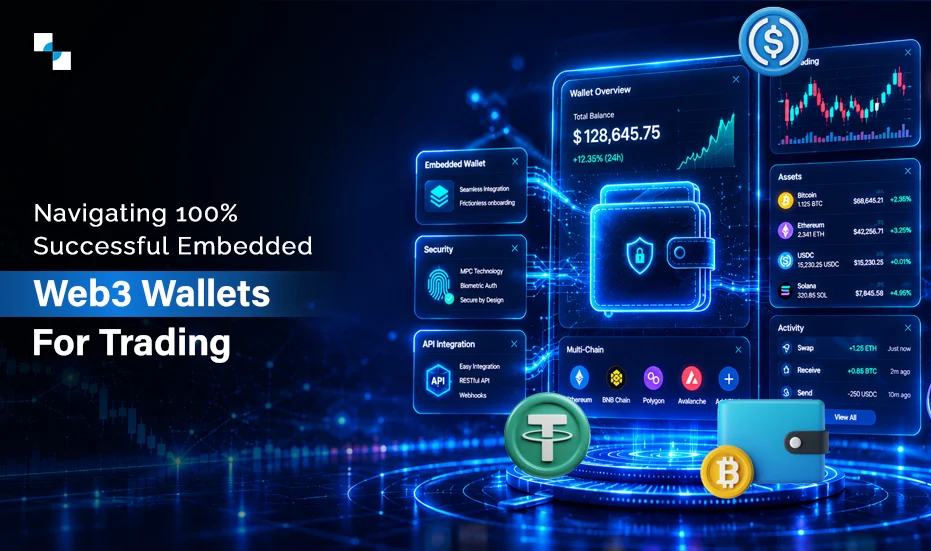
An embedded Web3 crypto wallet is an SDK or service layered into an app that exposes wallet operations natively to users without forcing them to leave the product for a separate wallet or extension. Architecturally, implementations fall into three models:
- Custodial-hosted crypto wallets where the platform holds keys and signs transactions server-side.
- Non-custodial wallets where private keys remain with the user’s device or browser.
- Hybrid or threshold/MPC-based wallets that split signing authority across client and server components to provide recovery and business policy controls while avoiding single-point custody risk.
Modern embedded wallets also combine smart contract wallets for programmable policies, gas abstraction for sponsor-paid transactions, and a policy-enforcement layer for AML/KYC and transaction controls.
Why do embedded wallets matter for trading platforms?
Embedded blockchain wallet development solutions let you internalize the trading lifecycle inside your product: onboarding, funding, order execution, settlement, custody, and reconciliation. That consolidation reduces friction that traditionally drives users out to third-party custodians or decentralized bridges. For enterprises, embedding wallet functionality means better control over latency, fees, and monetization routes while enabling new product primitives such as sponsored gas, programmatic payouts, on-platform market making, and instant off-chain crediting with on-chain settlement.
Trading Challenges Today
- Onboarding friction from external wallets and complex key management.
- Settlement latency and reconciliation complexity across chains and fiat rails.
- Compliance and reporting overhead when using disparate custody providers.
- Wallet UX that causes slippage and lost order flow.
- Security weak points from hot keys, unsegregated custody, and ad-hoc recovery flows.
- Monetization leakage when third-party wallets take a fee or data capture opportunities.
How Embedded Crypto Wallets Solve Those Trading Challenges?
- Reduce onboarding friction with social login, account linking, or KYC-backed wallets that feel like native accounts.
- Lower settlement friction by combining fast off-chain credit with batched on-chain settlement.
- Centralize compliance controls so policies are enforced at the infra layer rather than in ad-hoc integrations.
- Improve execution economics by offering gas sponsorship and bundled routing logic.
- Harden security using MPC, hardware modules, and policy-based signing.
- Preserve revenue by keeping swap and limit order flows inside your ecosystem.
These advantages are not theoretical. Leading infrastructure providers and enterprises are already deploying embedded wallet architectures to retain trading volume and reduce operational complexity.
Must-Have Features: Embedded Web3 Wallets Built for Trading
“Features determine whether a product captures value or becomes an operational cost.”
For visionary investors, a feature-rich embedded wallet is not a checklist item; it is the strategic scaffolding that shapes risk, revenue, and user experience. Before committing capital, you must insist that cryptocurrency wallet capabilities map directly to your business model, compliance posture, and go-to-market plan. Building with features in mind early prevents expensive rework, reduces regulatory friction, and preserves margin by keeping liquidity and flows inside your platform. Treat feature design as the first principle of product strategy: it clarifies tradeoffs, quantifies operational risk, and turns technical choices into measurable investment outcomes.
- Multi-chain support with unified asset ledger and canonical identifiers.
- Multi-signature and MPC key management with threshold signing.
- Hardware-backed key protection and HSM integrations for institutional-grade custody.
- Gas abstraction and meta-transaction support for sponsored UX.
- Programmable smart contract wallets for scheduled, conditional, or policy-bound transfers.
- Real-time reconciliation and transaction observability with immutable audit trails.
- Compliance layer: automated KYC, sanctions screening, AML workflows, and transaction monitoring.
- Onramp/offramp rails and fiat settlement connectors with reconciliation guarantees.
- Role-based access control and transaction policy engines for internal segregation of duties.
- Incident response tooling: instant transaction freezes, wallet revocation, and clear recovery workflows.
- SDKs and API-first design to reduce time to market and enable integration with exchange backends and OMS/EMS systems.
Build Your Trading Advantage!
Market Opportunity & Adoption Patterns
Embedded finance and payments are scaling aggressively; several market reports show large addressable markets for embedded payments and finance solutions over the next decade. This tailwind is especially helpful for embedded wallets as trading platforms want to keep value capture within their UX instead of giving it away to third-party wallet providers.
Adoption is strongest where on-chain activity and retail plus institutional demand intersect. Chainalysis and regional reports show rapid crypto adoption growth across Asia, Africa, and LATAM, and higher on-chain activity has translated into demand for streamlined trading primitives that embedded wallets deliver.
Top Countries That Most Urgently Need Embedded Wallets
1) India– Massive on-chain volumes, a mobile-first user base, and rapid retail and institutional adoption make India the single largest near-term market for embedded wallets. Embedded wallets remove onboarding friction and localize custody/settlement for a highly price-sensitive and scale-hungry market.
2) Nigeria– One of the highest crypto adoption rates globally, driven by remittances, FX frictions, and inflation hedging. Embedded mobile crypto wallets can convert high retail activity into monetizable, compliant trading flows and lower remittance costs.
3) Indonesia– Large population, rapidly growing crypto ownership, and rising DeFi usage. Platforms that embed wallets win by offering simplified custody, fiat bridges, and localized UX for mobile-first consumers.
4) Vietnam– High retail crypto adoption and active on-chain markets. Embedded wallets help capture local trading volume, reduce UX drop-off, and enable programmable features tailored to Vietnamese users.
5) Philippines– Extremely high remittance dependence and increasing stablecoin/remittance activity. Embedded wallets are a direct product fit for faster, cheaper inbound flows and programmable payout experiences.
6) Pakistan– Rapid growth in crypto adoption plus large diaspora remittances make programmable, compliant embedded wallets a high-impact solution to frictional cross-border flows.
7) Brazil– Strong regional crypto activity and growing institutional interest in Latin America. Embedded wallets let exchanges and fintechs bundle custody plus on-platform trading while addressing local compliance.
8) Mexico– Large remittance corridors (US↔MX) and increasing stablecoin usage. Embedded wallet rails reduce cost and latency for cross-border transfers and preserve revenue within platforms.
9) Turkey– Large crypto trading volumes amid currency volatility and evolving tax/regulatory moves. Platforms that embed compliant crypto wallets can offer hedging and on-platform settlement to users seeking alternatives to a weak local currency. Recent regulatory activity makes compliant embedded solutions particularly urgent.
10) United Arab Emirates (UAE)– Rapidly emerging crypto hub with favorable regulator-leaning policies and strong institutional interest. The UAE is a strategic market for white-label, compliant embedded wallet products aimed at HNWI and institutional flows.
11) Kenya (and parts of East Africa)– Mobile money ubiquity (M-Pesa), rising retail crypto uptake, and an active payments ecosystem. Embedded cryptocurrency wallet solutions enable low-friction rails between mobile money and on-chain assets for payments and merchant use cases.
12) South Africa– The leading African market for institutional and retail crypto activity; clear demand for regulated custody and programmatic wallet features that integrate with local banking rails
Why Do These Countries Matter?
- Top rankings in Chainalysis adoption indexes and regional reports (real on-chain value and user activity).
- Large remittance corridors or remittance dependence, where stablecoins and programmable wallets reduce friction and cost.
- Currency volatility / macro drivers that push users to crypto as a dollar alternative (increases product-market fit for embedded wallets).
- Clear regulatory momentum (either enabling or tightening) where compliant embedded wallets can be a competitive moat.
Quick Investor Takeaways- What To Do Next?
- Prioritize market selection by matching your product (custody model, fiat rails, KYC posture) to local drivers: remittances, FX hedging, or retail trading.
- Do early regulatory mapping (travel rule, custody segregation, and local licensing) before deploying wallets at scale; regulatory design materially affects time to market and operational cost.
- Design for modularity: multi-rail on-ramps, MPC/HSM custody options, and programmable smart-crypto wallet layers to localize UX and compliance without full re-architecture. (Industry best practice derived from global deployments.)
Embedded Crypto Wallet Regulatory Landscape & Compliance Considerations
Regulation is the single biggest product constraint for embedded blockchain wallets at scale. The EU’s Markets in Crypto-Assets (MiCA) regime and similar jurisdictional frameworks have introduced stricter requirements for service providers, particularly around disclosure, custody rules, and transaction reporting. Platforms offering embedded trading must design for auditable custody, clear segregation of client assets, and automated transaction surveillance to meet evolving rules.
Key regulatory design points for investors to probe: whether the product treats wallets as custody (and how client assets are segregated), how it addresses travel rule obligations, how onramp/offramp partners support KYC and source-of-funds checks, and whether local licensing is required to offer fiat settlement. These aspects materially affect operational costs and time to market.
Implementation Roadmap For Enterprise Deployment
- Strategy and risk alignment: choose custody model and compliance posture.
- Architecture design: select MPC vs HSM, on-chain vs smart-contract wallets, and off-chain settlement mechanisms.
- Regulatory mapping: identify licensing needs and data residency requirements.
- Integrations: connect order-management systems, liquidity providers, fiat rails, and AML/KYC vendors.
- UX and flow design: gas sponsorship, recovery UX, and funding paths.
- Security testing: code audits, pen tests, and incident simulations.
- Pilot and phased rollout: staged geographies, feature flags, and performance SLAs.
- Scale and monitoring: observability, reconciliation, and continuous compliance checks.
How Does Antier Help Enterprises Build Embedded Wallet Platforms?
Antier and its vast team of certified and experienced experts build white label crypto wallets and blockchain-based platforms that combine enterprise custody patterns, compliance-first design, and production-ready developer tooling. We maintain deep legal and compliance partnerships and help clients through licensing, KYC/AML integration, and proof-of-reserves practices. Our approach includes: architecting MPC HSM hybrids to reduce single-point failures, implementing programmable smart contract wallets for trading automation, and integrating reconciliation-first fiat rails so settlement is auditable for regulators and counterparties.
Our team also advises on governance: token handling policies, treasury controls, and operational playbooks for incident response. Our experience with regulated deployments and bank-grade integrations means we can accelerate time to market while minimizing regulatory risk.
Invest with clarity. Build with control. Trade with confidence. Connect now!
Frequently Asked Questions
01. What are embedded wallets in the context of crypto trading?
Embedded wallets are SDKs or services integrated into applications that allow users to perform wallet operations natively without needing to leave the product for a separate wallet or extension.
02. Why are embedded wallets important for trading platforms?
Embedded wallets streamline the trading lifecycle by internalizing processes like onboarding, funding, order execution, and settlement, which reduces friction and keeps users engaged within the platform.
03. What are the different models of embedded wallets?
The three models of embedded wallets are custodial-hosted wallets (where the platform holds keys), non-custodial wallets (where users retain keys), and hybrid wallets (which split signing authority between client and server components).