


✨ AI Summary
- AI agent development is predicted to be integrated into 33% of enterprise software applications by 2028, with a substantial economic potential estimated between $2.6 trillion to $4.4 trillion annually.
- However, successful implementation of AI agents heavily depends on the partnership with the right AI agent development company.
- This guide offers an in-depth analysis of the functions of AI agent companies, market trends, architectural choices, key disciplines, and the criteria for choosing the right vendor.
- AI agent companies design, build, and operate software systems that combine language models with tools, memory, and orchestration to perform tasks and learn from feedback.
- The guide covers two architecture choices, productized and custom build; offers insight into the nine disciplines of a full-stack AI practice; and provides a five-dimensional evaluation for choosing the right partner.
By mid-2026, AI agent development has crossed from boardroom buzzword into operational backbone. Gartner forecasts that 33% of enterprise software applications will embed agentic AI by 2028, up from less than 1% in 2024 — and McKinsey continues to peg the long-run economic potential of generative and agentic AI at $2.6 trillion to $4.4 trillion every year. Yet the same Gartner team warns that 40% of agentic AI projects will be cancelled by the end of 2027 because of weak evaluation, ballooning cost, and unclear value.
The single biggest variable between the projects that succeed and the projects that get killed is which AI agent development company you partner with. This guide walks through what these companies actually do, the trends reshaping the market, the two architectural shapes every buyer must choose between, the nine disciplines a serious partner ships, and the five dimensions that separate production-ready vendors from demoware shops.
What Does an AI Agent Development Company Actually Do?
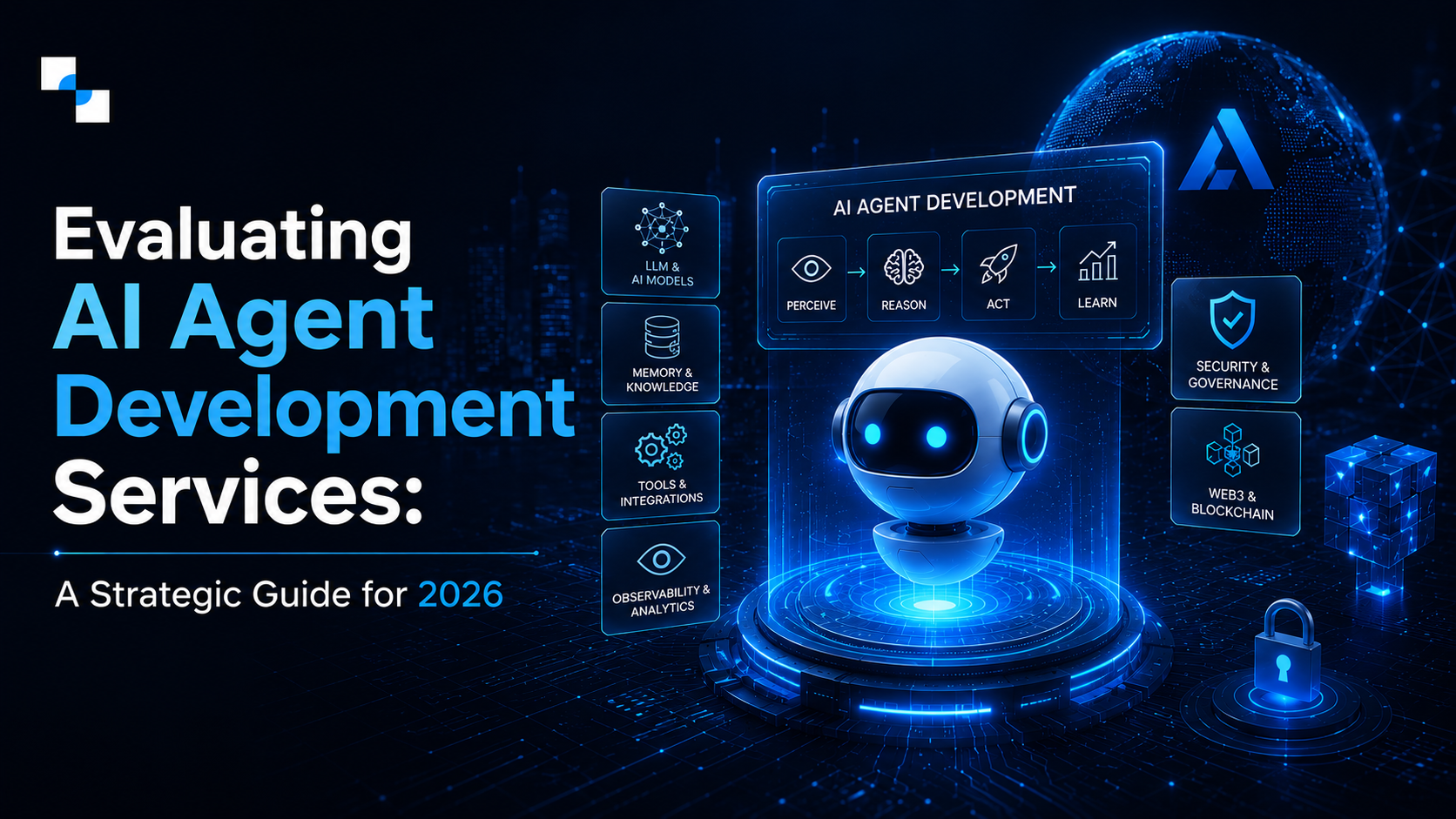
An AI agent development company designs, builds, and operates software systems that combine large language models with tools, memory, and orchestration so that the software can pursue a goal, take action, and learn from feedback. That is a meaningfully different job from building a chatbot, fine-tuning a model, or wiring a copilot into an existing app.
A modern AI agent development services engagement typically covers six things: discovery and use-case selection; reference-architecture design (single-agent, multi-agent, or agentic RAG); model selection and routing; integration with the customer’s data, tools, and identity layer; evaluation harness and observability; and governance documentation aligned to the EU AI Act, NIST AI RMF, or ISO/IEC 42001.
The companies that win in 2026 ship all six. The companies that lose ship the first three and call the rest a phase two.
Key Trends Reshaping AI Agent Platforms in 2026
Three shifts are reshaping how enterprises buy AI agent development solutions this year, and each one changes the evaluation criteria you should bring to a vendor conversation.
Vertical agents are replacing horizontal copilots. The first wave of generative AI gave every employee a horizontal copilot. The second wave is giving every role a specialised agent — claims adjudication for insurers, transaction monitoring for fintechs, treasury operations for crypto banks, anti-cheat for Web3 game studios. Buyers want agents that already understand their workflow on day one.
Memory and evaluation are the new differentiators. In 2024 the model was the differentiator. In 2026 it is the memory architecture and evaluation harness around the model. Senior buyers now ask vendors how they handle long-term memory, tenant isolation, and continuous evaluation before they ever ask about model choice.
Governance has moved from slide to system. With the EU AI Act’s general-purpose obligations in force since August 2025 and U.S. sector regulators publishing their own guidance, every serious AI agent development company now ships agents with risk classifications, human-in-the-loop checkpoints, and immutable audit logs out of the box.
“IT departments are going to become essentially the HR department of AI agents — onboarding them, evaluating them, retiring them.”
— Jensen Huang, CEO of NVIDIA, CES 2025 keynote
Productized vs. Custom: Choosing the Right Shape for Your Architecture
Most AI agent engagements fall into one of two shapes, and the choice between them is the single biggest decision a buyer makes after picking a partner. Understanding the difference up front saves months of misaligned expectations later.
The Productized Path
A productized AI layer sits on top of your existing platform as a non-disruptive overlay. Instead of rebuilding your stack, you deploy a set of pre-built universal agents — typically covering analytics, monitoring, support, and operations — alongside a smaller group of specialist agents tuned to your platform type. Engagement is usually structured as a one-time implementation fee plus a monthly licence or retainer.
This approach fits best when:
- You operate a live platform (an exchange, DeFi protocol, crypto bank, RWA platform, or Web3 gaming environment) and cannot afford downtime or replatforming.
- You want measurable intelligence in weeks, not quarters.
- Your in-house engineering team is already stretched and needs leverage, not a long custom project.
The trade-off: you get speed and predictable cost, but less control over deep customisation.
The Custom Build Path
For organisations that need agents woven into the fabric of their operations, products, or proprietary workflows, the custom-build path is the right fit. Engineering, architecture, and governance specialists work alongside your team to take an agent from idea to production — covering discovery, model selection, integrations, evaluation, observability, and compliance documentation.
This approach fits best when:
- You have a unique workflow, regulated environment, or proprietary data moat that off-the-shelf agents cannot serve.
- You want full IP ownership, model portability, and an exit plan baked in.
- You are willing to invest 8 to 16 weeks (or longer for regulated builds) in exchange for an agent that fits your business precisely.
The trade-off: longer timeline and higher upfront cost, but a system you fully own and can evolve.
Why this matters
Most vendors only sell one of these two shapes — and quietly push every buyer toward it regardless of fit. Antier was built around the opposite conviction. The Antier Intelligence Layer (AIL) is the productized path: a non-disruptive overlay for Web3 and financial platforms, with four universal agents plus specialist agents, deployed in weeks for an implementation fee plus monthly licence. Antier AI Services is the custom path: ground-up builds across nine disciplines, delivered by the same engineering bench. Buyers pick the shape that fits their reality — not the vendor’s comfort zone.
Build Your AI Agents with US
Nine Essential Disciplines of a Full-Stack AI Practice
A serious AI agent development engagement rarely sits inside one neat skill. The strongest partners deliver across nine connected disciplines.
These nine disciplines apply whether you’re evaluating a productized AI layer or commissioning a custom build — productized vendors should have all nine in their stack even if you only consume a subset.
- AI Agents & Copilots — the core practice. Single-agent, multi-agent, and copilot deployments tuned to specific business workflows.
- Conversational AI — voice and chat agents that go beyond traditional bots, with intent handoff, sentiment routing, and multilingual support.
- Document & Knowledge AI — agentic RAG systems that turn static knowledge bases, policies, and contracts into sources that answer questions and take action.
- Custom GenAI Applications — end-to-end generative AI products built on the model of your choice, with your branding, your data, and your IP.
- AI Strategy Consulting — a roadmap before code: use-case selection, ROI modelling, and build-vs-buy advisory for leadership teams.
- AI Integration & MLOps — the production engineering layer most vendors skip: CI/CD for prompts and agents, evaluation pipelines, observability, and cost control.
- Web3 + AI — a specialist discipline combining DeFi agents, smart-contract AI, on-chain monitoring, and the Web3-native engineering depth few generalist firms carry.
- Predictive Analytics & ML — forecasting, anomaly detection, and recommendation engines that pair classical ML with agentic action loops.
- AI Governance Frameworks — documented controls, audit logs, and human-in-the-loop guardrails mapped to the EU AI Act, NIST AI RMF, and ISO/IEC 42001.
When evaluating partners, treat any vendor that ships only the first three disciplines as a model-and-prompt shop. The remaining six — applications, strategy, MLOps, vertical depth, predictive ML, and governance — are what separate a working prototype from a production system that survives audit and scale.
Antier delivers all nine under one roof, with particular depth in Web3 + AI: years of on-chain engineering, smart-contract auditing, and tokenisation work that few generalist AI firms can match.
Five Dimensions for Evaluating Your AI Agent Development Partner
If you are shortlisting partners right now, five concrete dimensions separate the production-ready vendors from the demoware shops.
- Production references, not demo videos. Ask to see live deployments and the last incident the agent caused. Anyone who has shipped agents in production has incident stories. Anyone who says they haven’t, hasn’t shipped.
- Vertical fluency. A generalist will hand you a generic loop. A specialist already knows your domain’s edge cases — and can quote you the three failure modes most likely to show up in your first month live.
- Documented governance posture. Ask for a written risk register and a control map to whichever regime applies to you (EU AI Act, NIST AI RMF, ISO/IEC 42001, or sector regulators).
- Transparent cost curves. A serious vendor can quote per-task cost at 10× and 100× volume — not just at launch. If a vendor can only price the pilot, expect a step-function bill the day production traffic arrives.
- A real exit plan. Code ownership, model portability, data export, and the freedom to take the work elsewhere. Healthy partnerships start with a clean exit clause.
“We’re moving from software as a tool to software as a teammate. The interesting question isn’t what an agent can do in a demo — it’s whether it can be trusted to do it again at 3 a.m. on a Tuesday.”
— Enterprise architecture sentiment, Q1 2026 industry forums
Antier was designed against exactly this scorecard: production-first engineering with evaluation harnesses and observability built in, governance documentation ready for EU AI Act audits, transparent commercial models, and exit clauses written before kickoff — not negotiated under pressure at contract end.
Where AI Agents Deliver the Strongest ROI in 2026
Different verticals lean toward different shapes. Live Web3 platforms typically start with a productized layer; regulated enterprises typically commission custom builds. Both paths apply across all six verticals below.
- Crypto exchanges and Web3 platforms — monitoring, support, and operations agents that ship in weeks rather than quarters. Antier’s AIL is built for exactly this profile.
- DeFi protocols — liquidity-watching, risk-flagging, and on-chain telemetry agents. Antier’s Web3 + AI discipline is one of the deepest in the market.
- Crypto banking and RWA tokenisation — KYC, transaction monitoring, treasury and regulatory reporting agents working under tight oversight.
- Web3 gaming — economy balancing, anti-cheat, and player-retention agents tuned to in-game telemetry.
- Banking, insurance, and BFSI — claims, compliance, advisory, and customer-operations agents built under regulated governance.
- Healthcare, retail, and enterprise SaaS — document agents, support agents, and predictive workflows where domain expertise meets agentic action.
Across all six, the rule of thumb is the same: agents create the most measurable impact where the workflow is repetitive, the data is structured, and the auditor will eventually ask for proof.
The Bottom Line
Choosing an AI agent development company in 2026 is no longer a procurement decision — it’s an architecture decision. The right partner brings vertical fluency, production engineering, governance discipline, and a commercial model that protects you from lock-in.
Antier was built to match that scorecard with two production-grade product lines:
- Antier Intelligence Layer (AIL) — the fast, productized path for Web3 and financial platforms that need intelligence layered onto existing infrastructure in weeks.
- Antier AI Services — the deep, custom path for enterprises building AI agents into their core operations, products, or regulated workflows across nine specialised disciplines.
Both paths are delivered by the same engineering bench, with the same Web3 + AI depth, and the same governance discipline.
Whether you need a productized intelligence layer for your Web3 platform or a custom AI agent built for an enterprise workflow, Antier brings two production-grade product lines, nine specialised disciplines, and a track record across BFSI, DeFi, RWA, and Web3 gaming.
Frequently Asked Questions
01. What is the role of an AI agent development company?
An AI agent development company designs, builds, and operates software systems that integrate large language models with tools, memory, and orchestration to pursue goals, take actions, and learn from feedback.
02. What are the key components of a modern AI agent development services engagement?
A modern engagement typically includes discovery and use-case selection, reference-architecture design, model selection and routing, integration with customer data and tools, evaluation harness and observability, and governance documentation.
03. What trends are influencing the purchase of AI agent development solutions in 2026?
Key trends include the shift from horizontal copilots to vertical agents tailored for specific roles, reflecting a demand for specialized agents that understand industry-specific needs.