




AI Summary
- Experience the evolution of Artificial Intelligence with the rise of AI agents!
- Say goodbye to limitations of chatbots as AI agents take center stage, autonomously executing tasks and making decisions.
- Dive into this blog post to discover how AI agents differ from traditional chatbots, their core characteristics, and real-world applications across industries like finance, healthcare, and e-commerce.
- Learn about the architecture of AI agents, their types, and the benefits they offer in terms of proactive intelligence, end-to-end workflow execution, advanced decision-making, and continuous learning.
- Explore why AI agents are the future of intelligent automation and how they are reshaping businesses by driving efficiency, scalability, and strategic growth.
Artificial Intelligence is entering a new phase, one where systems don’t just respond but actively execute. For years, businesses have relied on chatbots to handle customer queries, automate responses, and improve engagement. While effective, these systems are fundamentally limited; they can only react within predefined boundaries.
Today, a more advanced and transformative technology is taking center stage: AI agents. These intelligent systems are capable of understanding context, making decisions, and completing tasks autonomously. As enterprises aim for deeper automation and smarter operations, the demand for AI agent development services is rapidly accelerating.
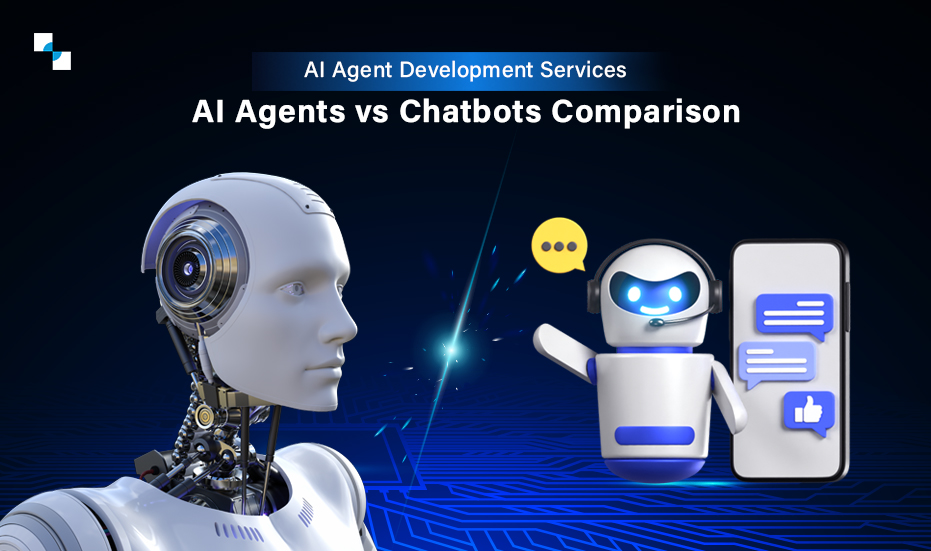
This blog explores the AI agents vs chatbots comparison, why it matters, and how businesses can leverage AI agents to drive measurable outcomes.
What Are AI Agents?
AI agents are goal-oriented, autonomous software entities that can perceive their environment, process information, and take actions to achieve specific objectives without requiring constant human input.
Unlike traditional AI systems that operate within rigid rules, AI agents are designed to function in dynamic environments, where they continuously adapt based on new data, feedback, and changing conditions.
Core Characteristics of AI Agents
1. Autonomy
AI agents operate independently. Once assigned a goal, they determine the best way to achieve it without needing step-by-step instructions.
2. Goal-Driven Behavior
Instead of responding to isolated inputs, AI agents focus on achieving outcomes. They break down high-level objectives into smaller, actionable steps.
3. Context Awareness
They understand context across interactions, systems, and datasets, thus allowing them to make informed decisions.
4. Decision Intelligence
AI agents leverage advanced models (LLMs, ML algorithms) to evaluate multiple scenarios and choose optimal actions.
5. Continuous Learning
Through feedback loops, AI agents improve performance over time, making them more efficient and accurate.
What Are Traditional Chatbots?
Chatbots are software applications designed to simulate human conversation through text or voice interactions. Many businesses rely on AI chatbot development services to deploy these solutions for customer support and engagement.
Types of Chatbots
1. Rule-Based Chatbots
- Operate on predefined scripts
- Follow decision trees
- Limited flexibility
2. AI-Powered Chatbots
- Use NLP (Natural Language Processing)
- Can understand user intent to some extent
- Still limited in multi-step reasoning
Strengths of Chatbots
- Quick response to common queries
- Cost-effective customer support
- Easy to deploy and scale
Limitations of Chatbots
- Cannot handle complex workflows
- Limited contextual memory
- Require user prompts to function
- No independent decision-making
AI Agents vs Chatbots: The Real Difference
The following AI agents vs chatbots comparison highlights the key differences in capabilities, intelligence, and business impact:
| Feature | Chatbots | AI Agents |
| Core Functionality | Conversational interface for answering queries | Goal-oriented systems that execute tasks and deliver outcomes |
| Autonomy | Fully dependent on user input | Operate autonomously and can initiate actions independently |
| Intelligence Level | Rule-based or NLP-driven | Advanced AI (LLMs + reasoning + decision engines) |
| Task Complexity | Handles simple, predefined queries | Manages complex, multi-step workflows across systems |
| Interaction Model | Reactive (responds only when prompted) | Proactive + autonomous (plans and acts toward goals) |
| Decision-Making | Scripted logic/decision trees | Data-driven, adaptive, and context-aware decisions |
| Learning Ability | Limited, requires manual updates | Continuous learning from data, feedback, and interactions |
| Context Retention | Short-term or session-based memory | Long-term memory with deep contextual understanding |
| Integration Capabilities | Limited APIs and systems | Deep integration across enterprise ecosystems (CRM, ERP, APIs) |
| Workflow Execution | Single-step or linear flows | Multi-step orchestration with dynamic task planning |
| Personalization | Basic, rule-based personalization | Advanced, real-time hyper-personalization using behavioral data |
| Scalability & Flexibility | Scales for repetitive queries only | Scales across complex operations and evolving business needs |
| Business Use Cases | Customer support, FAQs, basic assistance | End-to-end automation, operations, analytics, decision-making |
| Business Impact | Improves support efficiency | Drives productivity, automation, and strategic growth |
AI Agents vs Chatbots: Which One Should You Choose?
While the differences are clear, choosing the right approach depends on your specific business needs and goals.
- If your primary goal is handling customer queries and basic support, chatbot solutions can be effective and cost-efficient.
- If your business requires automation of complex workflows, real-time decision-making, and integration across multiple systems, AI agents are the better choice.
- For enterprises aiming to scale operations, reduce manual effort, and enable intelligent automation, investing in AI agent development solutions provides significantly higher long-term value.
Why AI Agents Are the Next Big Evolution?
The shift toward AI agents marks a new era of intelligent automation, where systems are designed not just to assist, but to execute, adapt, and optimize outcomes independently.
1. Proactive Intelligence
AI agents go beyond passive interaction by anticipating needs, identifying opportunities, and initiating actions without waiting for user input.
2. End-to-End Workflow Execution
AI agents can manage entire processes from start to finish, analyzing data, making decisions, triggering actions, and monitoring results, ensuring seamless execution across systems.
3. Advanced Decision-Making
By leveraging large language models and machine learning, AI agents can process vast datasets, evaluate multiple scenarios, and make informed, real-time decisions.
4. Deep Context Awareness
AI agents maintain and utilize context across interactions, systems, and datasets, enabling more accurate, consistent, and intelligent outcomes.
5. Continuous Learning and Optimization
Through feedback loops and data-driven insights, AI agents continuously refine their performance, improving efficiency and accuracy over time.
Transform Your Business with Intelligent AI Agents
How AI Agents Work (Architecture Breakdown)?
Understanding the architecture helps businesses evaluate AI agent development solutions more effectively and choose the right AI agent development company for implementation.
1. Data Layer
This layer collects and processes data from:
- CRM systems
- APIs
- Databases
- User interactions
Clean, high-quality data is critical for performance.
2. Reasoning Layer (Brain of the Agent)
This is powered by:
- Large Language Models (LLMs)
- Machine Learning algorithms
It:
- Interprets data
- Breaks down goals
- Plans actions
3. Action Layer
Executes tasks using:
- APIs
- External tools
- Enterprise systems
This is where AI agents create real-world impact.
4. Memory & Feedback System
- Stores past interactions
- Learns from outcomes
- Improves future performance
5. Orchestration Layer
Coordinates multiple tasks, tools, and sub-agents to ensure smooth execution.
Types of AI Agents
AI agents can be categorized based on their level of intelligence, learning capability, and the complexity of tasks they are designed to handle. As part of advanced AI agent development services, each type serves a unique purpose, helping businesses choose the right approach for their specific automation needs.
1. Reactive Agents
These agents respond only to current inputs without considering past interactions. They operate without memory or learning capabilities, making them suitable for simple, real-time responses.
2. Goal-Based Agents
Goal-based agents are designed to achieve specific objectives by planning and executing multiple steps. They evaluate different possibilities and choose actions that best align with their defined goals.
3. Learning Agents
Learning agents continuously improve their performance by analyzing feedback and past outcomes. Over time, they adapt to new data and become more accurate and efficient in decision-making.
4. Multi-Agent Systems
In this approach, multiple AI agents work collaboratively, each handling specialized tasks. Together, they solve complex, large-scale problems more efficiently than a single system.
These types of AI agents are rapidly becoming the backbone of modern enterprise AI ecosystems, enabling smarter, scalable, and more autonomous operations.
Real-World Use Cases of AI Agents
These real-world use cases highlight how an AI agent development company enables businesses to drive transformation across industries:
1. Finance & Fintech
AI agents automate trading strategies, detect fraudulent activities, and assess financial risks in real time. By analyzing massive datasets and market trends, they enable faster, data-driven decisions and improve overall financial performance.
2. Healthcare
In healthcare, AI agents assist in diagnostics, monitor patient conditions, and recommend personalized treatment plans. They enhance accuracy, reduce workload on medical professionals, and support better patient outcomes through continuous data analysis.
3. E-commerce & Retail
AI agents power personalized shopping experiences, optimize inventory management, and adjust pricing dynamically. They analyze customer behavior and market demand to increase conversions, improve engagement, and streamline retail operations.
4. Enterprise Operations
AI agents automate internal workflows such as HR processes, document management, and task coordination. By reducing manual effort and improving efficiency, they help organizations scale operations with greater speed and accuracy.
5. Supply Chain & Logistics
AI agents optimize demand forecasting, streamline logistics, and enable predictive maintenance in supply chains. They reduce operational costs, minimize delays, and ensure smoother coordination across the entire distribution network.
When Should Businesses Use AI Agents?
You should consider AI agent development solutions if:
- Your operations involve complex workflows
- You need real-time decision-making
- Your teams handle repetitive, multi-step tasks
- You want scalable automation with minimal human input
If your goal is efficiency and intelligence, AI agents are the right investment.
Limitations of Chatbots (Why Businesses Are Moving On)
Despite their widespread adoption, traditional conversational systems have inherent limitations that restrict their ability to support complex and evolving business needs. As organizations scale and demand more intelligent automation, these constraints become increasingly apparent.
1. Limited Decision-Making Capabilities
Most rule-based chat interfaces rely on predefined logic or trained intents. While effective for simple queries, they lack the ability to evaluate complex scenarios, process multiple variables, or make context-driven decisions.
2. Inability to Manage Multi-Step Workflows
Legacy chatbot systems are typically designed for linear, single-step interactions. When processes involve multiple stages—such as validation, approvals, and system integrations—these systems struggle to execute them seamlessly.
3. Weak Context Retention
Traditional conversational systems often fail to maintain context across extended interactions. This results in fragmented conversations, repeated inputs, and a less cohesive user experience.
4. Reactive by Design
These systems operate only when prompted by a user. They cannot initiate actions, anticipate needs, or respond proactively to changing conditions.
5. High Dependency on Human Intervention
In complex or ambiguous scenarios, chatbot systems frequently require escalation to human agents. This reduces operational efficiency and limits automation potential.
Future of AI Agents (2026 and Beyond)
AI agents are quickly transitioning from experimental tools to core drivers of the digital workforce, enabling businesses to operate with greater intelligence, speed, and autonomy. As organizations move toward outcome-driven automation, AI agents will play a central role in reshaping how work gets done.
Key Trends Shaping the Future
Rise of Autonomous Enterprises
Businesses are moving toward fully autonomous operations where AI agents manage workflows, make decisions, and optimize processes with minimal human intervention, unlocking efficiency at scale.
Growth of Multi-Agent Collaboration
Instead of relying on a single system, enterprises will deploy multiple AI agents working together each specialized in a specific task, collaborating to solve complex problems.
Integration with Web3 & Decentralized Ecosystems
AI agents will increasingly interact with decentralized platforms, enabling secure, transparent, and trustless operations across blockchain-powered ecosystems and digital economies.
AI Agents as SaaS Products
AI agents are evolving into scalable, subscription-based solutions, allowing businesses to deploy intelligent automation without heavy infrastructure investment, making advanced AI more accessible than ever.
The future will not be driven by manual processes or static automation tools. Instead, organizations will rely on AI-powered decision systems that can think, adapt, and execute, thus transforming operations from reactive workflows to intelligent, self-optimizing ecosystems.
Conclusion
AI agents represent a fundamental shift in how businesses leverage artificial intelligence from passive interaction to intelligent execution. While chatbots laid the foundation for conversational AI, they fall short in meeting the growing demands of modern enterprises. AI agents bridge this gap by enabling autonomy, scalability, and real-time decision-making.
As industries move toward outcome-driven automation, adopting advanced AI agent development solution is no longer optional; it’s a strategic necessity. Businesses that embrace this shift early will gain a significant competitive advantage.
As a leading AI agent development company, Antier specializes in building intelligent AI agents tailored to complex business needs. Our solutions go beyond automation, helping enterprises unlock efficiency, innovation, and long-term growth.
Frequently Asked Questions
01. What are AI agents and how do they differ from traditional chatbots?
AI agents are autonomous software entities that can understand context, make decisions, and complete tasks independently, while traditional chatbots operate within predefined rules and primarily respond to user inputs.
02. What are the core characteristics of AI agents?
The core characteristics of AI agents include autonomy, goal-driven behavior, context awareness, decision intelligence, and continuous learning, allowing them to adapt and improve over time.
03. Why is the demand for AI agent development services increasing in businesses?
The demand for AI agent development services is increasing as businesses seek deeper automation and smarter operations, enabling them to achieve measurable outcomes through advanced, autonomous systems.
04. What is the cost of building an AI agent?
he cost depends on factors like complexity, integrations, data requirements, and scalability. A basic AI agent may cost less, while enterprise-grade solutions require higher investment but deliver stronger ROI.
05. How long does it take to develop an AI agent?
Development timelines can range from a few weeks to several months, depending on the scope, features, and level of customization required.
06. How can businesses get started with AI agent development?
Start by identifying your business needs, defining automation goals, and partnering with an experienced provider offering customized AI agent development solutions.