




✨ AI Summary
- In 2026, gaming monetization is no longer just about deciding whether to monetize, but choosing the most sustainable revenue generation architecture for your game model.
- The three dominant models are Free-to-Play (F2P), Play & Earn, and Tap-to-Earn (T2E), each with unique economic logics, player profiles, and revenue margins.
- F2P dominates market volume.
- Play & Earn has the highest player loyalty and asset-economy depth, while T2E excels in viral user acquisition speed.
- Your choice should align with your target audience, budget, and long-term retention strategy.
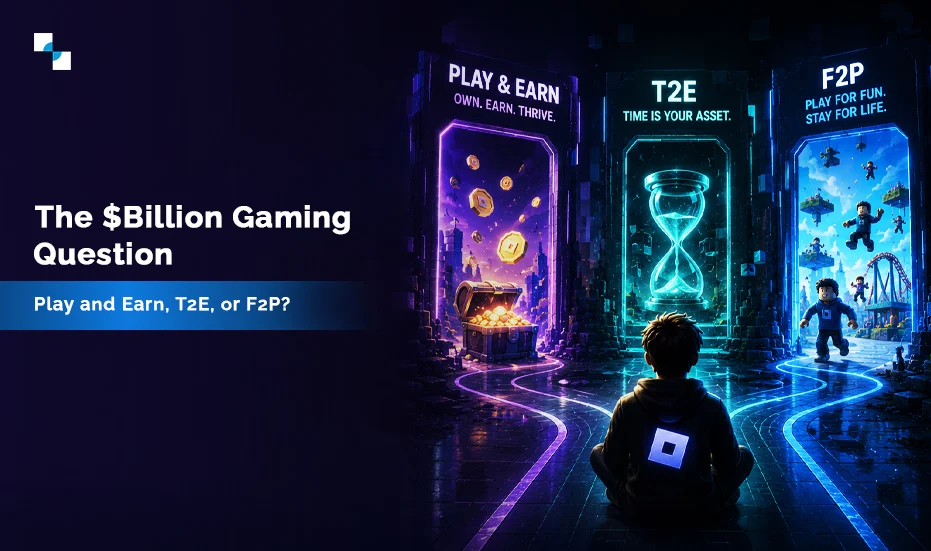
The question every studio founder and Web3 investor is asking in 2026 is no longer “should we monetize our game?” The real question is which monetization architecture generates the most sustainable revenue for the model you are building. Three models now dominate the conversation: Free-to-Play (F2P), Play & Earn, and Tap-to-Earn (T2E). Each operates on entirely different economic logic, attracts different player profiles, and returns radically different margins to the developers who build them.
This analysis breaks down all three with verified 2026 market data so you can make the decision that is right for your studio, your audience, and your financial goals.
Quick Answer: Free-to-Play dominates raw market volume. Play & Earn commands the highest player loyalty and asset-economy depth. Tap to Earn game development wins on viral user acquisition speed. The right choice depends entirely on your target audience, budget, and long-term retention strategy.
So, which one generates the most revenue in 2026? Let’s break it down.
A Quick Look at the Three Models
| Model | Primary Revenue Source | User Acquisition | Retention Potential | Best For |
|---|---|---|---|---|
| Play and Earn | Token economies, NFTs, staking | Medium | High | Web3 gaming ecosystems |
| Tap to Earn | Ads, referrals, token rewards | Very High | High | Viral Telegram games |
| Free to Play | In-app purchases, ads, subscriptions, referrals | Very High | Very High | Mainstream gaming studios |
The Evolution of Gaming Monetization in 2026
Gaming monetization has evolved from one-dimensional payment systems into multi-layered digital economies. The global online gaming market is projected to grow from USD 244.68 billion in 2026 to USD 501.91 billion by 2034, showing how rapidly gaming ecosystems are expanding across mobile, PC, console, and blockchain infrastructure. (fortunebusinessinsights.com)
In 2026, successful gaming businesses are no longer measured only by downloads. The dominant KPI stack includes:
- Retention loops
- Community participation
- Creator economy integrations
- Digital asset velocity
- Token circulation
- Lifetime value per player
- Wallet activity
- Ad monetization efficiency
- On-chain transaction volume
This is exactly why monetization architecture has become a core business decision. While F2P still dominates mobile gaming volume, play and earn and T2E models are creating entirely new economic layers that combine gaming, social engagement, digital ownership, and reward-based participation.
Need help choosing the right monetization stack?
Play and Earn vs T2E vs F2P: How Each Model Makes Money in 2026
Understanding which gaming model generates stronger profitability begins with one important question: How does revenue actually move inside the ecosystem?
While all three models aim to maximize engagement and monetization, they operate on entirely different economic logic. Some prioritize digital ownership, others focus on viral user growth, while mainstream gaming continues scaling through premium spending behavior. The real difference lies in how players spend, why they stay, and what keeps the economy growing over time.
1. Play-and-Earn: Building a Sustainable Player Economy
Modern play and earn game development has evolved far beyond simple token rewards. In 2026, successful play and earn ecosystems are designed around long-term economic sustainability, player ownership, and multi-layered monetization. At its core, the model works by transforming gameplay participation into economic activity.
A player may purchase a digital asset, use it for progression, customization, or competition, and later generate value through marketplace activity, staking systems, or ecosystem participation. As assets circulate, developers continue benefiting through marketplace fees, premium upgrades, ecosystem participation, and creator-driven economies.
Revenue within play and earn ecosystems often comes from:
- Marketplace transaction fees
- Premium digital asset purchases
- NFT utility systems tied to progression
- Staking-based engagement models
- Governance participation systems
- Creator-generated marketplaces
- Exclusive memberships and premium experiences
What makes this model particularly attractive in 2026 is the growing maturity of blockchain gaming economics. Earlier play and earn ecosystems introduced the concept of player-owned economies. Today, studios are focusing on stronger utility systems, progression-first gameplay, balanced token mechanics, and ecosystem longevity to create richer player experiences.
According to CoinLaw’s 2026 crypto gaming statistics, growing player enthusiasm for ownership-driven ecosystems, with approximately 32% of blockchain gamers earning more than $100 monthly through gameplay participation. For founders planning long-term gaming ecosystems, Play-and-Earn offers something unique: deeper player commitment combined with diversified monetization opportunities.
2. Tap-to-Earn: The Viral User Growth Machine
If play and earn focuses on ownership, tap-to-earn game development focuses on speed. T2E is becoming one of the fastest-growing gaming segments because it removes friction almost entirely. Players can join instantly, interact through lightweight mechanics, and begin participating without downloads, wallets, or lengthy onboarding processes.
The biggest advantage of this model lies in distribution.
In fact, by early 2026, Telegram crossed 1 billion monthly active users, while nearly 500 million users interacted with mini-app ecosystems daily, creating enormous opportunities for T2E experiences. Unlike traditional gaming ecosystems that depend heavily on upfront immersion, T2E monetization thrives through volume and repeat interaction.
The strongest T2E ecosystems grow through viral loops rather than traditional player acquisition.
Take Notcoin as an example.
Instead of relying on expensive marketing campaigns, Notcoin scaled through frictionless onboarding, referral mechanics, community sharing, and reward psychology. Players invited friends, competed socially, and participated daily, helping the platform attract over 35 million users within three months, with peak daily engagement exceeding 6 million users.
Another strong example is Catizen, which expanded rapidly by combining lightweight onboarding with deeper engagement systems. Within four months, the platform crossed 20 million users while generating more than $300 million in in-game transaction volume.
Revenue in T2E ecosystems commonly flows through:
- Advertising partnerships
- Sponsored interactions
- Referral-based incentives
- Premium gameplay upgrades
- Brand collaborations
- Community expansion systems
For gaming founders prioritizing rapid visibility, strong onboarding, and large-scale user growth, T2E offers one of the most exciting monetization opportunities in 2026.
3. Free-to-Play: The Revenue Benchmark of Modern Gaming
While newer models continue gaining momentum, F2P remains the benchmark for gaming monetization at scale. Its strength comes from simplicity. Players enter at no cost, engage deeply with gameplay, and gradually spend on experiences that improve customization, progression, exclusivity, or status.
This approach continues driving massive commercial success.
The Free-to-Play market is projected to grow from USD 71.45 billion in 2026 to USD 173.68 billion by 2032, reflecting continued demand for accessible gaming experiences combined with scalable monetization.
Major ecosystems such as Fortnite, Roblox, and PUBG Mobile continue demonstrating how premium experiences can scale into billion-dollar ecosystems.
Take Roblox as an example.
In Q1 2026, Roblox reported $1.44 billion in revenue, $1.73 billion in bookings, and approximately 132 million daily active users, highlighting the massive revenue potential of highly engaged player ecosystems.
F2P monetization commonly includes:
- Battle passes
- Cosmetic upgrades
- Seasonal events
- In-game currencies
- Creator marketplaces
- Subscription programs
- Premium progression systems
For founders seeking mainstream scale, predictable monetization, and high player lifetime value, F2P continues to set the benchmark for long-term gaming profitability.
Not Sure Which Model Fits Your Studio?
Which Gaming Model Should You Choose in 2026?
The answer depends entirely on what kind of gaming business you want to build.
| If Your Goal Is | Best Model |
|---|---|
| Rapid user growth and visibility | T2E |
| Ownership-driven gaming economies | Play-and-Earn |
| Mass-market monetization | F2P |
| Strong retention + diversified revenue | Hybrid model |
For founders seeking viral community growth, Tap-to-Earn offers speed and accessibility. For businesses building long-term digital ownership ecosystems, play and earn creates stronger player commitment and deeper engagement.
For studios prioritizing scalability and predictable monetization, F2P remains the strongest commercial benchmark. Increasingly, however, gaming businesses are blending multiple approaches to build richer player journeys. Hybrid ecosystems that combine F2P accessibility, T2E onboarding, and play and earn ownership mechanics are creating stronger engagement loops and diversified revenue streams across the gaming landscape.
Why Hybrid Gaming Economies Are Becoming Popular in 2026
One of the biggest trends shaping gaming monetization is the rise of hybrid ecosystems. Rather than choosing a single model, many founders are blending monetization strategies.
For example:
- Play and Earn + F2P
Players enter for free while ownership features unlock premium engagement opportunities.
- T2E + F2P
Simple onboarding attracts users while premium systems support revenue growth.
- Play and Earn + T2E
Community rewards encourage participation while ownership strengthens long-term engagement. This hybrid approach gives gaming businesses the flexibility to optimize user acquisition, retention, and monetization simultaneously. It also reflects a broader industry movement toward player-centric ecosystems.
Conclusion
The right monetization model is the one your team can execute sustainably, not the one generating the most revenue in aggregate. F2P wins on scale if you have the acquisition budget and LiveOps capability to feed it. P2E wins on community depth if you can design a token economy that stays healthy after early adopters move on. T2E wins on speed if you need a user base before you need a product.
Most studios in 2026 will blend more than one. The hybrid combinations covered in this piece exist precisely because each model solves a different problem. The question worth asking is which model fits the audience you are building for, and which one your infrastructure can actually support from day one.
Antier has helped gaming studios across Web3 and mobile build monetization architectures that are matched to their audience, their budget, and their long-term growth goals. Whether you are exploring Play and Earn, Tap to Earn, or a scalable Free to Play ecosystem, the right foundation starts with the right partner.
Explore Antier’s Game Development Services and build your monetization strategy today.
Frequently Asked Questions
01. What are the three main monetization models for games in 2026?
The three main monetization models are Free-to-Play (F2P), Play & Earn, and Tap-to-Earn (T2E), each with different economic logic and player profiles.
02. Which monetization model generates the highest player loyalty?
The Play & Earn model commands the highest player loyalty and asset-economy depth.
03. How has gaming monetization evolved by 2026?
Gaming monetization has evolved into multi-layered digital economies, focusing on various KPIs like retention loops, community participation, and digital asset velocity, rather than just downloads.