




✨ AI Summary
- Perpetual futures contracts have revolutionized the trading of digital assets by allowing traders to hold long and short positions indefinitely, thereby removing the need for contract rollovers.
- This innovation has made perpetual futures trading the dominant force in crypto derivatives, with trading volumes reaching $92.9T in 2025, a 64.5% YoY increase.
- There is also a shift towards decentralized exchanges (DEX), with DEX perps surging by 346% to $6.7T.
- This shift towards decentralized architecture offers transparency, self-custody, and permissionless access, attracting both retail and professional traders.
- Perpetual DEX is an on-chain derivative venue where smart contracts handle margin accounting, position tracking, liquidations, and funding rate settlement.
Perpetual futures have fundamentally transformed how traders speculate on digital assets. Unlike traditional futures contracts with fixed expiry dates, perpetual futures contracts allow traders to hold long and short positions indefinitely while maintaining exposure to price movements. This innovation eliminates the friction of contract rollovers, making perpetual futures trading the dominant force in crypto derivatives.
Perpetual swap trading, especially on decentralized exchanges, exploded by 64.5% YoY in 2025 with volumes reaching $92.9T. This also revealed a crypto market shift from spot trading to derivatives-based price discovery. DEX perps surging by 346%, hitting $6.7T, while CEX open interest declining, also demonstrates a major capital migration from centralized to decentralized infrastructures.
Retail and professional traders alike gravitate toward decentralized perpetual exchange architectures for transparency, self-custody, and permissionless access. This progression reflects a structural shift. For operators, the perpetual futures exchange development model provides continuous revenue through trading fees, withdrawal charges, and funding rates, enabling them to benefit from constant trading activity as users maintain positions.
What Is a Decentralized Perpetual Exchange? (Perpetual DEX Explained)
A perpetual DEX is an on-chain derivative venue where smart contracts autonomously handle everything that a CEX does with a back office, including:
- Margin accounting,
- Position tracking
- Liquidations
- Funding rate settlement
Perpetual futures contracts allow traders to speculate on the price of cryptocurrencies without holding the underlying asset. Positions can be held indefinitely as long as margin requirements are met. This creates a powerful instrument for both speculation and hedging across volatile markets.
Unlike traditional futures, perpetual contracts have no expiry date. Instead, a periodic funding rate mechanism transfers payments between longs and shorts to keep the contract price anchored to the underlying spot price. Users connect wallets, post collateral (typically USDC or USDT), and open long or short positions with leverage while funds remain in self-custody.
The perpetual futures crypto exchange architecture relies on either liquidity pools or on-chain order books to enable permissionless leverage trading. Hyperliquid and Drift use order-book models for granular price discovery, while GMX v2 employs liquidity pools where traders trade against the pool itself.
Core components of a perpetual DEX include:
- Margin Engine: Manages initial capital, maintenance margin, and collateral accounting
- Funding Rate Mechanism: Keeps contract price aligned with spot markets through periodic funding payments
- Liquidation Engine: Closes undercollateralized positions to protect the system
- Oracle Layer: Provides real-time market prices via Chainlink or Pyth
- Liquidity Pools or Order Books: Enable trade execution and price discovery
Top Perpetual DEX Platforms to Watch in 2026
The perpetual DEX landscape in 2026 is led by a handful of high-activity platforms with distinct perpetual futures exchange development model choices. Here’s a clean comparison of the leading protocols, chains they operate on, fee model, leverage, liquidity design and notable features.
Platform Comparison
| Platform | Chain | Max Leverage | Fee Model | Liquidity Design | Notable Features |
|---|---|---|---|---|---|
| Hyperliquid | Custom L1 | Not consistently stated in the sources I found | Dynamic protocol fees | Order book | HIP-3 lets deployers permissionlessly launch perpetual markets and set oracle/risk parameters; recent coverage puts TVL around $4.5B and 30-day perp volume around $178B mexc+1. |
| GMX v2 | Arbitrum, Avalanche | Up to 100x on some markets/deployments | Protocol fees on opens/closes, swaps, liquidations, and borrowing | Multi-asset liquidity pools | GMX v2 uses a multi-asset pool model with oracle-based pricing and LP fee earnings; DefiLlama’s protocol page describes the fee structure and liquidity design, while third-party reviews report leverage up to 100x defillama+1. |
| Drift | Solana | Varies by market and account settings; not fixed at 20x in the sources I found | Tiered taker/maker fees based on 30-day volume, with staking discounts | Hybrid order book + AMM-style backstops | Drift’s docs show a tiered fee schedule and its 2025 update says the structure now applies across perp markets; the protocol is built for low-latency trading on Solana drift+1. |
| dYdX v4 | Cosmos SDK chain | Governable by community parameters; the exact cap is not stated in the sources I found | Governance-adjustable fee schedule | Order book | dYdX v4 runs on its own chain, and governance can adjust market parameters, fee schedule, funding formula, and insurance-fund controls dydx+2. |
| Jupiter Perps | Solana | Up to 100x in one 2026 review, but this varies by source | Around 0.06% taker and 0% maker in one review; other sources differ | Pool-based/oracle-priced perp model | Jupiter Perps uses the JLP pool as counterparty, supports major assets, and is positioned as a retail-friendly Solana perp venue perps+1. |
- Hyperliquid stands out for HIP-3, which allows permissionless market deployment and puts market-specific risk configuration in the hands of deployers. Recent reporting also places it at roughly $4.5 billion TVL and about $178 billion in 30-day perp volume, so the protocol is clearly operating at a very large scale.
- GMX v2 remains a pool-based perpetual venue across Arbitrum and Avalanche, and the most defensible description is that it uses multi-asset liquidity with oracle-based execution rather than an order book. The exact leverage and fee details should be written conservatively unless you pin them to a specific market or official parameter page.
- Drift is best described as a Solana-native perp protocol with a tiered fee schedule and strong low-latency trading focus.
- dYdX v4 is better framed as a standalone Cosmos-based chain with governance-controlled parameters, rather than with a fixed leverage or fee number that may become outdated.
- Jupiter is best known as Solana’s leading DEX aggregator, routing swaps across the Solana ecosystem. Its perp product, Jupiter Perps, is a separate perpetuals venue built under the Jupiter umbrella, and its docs describe it with up to 250x leverage on some assets such as SOL and ETH.
How Does a Crypto Perpetual Exchange Work?
A trade lifecycle on a perpetual exchange follows a clear sequence:
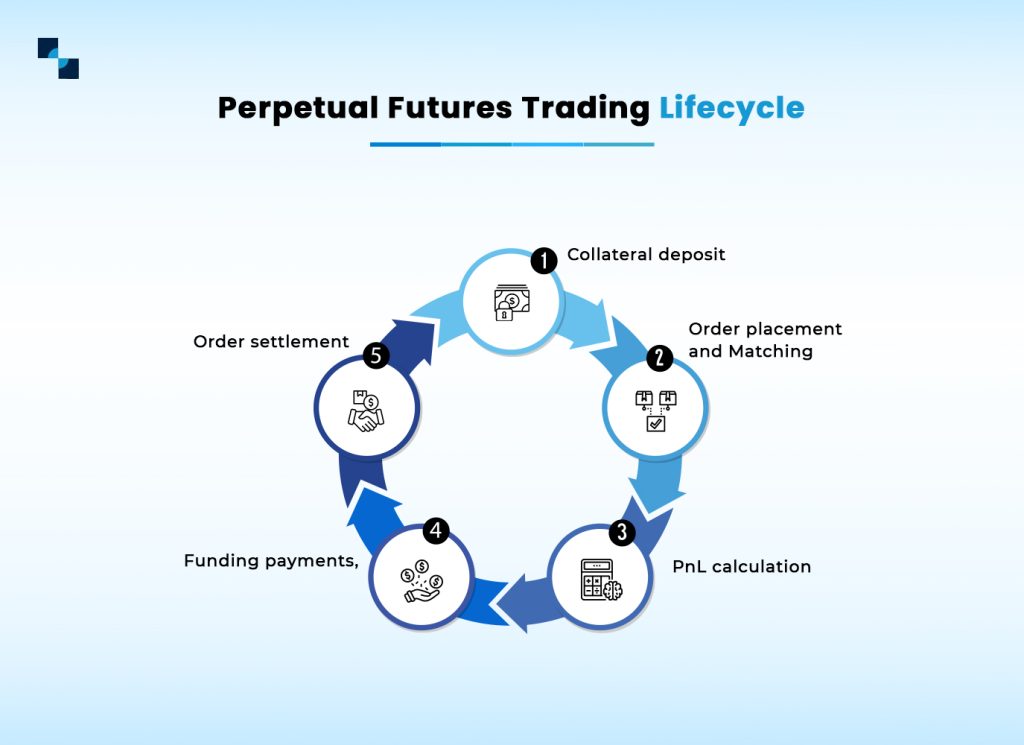
The perpetual futures DEX development requires a robust tech stack, including blockchain networks for smart contracts, oracles for real-time pricing, and a matching system for trade execution.
Oracles like Chainlink and Pyth are integrated into perpetual crypto exchanges to provide real-time market prices, ensuring accurate and up-to-date trading information. The system distinguishes between mark price (used for liquidations) and index price (used for funding rate calculations) to prevent manipulation.
A matching engine must be developed to handle rapid, 24/7 trading volume and quickly settle trades. Leverage options range from conservative 2x-5x up to 100x on some platforms. Leverage in perpetual futures trading enables traders to control larger positions than their actual capital, which increases both potential gains and risks.
Advanced charting integrations (like TradingView libraries) and sophisticated order types, including limit, market, stop, TP/SL, are mandatory UX elements for winning active traders.
Margin Systems and Liquidation Logic
Margin systems define how a perpetual futures crypto exchange manages risk exposure. Initial margin is the collateral required to open a position; maintenance margin is the minimum balance before liquidation risk triggers.
Example: Opening a $100,000 BTC-perp position at 10x leverage requires a $10,000 initial margin. If the maintenance margin is set at 5%, the position liquidates when equity falls below $5,000.
Two primary perpetual exchange funding rate approaches exist:
- Isolated Margin: Each position has separate collateral, limiting losses per trade
- Cross Margin: Portfolio-wide collateralization allows positions to share margin, improving capital efficiency but introducing systemic risk
Liquidation engines must balance speed with fairness. Leading perpetual futures platforms implement partial liquidations at specific thresholds and full liquidation only when the maintenance margin is breached. The liquidation discount affects both user experience and market dynamics.
Leading perpetual futures DEX development companies design custom margin systems tailored to the exchange’s risk appetite that varies for retail-focused platforms and institution-grade deployments.
Funding Rate Mechanism in Perpetual Futures
The funding rate mechanism maintains price stability between perpetual contracts and spot markets in the absence of an expiry date. The funding rate is periodically paid between long and short positions based on whether the perpetual trades above or below the index price.
Example: If BTC-perp trades at a premium (above spot) for several hours, long position holders pay a percentage to short position holders every 8 hours. This creates arbitrage incentives that naturally align prices.
The funding rate mechanism in perpetual futures trading helps maintain the contract price close to the underlying asset’s spot price by facilitating payments between long and short position holders based on market conditions.
Most crypto exchange perpetual futures platforms use discrete 8-hour payment cycles matching the legacy BitMEX standard. Rates typically range from -0.1% to +0.1% per period on major assets, though extreme market volatility can push rates to 1%+ (annualizing to 300%+).
Antier helps clients tune funding parameters to balance trader incentives, trading costs, and perpetual futures crypto exchange revenue.
Architecting Your Own Crypto Perpetual Exchange Software
Perpetual futures crypto exchange development involves complex financial engineering, including decisions on centralized versus decentralized models. A perpetual exchange typically uses a blockchain network such as Ethereum or Arbitrum to support smart contracts and ensure high performance.
Architecture breaks into core layers:
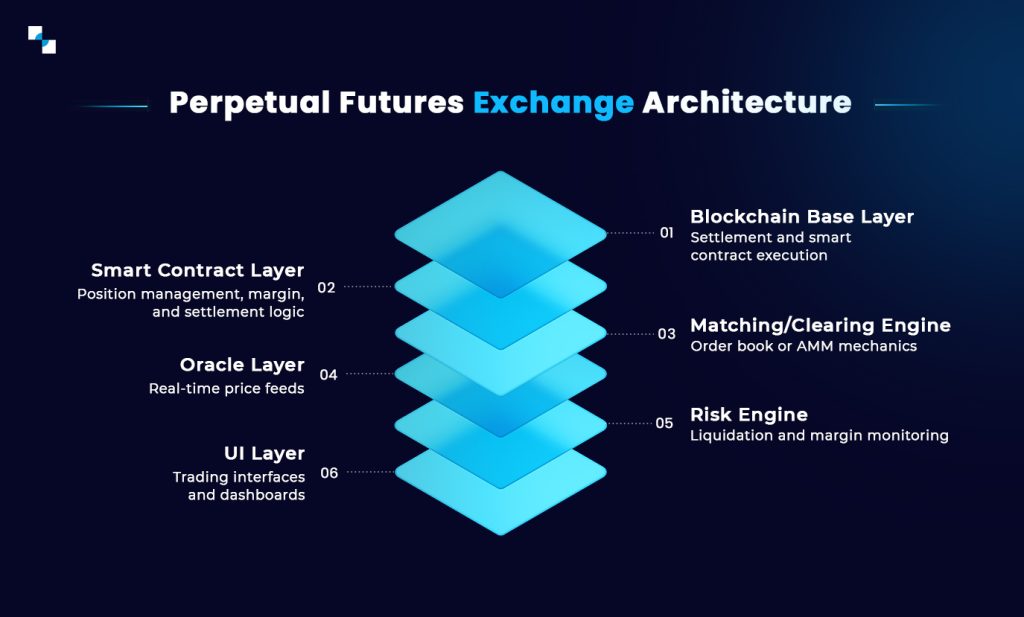
The fundamental choice between order-book (Hyperliquid-style) and liquidity pools/vAMM (GMX-style) models depends on target users and capital efficiency requirements.
Choosing the Right Blockchain and Infrastructure Stack For Perpetual DEX Development
Key blockchain selection criteria include throughput (TPS), finality time, transaction fees, ecosystem liquidity, and tooling availability.
| Option | Strengths | Best For |
|---|---|---|
| Solana | 50k+ TPS, sub-second finality | Performance-first retail platforms |
| Arbitrum/Base | EVM compatibility, Ethereum security | Teams with Solidity expertise |
| Cosmos SDK | Full customization, app-chain architecture | Hyperliquid/dYdX-style standalone chains |
Recommended 2026-ready perpetual DEX development technology stack:
- Smart Contracts: Solidity (EVM) or Rust (Solana/Cosmos)
- Backend Services: Node.js/TypeScript
- Databases: Postgres/MongoDB with Redis caching
- Infrastructure: AWS with Kubernetes or Docker
- Oracles: Chainlink primary, Pyth backup
Core Smart Contracts and Exchange Logic
Key contract modules for perpetual DEX development include:
- Position Manager: Tracks user positions, entry prices, and PnL
- Margin Vault: Handles collateral deposits, withdrawals, and accounting
- Funding Rate Engine: Calculates and distributes funding payments
- Liquidation Module: Monitors positions and executes liquidations
- Fee Accounting: Manages trading fees distribution
- Governance: Parameter updates and protocol upgrades
Writing smart contracts for perpetual decentralized exchange development requires extensive unit, integration and property-based testing, plus formal verification for critical math functions. Contracts must be upgrade-aware using timelocks and governance while minimizing attack surfaces.
Antier integrates security audits from reputable firms during perpetual DEX development and coordinates multi-round testing before mainnet launch.
Designing Trader Experience: UI, UX, and Advanced Charting
User experience on perpetual DEX determines whether traders stay or migrate to competitors.
Modern perpetual futures trading interfaces must deliver professional-grade functionality while remaining accessible. Some essential screens for perpetual futures DEX development include:
- Markets overview with live prices and 24h changes
- Single-market trading terminal with advanced charting
- Positions and PnL dashboard
- Funding and fee history
- Liquidation risk monitor with visualizations
The perpetual futures DEX developers must integrate TradingView libraries with overlays for funding rate, open interest, and liquidation levels. The UX must also support one-click trading, keyboard shortcuts, and downloadable trade history for compliance needs.
Wallet Connectivity and Onboarding
The perpetual futures DEX must also support major wallets including MetaMask, Coinbase Wallet, Phantom, WalletConnect-compatible mobile wallets, and hardware wallets for institutional users.
Design Minimal-Friction Onboarding On Perpetual DEXs
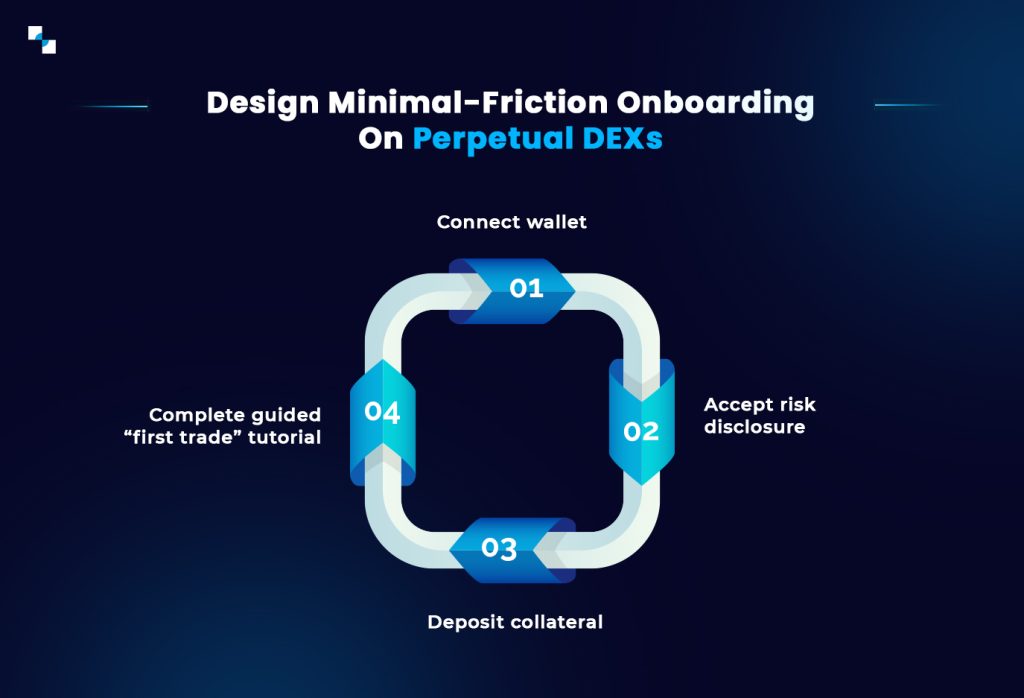
The perpetual exchanges must also localize UI for major markets (US, EU, MENA, APAC) to maximize reach and consider fiat on-ramps where regulations permit.
Risk, Compliance, and Security for Perpetual DEX Builders
While a decentralized perpetual exchange is non-custodial, regulatory and security responsibilities remain critical. Implementation of robust risk management systems, including liquidation engines and funding rates, is critical for perpetual exchange development.
Security layers for perpetual futures DEX development must include:
- Smart contract audits from multiple firms
- Bug bounty programs ($10K-$1M+ for vulnerabilities)
- On-chain activity monitoring
- Emergency pause mechanisms
- Transaction monitoring for suspicious patterns
Regulatory compliance, including KYC and AML standards, is increasingly necessary as the U.S. CFTC actively works to establish purpose-fit frameworks to onshore perpetual futures exchanges. In the UK, launching a crypto derivatives exchange requires compliance with Financial Conduct Authority (FCA) regulations under the comprehensive cryptoasset regulatory framework. To operate a compliant Cryptoasset Trading Platform (CATP) in the UK, businesses must integrate KYC verification, AML monitoring, market abuse reporting, and secure custody systems. UK startups must also ensure data protection compliance under UK GDPR to protect user information.
Building a Robust Risk Engine For Perpetual Futures Exchange Development
Real-time risk assessment across all open positions, collateral types, and active markets is essential. Key features include:
- Per-asset risk weights and margin tiers
- Dynamic leverage caps during market volatility
- Oracle failure detection with automatic fallbacks
- Cascading liquidation prevention via circuit breakers
- Position throttles during high-risk periods
Risk dashboards should show live open interest, concentration by account, and funding rate spikes. Antier incorporates AI-based anomaly detection to flag unusual trading activity before impacting users.
Step-by-Step Perpetual Futures Exchange Development Roadmap
This phased roadmap guides builders from concept to live perpetual DEX in 6-12 months, depending on scope. The timeline accounts for custom architectures rather than copycat deployments.
Phase 1: Discovery, Research, and HIP-3-Style Governance Design
Duration: 4-6 weeks
- Define business objectives: target regions, user segments, leverage range, supported assets
- Benchmark against Hyperliquid, GMX, Drift, and dYdX and analyze HIP-3 governance for tokenomics inspiration
- Shape value proposition: lower fees, better liquidity, unique margin systems, or new asset classes
- Create technical specification and product requirements for perpetual DEX development
Deliverables: Product brief, regulatory mapping, solution architecture, go-to-market plan
Phase 2: Architecture, Tech Stack, and Smart Contract Design
Duration: 6-8 weeks
- Finalize chain selection and infrastructure design
- Design data flows between the matching engine, oracles, and risk engine
- Specify smart contract interfaces and storage layouts
- Plan liquidity integration patterns and cross-chain functionality for perpetual futures crypto exchange development
Deliverables: Architecture diagrams, contract specs, database schema, AWS deployment plan
Phase 3: Development, Integration, and Testnet Launch
Duration: 12-16 weeks
- Implement smart contracts, off-chain services, UI, and admin dashboards
- Integrate price oracles, wallet providers, and analytics tools
- Run comprehensive testing, including edge cases: extreme volatility, oracle lags, high-leverage liquidations
- Deploy on public testnet with the early tester community
Deliverables: Testnet deployment, bug reports, updated risk parameters, pre-audit code freeze
Phase 4: Security Audits, Mainnet Launch, and Liquidity Bootstrapping
Duration: 6-8 weeks
- Conduct multi-firm smart contract and infrastructure audits
- Set up monitoring for on-chain events and oracle performance
- Liquidity bootstrapping involves partnering with market makers or establishing liquidity pools to ensure sufficient market depth
- Execute liquidity mining programs, points systems, and market maker partnerships
Deliverables: Audited contracts, mainnet perpetual DEX deployment, deep liquidity seeded, active trading community
Phase 5: Continuous Improvement, Expansion, and AI-Driven Insights
Ongoing
- Add new markets (L1s, L2s, RWAs, indices), margin assets, and order types
- Optimize fees, funding rate parameters, and risk settings based on live data
- Introduce AI features: smart order routing, smooth order execution optimization, personalized risk recommendations
- Explore cross-chain liquidity integration and institutional portfolio margin
Deliverables: Version releases, governance proposals, and expanding user and liquidity metrics
Why Partner with Antier for Perpetual Futures Exchange Development?
Antier is a B2B Web3 and AI consultancy specializing in compliance-first decentralized perpetual exchange development. Our teams have delivered blockchain infrastructure across multiple chains, built compliant architectures for regulated markets, and integrated AI-enhanced risk engines.
We build Hyperliquid-like perpetual DEX platforms with unique branding, custom tokenomics, and differentiated UX – not clones. Our approach ensures full control of the platform architecture while leveraging proven trading modules and smart contract automation.
Complementary capabilities include:
- Identity management and KYC/AML integration
- RWA tokenization for expanded asset classes
- Intelligent document processing for institutional onboarding
- Multi-chain operations and liquidity management
Ready to launch your own crypto perpetual exchange with a 2026-ready architecture? Contact Antier to scope your perpetual exchange development project.
Frequently Asked Questions
01. How long does it take to build a Hyperliquid-style perpetual DEX from scratch?
Expect 6-9 months for an MVP and 9-12+ months for a fully featured, audited, multi-chain perpetual DEX with institutional tooling. Factors affecting duration include custom chain versus existing L2, the number of markets, the complexity of margin systems, and compliance requirements by jurisdiction. Antier accelerates delivery using pre-built modules for funding rate, margin, and liquidity integration while ensuring platform uniqueness.
02. What budget range should I plan for a production-grade perpetual futures exchange?
Plan for low- to mid-seven-figure USD budgets for fully audited, enterprise-grade perpetual DEX builds, including infrastructure and security. Simpler single-chain deployments cost less, while custom app-chains or heavy compliance layers increase investment. A discovery workshop helps refine the scope and create phased budgets aligned with milestones.
03. Can I legally offer perpetual futures in my target jurisdiction?
Legality depends entirely on local derivatives regulation, licensing requirements, and whether the platform serves residents in restricted jurisdictions. The British Virgin Islands, Singapore, and the UAE offer more flexible frameworks than the US or the EU. Consult local legal counsel familiar with digital asset derivatives. Antier implements technical controls-geo-fencing, KYC tiers, and product restrictions aligned with regulatory guidance.
04. How do perpetual DEXs attract enough liquidity to compete with leading platforms?
Legality depends entirely on local derivatives regulation, licensing requirements, and whether the platform serves residents in restricted jurisdictions. The British Virgin Islands, Singapore, and the UAE offer more flexible frameworks than the US or the EU. Consult local legal counsel familiar with digital asset derivatives. Antier implements technical controls-geo-fencing, KYC tiers, and product restrictions aligned with regulatory guidance.
05. Is it better to use an order book or an AMM/liquidity pool model for a new perpetual exchange?
Order books (Hyperliquid, Drift) offer granular price discovery and CEX-like experience, but require active market makers. AMM/pool models (GMX-style) are simpler to bootstrap but require careful risk management for liquidity providers. Align your choice with target traders: professional traders prefer order books, while retail-first platforms may start with pool-based designs. Antier advises on hybrid approaches optimized for your trading strategy and capital structure.