






✨ AI Summary
- The blog post discusses the rise of compliance-grade perpetual futures trading platforms in the cryptocurrency market.
- It highlights the shift towards compliance-aligned exchanges, emphasizing the importance of regulations in attracting institutional customers.
- The post delves into the key features of compliance-ready white label crypto exchanges, including CFTC/ESMA alignment, proof-of-reserves systems, and hybrid custody.
- It also explores the technology stack behind compliance-first perpetual futures crypto exchange development, focusing on regulated custody, AI-driven risk management, and proof-of-reserves protocol.
- The blog further outlines a 90-day plan to launch a compliance-ready perpetual trading crypto exchange, emphasizing the essential phases and components involved.
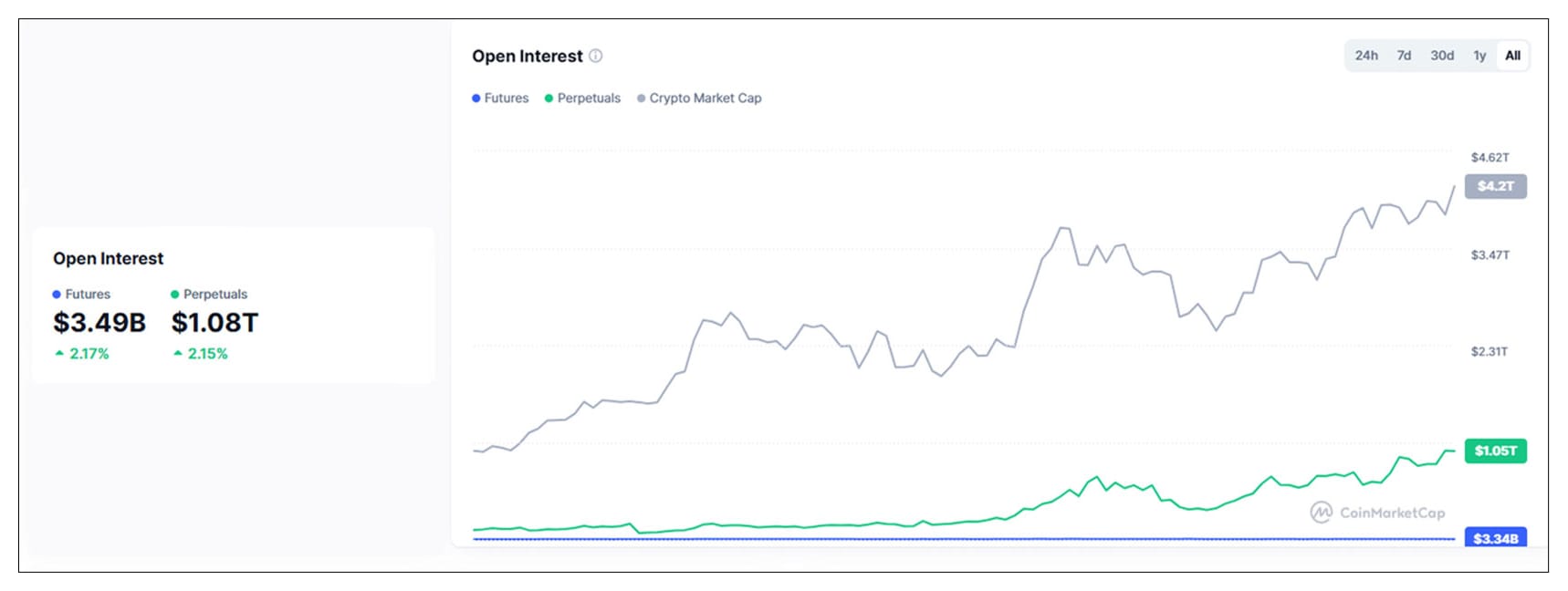
Perpetual futures contracts rely on a funding rate mechanism to keep their prices in line with the spot market price, giving traders exposure to wild swings without asset ownership. The cumulative trading volume of these non-expiring derivatives since 2020 has transcended $60 trillion, far exceeding trading volumes of both the underlying cryptocurrencies and conventional futures contracts.
After years of operating in a gray zone and showing a flat growth curve, 2025 marks a turning point for the crypto perpetual futures markets. At the time of writing this, the perpetuals trading volume stands at its highest at $1.05 trillion.
Also Read: A Futuristic Guide to Building Crypto Futures Trading Platforms
Why Compliance-Grade Perpetual Trading Platforms Are Gaining Popularity?
To understand this, we need to determine what that one thing is that anyone seeking to break into the perpetual trading crypto market must know. Here’s a
- Binance, despite being the biggest crypto exchange, got hit by lawsuits and regulatory pressures.
- FTX’s collapse was a momentous shake-up that forced regulators to enforce laws, close loopholes, and hold exchanges accountable. This shook traders’ trust in unregulated exchanges.
- Coinbase launched CFTC-approved crypto futures in the US, proving that following rules can actually open doors instead of closing them. As a result, institutional customers accounted for $194 billion in trading volume (roughly 81.9% of the total volume on the platform) post the perpetual trading launch in July 2025. Even monthly trading volumes and user base showed an upward trend.
Earlier, being unregulated in Web3 meant faster growth and fewer restrictions, but Coinbase’s move signalled that being compliant actually attracts more users, investors, and institutions. This signals that compliance-aligned perpetual futures crypto exchanges are no longer optional but a market standard.
The Rise of Compliance-First White Label Perpetual Trading Crypto Exchanges
With compliance-grade white label crypto exchange software enabling perpetual trading, institutions and fintech startups can deploy a CFTC or ESMA-aligned perpetual futures crypto exchange. These modular ecosystems with KYC/AML, fiat on ramps, segregated custody, Wall Street’s legal polish, and AI-driven risk engines enable crypto perpetual futures trading at Binance-level performance, which means:
- High-speed matching engine: millisecond-level order execution
- High-throughput: millions of orders per second
- Global liquidity depth: zero slippage
Note: Binance’s matching engine can reportedly handle 1.4 million orders per second, which is among the highest in the industry. But today, other exchanges like OKX, Bybit, and Hyperliquid have matching speeds and throughput in the same ballpark. Reputable white label cryptocurrency exchange companies now match or exceed those specifications in custom cryptocurrency exchange software deployments.
Key Features of Compliance-Ready White Label Crypto Exchanges With Spot Perpetual Futures
The institutional market has always been crypto’s upside, and every exchange craves a fair share of institutions’ interest (and capital), but no one wants the chaos that comes with it. Until now, the risk profile of trading perpetual futures crypto has been characterized by opaque custody, liquidation spirals, unregulated venues, etc., keeping serious capital out.
The new CFTC and ESMA-ready white label spot and perpetual futures crypto exchanges flip the script with the following features:
- CFTC/ESMA alignment: Built with compliant derivatives logic, margin segregation, and transparent clearing
- Proof-of-reserves systems: Real-time cryptographic verification that rebuilds user trust.
- Regulated liquidity providers: Partner integrations delivering compliant execution with verifiable audit trails.
- Hybrid custody: User assets remain visible and verifiable even when order execution is centralized for speed and performance.
Institutional traders seek such perpetual futures trading venues that feel like the Chicago Mercantile Exchange (CME), perform like Binance, and pass regulatory due diligence.
What is the Technology Stack Behind Compliance-First Perpetual Futures Crypto Exchange Development?
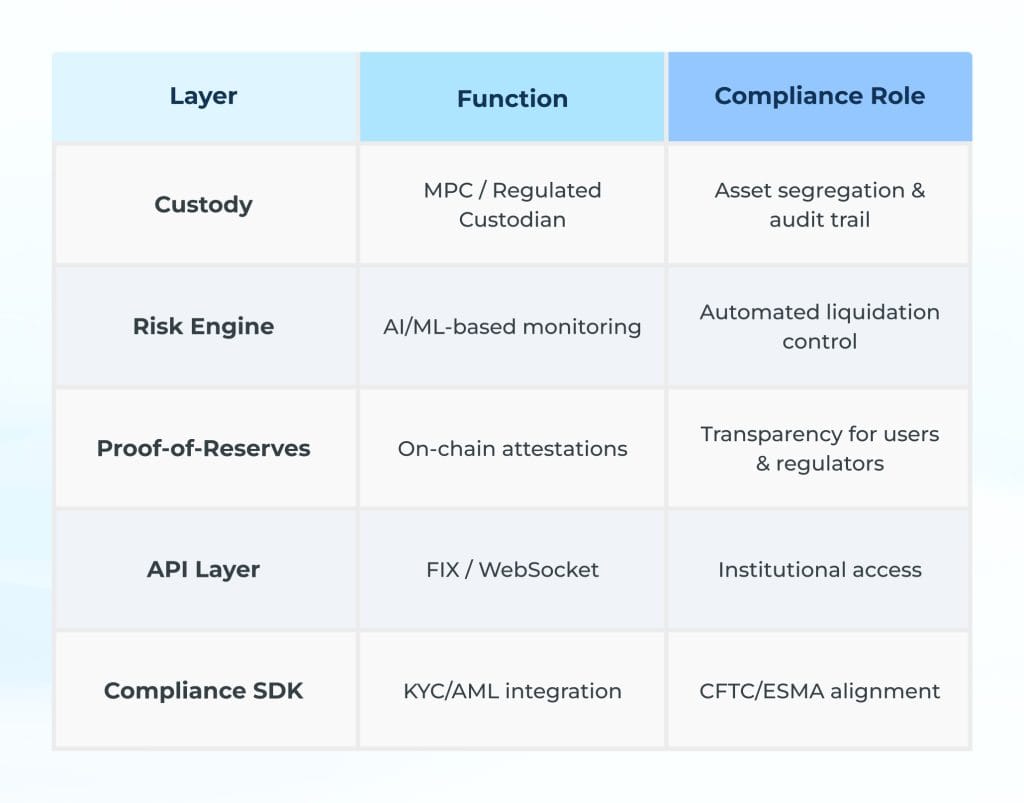
1. Regulated Custody Layer:
This layer includes licensed custodians, MPC wallets, or SOC-2 certified custody infrastructure, ensuring funds remain safe, segregated, auditable, and compliant. Hybrid custody perpetual futures crypto exchanges with a centralized performance and an on-chain proof layer also attract institutional and retail investors, ensuring:
- Assets are held in MPC or zk-proof-backed accounts.
- Collateral remains user-verifiable at all times.
- Withdrawals and balances can be publicly validated without exposing user data.
The hybrid approach ensures operational security and on-chain assurance, removing the need for traders to “trust” the exchange entirely, and satisfies both:
- Regulators who want auditable systems
- Traders who demand control over their assets.
2. AI-Driven Risk Management and Compliance:
Machine learning models forecast liquidation cascades, auto-adjust leverage limits, and dynamically recalibrate margin requirements. Next-generation white label perpetual futures crypto exchanges are onboarding AI as their new risk and compliance officers. These AI risk engines do the following to ensure traders remain safe and regulators remain calm.
- Predict liquidation chains before they start
- Adjust leverage limits based on real-time volatility
- Flag anomalies that hint at manipulation or wash trading
Besides these risk controls, AI-powered compliance modules for real-time KYC/AML screening, transaction monitoring, and geo-fencing are also gaining traction. A reputable white label crypto exchange development company ensures that these integrations align perfectly with CFTC and ESMA mandates for surveillance, reporting, and capital protection.
3. Proof-of-Reserves Protocol:
This security layer ensures that your perpetual futures crypto exchange doesn’t rely completely on timely audits but has automated mechanisms for on-chain auditing. Exchanges implement these on-chain analytics, auditing, and collateral attestation mechanisms to remove the “trust me, bro” model that doomed FTX. They ensure the following:
- Connection with blockchain intelligence providers to flag wallets linked to hacks, mixers, or sanctioned entities.
- Automated Merkle tree attestations to verify customer deposits vs. liabilities.
- Creation of API-driven transparency dashboards that regulators or users can inspect anytime.
At this layer, trade surveillance and market integrity tools are also integrated to monitor spoofing, front-running, insider activity, and manipulation. They recognize patterns and flag suspicious order book behaviors.
4. Institutional APIs and Embedded Compliance SDKs:
Modern white label exchange software with crypto perpetual futures trading is built with compliance-aware API architectures, ensuring high-speed FIX (Financial Information eXchange) connectivity and automated regulatory compliance. The FIX integration enables high-frequency traders, proprietary desks, hedge funds, and algorithmic traders to integrate their strategies directly into the exchange’s order book, ensuring ultra-low latency and institutional-grade precision.
While APIs only focus on speed, the new white label crypto exchange software solutions with spot perpetual futures also bake compliance into every API call. Integrated compliance SDKs perform automated KYC, AML, and sanctions screening in the background, ensuring that each connection, order, and fund transfer adheres to jurisdictional requirements before execution.
The dual-layer design enables institutional participants to trade programmatically at millisecond speed without bypassing compliance checks. The ability to plug into the exchange via FIX or REST APIs also attracts more regulated entities.
How to Launch Your Compliance-Ready Perpetual Trading Crypto Exchange in 90 Days?
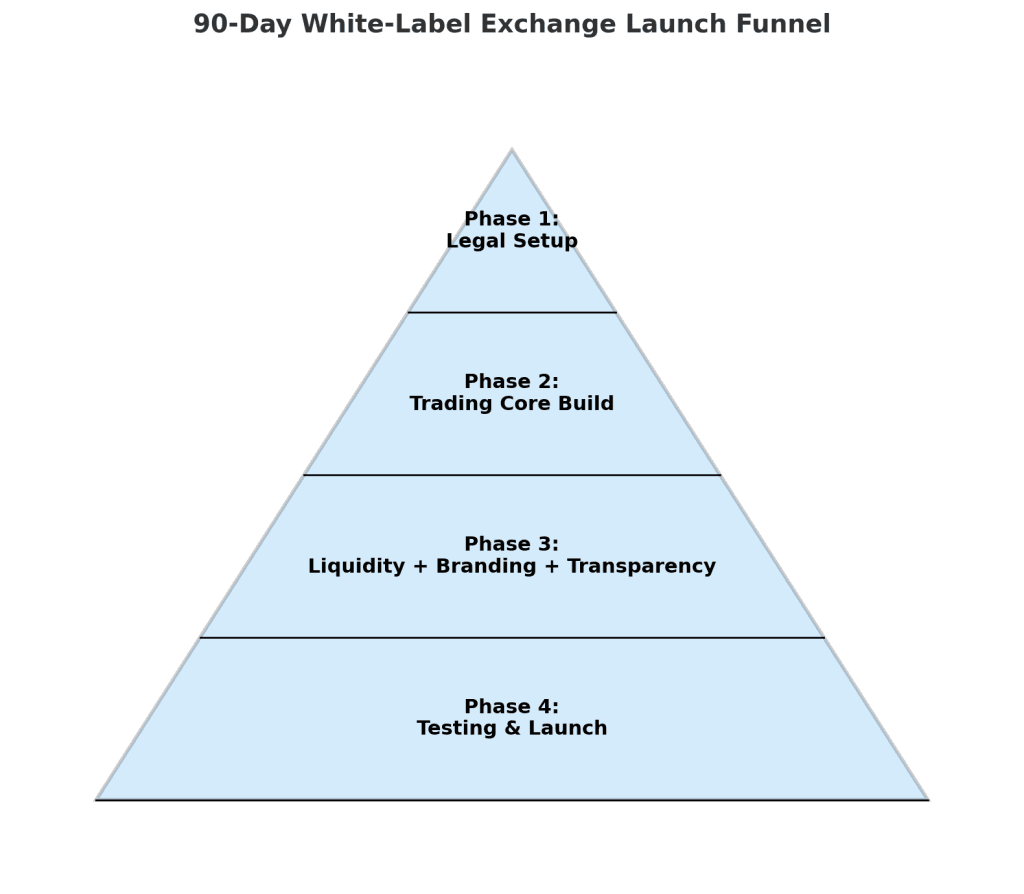
The white label exchange software with crypto perpetual futures functionality or “derivatives-as-a-service” models compresses the typical 12-month development cycle into 8-12 weeks.
Your 90-day crypto perpetual futures exchange development and launch plan includes:
1. Phase 1 (Week 1-3)
At this stage, your white label cryptocurrency exchange development company aims to make your exchange legally clean and operation-ready.
- Regulatory Scoping: Figure out what licenses or approvals are required in your target market (CFTC for the US, ESMA for Europe).
- KYC/AML Integration: Connect APIs from vendors like Sumsub or Onfido, so users can verify identity automatically.
- Fiat Partner Setup: Integrate with a licensed payment gateway or banking partner so users can deposit or withdraw money in USD, EUR, etc.
2. Phase 2 (Week 4-6)
Here, you join forces with your white label crypto exchange software development company to get the actual fast and secure trading system live. All the essential components of perpetual futures trading exchanges are developed/customized at this stage.
- Core trading engine: Your tech partner builds the software that matches buy/sell orders at high speed.
- Risk modules: Your white label cryptocurrency exchange development company creates logic that handles leverage, liquidation, and margin requirements to prevent system crashes.
- Hybrid custody architecture: This spot perpetual futures trading feature combines centralized speed with on-chain transparency, ensuring assets are held securely in MPC wallets, but proof-of-reserves remains verifiable.
3. Phase 3 (Week 7-9)
After the crypto perpetual trading infrastructure is set up, it’s time to add liquidity, enhance the user interface, and integrate transparency tools.
- Liquidity APIs: Your white label crypto exchange software development company now connects your platform to external market makers or liquidity networks, so trades always have counter-orders.
- Branded frontend: User experience is essential when it comes to offering Wall Street-standard trading. Your white label exchange software provider customizes the UI with your logo, theme, and branding at this stage. Any further enhancements add to your white label perpetual futures crypto exchange cost.
- Proof-of-reserves dashboards: As an essential for CFTC and ESMA regulations, perpetual futures crypto exchanges need to create a real-time page showing users that all funds on the platform are verifiably backed 1:1. This builds user trust.
4. Final Phase (Week 10-12)
At this stage, you collaborate with your white label crypto exchange software development company to do the final checks before going live.
- Testing: This includes stress tests for engine speed, order execution, wallet security, and funding rate logic.
- Legal validation: Your white label exchange software provider also ensures all workflows meet regulatory guidelines (for CFTC/ESMA or your target audience readiness).
- Go-live: Launch to a limited group (beta or institutional partners), then open publicly once your perpetual trading crypto exchange is stable.
Also Read>>> How to Launch Crypto Exchange Software in Crypto-Friendly Nations
What’s Ahead For Compliance-First Cryptocurrency Exchanges For Trading Perpetual Futures?
AI automation, hybrid custody, and modular compliance are reshaping what a crypto perpetual futures exchange will look like. The next generation of perpetual futures trading platforms will feature:
- On-chain proof dashboards for regulators.
- RWA-collateralized margin systems.
- Token-gated institutional accounts with custom limits.
- AI-driven post-trade analytics and reporting.
Launch CFTC-Friendly Futures Exchange in 90 Days With Antier
Institutions Are Moving In… When Are You?
Major cryptocurrency exchanges are launching their derivatives trading arm. It isn’t just another revolution taken forward by random startups. Bullish, MetaMask, Pi42, CME Group, Coinbase, and Kraken recently added crypto perpetual futures trading to their platforms. Many liquidity networks are also emerging to provide compliant leverage and settlement for multiple exchanges. The shift towards perpetual futures trading is clear, but the race isn’t about only UX anymore. Institutions are looking for regulated trading infrastructure, so it’s about who gets licensed first and launches fastest with liquidity from day 1.
So, what used to be the bottleneck is the selling point in terms of crypto exchanges. Compliance-grade white label crypto exchange software with AI risk controls and hybrid custody is essential for anyone launching their spot perpetual futures exchange in 2025 and beyond.
At Antier, we’re helping global clients build Wall Street-grade, compliance-ready perpetual futures exchanges from the ground up.
- CFTC/ESMA-aligned derivatives modules
- AI-driven risk management and hybrid custody
- Proof-of-reserves and on-chain transparency
- Fiat integration and regulatory-ready APIs
Launch your regulated perpetual futures exchange fast, compliant, and future-proof with Antier.
Frequently Asked Questions
01. What are perpetual futures contracts and how do they work?
Perpetual futures contracts are derivatives that allow traders to gain exposure to price movements without owning the underlying asset. They utilize a funding rate mechanism to align their prices with the spot market.
02. How has the trading volume of perpetual futures contracts changed recently?
Since 2020, the cumulative trading volume of perpetual futures contracts has surpassed $60 trillion, with the current trading volume reaching a record high of $1.05 trillion in 2025.
03. Why are compliance-grade perpetual trading platforms becoming more popular?
Compliance-grade platforms are gaining traction because they enhance trust among traders following regulatory challenges faced by major exchanges. This shift has shown that adhering to regulations can attract more users and institutional investors.