





✨ AI Summary
- In 2025, the landscape of real-world asset tokenization is shaped by legal, regulatory, and operational frameworks.
- Three main models dominate the field: on-chain tokens for maximum transparency, off-chain tokens for legal compatibility, and hybrid models combining efficiency with regulatory compliance.
- The success of tokenization platforms hinges on accurate legal ownership representation.
- The blog post also delves into the global regulatory landscape, highlighting frameworks in the United States, European Union, and Asia.
- It emphasizes the importance of legal recognition, title, and custody structures for tokenized assets, as well as compliance dimensions like securities classification, AML/KYC, and taxation.
For the Real-World Asset Tokenization Platform, regulatory frameworks now determine legitimacy, investor trust, and scalability. Misinterpret compliance, and your platform risks classification as an unregistered securities issuer. To operate within an entirely legal, globally interoperable capital system, the platform must be structured.
This comprehensive roadmap unpacks the legal, regulatory, and operational frameworks driving compliant tokenization in 2025, providing clarity for builders, issuers, and investors navigating this evolving domain.
What Are the Legal and Structural Foundations for Tokenized Assets?
The success of any RWA tokenization initiative depends on how accurately the digital token reflects enforceable legal ownership. Regulators assess tokenization by examining how tokens interact with property, contract, and securities law. In 2025, three principal frameworks dominate the tokenization landscape. Each offers a distinct balance between legal certainty, operational efficiency, and regulatory compatibility.
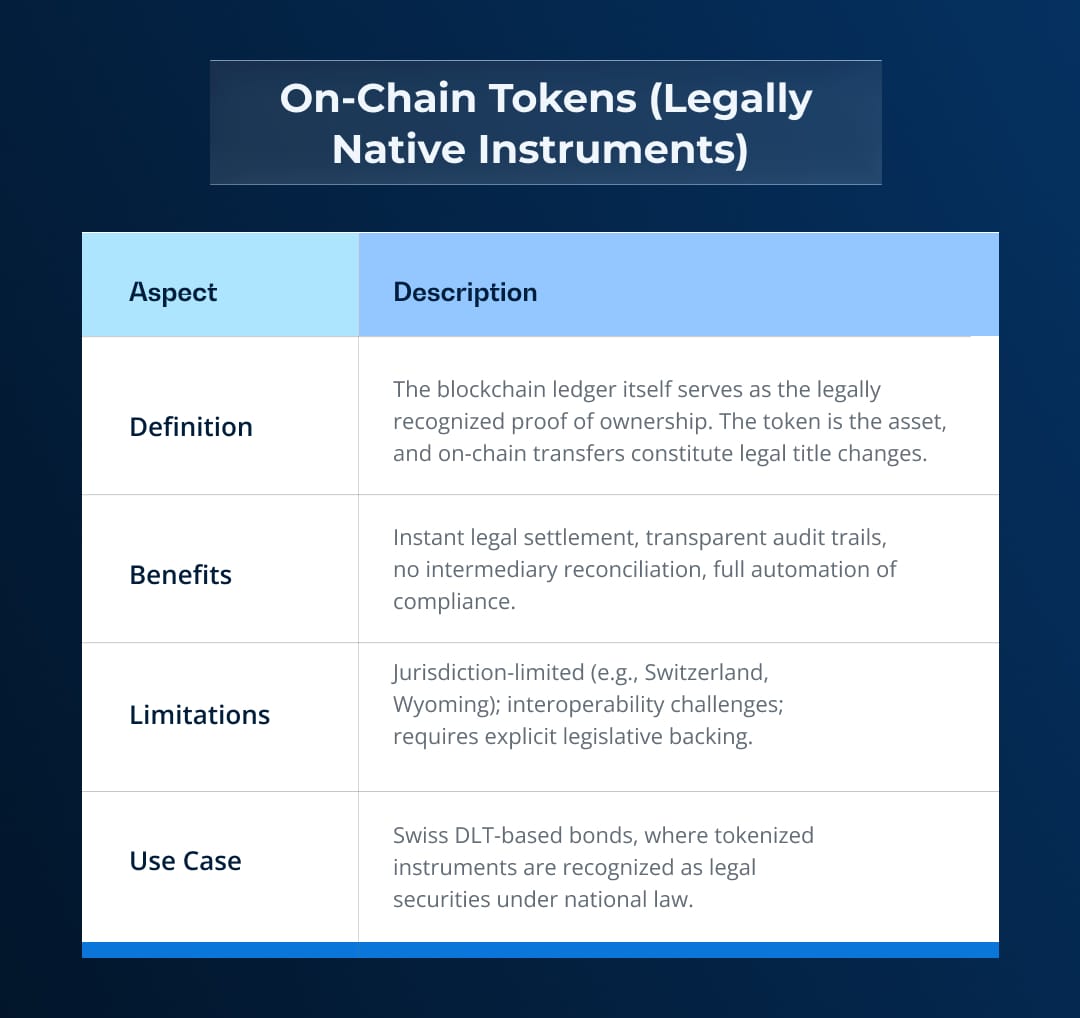
1. On-Chain Tokens (Legally Native Instruments)
On-chain models make blockchain records legally authoritative, replacing traditional registries entirely. This structure offers maximum transparency and efficiency, enabling direct, final settlement without intermediaries. However, its viability depends on jurisdictions that have formally recognized distributed ledgers as valid proof of title. While ideal for fully digital securities, adoption remains limited to advanced legal ecosystems where blockchain enjoys statutory recognition as the primary source of ownership truth.
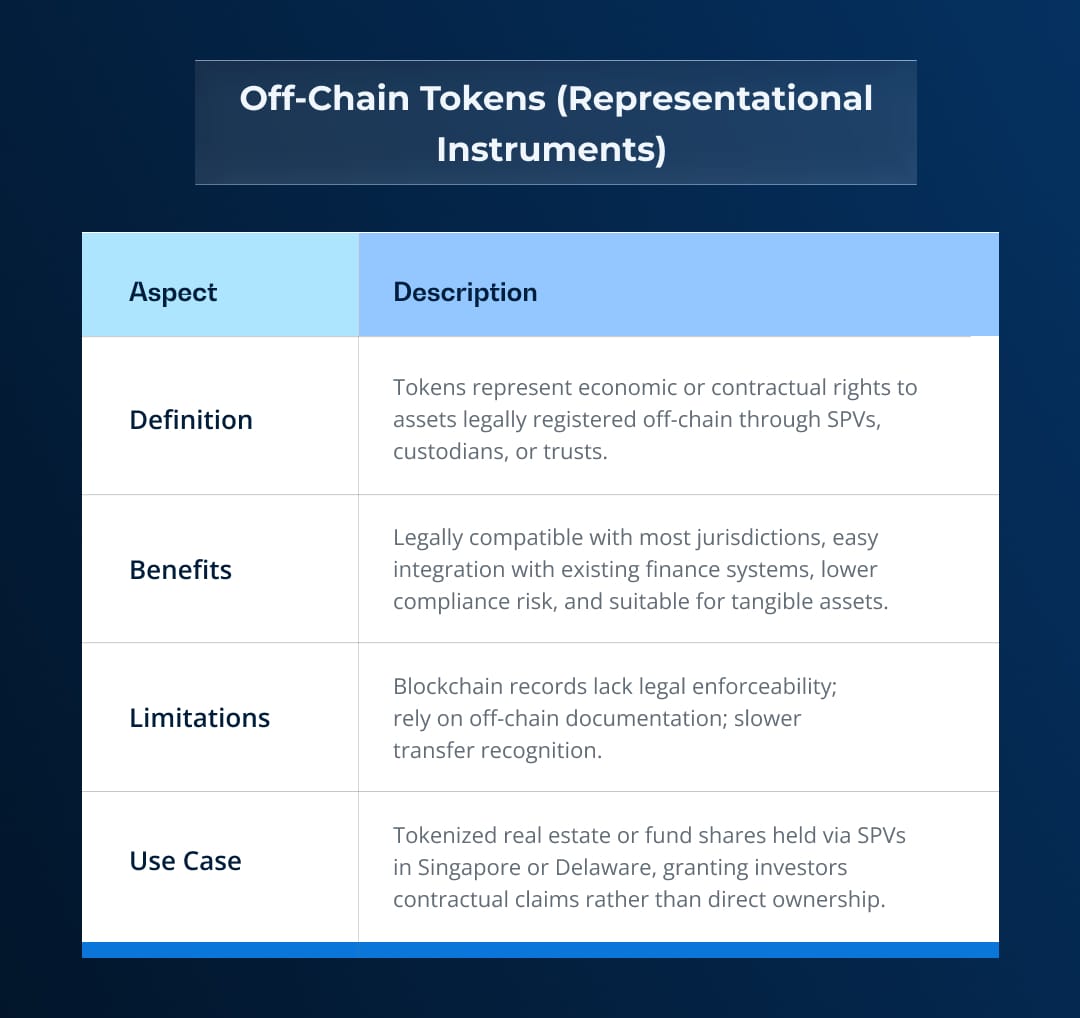
2. Off-Chain Tokens (Representational Instruments)
Off-chain tokenization mirrors existing financial law, linking tokens to assets through contracts rather than blockchain-enforced titles. It’s the most widely adopted approach, offering universal legal compatibility and easier regulatory acceptance. However, it trades automation for certainty; each transaction must be validated against off-chain records. This model suits assets like real estate or funds, where physical or legal registries must remain the authoritative record of ownership.
3. Hybrid Models (Integrated Legal-Tech Frameworks)
Hybrid tokenization bridges traditional finance and blockchain, combining off-chain legal certainty with on-chain automation. Custodians or SPVs hold legal title, while blockchain ensures verifiable settlement, programmable compliance, and transparency. It’s the prevailing model in 2025 due to its global scalability and regulatory compatibility, enabling institutions to operate within existing laws while leveraging blockchain’s efficiency and auditability for investor management and secondary market transactions.
These structures define how regulators interpret tokenized assets under securities, property, and financial law.
Launch a legally Compliant Asset Tokenization Platform!
RWA Tokenization Market Scale and Institutional Maturity
In 2025, tokenized real-world assets will surpass $25 billion in on-chain value. This acceleration is led by institutional adoption, with all issuing tokenized Treasuries and funds under regulated frameworks.
Driver Behind the Tokenization Growth
- Regulatory Clarity: Europe’s MiCA, Singapore’s Project Guardian, and Japan’s FSA-led guidelines have established frameworks for security tokens and tokenized funds.
- Institutional Integration: Traditional custodians and market makers provide regulated liquidity for tokenized assets.
- Operational Compliance Infrastructure: AML/KYC automation, audited proof-of-reserves, and standardized token issuance frameworks build trust among regulators and investors.
- DeFi Convergence: Regulated DeFi pools now use tokenized bonds and funds as collateral, connecting blockchain efficiency with traditional investor safeguards.
The Global Regulatory Landscape for Asset Tokenization
1. United States
The U.S. applies substance-over-form analysis. If a token behaves like a security, it is one. Under the SEC’s Howey Test, most tokenized RWAs fall within the securities definition, requiring registration or exemption (Reg D, Reg S, Reg A+).
FinCEN classifies tokenization platforms as Money Service Businesses (MSBs), requiring AML/KYC compliance. The IRS applies capital gains taxation to digital transfers, and state-level reforms (e.g., Delaware’s and Wyoming’s UCC Article 12) now recognize “controllable electronic records” as collateral.
U.S. platforms thus operate through SPVs or trust wrappers, linking on-chain records to legally recognized ownership rights.
2. European Union
The EU represents the most mature tokenization framework globally. The regulators now focus on supervisory harmonization, ensuring that DLT-based instruments maintain parity with traditional securities.
- MiCA (Markets in Crypto-Assets Regulation) regulates digital assets that are not traditional securities.
- MiFID II governs tokenized securities under existing financial law.
- The DLT Pilot Regime allows trading and settlement of tokenized instruments, granting temporary exemptions to infrastructure operators.
By 2025, MiCA’s passporting provisions will enable cross-border token operations across 27 EU states.
3. Asia
Asia leads in sandbox-driven, principle-based regulation that balances oversight with experimentation.
- Singapore (MAS – Project Guardian): Institutional pilots for tokenized bonds and funds under strong AML/KYC controls.
- Hong Kong (SFC & HKMA): Tokenized securities regulated through licensed intermediaries and client protection mandates.
- Japan (FSA): Security tokens fall under the Financial Instruments and Exchange Act; issuers must comply with disclosure and custody rules.
These frameworks converge on one principle: tokenization cannot replace regulation; it must comply with it.
Legal Recognition, Title, and Custody for Tokenized Assets
The foundation of compliant RWA tokenization lies in ownership recognition and custody structure. Blockchain may prove transfer, but legal title is still determined by courts, not code.
1. Proof of Title
Courts recognize titles through registries, custodians, or trustees.
Tokens linked via contractual mechanisms, typically through SPVs or custodial trusts, create a legal bridge between off-chain title and on-chain representation.
2. Custody Frameworks
- Institutional Custody: Licensed custodians (banks, trust companies) hold physical or legal assets, providing insured segregation and compliance reporting.
- On-Chain Custody: Decentralized custody lacks clear insolvency protections; regulators hesitate to recognize it for financial instruments.
- Hybrid Custody: The 2025 standard, off-chain custodians hold legal title, while blockchain tracks investor entitlements in real time.
Ownership claims must survive insolvency and dispute scenarios. Legal enforceability depends on custody documentation, not token metadata.
Key Compliance Dimensions for Asset Tokenization: Securities, AML/KYC, and Tax
Securities Classification
If a tokenized asset offers profit derived from others’ efforts, it meets the investment contract test and falls under securities law. Issuers must register, seek exemptions, or risk enforcement.
AML/KYC
Regulators classify tokenization platforms as Virtual Asset Service Providers (VASPs). Requirements include:
- Verified identity checks and source of funds validation
- Ongoing monitoring and risk scoring
- Sanction list integration
Platforms must also comply with Travel Rule standards for cross-border token transactions.
Taxation
Token transfers can trigger capital gains or withholding taxes depending on the jurisdiction. Under FATCA and CRS, issuers must disclose cross-border investor data. Tax-efficient tokenization structures remain common but face increasing scrutiny.
Investor Protection
Tokenized finance mirrors traditional investor protection regimes: disclosures, risk assessments, and clear redemption mechanisms. Platforms must ensure transparency equivalent to regulated financial products.
Asset Tokenization: Standardization and Liability Allocation
Tokenization thrives when legal and technical standards align.
- Technical Standards
The ERC-1400 and ERC-3643 (T-REX) token standards integrate transfer restrictions, investor whitelists, and compliance logic. These standards ensure that only verified investors can transact, meeting regulatory transfer obligations.
- Legal Standardization
Consistent documentation, offering memorandums, proof-of-asset audits, and custodial agreements forms the legal backbone of RWA ecosystems.
- Liability Allocation
Issuers, custodians, and technology operators share legal responsibility. Well-drafted agreements define liability boundaries, limiting exposure to operational or smart contract failures.
What Are the Emerging Risks in 2025 and How to Mitigate Them?
Even with progress, several risks persist:
- Regulatory Divergence: Fragmented definitions between securities and crypto-assets create cross-border friction.
- Custody Insolvency Risks: Ambiguous ownership when custodians fail.
Smart Contract Vulnerabilities: Legal liability for code malfunction remains unsettled. - Tax Inconsistency: Jurisdictions differ on whether tokens are property, security, or payment instruments.
Continuous monitoring and proactive legal reviews remain non-negotiable for sustainable tokenized operations.
Build an RWA Tokenization Infrastructure that Regulators Trust
The Next Evolution: Regulatory Convergence and Statutory Recognition
By 2030, global convergence will define RWA tokenization. Key trajectories include:
- Statutory Ledger Recognition: Legal systems are beginning to treat distributed ledgers as authoritative ownership registries.
- Global Tokenization Standards: Harmonization under BIS, IOSCO, and FATF guidance.
- Regulated DeFi: Institutional-grade DeFi ecosystems operating under VASP and securities licenses.
- Hybrid Infrastructure: Traditional exchanges integrating blockchain settlement layers for regulated digital securities.
These shifts will make compliance not an add-on but the infrastructure layer of financial systems.
Takeaway
The tokenization of real-world assets is forcing finance to reconcile two systems, legal finality and digital efficiency. The real challenge is not technological scalability but jurisdictional coherence: ensuring that every tokenized claim can stand up in court as firmly as it executes on-chain. The maturity of this market will be measured not by total value locked, but by how seamlessly legal enforceability, investor protection, and regulatory clarity are coded into financial infrastructure. The success of a platform will depend upon how law and ledger converge.
Make Compliance a Competitive Edge with Antier
A compliant RWA platform requires more than legal interpretation; it demands technical precision, regulatory interoperability, and operational foresight. At Antier, we help businesses to design and implement end-to-end RWA tokenization solutions that align with global regulatory frameworks.
From smart contract governance and AML-integrated architecture to custody frameworks and secondary market compliance, our Asset Tokenization Platform Development Company combines deep blockchain engineering with legal insight to build platforms that regulators recognize and investors trust.
Partner with us to design RWA ecosystems that are technology-advanced and legally unassailable.
Frequently Asked Questions
01. What is the importance of regulatory frameworks in Real-World Asset Tokenization?
Regulatory frameworks determine the legitimacy, investor trust, and scalability of tokenization platforms. Misinterpreting compliance can lead to classification as an unregistered securities issuer.
02. What are the three principal frameworks for tokenization in 2025?
The three principal frameworks are On-Chain Tokens (legally native instruments), Off-Chain Tokens (representational instruments), and Hybrid Models (integrated legal-tech frameworks), each offering different balances of legal certainty, operational efficiency, and regulatory compatibility.
03. How do On-Chain Tokens differ from Off-Chain Tokens?
On-Chain Tokens make blockchain records legally authoritative, enabling direct settlement without intermediaries, while Off-Chain Tokens link tokens to assets through contracts, requiring validation against off-chain records for each transaction.