





✨ AI Summary
- Charles Schwab, managing over $10 trillion in client assets, has quietly launched Schwab Crypto, offering Bitcoin and Ethereum trading on the same platform where clients buy index funds.
- This follows similar moves from Interactive Brokers and Morgan Stanley.
- The trend comes as spot crypto trading becomes a standard offering for serious brokerages, regional banks, and financial apps.
- The challenge now is deciding whether to launch a custom or white label exchange or opt for an institutional integration.
- Retail investors have been using Coinbase, Kraken, and Robinhood for crypto trading, but the switch between apps is a friction point for many users.
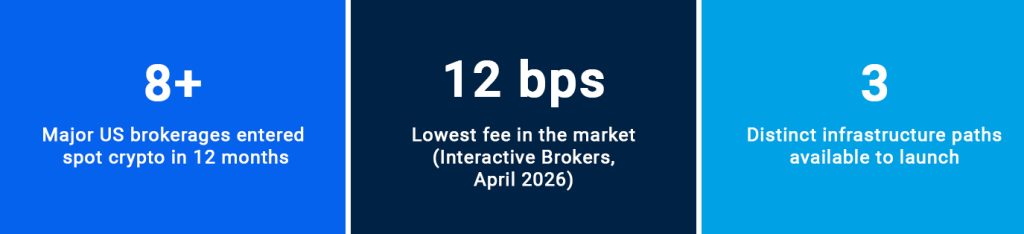
Charles Schwab, a firm that manages over $10 trillion worth of client assets, quietly launched “Schwab Crypto,” bringing Bitcoin and Ethereum trading directly inside the same dashboard where clients buy Index funds. Weeks earlier, Interactive Brokers had already set the competitive floor when it went live with EEA-wide BTC trading at an aggressive fee structure. Morgan Stanley also entered this lane late in 2025.
Spot crypto trading is now a table-stakes offering for every serious brokerage, regional bank, and financial superapp. It is a core financial service that clients expect the same way they would want an equity trading engine or a savings account. But the harder question that every product and engineering leader at brokerage is staring at is: whether to launch a custom or white label exchange or go for an institutional integration.
Why US Brokerage Clients Demand Spot Crypto Trading Now
Before you choose your crypto trading infrastructure path, it’s worth understanding what’s actually driving the demand. Because that also explains which feature to ship first.
Retail investors have been using Coinbase, Kraken, and Robinhood for crypto trading for years. The switch between apps, which includes offloading money from one place and putting it into another account in another application, is the friction that all brokerages are addressing. When Schwab launched BTC and ETH trading inside the same interface where clients hold their other credible assets, it was not offering a new product. It is actually removing the friction that clients were already facing.
Morgan Stanley made the logic explicit when its Head of Wealth Management, Jed Finn, described the goal of this move as preventing “app leakage,” which means the migration of client assets to crypto-native platforms.
The race is to become one place where your clients never need to go anywhere else.
How Top US Brokerages Launched Spot Crypto Trading?
| Institution | Category | Strategy | Trading Fees (Basis Points) | Time of Move |
|---|---|---|---|---|
| Charles Schwab | Primarily a retail brokerage aggregator, it now offers direct spot trading. | Launched “Schwab Crypto” for side-by-side spot crypto trading and stock trading. Leverages Paxos for sub-custody to deliver a seamless, traditional UX over a crypto-native backend. | 50 bps (0.50%) | April 2026 |
| Interactive Brokers | Multi-asset brokerage, expanded in Europe with end-to-end integration | Launched direct EEA-wide BTC trading through its Irish affiliate, leveraging Zero Hash for regulated trading, custody, and compliance across both the US and Europe | 12-18 bps (0.12%-0.18%) | April 2026 |
| Morgan Stanley | Investment bank offering wealth management and full-service advisory | Launched direct spot trading for retail users to prevent “app leakage” to crypto-native platforms | 50 bps (0.50%) | Late 2025 |
| Fidelity | Asset manager and custodian transitioned from being an “access point” to a core “financial infrastructure” provider | Built its own quantum-ready, institutional-grade custody (Fidelity Digital Assets) with expanded derivatives and a native stablecoin (FIDD) | 35-95 bps (Spread-based) | Early 2026 |
| Robinhood | The Hybrid Brokerage owns a multi-asset ecosystem | Offers 25+ tokens, native staking, and a self-custody wallet with L2 support (Arbitrum/Base). | 35–95 bps (Built into spread) | May 2026 |
| MoneyLion | Neobank, moving towards embedded finance | Integrated a full crypto suite into their mobile banking app via Zero Hash APIs, allowing users to trade 20+ assets seamlessly. | ~95 bps (Spread) | Ongoing |
| Public.com | Social investing brokerage is becoming the multi-asset hub | Uses Bakkt/Zero Hash to offer spot trading, allowing users to move from stocks to crypto in one click. | 0 commission (Spread-based) | Early 2026 Expansion |
| Alinea Invest | Wealth management and automated portfolios for Gen Z | Leverages white label rails to offer “Crypto Stacks” (themed baskets), simplifying the entry for younger investors. | Variable / Subscription | 2025 |
| Goldman Sachs | Investment Bank | Direct Allocation: Disclosed $2.36B in direct crypto exposure (BTC, ETH, SOL, XRP) for institutional and wealth tiers. | Institutional/Tiered | May 2026 |
| State Street | Custodian bank/asset manager, now a tokenization hub | Launched a “Digital Assets Platform” focusing on tokenized MMFs, ETFs, and stablecoin deposits for institutional clients. | Tiered/Institutional | January 2026 |
| Citigroup | Global Bank / Custodian | Digital Asset Servicing: Integrated BTC/ETH custody directly into its $30T asset servicing framework. | Late 2026 (Planned) | TBD / AUM-based |
The largest established players chose deep institutional partnerships where the infrastructure is invisible to the user. The two platforms, Fidelity and Robinhood, have the most product-native crypto ambitions built in-house. The faster-moving, newer entrants (MoneyLion, Public.com, and Alinea) launched via white-label exchange APIs and embedded rails.
These are not some random choices. Each maps directly to a specific combination of resources, timelines, and strategic positioning. Those planning crypto exchange software development or partnerships for their brokerages must comprehend the map as a starting point for their own decision.
3 Proven Paths for US Brokerages to Launch Crypto Trading
Crypto Trading Launch Path 1: Institutional Integration
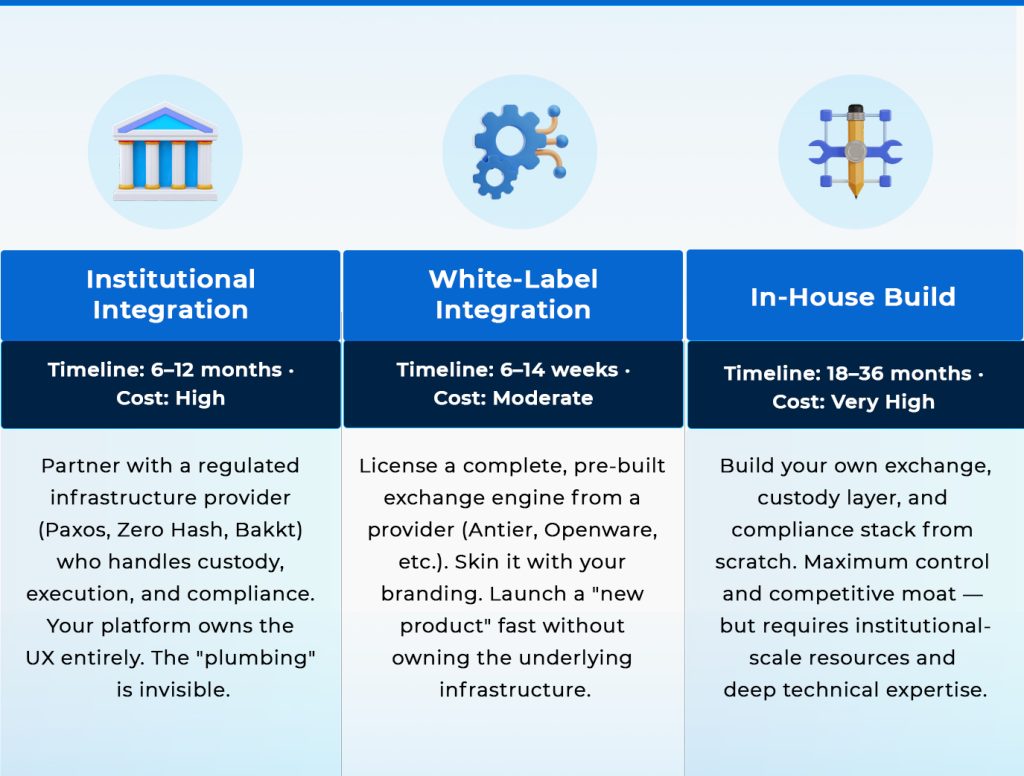
The defining characteristic of institutional integration is invisibility. When a Schwab client buys Bitcoin, they see the Schwab interface, their confirmation, and their account balance update. Paxos, the OCC-regulated provider handling actual trade execution and sub-custody, is never mentioned, and the customer experience is indistinguishable from buying a stock.
The brokerage builds its own UI from scratch, connects to the partner’s execution and custody rails via API, and owns everything the client sees and experiences. The partner still owns private key management, order routing, regulatory capital, and blockchain settlement in this API-deep infrastructure partnership.
This way, the brokerage can also dodge the licensing requirements, just like Interactive Brokers did by connecting to ZeroHash, which holds regulatory approvals across EEA jurisdictions. Interactive Brokers was therefore able to launch EU-wide spot crypto trading through the Irish affiliate without separately acquiring any licensing in each country. What could have taken years to build in-house and get licensing for was inherited through a single partnership. This operational efficiency achieved through outsourcing the custody, which is quite expensive, enabled them to offer a competitive fee structure (12-18 bps).
Crypto Trading Launch Path 2: White Label Crypto Exchange
White label cryptocurrency exchange development is the fastest route from decision to launch. Providers like Zero Hash, Bakkt, and Antier offer ready-to-deploy exchange products, including liquidity sourcing, order books, KYC/AML workflows, custody, regulatory coverage, etc.
MoneyLion connected to ZeroHash APIs and surfaced 20+ tradeable assets inside its existing mobile banking app. From the users’ perspective, it looks like a MoneyLion feature while ZeroHash handles liquidity, custody, and regulatory complexity. Public.com launched crypto trading under its “no-commission” brand identity, wherein it absorbed the spread. Economics still flows through the white label exchange provider. Alinea Invest leverages white label rails to build crypto stacks, the themed baskets of crypto assets designed for Gen Z investors who want exposure to a theme, not a coin. Neither of these innovations requires a full-fledged crypto exchange infrastructure development.
The only trade-off in white label crypto exchange products is control and feature constraints. When the underlying infrastructure provider makes a product decision, it becomes your product decision. Also, the provider may offer extra or restricted features, which might not match your requirements. Fee structures, supported assets, wallet functionality, and API capabilities are also ultimately set by the providers. Those who want full control over their white label crypto exchange development solutions can pick Antier, as they offer complete control over the product. From its design to fee structure, asset compatibility, custody, and liquidity options, you completely own it when you build using Antier’s white label cryptocurrency exchange solutions.
This trade-off is reasonable for those considering crypto as a supporting feature. However, for those who plan to compete on crypto product depth, it becomes a ceiling.
| Topic | White Label Crypto Exchange | Institutional Crypto Trading Integration (API) |
|---|---|---|
| Key distinction | Provider supplies most of the stack and a brandable front‑end, letting you launch quickly | You integrate back‑end services (custody, settlement) from a regulated partner via APIs and build your own front‑end. |
| Who builds the UI? | The provider applies your logo and colours to a pre‑built interface. | The front‑end is built entirely in‑house or by a crypto exchange development company from scratch (using APIs to connect back‑end services). |
| Who owns the back‑end? | The provider bundles and operates the liquidity, custody, and compliance. | A regulated partner (e.g., Paxos, ZeroHash) that you connect via API handles custody, settlement, and compliance services. |
| Product experience | Feels like a separate “crypto product” sitting inside your platform (branded module). | Indistinguishable from your existing platform, as crypto appears as another native asset class in your UX. |
| Customisation ceiling | Limited. It is constrained to the features and UI that the provider supports unless you pay for custom work. | Full. Any feature is possible, constrained mainly by your development resources and compliance requirements. |
| Compliance & custody | Bundled. You inherit the provider’s licences and custody arrangements (reduced regulatory burden). | Outsourced to a regulated partner. The partner holds custody/keys and performs KYC/AML; you do not hold the keys directly. |
| Launch timeline | 6-14 weeks Typical vendor marketing range for white‑label deployments. | 6–12 months Typical custom build & compliance integration timeframe. |
| Real‑world example | MoneyLion, Public.com, Alinea Invest (embedded/white‑label or vendor‑powered examples). | Charles Schwab (Paxos), Interactive Brokers (ZeroHash integrations) are examples of API/regulatory partner models zerohash. |
| Best for | Fast validation Add crypto as a feature line and test market demand quickly. | Platform evolution Treat crypto as a native, invisible asset class with deep UX and product control. |
Crypto Trading Launch Path 3: Custom Build
Fidelity Digital Assets is arguably the most significant crypto exchange infrastructure built in institutional crypto history. Fidelity began building its own custody and trading infrastructure years before most of its competitors acknowledged that crypto was relevant to their business. As stated above, they launched a quantum-ready custody system serving retail and institutional clients, which is a competitive moat that cannot be easily replicated.
Robinhood, on the other hand, launched crypto to enhance its product breadth. With 25+ tokens, native staking, a self-custody wallet, and Arbitrium and Base network support, Robinhood built capabilities while controlling everything from order routing to wallet infra and blockchain node operation.
Any infrastructure provider picking this crypto exchange development path must learn that it requires 12-24 months of focused engineering, a $100k+ capital investment, and regulatory expertise over every jurisdiction you wish to operate in.
Brokerages can either go for in-house custom crypto infrastructure development or partner with a reliable crypto exchange development company.
| Topic | In-house build | Crypto exchange development partner |
| Who does the work? | Your own engineers, recruited and managed internally across every layer, including exchange engine, custody, compliance, DevOps | A specialist firm with pre-built crypto expertise, including blockchain engineers, security auditors, and compliance architects already on staff |
| IP ownership | 100% yours Every line of code is a proprietary asset you fully control | Negotiable Most firms offer full source code ownership post-delivery. One must confirm this in the contract |
| Time to launch | 18-36 months Hiring, onboarding, and building from first principles takes years | 3-9 months Leverages existing frameworks, prior builds, and a team that has done this before |
| Upfront cost | Very high Salaries, benefits, tooling, security infrastructure, and regulatory licensing, which easily cost $5M-$20M+ | Moderate Fixed project fee or milestone-based billing, which typically totals anywhere around $500K-$3M, depending on scope |
| Ongoing cost | Full internal team on payroll indefinitely Headcount scales with product complexity | Retainer for maintenance, updates, and support Or hand off to your internal team post-launch |
| Domain expertise | Must be hired from scratch, blockchain, DeFi, and crypto security talent is scarce and expensive | Already embedded The partner has built white label exchange infrastructure before and carries institutional knowledge you can’t replicate quickly |
| Customisation | Unlimited You build exactly what you want, to your exact specification, with no external constraints | Very high A good development partner builds to your specifications, not as per their template or white label exchange. |
| Security & audits | You hire your own security team and commission third-party audits independently | Reputable partners come with security audit experience and established relationships with audit firms (CertiK, Halborn, etc.) |
| Regulatory risk | Entirely your responsibility You must navigate BitLicense, MiCA, MSB registration, and custody rules yourself. | A partner with prior brokerage experience understands the regulatory surface and can build a compliance-ready white label crypto exchange architecture from day one. |
| Scalability control | Full You architect for your exact scale targets and own all infrastructure decisions | High But dependent on the partner’s architecture decisions, which you can always control. |
| Key risk | Talent & time Losing key engineers mid-build, or underestimating crypto-specific complexity such as mempool management, key sharding, chain re-orgs, etc., might impact crypto exchange development quality. | Vendor dependency Choosing a partner without verifiable prior work, or without a clear post-delivery handoff and maintenance plan, can result in major shake-ups. |
| Best for | Firms with Fidelity- or Robinhood-scale resources, a multi-year runway, and a strategic mandate to own crypto infrastructure as a core business asset | Brokerages that want a fully custom, proprietary exchange without the hiring overhead and timeline risk of building from first principles |
The Bottom Line
There’s no universally correct crypto exchange development infrastructure path for brokerages or traditional financial institutions. Any path you choose must align with your timeline, capital position, client expectations, and long-term product ambitions.
Waiting for the perfect path or a white label crypto exchange software provider is no longer an option, as crypto is no longer optional. Institutions are already competitive on time-to-market, fees, UX, features/depth, etc. So, don’t wait for more major players to complete their complex rollouts and reset the client expectations. Instead, integrate a feature-rich, regulation-ready, and well-audited white label cryptocurrency exchange software that gives you control, the latest features, security, and regulatory compliance.
Antier offers the best white label crypto exchange solutions trusted by top-notch brokerages, traditional banks, and other financial institutions. In its 10+ years of blockchain development experience, they have delivered more than 250 crypto deployments. If you’re one of those planning your crypto expansion, Antier has got the legal, technical, and marketing expertise you require. Connect with subject matter experts today to share your requirements.
Frequently Asked Questions
01. What is Schwab Crypto and when was it launched?
Schwab Crypto is a service launched by Charles Schwab that allows clients to trade Bitcoin and Ethereum directly within the same dashboard where they manage other investments. It was launched in April 2026.
02. Why are US brokerage clients demanding spot crypto trading now?
US brokerage clients are demanding spot crypto trading to reduce friction caused by switching between different apps for crypto transactions. By integrating crypto trading into their existing platforms, brokerages aim to prevent "app leakage" and keep client assets consolidated.
03. How do the trading fees for Schwab Crypto compare to other brokerages?
Schwab Crypto charges a trading fee of 50 basis points (0.50%), which is competitive compared to other brokerages like Interactive Brokers, which has also launched similar services.