



✨ AI Summary
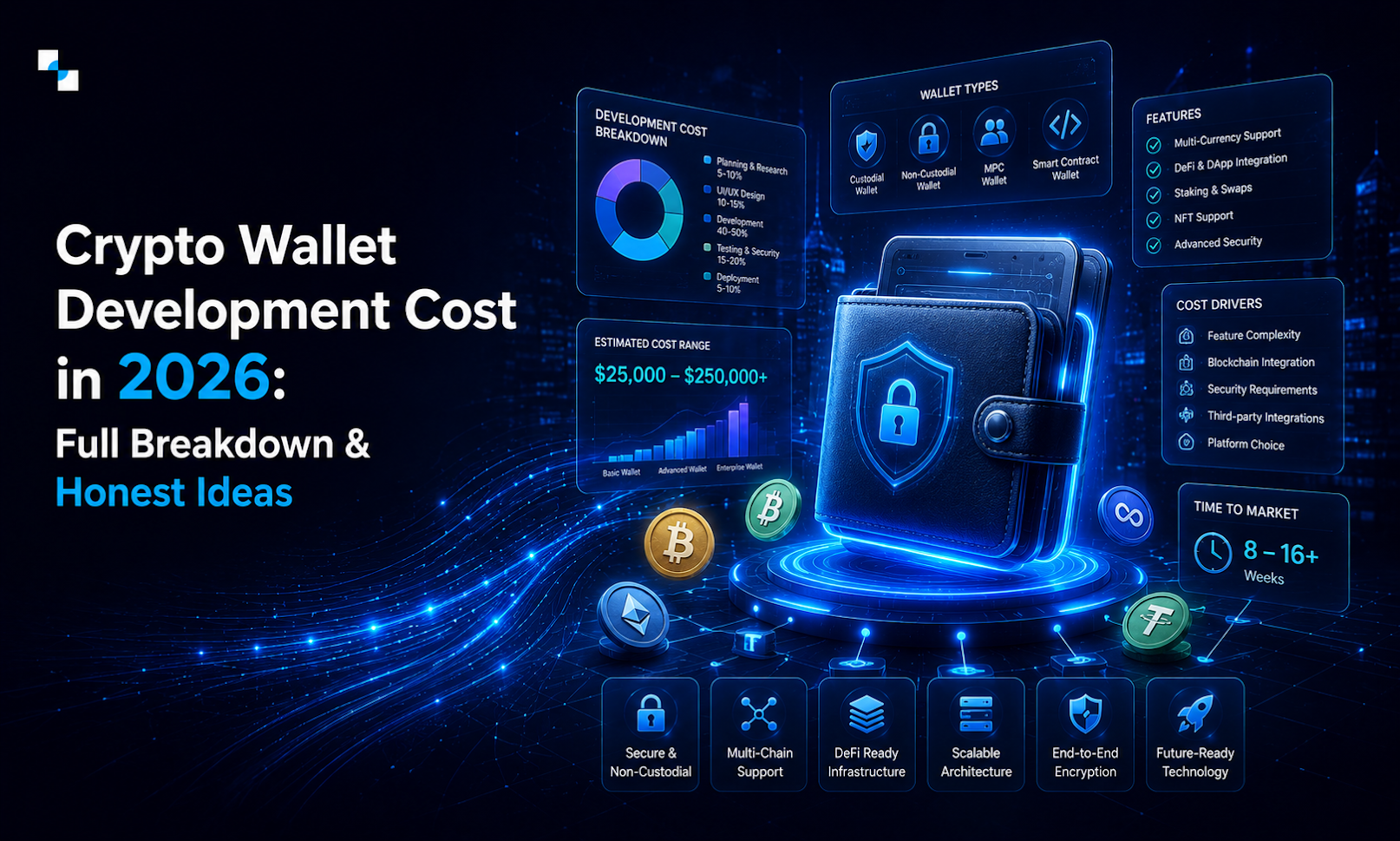
- This blog post is a comprehensive guide on the costs involved in developing a crypto wallet, ranging from $50,000 to over $500,000 in 2026.
- The post details the factors influencing these costs, including wallet complexity, engineering rates, development phases, blockchain setup, and security compliance.
- It highlights the significance of understanding these components to prevent budget overruns and ensure the wallet meets user expectations and regulatory requirements.
- Key cost drivers such as wallet type (custodial vs non-custodial), security architecture, blockchain integration complexity, regulatory compliance requirements, and development approach (custom, white label, or clone scripts) are discussed.
- The blog also provides an accurate cost estimation framework for different wallet types and offers strategies to reduce costs without compromising security.
Crypto wallet development costs range from $50,000 to $500,000+ in 2026, making cost transparency essential before committing resources to any project. The total cost of developing a crypto wallet includes various components such as wallet complexity, engineering rates, development phases, blockchain setup, and security compliance, which all contribute to the final budget. Understanding these factors prevents budget overruns and ensures your wallet meets both user expectations and regulatory requirements.
This guide covers development costs, hidden expenses, and optimization strategies for businesses considering cryptocurrency wallet development. Whether you’re an enterprise seeking institutional-grade custody, a fintech building consumer-facing crypto wallet apps, or an institution requiring robust security measures, this resource addresses the specific cost drivers relevant to your situation.
Direct answer: Crypto wallet development cost depends primarily on wallet type (custodial vs non-custodial), security architecture, blockchain integration complexity, regulatory compliance requirements, and whether you pursue custom development, white label solutions, or clone scripts.
By the end of this guide, you will gain:
- Accurate cost estimation frameworks for different wallet types
- Understanding of the seven factors that move development pricing
- Clear comparison between custom, white-label, and clone approaches
- Identification of hidden costs most quotes miss
- Actionable strategies to reduce costs without compromising security
Understanding Crypto Wallet Types and Their Cost Impact
Are you wondering “how much does it cost to build a crypto wallet?” Well, the wallet type you choose determines the foundation of your entire development budget. Developing a cryptocurrency wallet involves creating a secure interface to manage blockchain private keys, enabling users to store, send, and receive digital assets, but how you implement that interface varies dramatically in cost and complexity.
Wallet type selection is the primary cost driver because it dictates your security architecture, compliance obligations, and infrastructure requirements before a single line of code is written.
Custodial vs Non-Custodial Wallets
Custodial wallets store and manage private keys on behalf of users, simplifying the user experience but dramatically increasing your compliance and security burden. Non-custodial wallets give users complete control over their seed phrases and keys, shifting complexity to the user while reducing your ongoing custody liability.
The cost difference is substantial. Custodial solutions require KYC/AML implementation, transaction monitoring systems, and often regulatory licensing that can cost €250,000–€500,000 in jurisdictions like Germany under MiCA regulations. Annual compliance costs for larger custodial entities run $2–6 million or more when you factor in surety bonds, audits, and dedicated compliance staff. Non-custodial wallets reduce these ongoing costs but require more sophisticated UX design for seed phrases, secure enclaves integration, and key management systems that users can actually understand and use safely.
Mobile, Web, and Desktop Wallets
Platform choice affects both development cost and security implementation. Mobile wallet app development for iOS and Android requires native development to properly integrate biometric authentication, secure enclaves, and device-specific security features.
Cross-platform frameworks like React Native or Flutter can reduce costs by 30–40%, but often require platform-specific modules for cryptographic operations. Web wallets and browser extensions introduce additional security hardening requirements against XSS attacks and phishing- implementing phishing-resistant cues is an essential part of UI/UX security in crypto wallet development. Desktop wallets may require deeper OS integration and more extensive QA testing, adding to development timelines and costs.
Enterprise vs Consumer Wallets
Consumer crypto wallet apps benefit from simpler trust models, more forgiving service level agreements, and lower transaction volumes. Enterprise wallets demand an entirely different feature set that can triple development costs.
Multi-signature (multisig) functionality can remove single points of failure in crypto wallets, particularly for treasury or high-value wallets. Enterprise requirements also include audit trails, role-based access control, chain of custody documentation, and separation between hot crypto wallets, warm storage, and cold wallets with hardware security module integration.
Institutions often require SOC-2 compliance or equivalent certifications, external security audits, and substantial insurance coverage, all of which add high costs beyond the core features.
What Actually Determines Crypto Wallet Development Cost?
Development costs for cryptocurrency wallets increase significantly with app complexity; a basic crypto wallet is cheaper to build than a multi-chain wallet with advanced features like staking and security measures. Seven critical factors determine where your project lands on the $50,000 to $500,000+ spectrum.
Security Architecture and Implementation
Security implementation is where enterprise wallets diverge most dramatically from consumer products. Key management in crypto wallets should never store private keys or seed phrases in plaintext and should utilize secure, encrypted storage mechanisms.
Multi-signature vs MPC: Traditional multisig requires smart contract deployment and exposes signer sets publicly on-chain. Multi-Party Computation (MPC) technology can enhance wallet security by splitting private keys into encrypted shares, reducing the risk of single points of failure without the on-chain overhead.
Hardware security modules (HSMs) meeting FIPS 140-2/3 standards are non-negotiable for custodial services storing significant crypto assets. Implementing strong encryption methods is essential for protecting private keys and sensitive user data in crypto wallets. Testing for vulnerabilities in crypto wallet development often includes conducting extensive security audits, such as penetration testing. These audits cost $15,000–$100,000+, depending on the complexity of your smart contracts and wallet logic.
Blockchain Integration Complexity
Blockchain integration in a cryptocurrency wallet includes connecting the backend to specific blockchains using nodes or APIs to track balances and broadcast transactions. Single-chain support (Ethereum only) represents the lowest complexity baseline.
Adding Bitcoin, Solana, Polygon, or other major blockchain networks requires different SDKs, fee mechanisms, addressing formats, and confirmation models. Each additional chain typically adds $5,000–$20,000 in development cost. Cross-chain swaps, DEX aggregator integration, and bridging features increase both implementation effort and ongoing maintenance requirements as protocols evolve.
Advanced Features and DeFi Integration
Advanced wallet features impact pricing dramatically:
- Staking: Staking features in crypto wallets enable users to earn rewards by holding specific cryptocurrencies, adding an investment aspect to wallet functionality. Budget $15,000–$40,000 per major protocol integration.
- NFT support: Building NFT crypto wallets requires metadata resolution, display UI for digital collectibles, and verification across multiple token standards. Expect $10,000–$30,000.
- Instant swap and buy: Instant swap and buy features allow users to exchange digital assets and purchase cryptocurrencies directly within the wallet, simplifying the user onboarding process for new users. Fiat on-ramp and off-ramp integration adds $8,000–$20,000 in development costs plus ongoing transaction fees.
Defi crypto wallets connecting to yield farming protocols and decentralized exchange integration require extensive smart contract interaction capabilities and add substantial testing requirements.
Compliance and Regulatory Requirements
Regulatory compliance costs are frequently underestimated. MiCA compliance in the EU requires capital thresholds of €50,000–€150,000 depending on service class, plus governance structures and professional requirements.
AML/KYT tools like Chainalysis cost $100,000–$500,000 annually for enterprise-grade global coverage. Compliance checks require integration with third-party services for PEP/sanctions screening and travel rule compliance. Legal counsel for licensing, terms of service, and privacy policies can run $50,000–$200,000 for initial filing and compliance program setup alone.
User Interface and Experience Design
A personalized dashboard allows users to view their portfolios, track transactions, and monitor the market, enhancing user experience in crypto wallets. Custom UI/UX design runs $30,000–$70,000 for enterprise-grade interfaces with user onboarding flows, accessibility features, and responsive design.
Template-based approaches reduce this to $3,000–$8,000 but limit differentiation. Multi-language localization, fraud-prevention features, and support materials add to design and development time.
Third-Party Integrations and APIs
Integration with payment gateways, market data APIs, push notification services, and analytics platforms adds both development and ongoing operational costs. Each integration requires testing, maintenance, and monitoring.
Node infrastructure decisions matter significantly. Operating your own nodes versus using providers like Alchemy, Infura, or QuickNode affects costs based on chains supported, traffic volume, and SLA requirements. Handling forks and chain upgrades must be built into your operational process.
Development Team Structure and Location
Hourly rates vary dramatically by geography. US/Canada/Western Europe blockchain engineers command $80–$200+/hour. Eastern Europe runs $40–$70/hour. South Asia and Southeast Asia offer lower rates but introduce quality and communication variables.
In-house teams provide control but incur fixed costs for hiring, benefits, and infrastructure. Outsourced or hybrid models offer flexibility but may add oversight and coordination expenses.
Custom Build vs White-Label vs Clone: The Real Cost Comparison
| Factor | Custom Development | White Label | Clone Script |
|---|---|---|---|
| Upfront Cost | $200,000–$500,000+ | $30,000–$80,000 | $500–$10,000 |
| Timeline | 9–15 months | 2–4 months | Days to weeks |
| Customization | Complete control | Moderate | Minimal |
| Security | Audited, enterprise-grade | Vendor-dependent | Unaudited |
| Compliance | Built-in | May require adaptation | Non-existent |
| Long-term ROI | Highest | Moderate | Negative |
| Risk Level | Lowest | Low-Medium | Extreme |
Over three years, the total cost of ownership often favors custom development despite higher upfront investment, particularly for businesses handling significant funds or operating in regulated markets.
Let’s Understand Both The Aspects:
1. Custom Crypto Wallet Development
Custom crypto wallet development provides full control over architecture, security model, and compliance frameworks. You own the codebase, can implement industry-leading security protocols exactly as needed, and build for your specific business needs. Secure generation and storage of private keys in wallets can be achieved using HD (Hierarchical Deterministic) wallet standards (BIP-32/44) for seed phrases; custom development lets you implement this exactly to your specifications.
Higher upfront costs yield better long-term scalability, easier regulatory adaptation, and genuine competitive differentiation in the market.
2. White-Label Wallet Solutions
White label crypto wallet solutions allow businesses to launch their own branded crypto wallet quickly, leveraging existing technology to reduce development time. These solutions typically offer customizable features, enabling businesses to tailor the wallet’s interface and functionalities to align with their brand identity. White label wallets can support multiple cryptocurrencies and tokens, providing users with a comprehensive platform for managing their digital assets. Monthly subscriptions typically run $3,000–$15,000 after initial setup.
The tradeoff: constraints on customization depth and dependence on your vendor for security updates and regular updates to address emerging threats.
Contact & Get The Crypto Wallet App Price Estimation As Per Your Customization
Clone Script Deployment
Clone scripts offer the lowest upfront cost but represent the highest long-term risk. Limited customization capabilities mean you cannot differentiate your product, and potential security vulnerabilities are baked into code you don’t fully understand.
The Hidden Cost of Clone Scripts: Why $500 Can Cost You Millions?
The $500 clone trap is devastatingly simple: unaudited code, no compliance framework, no dedicated support team, and one exploit can cost millions. Studies show unauthorized forks amplify vulnerabilities, and clone scripts rarely receive the continuous updates to software and libraries necessary to address new threats and vulnerabilities in crypto wallet development.
Recovery costs from security breaches in clone-based wallets average $4.45 million. Add regulatory fines, legal liability, user compensation, and reputational destruction, and that $500 “bargain” becomes catastrophic.
Quality development from experienced partners isn’t just higher cost—it’s risk mitigation for your users’ assets and your business’s survival.
Hidden Costs of Crypto Wallet Development That Most Quotes Miss
Many quotes focus only on initial development, omitting expenses that can double your total budget over time.
Ongoing Security and Compliance Costs
Regular security audits and vulnerability assessments are critical for maintaining the integrity and security of crypto wallets over time. Budget for annual penetration testing, code audits, and bug bounty programs. Compliance monitoring requires adapting to evolving regulations; MiCA enforcement deadlines, VASP licensing changes, and updated AML requirements all demand ongoing attention and expense.
Infrastructure and Operational Expenses
Cloud hosting, CDN services, database management, and disaster recovery systems accumulate high monthly costs. Node provider fees scale with usage and chains supported. Multi-currency wallets can support a wide range of cryptocurrencies, allowing users to manage various digital assets in one place, but the integration of multi-currency support in wallets often requires handling different blockchain protocols and transaction methods, which can increase development complexity and costs.
Maintenance and Updates
Bug fixes, feature updates, and blockchain protocol upgrade adaptations require ongoing development resources. Secure Software Development Lifecycle (SDLC) practices integrate security from the early stages of development and must continue throughout the product lifecycle. Customer support, documentation updates, and user training materials scale with your user base.
Legal and Insurance Costs
Legal compliance reviews, insurance premiums for cyber risk and crime coverage, and liability protection represent substantial ongoing expenses. Patent searches, trademark registration, and intellectual property protection add further costs. For custodial services, insurance policies can cost hundreds of thousands annually, depending on assets under management.
How to Reduce Crypto Wallet Development Cost Without Cutting Corners?
Strategic approaches optimize development costs while maintaining security layers and compliance standards.
Phased Development Approach
MVP development focusing on core features first reduces initial capital requirements while validating market fit. Launch with essential transaction signing, balance tracking, and secure key management, then iterate based on user feedback.
This approach lets you allocate resources to additional features that users actually want rather than building everything up front.
Open Source and Proven Technologies
Leveraging established frameworks, libraries, and security standards reduces development time without reinventing tested solutions. Building on proven blockchain SDKs accelerates development while maintaining security.
The key: audit any open-source code thoroughly before integration, and maintain a strong security review pipeline. Encryption and security measures such as two-factor authentication (2FA) and biometric authentication are crucial for secure wallet development—use proven implementations rather than custom cryptography.
Strategic Partner Selection
Choosing development partners with blockchain expertise and enterprise experience provides value beyond code delivery. Partners with regulatory knowledge can navigate compliance requirements efficiently, avoiding costly missteps.
Working with experienced companies ensures quality assurance, compliance readiness, and access to lessons learned across multiple projects.
Automated Testing and CI/CD Implementation
Automated testing reduces manual QA costs and catches issues earlier in development when fixes are cheaper. Continuous integration and continuous deployment pipelines accelerate iteration while maintaining code quality.
Long-term cost savings compound as your codebase grows and you need to ship regular updates safely.
Conclusion and Next Steps
Crypto wallet development costs vary significantly based on wallet type, security requirements, compliance obligations, and development approach. The range from $50,000 to $500,000+ reflects the difference between a basic crypto wallet for a single chain and enterprise-grade institutional custody platforms with full regulatory compliance.
Immediate actionable steps:
- Define your requirements clearly- wallet type, target chains, features, and compliance needs
- Evaluate development approaches: custom build for maximum control, white-label for speed to market
- Select qualified partners with blockchain expertise and enterprise security experience
- Budget for ongoing costs beyond initial development
For businesses building in the digital assets space, related topics worth exploring include RWA tokenization platforms, DeFi integration strategies, and enterprise blockchain solutions that can extend your wallet’s capabilities over time.
Frequently Asked Questions
01. What is the estimated cost range for developing a crypto wallet in 2026?
The estimated cost range for developing a crypto wallet in 2026 is between $50,000 and $500,000+.
02. What factors influence the cost of developing a cryptocurrency wallet?
The cost of developing a cryptocurrency wallet is influenced by wallet type (custodial vs non-custodial), security architecture, blockchain integration complexity, regulatory compliance requirements, and the choice between custom development, white label solutions, or clone scripts.
03. What are some strategies to reduce crypto wallet development costs?
Strategies to reduce crypto wallet development costs include understanding hidden expenses, choosing the right wallet type, and comparing custom, white-label, and clone approaches without compromising security.