




AI Summary
Building a production-grade crypto exchange in 2026 costs between $40k – $1M and takes anywhere from 3-9 months for a custom build. Crypto exchange development requires integrating a matching engine, multi-signature wallet infrastructure, liquidity layer, and full KYC/AML compliance from day 1.
Crypto exchanges are no longer limited to trading interfaces. They’re becoming liquidity hubs, derivatives trading venues, custody layers, yield platforms, community engagement spots, and all-in-one fintech ecosystems. This guide covers everything from architecture and cost to compliance and launch strategy for 2026 and beyond.
Essential Features of Cryptocurrency Exchange Software in 2026
If you’re planning to build a crypto exchange app in 2026, you should not be focusing on being feature-rich, but ecosystem-centric. Spot-only or buy/sell crypto exchanges were long dead.
A modern-day competitive digital asset exchange should therefore be a safe place to trade, a licensed financial institution, a Web3 gateway, and an AI-assisted wealth manager.
Here’s an updated breakdown of features for those considering cryptocurrency exchange development:
1. The Must-Have Features
- Order Book and Matching Engine: This is a foundational layer. Every other advanced setup for matching or order execution sits on this layer.
- High TPS Matching Engine: Enable 1M+ transactions per second with microsecond latency.
- Proof of Reserves & Liabilities: Integrate real-time, on-chain dashboards so users can verify exchange solvency
- Unified Account Margin: Enable trading for spot, futures, and options using a single collateral pool.
- Advanced Order Types: Move beyond limit/stop and include TWAP, VWAP, and Iceberg orders
2. Compliance and Security
- Licensing and Regulatory Framework: VASP/MSB licensing, jurisdiction-specific compliance, geo-based access controls, and GDPR-equivalent data protection are baseline requirements.
- Adaptive KYC/AML: Implement AI-driven, geofencing-enabled onboarding that adjusts requirements based on the user’s jurisdiction and risk score.
- Travel Rule Integration: Support automatic sharing of originator/beneficiary information for cross-platform transfers.
- Proof of Solvency: Allow regulators to audit the cryptocurrency exchange’s health without exposing sensitive user data.
- Passkey and Biometric Auth: Ditch SMS 2FAs and embrace FIDO2/Web3Auth standards with FaceID and Yubikeys.
3. Web3 and DeFi Integration
- Cross-Chain Bridge Aggregator: Deploy built-in tools to move assets across L1s, L2s, and other asset classes.
- Multi-Currency Wallet Infrastructure: Hot/cold wallet segregation, multi-signature authorization, and MPC-based custody are the structural layers for all Web3 and DeFi integrations.
- CEX-DEX Hybrid Trading: Build a DeFi wallet for your CEX and support other self-custody wallets
- Yield Aggregator: Integrate a one-click interface to deposit assets into external DeFi protocols or build staking, lending, and borrowing inside your crypto exchange app development.
- Account Abstraction (ERC-4337) Wallet: Enable gasless transactions and account recovery via Gmail, iCloud, or FaceID.
- Intent-Based Trading: Let users state the outcome while solvers find and execute the path.
4. Modern Trading Instruments
- Real-World Assets: Facilitate trading of tokenized stocks, T-bills, real estate, and other credible assets.
- Liquidity as a Service: Allow institutions to provide liquidity to the exchange’s internal pools for a fair share of fees.
- Prediction Markets: Don’t force people to trade impact on assets; enable direct betting on real-world events.
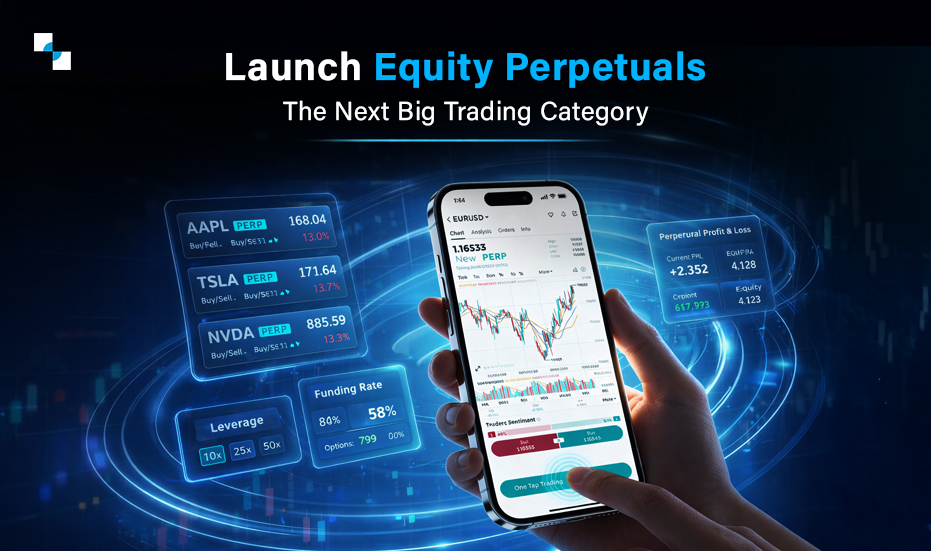
- Perpetual Trading: Top 10 perp exchanges processed $92.9 trillion in trading volumes, surpassing spot. Enable perpetual futures trading for crypto, equities, other RWAs, outcome contracts, etc., to capture the massive liquidity.
- Liquidity & market depth layer: Market maker integrations, external liquidity aggregation from tier-1 venues, and spread optimization are prerequisites for modern-day crypto exchange software development. Modern instruments like RWAs and prediction markets are illiquid without an active depth layer underneath them.
5. AI and Automation
- AI Trading Copilot: Integrate a chat-based assistant that can execute trades and abstract the complex blockchain processes.
- Smart Risk Management: Deploy customer-facing AI that monitors a user’s portfolio, warns high-leveraged positions, and over-exposed assets.
- AI-Agent Wallet Support: Secure “Agentic Wallets” EIP 7702 that allow autonomous AI agents to spend, earn, and trade within user-defined guardrails.
6. User Retention and Lifestyle Features
- Copy Trading: Don’t stop at copy/social trading for crypto; offer copy trading for RWAs to meet the growing demand for tokenized RWAs.
- Strategy Vaults: Allow traders to subscribe to automated quant strategies & leverage advanced expertise
- Crypto Cards & Merchant Pay: Integrate cards and local payment applications, and also build payment functionality to allow everyday payments.
- Gamified Loyalty: Gamify your crypto exchange with soulbound tokens that can track user reputation or VIP status, and also grant lower fees or early access.
Crypto Exchange Software Architecture
An enterprise-grade crypto exchange is not a monolithic application but a distributed system of interdependent layers, each scalable and failure-isolated.
1. Frontend layer
- The trading interface is built on ReactJS or NextJS with WebSocket connections for real-time order book, price feed, and portfolio updates.
- Android and iOS mobile apps are developed in parallel using React Native or Flutter.
- The frontend communicates exclusively through the API gateway and never touches backend services directly.
2. Backend & microservices
- The backend is decomposed into independently deployable microservices, including user management, order management, trade history, notification, fee engine, and reporting.
- An API gateway handles routing, authentication, and rate limiting across all services.
- Horizontal scaling ensures no single service becomes a bottleneck under peak load.
3. Matching engine
- The matching engine, the core of the exchange, runs entirely in-memory for sub-millisecond order execution, maintains the order book using price-time priority logic, and processes all trade events deterministically.
- It operates as an isolated, stateless service that can be independently scaled, upgraded, or replaced without touching other layers.
4. Wallet & custody
- The wallet layer segregates hot wallets that are used for automated daily withdrawals from cold storage, which holds the majority of user funds offline.
- MPC and multi-signature authorization govern all outbound transactions above defined thresholds.
- Deposit detection, withdrawal queues, and fee estimation run as dedicated microservices within this layer.
5. Blockchain & on-chain layer
- Node infrastructure connects the crypto exchange software to every supported blockchain.
- Block listeners detect deposits, confirm transactions, and relay on-chain events back to the backend.
- For DEX and hybrid models, smart contracts handle settlement, custody, and interactions with the liquidity pool. This layer also manages cross-chain bridge relayers to support multi-chain assets.
6. APIs & integrations
- The cryptocurrency exchange exposes REST APIs for account and order management, WebSocket streams for live market data, and FIX protocol support for institutional and algorithmic traders.
- External integrations include KYC/AML providers, payment gateways, oracle price feeds, liquidity aggregators, and third-party DeFi protocols for yield and lending features.
7. Database & storage
- Order books and trade state are managed in high-throughput in-memory stores like Redis.
- Persistent trade history, user records, and audit logs live in relational databases, typically PostgreSQL.
- Time-series databases like InfluxDB or TimescaleDB handle market data and OHLCV candle storage.
- All data layers are replicated across availability zones with automated failover.
8. Security infrastructure
- Security runs as a cross-cutting layer across every component above.
- This includes DDoS mitigation at the edge, API rate limiting, Web Application Firewall (WAF), role-based access controls, end-to-end encryption, HSM-backed key management, and 24/7 anomaly detection.
- Smart contracts on DEX and hybrid exchanges undergo independent audits and formal verification before deployment.
Get A Free Consultation & Architecture Audit
Centralized vs Decentralized vs Hybrid Crypto Exchange Software: Which One To Build?
| Factor | CEX | DEX | Hybrid (HEX) |
|---|---|---|---|
| Custody Model | Full Custodial | Self-Custody (On-chain) | Shared Custody/Self-Custody |
| Order Matching | Off-chain (Database) | On-chain (AMM/Orderbook) | Off-chain High-Speed Matching+On-Chain Settlement |
| Throughput | Very-High | Chain-Limited | High |
| Settlement | Internal Ledger | On-chain (Instant) | Optimistic / ZK-Settlement |
| Transparency | Limited | Full | Partial |
| KYC/Onboarding | Mandatory (Strict) | Optional / Permissionless | Adaptive / Soulbound Identity |
| User Experience | Like a Banking App | Wallet-heavy (Friction) | Account Abstraction (No Gas) |
| Liquidity Access | Internal / Market Makers | Liquidity Pools | Cross-Chain Aggregators |
| Regulatory Risk | Max (MiCA/VARA full) | Minimal (Code-based) | Programmable Compliance |
| Best For | Institutions, retail, HFT | DeFi-native users | Perpetuals, advanced derivatives |
| Typical Cost | $200K – $1.5M+ | $50K – $250K | $200K – $750K |
How to Build Your Crypto Exchange Software in 2026?
There’s no universally accepted path to crypto exchange software development. The right methodology depends on your budget, timeline, and how much of the product you need to own.
Here are the primary approaches that cryptopreneurs use in 2026 for crypto exchange platform development.
- Custom Development:
In custom development, the crypto exchange development company designs and engineers the entire exchange stack from scratch. It includes building and putting together a matching engine, wallet infrastructure, compliance layer, and UI. This is the most resource-intensive path but gives you complete control over architecture, data, and product roadmap.
- White Label Crypto Exchange Development
A white label crypto exchange software development basically involves leveraging a prebuilt, production-ready digital asset trading infrastructure and customizing it to fit certain branding and compliance requirements. The core components, including the matching engine, custody layer, compliance modules, etc., are already built in and battle-tested. Those getting it customized usually focus on testing and go-to-market, and not the engineering part.
- Open Source Fork
Many exchange aspirants may also want to fork an established open-source exchange protocol or codebase offered by a cryptocurrency exchange software provider. It requires a lower upfront cost than a custom build but demands strong engineering capabilities to maintain, secure, and scale a prebuilt, forked codebase.
Custom Vs White Label Exchange Development Vs Open Source Fork
| Factor | Custom Crypto Exchange Development | White Label Exchange Development | Open-source fork |
|---|---|---|---|
| Timeline | 8 -18 months | 2 – 5 weeks | 2 – 8 months |
| Cost | $200K – $1M+ | $30K – $150K | $70K – $400K |
| Ownership | 100%, full | Licensed, vendor-dependent | Partial, bound by licence terms |
| Customization | Unlimited | Limited to the vendor roadmap | High, but bounded by base architecture |
| Pros | Full control, scalability, competitive advantage | Fastest launch, vendor support, lower risk | Low licence cost, transparent codebase, extensible |
| Cons | High cost, long timeline, needs a strong internal team | Vendor lock-in, limited differentiation, and ongoing fees | Security debt, maintenance burden, no vendor support |
| Best suited for | Funded teams building for long-term market position | Entrepreneurs and regional exchanges need speed | Technical teams wanting flexibility without full greenfield cost |
Cost of Crypto Exchange Development in 2026
A crypto exchange development company typically charges you for UI/UX design, order book, matching engine, backend development, custody and security, liquidity integration, compliance and licensing, etc. The exact cryptocurrency exchange development cost will depend on the development methodology, type of exchange, features, and security mechanisms you choose to build with.
The following is a basic cost and timeline estimation based on types of crypto exchange software:
| Exchange type | Estimated total cost | Time to market |
|---|---|---|
| Centralized Crypto Exchange | $300K – $1M+ | 6-18 months |
| Decentralized Exchange | $40K – $200K | 2-8 months |
| Hybrid | $150K – $500K | 4-12 months |
How Much Time Does It Take To Build a Cryptocurrency Exchange Platform?
Your crypto exchange development timeline majorly depends on the development methodology you choose.
- Weeks 1-4, Planning & architecture: At this phase, the crypto exchange software provider collaborates with the cryptopreneurs for project scoping. It further includes tech stack selection, system design documentation, infrastructure scoping, compliance mapping, etc.
- Weeks 5-16, MVP development: The crypto exchange development company then creates the minimum viable exchange with a core trading engine, wallet system, user authentication, and basic order types.
- Months 4-9, Feature expansion: During this phase, the digital asset exchange development company builds all the advanced features and complex requirements, including margin trading, staking, public APIs, mobile apps, and liquidity integrations.
- Weeks before launch, Testing & security audits: Before delivering the technology, the provider also performs load testing, penetration testing, smart contract audits (DEX), vulnerability remediation, etc.
- Launch, Deployment: The crypto exchange software provider then helps you roll out the trading and fintech venue in phases. All the monitoring systems live, and market maker agreements are activated during the final deployment.
Also Read>>> New Revenue Streams From Next-Gen Cryptocurrency Exchange Development
Build Your Blockchain-Based Commodity Exchange With Antier
Conclusion
If you’re building your cryptocurrency exchange software in 2026, you’re not building a venue where people trade but architecting the next generation of finance. It won’t alone decide where the crypto trading will take place, but will define the compliance, security, and product standards.
Key takeaways
- Ecosystem over features: The competitive cryptocurrency exchange development moat in 2026 is built through RWA access, DeFi integrations, AI tooling, and lifestyle features that keep users inside your platform.
- Architecture is the product: Your matching engine, custody model, and on-chain vs off-chain decisions define your exchange’s ceiling for throughput, compliance, and scalability. Get these right before writing a single line of feature code.
- Compliance is the foundation: VASP licensing, adaptive KYC/AML, and Travel Rule support are not post-launch checkboxes. They define which markets you can enter and how fast you can grow in them.
- Methodology determines trajectory: Custom builds give you the highest ceiling but the longest runway. White label crypto exchange gets you to market in weeks. Open-source forks sit in between with lower cost and higher engineering debt. The choice is based on your stage, not your ambition.
- Liquidity is existential: A crypto exchange software without depth is not an exchange. Market maker agreements, liquidity aggregation, and internal incentive programs are not growth levers but survival requirements from day one.
The next generation of exchanges will not look like Binance circa 2019. They will look more like an AI-native, cross-chain financial OS where users trade tokenized equities, earn yield, pay merchants, and deploy autonomous agents, all without switching platforms. The crypto exchange development teams building that infrastructure today are not chasing trends but setting them.
Antier is a full-stack crypto exchange software development company that has shipped CEX, DEX, and hybrid trading platforms across 12+ jurisdictions. From matching engine architecture to post-launch liquidity strategy, Antier builds exchanges that are engineered to scale.
Frequently Asked Questions
01. What are the essential features of cryptocurrency exchange software in 2026?
Key features include a high TPS matching engine, proof of reserves and liabilities, unified account margin for various trading types, advanced order types, and compliance with licensing and regulatory frameworks.
02. How should compliance and security be addressed in a modern crypto exchange?
Compliance and security should include adaptive KYC/AML processes, travel rule integration, proof of solvency for audits, and advanced authentication methods like passkeys and biometric authentication.
03. What role does Web3 and DeFi integration play in cryptocurrency exchanges?
Web3 and DeFi integration enables cross-chain asset movement, multi-currency wallet infrastructure, and hybrid trading options between centralized and decentralized exchanges, enhancing the overall trading ecosystem.