



✨ AI Summary
- In the world of DeFi development, the key challenge is user drop-off during onboarding.
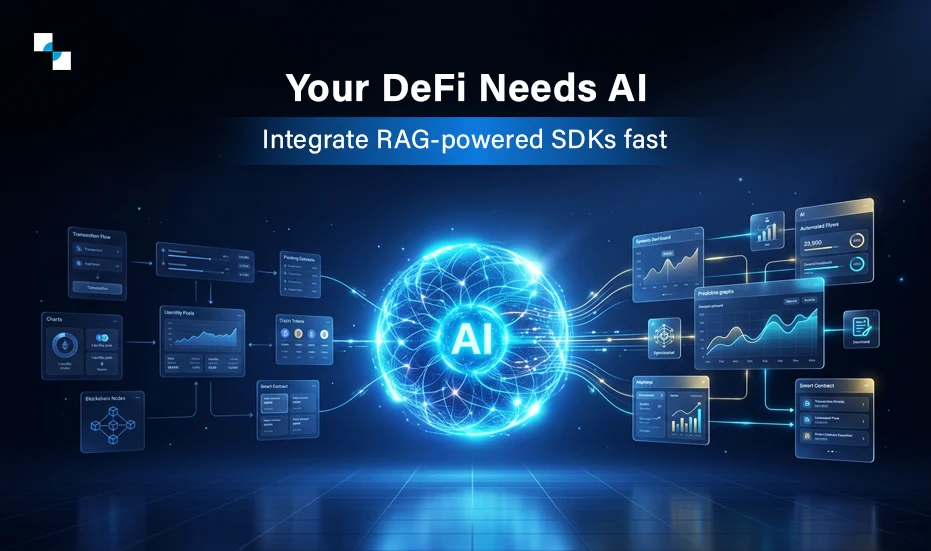
- The solution lies in implementing an intelligent "Ask AI" layer powered by RAG, which can guide users in real time and enhance activation.
- This shift from static platforms to intelligent, user-guided experiences is transforming the DeFi landscape.
- By integrating SDK-based approaches, teams can efficiently implement AI solutions without hindering their product roadmap.
- The step-by-step integration flow involves plugging in a knowledge layer, activating a retrieval mechanism, adding an AI query engine, connecting real-time data, and deploying the AI layer within the platform interface.
If you have reached this stage, you already understand the problem clearly.
- Users are dropping off during onboarding.
- Documentation is not solving it.
- And your platform still expects users to figure things out on their own.
You also understand the solution. Adding an intelligent “Ask AI” layer powered by RAG can reduce friction, guide users in real time, and improve activation. This is where modern DeFi development is evolving, from static platforms to intelligent, user-guided experiences.
Now the question is no longer what or why. It is how to implement it efficiently, without slowing down your product roadmap. This guide is designed for that exact purpose.
Why This Stage Matters in DeFi Development
Most DeFi teams reach a point where they recognize the gap between product capability and user understanding. They explore RAG in AI, evaluate its potential, and see how it can transform onboarding. But execution becomes the bottleneck.
There is uncertainty around architecture, integration, timelines, and cost. As a result, teams delay implementation. That delay has a direct impact on growth. While you evaluate, users continue to drop off. While you plan, competitors improve onboarding and retention. This is why modern DeFi development is moving toward faster, modular approaches that allow teams to integrate intelligence without rebuilding their entire system.
What You Are Actually Building
Before implementing anything, it is important to clearly understand the scope of what you are adding to your platform. You are not integrating a chatbot. You are embedding an intelligence layer into your product experience. This layer sits between your user and your protocol logic, acting as a real-time guidance system that helps users understand and act with confidence.
It is responsible for
- Understanding user intent in real time
- Retrieving protocol-specific information from structured data sources
- Combining live on-chain data with documentation and rules
- Generating accurate, contextual responses tailored to the user’s action
In practice, this means your platform is no longer just executing transactions. It is actively helping users make decisions, reducing confusion at critical moments such as onboarding, trading, or managing risk.
This is the foundation of scalable DeFi AI solutions.
When implemented correctly, this layer becomes deeply integrated into your product. It does not feel like a separate feature. Instead, it enhances every interaction, making your platform easier to understand and harder to abandon.
The Fastest Path: SDK-Based Integration
The biggest shift in modern DeFi development is the ability to integrate advanced systems through SDKs rather than building everything from scratch. Traditionally, implementing AI layers required significant time, resources, and custom infrastructure. Today, SDK-based approaches allow teams to move much faster while maintaining production-level quality. Instead of building a full RAG system internally, you can integrate a pre-built framework that connects.
- Your knowledge base and protocol data
- Retrieval infrastructure for semantic search
- AI models for response generation
- Frontend interface for seamless user interaction
This significantly reduces development complexity while still giving you control over how the system behaves within your platform. It also enables faster experimentation, allowing you to deploy an initial version quickly and improve it based on real user behavior. This is where implementing a RAG model becomes practical for real-world DeFi platforms. It allows teams to move from concept to deployment without long delays, enabling them to introduce intelligent onboarding and user guidance as part of their core product strategy.
Step-by-Step Integration Flow
To successfully integrate a RAG-powered AI layer into your platform, it is important to approach it as a structured system rather than a one-time feature addition. Each step builds on the previous one, ensuring that the final experience is accurate, responsive, and aligned with your protocol logic.
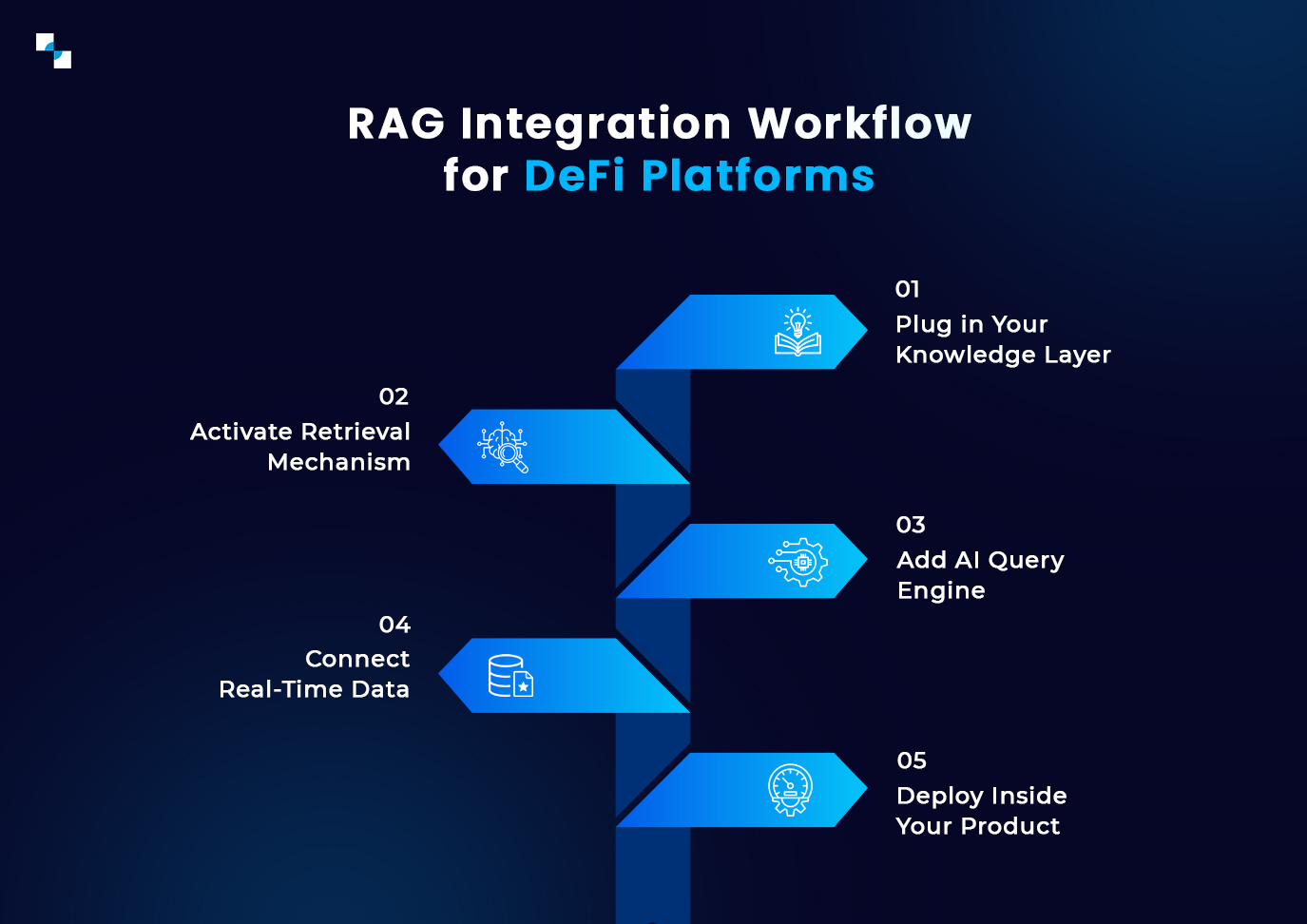
- Plug in Your Knowledge Layer
Start by connecting all relevant data sources that define how your protocol works.
- Protocol documentation
- Smart contract data
- Risk parameters
- Governance updates
At this stage, the goal is not just to collect data, but to organize it in a way that the system can understand and retrieve efficiently. This often involves structuring content into smaller, meaningful chunks and preparing it for indexing.
This ensures that your system has access to accurate, protocol-specific information, which becomes the foundation for every response it generates. Without a strong knowledge layer, even the most advanced AI will struggle to deliver reliable outputs.
- Activate Retrieval Mechanism
Once your data is structured, the next step is to make it searchable through semantic retrieval. Instead of relying on keyword matching, the system uses embeddings to understand the meaning behind user queries. This allows it to fetch the most relevant information even when questions are phrased differently or lack technical precision.
For example, a user might ask about “risk in my position” rather than “liquidation threshold,” and the system will still retrieve the correct data. This layer is critical because it ensures that the AI is always grounded in the right context before generating a response. It is the backbone of effective RAG model implementation.
- Add AI Query Engine
The AI query engine sits on top of the retrieval layer and acts as the reasoning component of the system.
It processes
- The user’s query
- Retrieved knowledge
- Contextual signals from the platform
Using this combined input, the AI generates responses that are not only accurate but also easy to understand. At this stage, it is important to align the output with your platform’s tone, rules, and user experience. The goal is to ensure that responses feel native to your product rather than generic AI outputs.
This is where RAG in AI becomes valuable, as it enables the system to produce responses that are both fluent and grounded in real data.
- Connect Real-Time Data
To make the system truly effective in DeFi environments, it must go beyond static knowledge and incorporate live data.
This includes
- Wallet state
- Market prices
- Position data
By integrating these inputs, the system can generate responses that are specific to the user’s current situation. For example, instead of explaining liquidation in general terms, the system can evaluate a user’s position and provide context-aware insights.
This transforms the system from a static knowledge tool into a dynamic decision-support layer, which is a key characteristic of advanced DeFi AI solutions.
- Deploy Inside Your Product
The final step is embedding the AI layer directly into your platform interface. This is where everything comes together from a user perspective. The AI assistant appears as a natural part of the product, allowing users to ask questions and receive answers without interrupting their flow.
A well-designed integration ensures that
- The assistant is easily accessible but not intrusive
- Responses are delivered instantly
- The experience feels seamless and intuitive
This reduces friction during onboarding and ongoing interactions, leading to better engagement and higher retention. In modern DeFi development, this step is what transforms a technically sound system into a user-friendly product that drives real adoption.
What Implementation Looks Like in Reality
Let’s make this more concrete. A real-world implementation typically involves
- Structuring and preparing protocol data
- Setting up retrieval and indexing systems
- Integrating AI models and orchestration layers
- Connecting real-time on-chain data pipelines
- Testing for accuracy, edge cases, and user experience
Depending on complexity, this process can take a few months. However, SDK-based approaches significantly reduce the initial deployment time, allowing you to launch faster and iterate based on real user behavior.
Get a custom integration roadmap tailored to your product
What Separates High-Performing DeFi Platforms
At this stage, the difference between average and high-performing platforms is not access to technology. Most teams today can integrate similar tools and infrastructure.
The real difference lies in how effectively that technology is implemented and experienced by users.
High-performing platforms focus on
- Speed of integration so they can launch improvements quickly and stay ahead of competitors
- Accuracy and relevance of responses to ensure users receive reliable, context-aware guidance
- Seamless user experience where AI feels like a natural part of the product, not an external add-on
They do not treat AI as an experiment. They treat it as a core product layer that directly impacts onboarding, engagement, and retention. This is where modern DeFi development solutions evolve. They move beyond backend execution and become true growth drivers that influence user behavior and platform performance.
Build vs Partner: The Real Decision
Every serious DeFi team reaches this point.
- You understand the value of RAG.
- You see the impact on onboarding and retention.
Now the decision is “Should you build internally or work with a specialized partner?”
| Factor | Build Internally | Work with a Partner |
|---|---|---|
| Control | Full control over architecture and customization | Guided control with expert frameworks |
| Expertise Required | High, requires AI, data engineering, and blockchain expertise | Minimal internal expertise required |
| Time to Market | Longer timelines due to research and development | Faster deployment with ready frameworks |
| Development Cost | High upfront investment | Optimized cost with predictable scope |
| Execution Risk | Higher risk of delays and errors | Reduced risk with proven implementation |
| Scalability | Requires internal planning and resources | Built for scalability from day one |
| Maintenance | Ongoing internal effort needed | Supported and optimized by experts |
If your team has deep expertise across AI, data systems, and blockchain, building internally can offer long-term flexibility. However, most DeFi teams operate in fast-moving environments where speed, accuracy, and reliability are critical. Delays in implementation directly impact user growth and market position.
This is why many projects choose to collaborate with an experienced DeFi development company that has already solved these challenges and can accelerate execution without compromising quality. The goal is not just to build. It is to build fast, build right, and scale with confidence.
If You Are Serious About Building This
At this stage, you likely fall into one of these categories.
- You are launching a new DeFi platform and want to integrate intelligence from the start.
- You already have a platform, but are facing onboarding and retention challenges.
- You are exploring AI integration, but need a clear execution path.
If this sounds like you, this is not just an idea—it is your next step. At Antier, we specialize in RAG-Powered DeFi Development, building high-performing platforms designed for growth and usability. We help you integrate RAG-powered SDKs in minutes, turning your product into an intelligent, user-guided experience. Ready to reduce drop-off and accelerate activation? Connect with our experts and get started today.
Frequently Asked Questions
01. What is the main issue teams face during onboarding in DeFi development?
Teams often experience user drop-off during onboarding because documentation fails to adequately guide users, leaving them to figure things out on their own.
02. How can integrating an "Ask AI" layer improve user onboarding?
An "Ask AI" layer powered by RAG can reduce friction, provide real-time guidance, and enhance user activation by helping users understand and navigate the platform more effectively.
03. What should teams focus on before implementing an AI layer in their platform?
Teams should clearly understand that they are embedding an intelligence layer that enhances user experience, rather than simply integrating a chatbot, ensuring it acts as a real-time guidance system.