




✨ AI Summary
- In a rapidly evolving crypto landscape, the integration of crypto wallets and exchanges is becoming a game-changer for investors and enterprises seeking to navigate the complexities of tokenized capital.
- Focusing on technical maturity, composability, and regulatory alignment over hype, the market now favors projects with robust engineering and auditable governance models.
- Different wallet-exchange integration patterns offer varying levels of security, compliance, and advanced features, catering to different user needs.
- Key market signals indicate the dominance of DEX aggregators, accelerated adoption of smart wallets, and growing institutional demand for custody and trading solutions.
- By launching or investing in exchange-integrated crypto wallets now, businesses can capitalize on the convergence of technical feasibility, market demand, and monetization models, setting the stage for future success in the Web3 ecosystem.
Are you prepared to back the crypto wallet app platform that will serve as the primary financial interface for tokenized capital? For investors and enterprise leaders weighing where to deploy strategic capital, the calculus is now driven by technical maturity, composability, and runway, not hype. Today’s market favors architectures built on proven protocol standards, deterministic settlement paths, and composable liquidity networks that scale securely across jurisdictions.
That makes this an inflection point: projects that marshal robust engineering, auditable governance models, and enterprise-grade operational controls will attract longer-term capital and strategic partnerships. Invest in infrastructure that is architected for durability and regulatory alignment, and you position your firm to capture the next wave of institutional flows into Web3.
Concept of Crypto Wallets & Exchanges Together
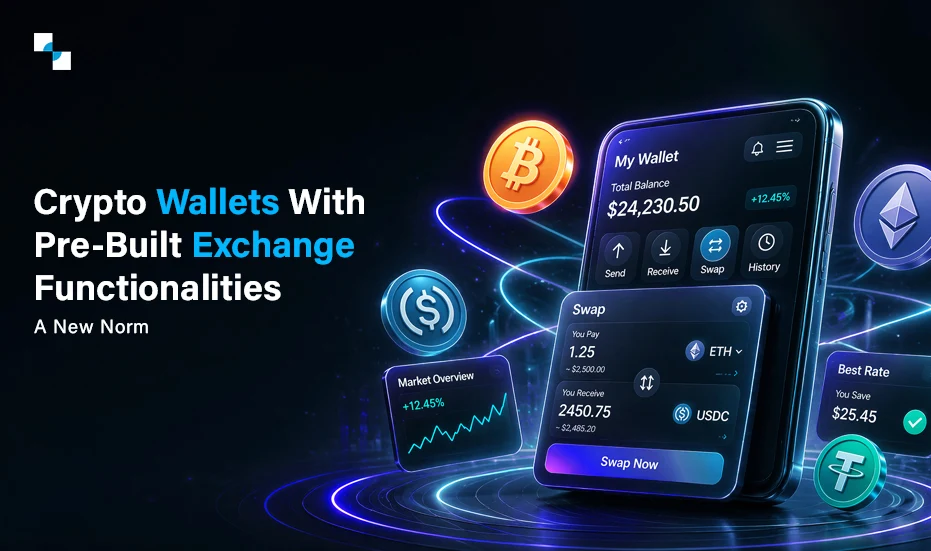
A crypto wallet with an integrated exchange bundles wallet UX (key/custody management, balances, transaction history) with trade execution and liquidity routing (fiat on-ramps, token swaps, limit orders). There are multiple patterns:
- Non-custodial + in-app DEX swaps : The cryptocurrency wallet app keeps non-custodial keys but invokes DEXs or aggregator APIs (e.g., 1inch) to execute swaps directly from the user’s wallet. This keeps self-custody while improving UX and pricing.
- Custodial wallet + exchange backend : Operator holds custody and provides full trading (order books, margin, AML/KYC). This is typical for institutional or fiat-on-ramp needs.
- Hybrid models / Smart wallets : Smart contract crypto wallets with programmable logic (account abstraction) that can route trades, batch transactions, pay gas on users’ behalf, or execute conditional orders. This pattern combines the best of both worlds, enabling advanced features.
Each pattern carries different regulatory, security, and revenue implications, which is why product design must be intentional. And to have an intentional and impactful wallet solution, you must get in touch with a crypto mobile wallet app development company specialized in crafting wallet solutions on preferred blockchain solutions, and as per your business requirements. Let us now explore the current market scenarios for a better understanding of where we are moving.
Market Signals & Evidence: Crypto Wallet Development With Exchange Is A Smart Investment
1. Aggregator dominance & better pricing : DEX aggregators (1inch, ParaSwap, Rubic, Odos, etc.) continue to be the default way to reduce slippage and MEV risk — making integration a practical necessity for any wallet offering swaps. Wallets that call aggregators consistently secure better execution for users.
2. Account abstraction adoption : Smart crypto wallets and ERC-4337 adoption have accelerated UX innovation, enabling gas abstraction, batched transactions, and programmable rules that are essential for advanced in-wallet trading experiences.
3. Custodial growth & institutional demand : The custodial wallet market projects a strong CAGR, and institutions are building custody/trading programs, signaling enterprise demand for integrated custody+trading rails (for trading desks, funds, corporate treasuries).
4. Regulatory scrutiny & product design constraints : Regulatory actions and enforcement attention toward wallet/exchange interface functions (e.g., legal scrutiny of swap/routing features) mean product teams must embed compliance controls early. This is a reason to prefer integrated (and compliant) exchange rails over ad-hoc third-party UX patches.
Pain Points
1. High friction between holding and trading : Users must move funds between their cryptocurrency wallet app solutions and exchanges, wait for confirmations, or trust third-party transfer flows. Integrated exchanges remove handoffs and speed conversion.
2. Poor routing & price slippage : Single-DEX swaps can produce bad pricing. Aggregation and smart routing inside the wallet improve execution quality.
3. Onboarding/fiat friction : Buying crypto via separate services increases drop-off. Integrated fiat rails (KYC + payment rails) lift conversions for higher-value users and enterprises.
4. Custody complexity for enterprises : Projects and funds need predictable custody, reporting, and integrated trading rails. Combined solutions reduce reconciliation and operational risk.
5. User UX & security trade-offs : Non-custodial wallets historically sacrifice convenience for security; smart wallets and account abstraction enable conveniences (meta-txs, gas sponsorship) without fully ceding custody.
Build the Next-Gen Crypto Wallet With Integrated Exchange Before It’s Too Late!
How Does an Exchange-Integrated Crypto Wallet Solve These Challenges?
- Single-flow transactions : Users sign one interaction in the wallet, and the swap or order executes without manual bridging. This cuts transfer time and reduces user errors.
- Smart routing & aggregation : Integrating DEX aggregators (or running your own aggregator) lets the wallet split trades across pools to minimize slippage and gas. This equals better realized prices for end users.
- Programmable wallets (Account Abstraction) : With ERC-4337 style smart wallets, wallets can implement pre-approved spend rules, gas sponsorship, batched orders, or deferred execution — enabling advanced features like gasless swaps and limit orders without server-side custody. That improves UX while keeping users in control.
- Compliance & optional custodian rails : For enterprise users, the integrated model can offer a custody-backed trading mode: segregated accounts, audit logs, and KYC/AML flows combined with internal liquidity — eliminating operational reconciliation between wallet and exchange.
Features of a Crypto Wallet Integrated with an Exchange
Core trading & liquidity features
- In-app token swap (single-tap).
- DEX aggregation / multi-path routing (split orders).
- Limit/stop orders & conditional executions (on-chain or hybrid).
- Cross-chain swaps and bridging (with slippage and MEV protection).
Custody & enterprise features
- Dual custody modes : non-custodial smart crypto wallets and custodial institutional accounts.
- Policy-based wallets (set spending/transfer policies by user roles or geographies).
- Threshold signature schemes (TSS) for secure key splitting beyond multisig.
- Institutional grade key recovery (integrated with custodians or insurers).
- Tokenized asset custody (support for RWAs — tokenized treasuries, real estate, commodities).
- Ledger-grade reporting dashboards (PnL, tax, compliance metrics).
On-ramp/off-ramp & compliance
- Embedded CBDC compatibility (direct settlement when CBDCs become mainstream).
- Automated tax calculation & export tools built into the wallet.
- Geo-shielded compliance (rules adapt by user location automatically).
- Regulated fiat accounts integration (virtual IBANs linked to wallet balances).
- Programmable compliance hooks (enterprises inject their own AML/KYC policies).
- Transaction monitoring and optional AML hooks.
User-experience & security
- Biometric signature approval (fingerprint/face scan for trade signing, not just login).
- Encrypted multi-device sync (use wallet seamlessly across devices).
- Context-aware security prompts (AI detects unusual behavior & warns before signing).
- Gasless cross-chain transfers (wallet handles fee optimization invisibly).
- Built-in DAO governance panel (vote directly from wallet balances).
- Wallet-as-a-superapp UX (messaging, DeFi, payments, NFTs in one streamlined hub).
Why Now Is The Right Time To Launch Or Invest?
Multiple compounding forces make 2025–2026 the inflection point for crypto wallet + exchange convergence. On one hand, infrastructure maturations, robust DEX aggregators, cross-chain routing, and account abstraction standards remove many technical restraints that previously prevented smooth in-wallet trading. On the other hand, institutional demand (custody + trading) and improved regulatory clarity in several jurisdictions are driving enterprises to seek integrated rails that reduce operational friction and compliance complexity. Simultaneously, user expectations (instant swaps, low slippage, fiat rails) set a high bar that only integrated digital wallet development solutions can meet without forcing users to hop between apps. For product leaders and enterprise buyers, this is a rare moment where technical feasibility, market demand, and monetization models align — delaying risks, higher acquisition costs,a and lost Web3 crypto wallet engagement.
Future Potential Of Web3 Crypto Wallet With Exchange
Over the next few years, cryptocurrency wallets that embed exchange capabilities will evolve from convenience layers into centralized financial experience platforms for blockchain users. Expect programmable smart wallets to enable advanced trading primitives (gasless limit orders, batched strategy execution), integrated fiat rails to turn wallets into onramps for mainstream users, and hybrid custody options to open institutional flows. With increased institutional custody services and ETFs driving more capital in, exchange-integrated crypto wallets will become the primary UX layer where users and businesses interact with tokenized assets, not just a signing tool. This repositioning will reshape monetization (swap fees, liquidity rebates, premium trading tools) and make wallets the first-touch commercial relationship between Web3 services and end customers.
This is The Time: Launch Crypto Wallet Platforms With Exchange Integration
This is a decisive moment, capital and adoption are moving fast, and integrated wallet-exchange platforms are where market leadership will be won. Investors who place conviction behind future-ready wallet infrastructure today position themselves ahead of the next wave of institutional flows and mainstream users. Act now with clarity and confidence — the market rewards builders who move first and build thoughtfully.
At Antier, we translate that conviction into execution. We design and deliver bespoke, enterprise-grade solutions and build customzied crypto wallet apps that align with your business model, compliance needs, and growth roadmap. As a trusted cryptocurrency wallet development company, our experts combine product strategy, security engineering, and regulatory-aware implementation to get you to production quickly and safely. We don’t just launch software; we collaborate with your team to ensure it scales, stays auditable, and keeps you competitively ahead in Web3. If you are ready to lead the next wave, we’re ready to build it with you.
Connect today!
Frequently Asked Questions
01. What factors should investors consider when choosing a crypto wallet app platform?
Investors should focus on technical maturity, composability, and runway, prioritizing architectures built on proven protocol standards, deterministic settlement paths, and composable liquidity networks.
02. What are the different types of crypto wallet and exchange integrations?
The main types include non-custodial wallets with in-app DEX swaps, custodial wallets with exchange backends, and hybrid models or smart wallets that utilize programmable logic for advanced features.
03. Why is it important to have an intentional product design for crypto wallets?
Intentional product design is crucial due to varying regulatory, security, and revenue implications associated with different wallet patterns, ensuring that the solution meets business requirements effectively.