




✨ AI Summary
- From ambiguity to precision, the regulation of digital assets has evolved globally, with the Dubai International Financial Centre (DIFC) leading the way in establishing a clear regime for digital assets.
- The DIFC's framework classifies tokens based on their economic and legal functions, ensuring they align with international standards.
- The DFSA oversees this regulatory architecture, embedding token regulation across various modules of its Rulebook.
- By following a functional approach, the DIFC prevents issuers from evading regulation based on token labels.
- The recognition and classification of tokens in DIFC determine their legal validity, allowing compliant tokens to access financial services and regulated markets.
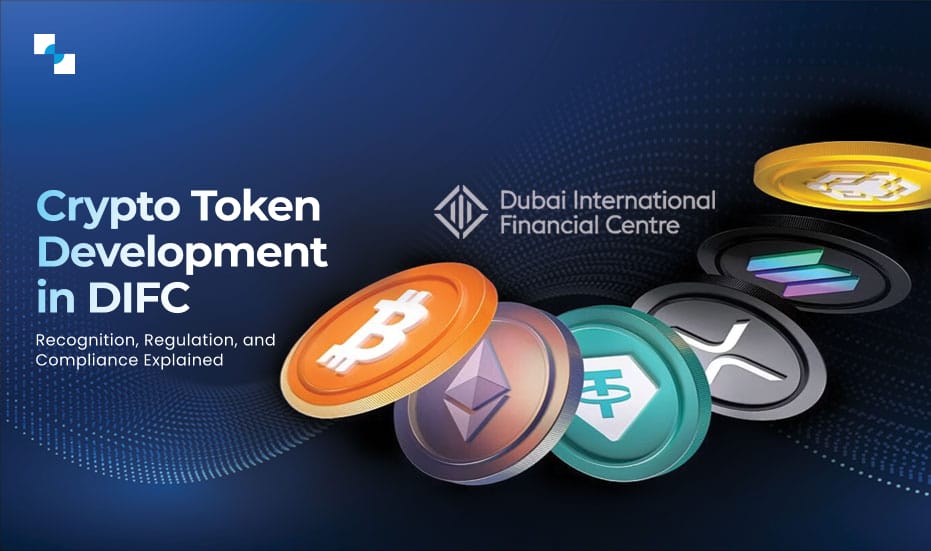
The regulation of digital assets has shifted from ambiguity to precision. Jurisdictions around the world are imposing formal rules on how tokens are classified, recognized, and integrated into financial markets. Among these jurisdictions, the Dubai International Financial Centre (DIFC) has distinguished itself by establishing a clear and enforceable regime for digital assets under the oversight of the Dubai Financial Services Authority (DFSA).
For firms engaged in crypto token development, the DIFC regime matters because it determines whether a token can lawfully participate in the financial system. Classification dictates whether the token is treated as an investment instrument, a crypto token requiring recognition, or an excluded instrument outside the perimeter.
This article provides a comprehensive legal analysis of token recognition and classification in DIFC.
Regulatory Architecture of DIFC’s Digital Assets Regime
The DFSA has embedded token regulation across several modules of its Rulebook:
- GEN (General Module): Establishes definitions of tokens, classification rules, recognition requirements, and prohibitions.
- COB (Conduct of Business Module): Governs disclosures, client assessments, and conduct rules for authorised firms dealing with crypto tokens.
- AML (Anti-Money Laundering, Counter-Terrorist Financing and Sanctions Module): Applies AML/CTF requirements comprehensively to crypto-token activities.
- CIR (Collective Investment Rules): Sets parameters for funds investing in crypto tokens.
- MKT (Markets Rules): Regulates authorised exchanges and multilateral trading facilities (MTFs) in relation to crypto-token trading.
Legal Philosophy: Substance over Form
The DIFC regime follows a functional approach. A token’s classification depends on its economic and legal function, not its label. This prevents issuers from evading regulation by branding a token as a “utility” or “membership” asset when it operates as a financial instrument.
This principle mirrors global practice. The U.S. relies on the Howey Test, the EU applies function-based categories under MiCA, and Singapore uses substance-focused classification under MAS. DIFC’s alignment ensures legal credibility and international comparability.
Statutory Definition of a Crypto Token and Its Boundaries
The DFSA’s General Module (GEN 3A.1.2) defines a Crypto Token as:
“A Token that is used, or is intended to be used, as a medium of exchange or for payment or investment purposes, and includes a right or interest in such a Token.”
Distinctions from Other Categories
- Investment Tokens: If a token replicates the rights and obligations of shares, bonds, or derivatives, it is not a crypto token but an investment token, subject to securities regulation.
Excluded Tokens: Utility tokens, NFTs, and central bank digital currencies (CBDCs) are excluded from the crypto-token framework unless they assume investment characteristics.
The boundaries matter because they determine whether a token must undergo the recognition process.
Create Compliant Crypto Tokens With Experts
Legal Taxonomy of Tokens: Investment, Crypto, and Excluded
- Investment Tokens
Defined in GEN App2, investment tokens mirror conventional securities. They include:
- Equity-like tokens conferring dividend or voting rights,
- Debt tokens replicating repayment obligations,
- Derivative tokens linked to underlying assets or indices.
Legal implications
- Issuers must comply with prospectus rules.
- Firms dealing in investment tokens require securities licences.
- Trading and custody of such tokens are subject to full DFSA oversight.
- Crypto Tokens
These Tokens are used as mediums of exchange, payment, or investment, but not securities. They include cryptocurrency and fiat-backed stablecoins.
Legal implications
- Only recognised crypto tokens may be used for financial services.
Custody, trading, and asset management activities require DFSA authorisation.
- Excluded Tokens
Excluded from recognition obligations:
- Utility tokens confined to closed ecosystems,
- NFTs representing unique ownership,
- CBDCs are issued by central banks.
If excluded tokens exhibit investment-like features, they may be reclassified into the regulated perimeter.
Recognition Requirements for Crypto Tokens under DIFC Law
Under GEN 3A.2.1, only Recognised Crypto Tokens may be used in connection with financial services, promotions, or offerings in DIFC.
Recognition Process – Major Changes Underway
- Current System: As of October 2025, DFSA maintains a list of nine recognised tokens: Bitcoin (BTC), Ethereum (ETH), Litecoin (LTC), Toncoin (TON), XRP, ZetaChain (ZETA), USDC, EURC, and Ripple (RLUSD). USDC and EURC became the first recognised stablecoins in February 2025.
- Proposed Changes (Effective 2026): The DFSA is shifting from maintaining a central recognition list to a firm-led “Suitable Crypto Token” regime for non-fiat tokens. Firms will assess and continuously monitor token suitability themselves, while fiat crypto tokens (stablecoins) remain under direct DFSA approval.
- Application for Recognition: Under the current system, tokens not on the list require a formal recognition application by an authorised firm, issuer, or developer, with a $10,000 application fee. This fee structure will be eliminated under the new framework.
Recognition Criteria
The DFSA assesses recognition applications against six principal criteria:
- Regulatory Status in Other Jurisdictions – whether the token is accepted in comparable regulatory environments.
- Liquidity and Market Depth – trading history, order book resilience, volatility analysis.
- Transparency – clarity in governance, consensus protocols, and upgrade procedures.
- Technology Adequacy – blockchain resilience, interoperability, and cybersecurity.
Risk Management – AML/CTF systems, custody standards, settlement frameworks. - Stabilisation (Stablecoins) – independently verifiable reserves, segregation of assets, redemption mechanics.
Legal Impact of Recognition
Recognition authorises the token to be used in:
- Custody arrangements by DFSA-licensed firms,
- Trading on authorised exchanges and MTFs,
- Asset management products,
- Investment advisory services.
Unrecognised tokens cannot lawfully enter these channels, regardless of market popularity.
Recent Regulatory Enhancements (June 2024 & October 2025)
The DFSA has introduced significant enhancements to its crypto token framework:
- Enhanced Custody Provisions: Authorised firms may now custody unrecognised crypto tokens under specific conditions, expanding beyond the previously restricted recognised-only approach.
- Staking Activities: Crypto token staking is now permitted with proper due diligence and risk management frameworks.
- Enhanced AML Requirements: Implementation of “travel rule” requirements for crypto token transfers, strengthening anti-money laundering compliance.
- Fund Investment Flexibility: Domestic Qualified Investor Funds can invest up to 10% in unrecognised tokens, while collective investment restrictions are proposed for removal under CP 168.
- Monthly Reporting: New monthly crypto token information returns will be mandatory via the DFSA e-portal, with fixed penalty notices for late filing.
Structure Crypto Tokens For DIFC Approval
Tokens Explicitly Excluded from DIFC’s Regulatory Perimeter
The DFSA draws two clear prohibitions that remain unchanged under current and proposed frameworks:
1. Privacy Tokens (GEN 3A.2.2)
Tokens designed to obscure transaction flows or ownership, such as Monero and Zcash, are banned. Their anonymity features prevent compliance with AML/CTF obligations.
2. Algorithmic Stablecoins (GEN 3A.2.3)
Tokens relying solely on algorithmic mechanisms to maintain value are prohibited. Their instability, highlighted by the Terra/LUNA collapse, poses systemic risks incompatible with DIFC’s standards.
Legal Implications: Public offers, promotions, and regulated activities involving these tokens are expressly unlawful.
Licensing and Incorporation Standards for Crypto-Related Activities
1. Authorisation Requirement
Under GEN 7, firms must obtain DFSA authorisation for activities involving crypto tokens, including:
- Dealing in tokens as principal or agent,
Operating exchanges or trading facilities, - Providing custody and wallet services,
- Offering advisory or asset management services.
2. Incorporation Mandate
Only firms incorporated in DIFC may obtain authorisation. Branches of foreign entities are prohibited from carrying out crypto-token business in the Centre.
Licensing Criteria
Applicants must demonstrate:
- Adequate capital and liquidity resources,
- Effective corporate governance and risk controls,
- AML/CTF compliance frameworks,
- Qualified and fit-and-proper senior management.
Client-Facing Legal Duties for Firms Dealing in Crypto Tokens
The COB Module establishes obligations toward clients:
- Financial Promotions (COB 3): Firms must not make misleading or unauthorised promotions.
Key Features Documents (COB 15.5): Detailed disclosure required for each crypto token offered. - Appropriateness Assessments (COB 15.6): Firms must test whether retail clients have the knowledge and capacity to bear risks.
- Risk Warnings: Standardised warnings must appear in all marketing and communications.
- Prohibition on Credit: Retail clients cannot use credit cards or loans to purchase crypto tokens.
These obligations reflect the DFSA’s emphasis on investor protection, particularly for retail participants.
Mandatory Anti-Money Laundering and Counter-Terrorist Financing Controls
The AML Module applies comprehensively to crypto-token activities. Authorised firms must implement:
- Customer Due Diligence (CDD): Identity verification, source of funds checks.
- Ongoing Monitoring: Continuous oversight of client transactions.
Sanctions Screening: Screening against local and international sanctions lists.
Suspicious Transaction Reporting: Mandatory reporting to the relevant authorities.
Non-compliance exposes firms to enforcement measures and reputational damage.
Limitations on Permitted Activities under the DIFC Framework
The regime imposes specific restrictions:
- Mixed Business Prohibition (GEN 3A.2.4): Firms cannot combine regulated crypto-token services with unregulated NFT or utility token businesses.
- Crowdfunding Platforms: DFSA-authorised crowdfunding operators cannot facilitate investments in crypto tokens.
- Representative Offices (GEN 2.26.1): Prohibited from promoting or marketing crypto tokens.
- Money Services Providers (GEN 3A.2.5): Limited to DFSA-recognised fiat-backed stablecoins.
These restrictions prevent regulatory arbitrage and preserve clarity in DIFC’s financial ecosystem.
Regulatory Oversight and Enforcement Powers of the DFSA
The DFSA exercises extensive supervisory authority, including:
- Notification Obligations: Firms must immediately report significant events affecting recognised tokens (GEN 11.10.21).
- Ongoing Supervision: Inspections, audits, and compliance monitoring.
- Enforcement Tools: Licence suspension, administrative fines, and public sanctions for breaches of the Rulebook.
The General Prohibition Against Misconduct (GEN 2A) applies to unauthorised or misleading activities, ensuring that unrecognised and prohibited tokens cannot infiltrate regulated markets.
DFSA’s Tokenization Regulatory Sandbox
In March 2025, the DFSA launched a Tokenization Regulatory Sandbox to support innovation in digital asset tokenisation. Selected firms can test tokenisation solutions under relaxed regulatory requirements while maintaining consumer protection standards. This initiative reinforces DIFC’s commitment to responsible innovation in the digital assets space.
Develop DIFC-compliant crypto tokens today
Structured Compliance Process for Crypto Token Development in DIFC
Given the proposed regulatory changes under CP 168, token developers should prepare for a transitional compliance framework:
Current Framework (Until Early 2026)
- Legal Classification Analysis: Determine whether the token qualifies as crypto, investment, or excluded.
- Governance and Technical Audit: Independent assessment of blockchain protocols, governance rights, and security.
- Recognition Application: Submit detailed documentation to DFSA addressing recognition criteria.
- Licensing Strategy: Apply for required DFSA licences covering custody, trading, or advisory functions.
- AML/CTF Framework: Implement CDD, monitoring, sanctions screening, and reporting mechanisms.
- Disclosure and Risk Documentation: Prepare Key Features Documents and marketing materials aligned with COB rules.
- Retail Protections: Establish processes for appropriateness assessments and investor categorisation.
- Ongoing Compliance: Maintain reporting channels with DFSA and undergo periodic supervisory reviews.
Transition Planning (2026): Prepare for the shift to firm-led suitability assessments, including internal token evaluation capabilities, website publication requirements for token lists, and enhanced monthly reporting systems. Existing recognised tokens will remain valid for a 3-month transition period before reassessment under the new framework.
Recognition and Classification as Determinants of Legal Validity in DIFC
The DIFC’s digital assets regime is structured, deliberate, and enforceable. By requiring recognition, prohibiting opaque or unstable models, and imposing strict licensing and conduct rules, the framework ensures that crypto tokens operate within a transparent, legally valid structure.
For developers and issuers, compliance is not merely advisable; it is the condition for market access. Recognition is the point at which a crypto token transitions from technical creation to legal validity. Classification defines its treatment, and authorisation governs its use.
Takeaway
In DIFC, crypto token development achieves legitimacy only when recognition, licensing, and compliance converge. That legitimacy is the foundation for institutional participation and sustainable growth in one of the world’s most respected financial jurisdictions.
Designing tokens that meet DIFC’s recognition and compliance standards calls for legal foresight, transparent governance, and regulatory fluency. At Antier, our experts integrate these dimensions, ensuring crypto token development is legally sustainable and institution-ready. Partner with our experts to launch DIFC-compliant crypto tokens.
Frequently Asked Questions
01. What is the significance of the DIFC regime for crypto token development?
The DIFC regime is crucial for crypto token development as it determines the lawful participation of tokens in the financial system, classifying them as investment instruments, recognized crypto tokens, or excluded instruments.
02. How does the DFSA regulate digital assets in the DIFC?
The DFSA regulates digital assets through several modules of its Rulebook, including definitions, classification rules, conduct of business, anti-money laundering requirements, and rules for collective investments and trading.
03. What legal philosophy underpins the DIFC's approach to token classification?
The DIFC's approach is based on a functional philosophy, where a token's classification is determined by its economic and legal function rather than its label, ensuring compliance with global regulatory practices.