




✨ AI Summary
- The blog post discusses the launch of the Unified Markets Interface (UMI) by the Reserve Bank of India, a significant step in modernizing India's financial infrastructure.
- UMI introduces a unified architecture for asset tokenization and settlement using wholesale Central Bank Digital Currency, aiming to standardize asset representation and improve liquidity in the financial market.
- The platform offers programmable settlement, tokenized assets, and integrated data access, leading to efficiency gains and increased market access.
- UMI's impact includes reduced cost of capital, expanded market participation, and data-driven risk evaluation.
- It redefines value, compliance, and settlement in India's digital financial markets, positioning India as a regional hub for tokenized capital flows.
The Reserve Bank of India’s launch of the Unified Markets Interface marks a measurable step in modernizing India’s financial infrastructure. Announced by Governor Sanjay Malhotra at the Global Fintech Fest 2025, the initiative introduces a unified architecture for asset tokenization and settlement using wholesale Central Bank Digital Currency.
Unlike earlier digital pilots, UMI is positioned as part of India’s core market infrastructure with an aim to standardize how assets are represented, transferred, and settled across institutions, creating a regulated environment for blockchain-based financial products.
How UMI Reframes India’s Financial Infrastructure?
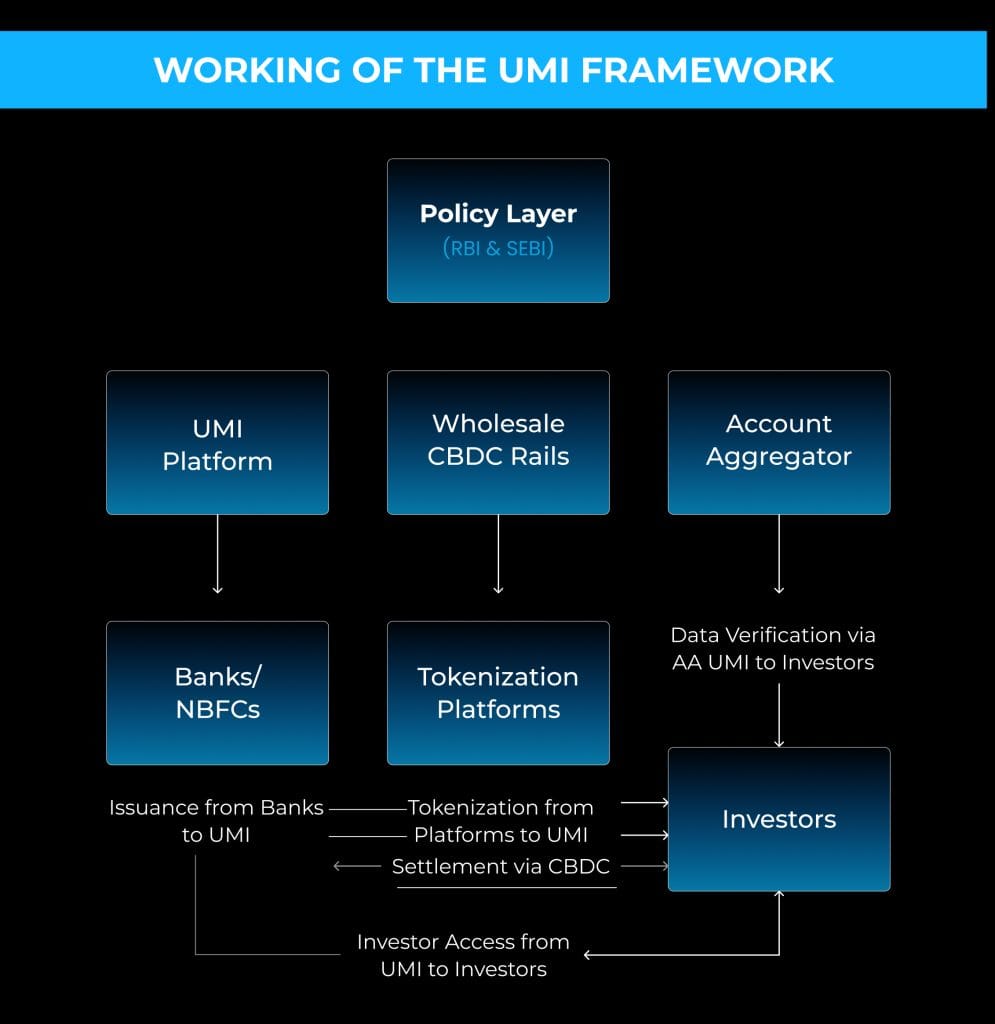
The platform’s design introduces three capabilities critical to capital market modernization:
- Programmable settlement using CBDC: Instant finality in interbank and securities transactions eliminates counterparty exposure and settlement delays.
- Tokenized representation of assets: Securities, money market instruments, and potentially physical assets can be recorded as digital tokens, improving liquidity and fractional access.
- Integrated data access via Account Aggregators: Verified financial data can be used to support tokenized credit, securitization, and structured products with transparent provenance.
This amalgamation sets the groundwork for a fully digitized financial market stack, one that combines regulatory control with market efficiency.
Market-Level Impact: Efficiency and Liquidity Creation
UMI’s pilot phase demonstrated measurable efficiency improvements in trade reconciliation and settlement cycles, according to RBI’s disclosures. These results mirror similar outcomes from Singapore’s Project Guardian and the UAE’s CBDC asset tokenization pilots, both of which cut multi-day settlement processes down to near real-time.
For India, the implications extend far beyond operational gains.
- Reduced cost of capital: Faster settlement reduces the duration of exposure and margin requirements, freeing liquidity in interbank and institutional lending.
- Expanded market access: Tokenized instruments can be fractionalized, enabling broader investor participation in high-value securities and asset pools.
- Data-driven risk evaluation: Integration with the AA network allows continuous credit assessment based on verified, real-time financial data, improving risk pricing and asset quality.
By embedding tokenization at the infrastructure level, the RBI is effectively compressing the cost and complexity of financial intermediation.
Build your Tokenization Platform aligned with RBI’s new Market Architecture!
Institutional Incentives and Competitive Realignment
- For Banks and NBFCs
UMI enables institutions to issue, manage, and settle tokenized instruments natively within a regulated ecosystem. This reduces dependence on multiple intermediaries for custody, clearing, and reconciliation. The operational and compliance savings could be substantial, especially for large issuers in government and corporate debt markets.
- For Fintech Builders
Companies engaged in the RBI tokenization platform can now align directly with a formal central bank architecture instead of operating in legal uncertainty. Integration with UMI’s API or CBDC layer will become the benchmark for credibility in institutional-grade tokenization products.
Early entrants capable of building CBDC asset tokenization platforms that interoperate with CBDC settlements, KYC standards, and AA-based verification will gain a durable competitive position as regulatory clarity sharpens.
- For Investors
Institutional and accredited investors will gain access to regulated, high-liquidity tokenized instruments, including short-term debt, commercial paper, and structured credit. Over time, this model can extend to tokenized sovereign debt, infrastructure financing, and real estate-backed securities, providing diversification with settlement assurance.
UMI’s long-term implication will anchor tokenized financial products inside the regulatory perimeter, legitimizing them as part of India’s mainstream capital markets.
Implications for the Asset Tokenization Ecosystem
The introduction of UMI redefines how value, compliance, and settlement interact in India’s digital financial markets.

Together, these changes create the first environment in India where blockchain technology can support regulated capital formation.
Strategic Positioning: India’s Advantage in the Global Context
Globally, only a handful of economies- Singapore, Switzerland, and Hong Kong have attempted tokenized securities with CBDC-backed settlement. India’s approach stands apart due to its scale and integration:
- A unified payments infrastructure (UPI) is already processing 16+ billion transactions monthly.
- A consent-based data network (AA) with over 160 million accounts.
- The ability to integrate both into a wholesale digital currency system.
This synergy positions India to become a regional hub for tokenized capital flows, linking Asian, Middle Eastern, and African markets through interoperable CBDC corridors.
For global investors, this offers a future scenario where tokenized Indian securities or asset pools could be issued, traded, and settled in CBDC with cross-border interoperability – a major competitive leap for India’s financial exports.
Indian Tokenization Market: Economic and Investment Outlook
UMI’s eventual impact will be measured not just in efficiency metrics, but in how it shifts market behavior. Three outcomes are likely over the next five years:
- Acceleration of tokenization platforms: Domestic fintechs and global firms will race to build tokenization modules that integrate with the RBI’s infrastructure, especially across lending, trade finance, and asset securitization.
- Liquidity creation in private markets: Tokenized real estate and debt instruments will gradually become accessible through regulated exchanges, improving capital mobility in illiquid sectors.
- Institutional capital inflows: Regulatory certainty and programmable settlement will attract both domestic and foreign institutional participation in tokenized Indian assets.
For investors, these trends signal the start of India’s transition from fragmented capital markets to programmable, interoperable ones.
How Enterprises Can Build Tokenization Platforms Under RBI’s UMI Framework?
UMI gives Indian fintechs and financial institutions a reference framework to launch a compliant CBDC-enabled tokenization platform. The structure, coupled with the Account Aggregator framework and CBDC integration, provides the policy and infrastructure foundations required to build legally sustainable tokenization solutions. If you are planning to build a Real-World Asset Tokenization Platform, here is what you need:
Align With RBI’s Infrastructure Standards
Tokenization platforms should be designed by RBI’s infrastructure for digital asset markets to operate within UMI’s architecture rather than outside it. This means:
- Integrating with CBDC settlement rails for transaction finality.
- Using UMI-compatible APIs once public specifications are released.
- Ensuring asset issuance and settlement processes can interface with the RBI’s Regulated Financial Market Infrastructure (FMI) models.
Early alignment will help platforms qualify for participation once RBI formalizes the licensing or registration categories for tokenized asset operators.
Anchor Legal Structure and Custody
Under Indian law, tokenized assets representing financial instruments are likely to be treated as securities or securitized debt instruments, depending on structure. Businesses must:
- Partner with SEBI-registered custodians or depositories for holding and settlement.
Establish Special Purpose Vehicles (SPVs) or trust structures that legally issue the underlying asset. - Implement smart contracts that replicate these rights precisely- dividends, redemptions, transfer restrictions, and governance.
Without a legally enforceable link between the token and the underlying asset, platforms risk non-compliance under the Securities Contracts (Regulation) Act (SCRA).
Embed Compliance in Code
RBI and SEBI are increasingly emphasizing programmable compliance where KYC, investor eligibility, and transfer rules are enforced by code, not manual review. Tokenization platforms must:
- Integrate KYC and AML systems compatible with India’s Account Aggregator (AA) ecosystem.
- Use on-chain whitelisting to ensure only verified investors can hold or trade tokens.
- Maintain immutable audit trails that meet the reporting standards of financial regulators.
These capabilities will not only align with regulatory expectations but also provide operational assurance to institutional clients.
Integrate With Account Aggregator Data for Verification
The AA framework provides a regulated mechanism for consent-based data sharing between financial institutions. Tokenization platforms can use this infrastructure to:
- Validate asset ownership and creditworthiness in real time.
- Offer tokenized lending, fractional ownership, or securitization products backed by verified data.
- Support risk assessment and automated underwriting using authenticated financial information.
This integration is critical for platforms dealing with tokenized credit, property, or investment products. It replaces unverified, manual due diligence with data-driven transparency.
Engage in RBI’s Regulatory Sandbox or UMI Pilot Extensions
The RBI Regulatory Sandbox Framework under the FinTech Department (DF) allows tokenization projects to be tested under controlled environments.
Businesses aiming to build tokenization infrastructure should:
- Submit pilot proposals that demonstrate clear use cases within UMI’s operational goals -asset settlement, liquidity improvement, or risk mitigation.
- Partner with banks or NBFCs already participating in UMI or CBDC trials.
- Ensure transparent risk disclosures, operational controls, and technical documentation to qualify for evaluation.
Sandbox participation provides early visibility to regulators and a pathway to formal licensing once frameworks mature.
Establish Multi-Layer Partnerships
Launching a tokenization platform requires coordination between:
- Banks and custodians (for settlement and escrow).
- Blockchain infrastructure providers (for ledger operations).
- Legal advisors (for SPV setup and securities classification).
- Regulatory technology (RegTech) firms (for monitoring and compliance automation).
A well-structured consortium approach can reduce regulatory friction and improve credibility critical factors for onboarding institutional clients.
Prepare for SEBI–RBI Convergence
While RBI’s UMI governs settlement and digital asset infrastructure, SEBI will oversee securities issuance and investor protection. Businesses must prepare for dual compliance regimes, including:
- Disclosure standards similar to those of alternative investment funds (AIFs).
- Periodic reporting to regulators for tokenized instruments.
- Interoperability audits for blockchain-based infrastructure connected to regulated markets.
Anticipating this convergence early will position tokenization firms as long-term ecosystem players rather than temporary innovators.
Be among the First to Launch on India’s Regulated Tokenization Framework!
Focus on Institutional Readiness
The real commercial opportunity is not retail token issuance but institutional tokenization- government bonds, corporate debt, trade finance, and real estate investment instruments.
Businesses should structure their technology to meet:
- ISO 20022 messaging standards,
- Interoperable APIs for bank integrations, and
- Tiered access control models suitable for financial institutions.
Platforms that meet these benchmarks will be first in line when tokenized asset settlement becomes mainstream through UMI.
Takeaway
The Unified Markets Interface is not about digitizing existing processes; it’s about re-engineering financial infrastructure for liquidity, efficiency, and inclusivity at scale. The Indian financial system, following the concept, will lay the groundwork for a market that can compete on efficiency, transparency, and interoperability globally.
Partner with Antier to Build India-Ready Tokenization Platforms
Antier brings deep expertise in tokenization platform development aligned with RBI’s evolving regulatory and CBDC framework. From legal architecture to smart-contract governance and AA data integration, our Asset Tokenization Development Company helps businesses design, build, and launch compliant tokenization ecosystems tailored for India’s financial infrastructure. Collaborate with our experts to transform policy alignment into market-ready tokenized products that inspire institutional confidence.
Frequently Asked Questions
01. What is the Unified Markets Interface (UMI) launched by the Reserve Bank of India?
The Unified Markets Interface (UMI) is a modernized financial infrastructure initiative that introduces a unified architecture for asset tokenization and settlement using wholesale Central Bank Digital Currency (CBDC), aimed at standardizing asset representation, transfer, and settlement across institutions.
02. How does UMI improve the efficiency of financial transactions in India?
UMI enhances transaction efficiency by enabling programmable settlement with instant finality, reducing counterparty exposure and settlement delays, and improving trade reconciliation and settlement cycles, similar to successful outcomes seen in other countries' CBDC pilots.
03. What are the benefits of tokenization under the UMI framework?
Tokenization under UMI allows for improved liquidity and fractional access to securities, expanded market participation through fractionalized instruments, and enhanced risk evaluation via integration with verified financial data, ultimately reducing the cost of capital and improving asset quality.