



AI Summary
- In the competitive world of Web3, token-based projects face significant challenges in securing funding from venture capital firms.
- The landscape has evolved, with VCs now seeking structured economic systems that demonstrate clarity, sustainability, and compliance readiness.
- This shift requires founders to view utility token development as a strategic discipline, not just a technical task.
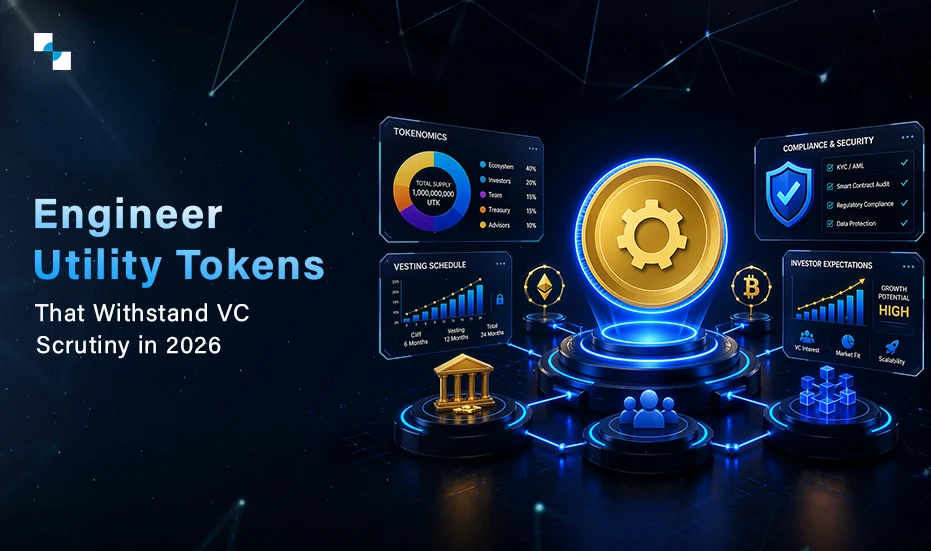
- Understanding the key pillars of VC due diligence for utility tokens, such as real utility, demand generation, value accrual, supply design, and regulatory awareness, is crucial for success.
- By following a structured framework that defines the token's role, establishes clear demand loops, connects value to platform success, designs sustainable tokenomics, and integrates compliance early on, founders can create a token that is investor-ready and stands out in the market.
Most Web3 founders today are not struggling to build tokens. The tooling exists. Smart contracts are easier than ever to deploy. Frameworks and templates are widely available. Yet, funding success tells a very different story. A large percentage of token-based projects fail not because of poor engineering, but because they fail to meet the expectations of institutional capital. Venture capital firms in 2026 are not investing in ideas alone. They are investing in structured economic systems that demonstrate clarity, sustainability, and compliance readiness.
If you are preparing for a raise, your token is no longer just a product feature. It is a core part of your financial architecture. This is where utility token development becomes a strategic discipline rather than a technical task. This guide is designed to help you understand exactly how VCs evaluate tokens today and how to design a model that can pass due diligence with confidence.
Why VC Due Diligence Has Evolved Significantly
The evaluation criteria for token-based projects have changed dramatically over the past few years. Earlier, venture firms were willing to back strong narratives, early traction, and community growth. Today, that approach has matured into a far more structured evaluation process.
Key reasons behind this shift:
- Increased regulatory scrutiny across major markets
- Capital losses from poorly designed token models
- Institutional entry into digital asset markets
- Growing focus on real-world utility and revenue alignment
As a result, VCs now approach tokens with the same rigor they apply to traditional financial instruments. They are looking for systems that are predictable, defensible, and scalable.
Understanding the VC Mindset in 2026
Before designing your token, you need to understand how investors think. A venture capitalist reviewing your project is not asking how innovative your token is. They are asking whether your token creates a sustainable economic loop.
They want to know:
- Does this token drive real demand
- Is there a clear path to value creation
- Can this model survive market volatility
- Does it align with regulatory expectations
If your token cannot answer these questions clearly, it will struggle to move forward in any serious investment conversation.
Book a strategic consultation and move forward with confidence.
The Five Core Pillars of VC Due Diligence for Utility Tokens
Let’s break down the actual evaluation framework used by experienced investors to assess the strength of utility token development services.
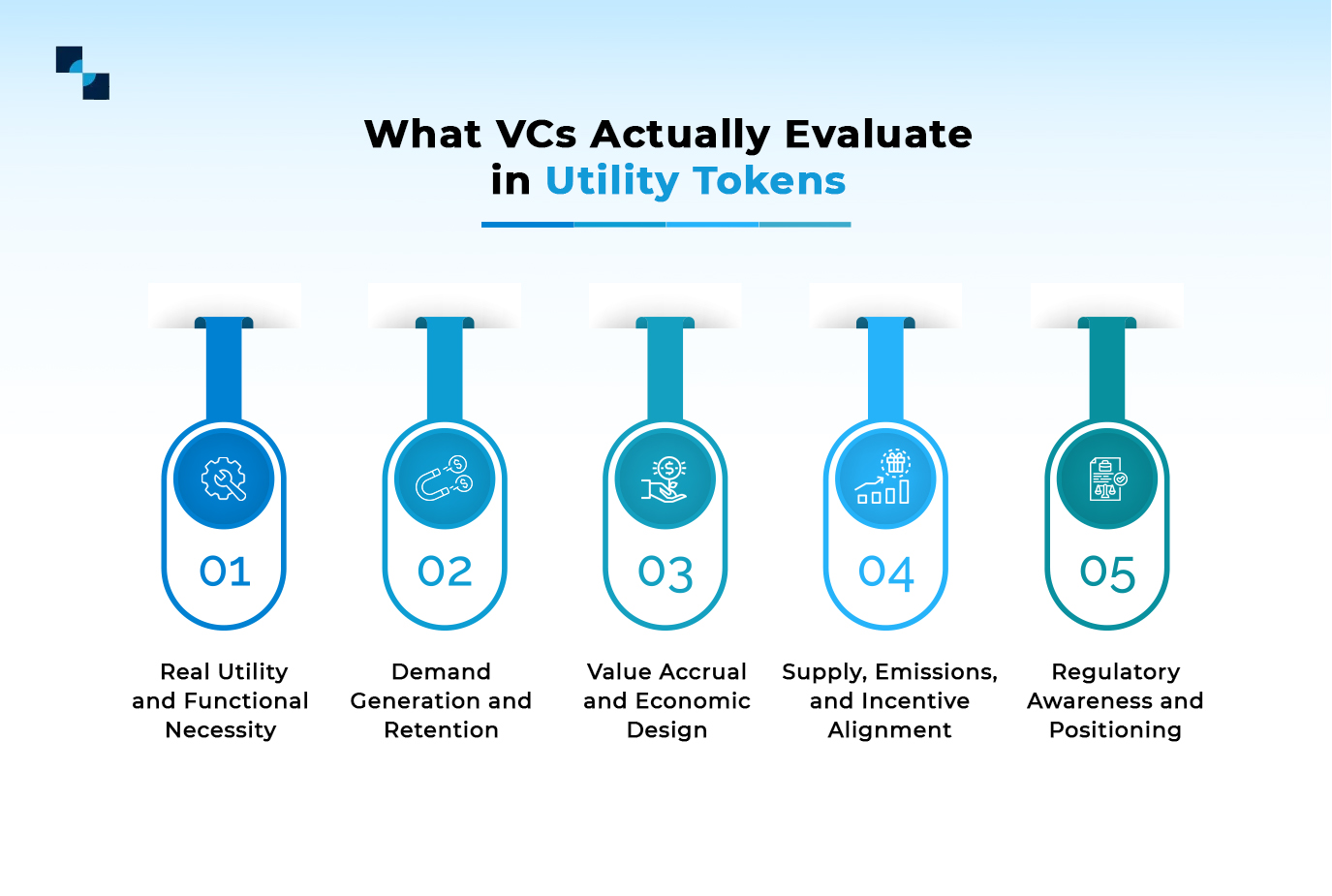
- Real Utility and Functional Necessity
Utility is one of the most misunderstood concepts in Web3. Many projects claim utility, but in practice, their tokens are optional rather than essential. A strong utility token must perform a function that cannot be easily replaced.
Examples include:
- Paying for protocol-level operations
- Accessing critical platform features
- Acting as collateral within the system
- Enabling execution of core network actions
If users can bypass your token without losing functionality, the utility is weak.
- Demand Generation and Retention
A token’s value is directly tied to demand. VCs analyze whether demand is:
- Organic and usage-driven
- Recurring rather than one-time
- Linked to platform growth
Strong demand drivers include:
- Transaction fees
- Subscription models
- API or infrastructure access
- Participation requirements within the ecosystem
Weak demand is usually driven by speculation rather than necessity.
- Value Accrual and Economic Design
Even if demand exists, the token must capture value from that demand. This is where many projects fail. Value accrual mechanisms can include:
- Fee redistribution models
- Buyback systems tied to revenue
- Token burns linked to usage
- Access-based pricing structures
Without value accrual, your token becomes disconnected from the success of your platform.
- Supply, Emissions, and Incentive Alignment
Token supply design is one of the most critical areas of evaluation.
VCs closely examine:
- Total supply structure
- Emission schedules
- Vesting timelines
- Allocation distribution
Poorly designed emissions can create selling pressure that destroys long-term value. Well-structured models align incentives across founders, investors, and users over time.
- Regulatory Awareness and Positioning
Regulation is no longer a secondary concern. It is a core part of due diligence. VCs assess whether your project demonstrates:
- Clear utility positioning
- Awareness of jurisdictional implications
- Legal structuring, where necessary
- Reduced the risk of classification as a security
Projects that ignore this layer often fail before deeper discussions even begin, exposing the risks of relying on generic crypto token development approaches without regulatory foresight.
The Enterprise Framework for Utility Token Development
You need a structured approach backed by investor-focused utility token development services to build a token that passes due diligence. Below is a practical framework used by teams that successfully raise capital.
Step 1: Define the Economic Role of the Token
Start with a simple but powerful question.
- What does the token actually do?
If the answer is vague or interchangeable with fiat or stablecoins, the design needs refinement.
Step 2: Build Clear Demand Loops
Identify where demand originates and how it sustains itself.
Ask:
- What actions require the token
- How often do users need it
- What drives repeated usage
This step ensures your token is embedded in real activity.
Step 3: Connect Value to Usage
Your token should benefit directly from platform success. As usage increases, value should flow back into the token ecosystem. This creates alignment between growth and token performance.
Step 4: Design Sustainable Tokenomics
Avoid short-term incentives that damage long-term viability.
Focus on:
- Gradual emissions
- Balanced reward structures
- Strategic treasury management
Sustainability is more valuable than aggressive growth.
Step 5: Integrate Compliance Early
Compliance should not be an afterthought. Incorporating regulatory awareness early reduces risk and builds investor confidence.
Let us evaluate your model and identify gaps before investors do.
Why Traditional Development Approaches Are Not Enough
The difference between launching a token and building a fundable asset lies in how you approach development, especially when applying a structured crypto token development strategy.
| Aspect | Traditional Approach | Advanced Approach |
|---|---|---|
| Focus | Technical deployment through standard crypto token development | Strategic + technical execution via utility Token development services |
| Approach | Token creation as a coding task | Token design as an economic and capital strategy |
| Outcome | Generic token models | Differentiated, purpose-driven token systems |
| Investor Readiness | Low confidence from VCs | Built for due diligence and funding success |
| End Goal | Launch a token | Build a fundable, scalable token ecosystem |
The takeaway is clear. If your goal is capital, not just deployment, your development approach must evolve accordingly.
What Defines a VC-Ready Token in Practice
A VC-ready token demonstrates clarity at every level.
It should show:
- A clear and necessary role within the ecosystem
- Strong and sustainable demand drivers
- Well-defined value capture mechanisms
- Balanced supply and incentive structures
- Awareness of regulatory considerations
When these elements are aligned, your token becomes more than a concept. It becomes an investable system.
Common Mistakes That Lead to Rejection
Even strong teams fall into predictable traps. Some of the most common include:
- Designing tokenomics before defining product-market fit
- Relying on staking rewards without real revenue
- Overcomplicating economic models
- Ignoring regulatory positioning
- Treating tokens as marketing tools instead of infrastructure
Avoiding these mistakes significantly increases your chances of success, particularly when guided by expert-led utility token development services designed for investor readiness.
This Is What Serious Founders Are Getting Right in 2026
At this stage, the difference is no longer about who can build faster. It is about who can build right. The founders who are successfully raising capital today are not treating tokens as an add-on. They are treating them as core financial infrastructure. Every decision around utility, demand, value capture, and compliance is intentional and aligned with how investors think.
If you are aiming for institutional capital, you already know what is at stake.
- You cannot afford weak tokenomics.
- You cannot rely on generic frameworks
- You cannot fix structural issues after pitching
What you need is clarity before you enter the room.
- You need a token that answers questions before they are asked.
- You need a model that holds up under scrutiny.
- You need a structure that signals confidence to capital.
This is exactly where most projects either move forward or quietly fall off. If you are preparing for a raise, the smartest move you can make right now is to align your token with how VCs evaluate opportunities. Working with an experienced partner like Antier gives you that edge. The focus is simple. Not just helping you launch, but helping you get funded.
If your goal is to build a token that withstands due diligence and attracts serious capital, this is the time to act. Connect with Antier, a renowned utility token development company, and start building a token that is designed for investors from day one.
Frequently Asked Questions
01. What are the main reasons for the shift in VC evaluation criteria for token-based projects?
The shift in VC evaluation criteria is due to increased regulatory scrutiny, capital losses from poorly designed token models, institutional entry into digital asset markets, and a growing focus on real-world utility and revenue alignment.
02. How should founders approach the development of their utility tokens in 2026?
Founders should view utility token development as a strategic discipline, ensuring that their tokens are integral to their financial architecture and capable of passing due diligence by demonstrating clarity, sustainability, and compliance readiness.
03. What key questions do VCs ask when evaluating a token project?
VCs typically ask if the token drives real demand, if there is a clear path to value creation, if the model can survive market volatility, and if it aligns with regulatory expectations.