



AI Summary
- Discover the perfect blend of control and convenience with self-custodial hybrid neo banking.
- This innovative model combines self-custody of crypto assets with modern neo banking features, offering users ownership without sacrificing ease of use.
- By holding the private keys themselves, users enjoy direct control over their assets while benefiting from familiar banking services like transfers, card spending, and compliance workflows.
- Unlike traditional digital banking platforms, self-custodial hybrid neo banking prioritizes user ownership and control, making it an attractive option for founders, enterprises, and serious investors seeking utility and scalability.
- This advanced financial layer seamlessly integrates crypto storage, fiat transactions, card usage, compliance, and user control, providing a holistic solution for those looking to navigate the evolving landscape of digital finance.
Self-custodial hybrid crypto-friendly neo banking sits in a very specific sweet spot: it gives users ownership without making them sacrifice convenience. In a self-custodial model, the user holds the private keys, which means they control access to the crypto assets rather than a third party. Neo banking, meanwhile, is the digital-first banking experience that lives online and often works through partner institutions instead of a traditional branch network. Put those two together, and you get a product that feels modern, fast, and familiar, while still preserving the core crypto principle of ownership. That is exactly why this model is attracting founders, enterprises, and serious investors who want utility, control, and scale in one place.
For a new audience, this may sound complex at first. For experienced investors, it sounds like infrastructure with a clear market use case. The real opportunity is not in building another app that looks like a wallet or another app that looks like a bank. The opportunity is in building a unified financial layer where crypto storage, fiat movement, card usage, compliance, and user control are all designed to work together.
What Is Self-Custodial Hybrid Neo Banking?
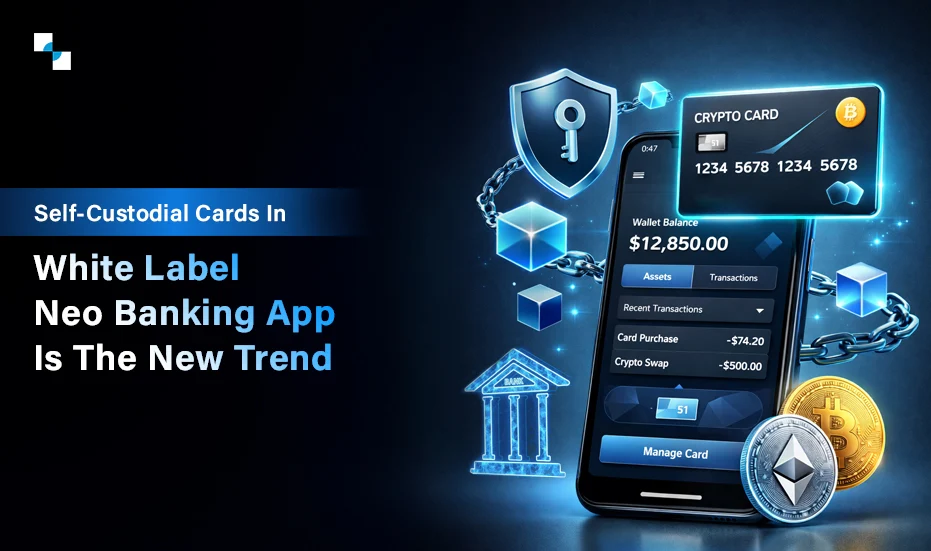
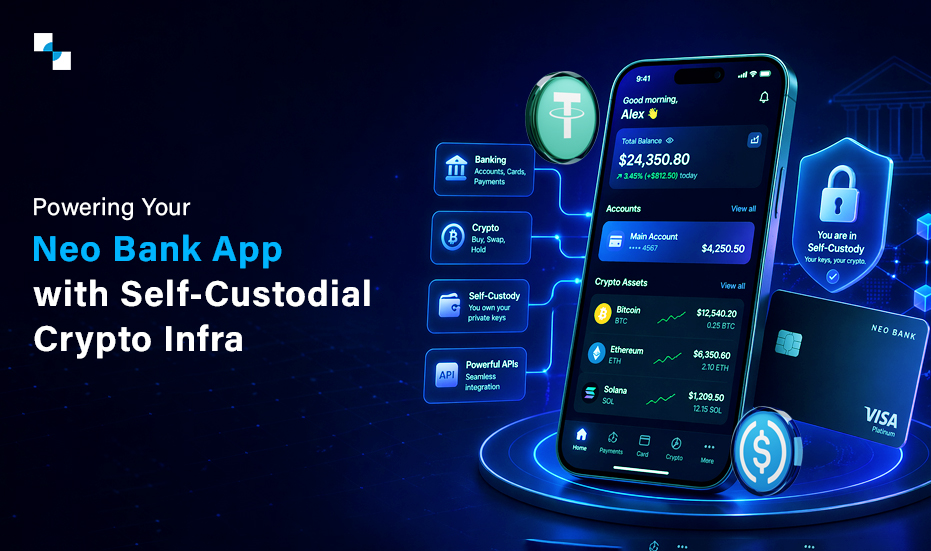
A self-custodial hybrid crypto neo banking app is a digital financial platform that combines self-custody for crypto assets with neo banking functions for everyday financial use. In practical terms, the user keeps control of the wallet keys, while the platform provides banking-style services such as balance views, transfers, card spending, fiat on and off-ramps, and compliance workflows around the experience. This model is built for people who want direct asset ownership without losing the smooth UX they expect from modern banking apps.
Neo Banking vs Self-Custodial Hybrid Neo Banking
The distinction below is simple but important. A neo banking platform is usually digital-only and commonly relies on partner banks or banking infrastructure. Self-custodial hybrid neo banking adds user-owned crypto control on top of that digital banking layer.
| Aspect | Neo Banking | Self-Custodial Hybrid Neo Banking |
|---|---|---|
| Core model | Digital-first banking experience | Digital-first banking plus self-owned crypto custody |
| Asset control | Usually managed through banking partners and platform rails | User controls private keys on the crypto side |
| Primary use | Payments, savings, transfers, cards, and account management | Payments, savings, transfers, cards, plus crypto ownership |
| User experience | Simple and app-based | Simple and app-based, but with stronger ownership |
| Custody layer | Typically not the main product focus | Central to the product design |
| Best for | Users who want modern banking convenience | Users who want convenience and control together |
Why Invest in Self-Custodial Hybrid Neo Bank App Development in 2026?
The strongest reason to invest in a self custodial neo banking development solution is that the product answers a real gap in the market. People want to move between crypto and fiat without feeling trapped in a custodial system, and they want to do it through one clean interface instead of several disconnected tools. That demand is not cosmetic. It is structural. Self-custody gives users direct control of their keys, while digital banking gives them speed, payment utility, and daily relevance.
From a business view, this model can unlock multiple value streams at once. You are no longer limited to one narrow product story. You can build around cards, transfers, premium accounts, FX, treasury tools, merchant flows, and cross-border use cases. That creates stronger retention because the app becomes part of the user’s financial routine, not just a place to store assets. It also makes the platform more investable, because the architecture can support expansion without forcing a rebuild.
- Speed- White-label neo bank models reduce time to market, which matters in a space where timing often decides whether a product gets attention or disappears. Antier’s own white-label crypto wallet and neo banking pages describe customizable, deployable platforms built for both custodial and non-custodial use cases, which shows how fast this category is moving toward modular delivery.
- Regulation- If the product is built with compliance in mind from day one, it is easier to scale across markets later. FATF guidance makes clear that virtual asset service providers should be licensed or registered and supervised, while FinCEN states that persons accepting and transmitting convertible virtual currency may fall under money services business obligations in the United States. In the EU, MiCA introduces a uniform framework for crypto-asset issuance and service provision.
Features of a Self-Custodial Hybrid Neo Bank Solution
The features that matter most are the ones that make the product usable, secure, and scalable.
- Self-custodial wallet access with user-owned keys
- Fiat and crypto balance visibility in one dashboard
- Self-custodial card support for real-world spending
- Multi-asset and multi-chain support
- Fiat on-ramp and off-ramp integration
- In-app transaction history and spend controls
- Role-based admin and risk dashboards
- Compliance automation for onboarding and monitoring
- Recovery, backup, and key-management flows
- Real-time notifications and ledger updates
These are not just “nice to have” BaaS platform capabilities. They are the components that make the product feel trustworthy, spendable, and enterprise-ready.
Go Live with a Self-Custodial Neo Bank
How Does a Self-Custodial Hybrid Neo Banking App Work?
A user signs up, completes identity verification, and creates or links a self-custodial crypto wallet. The app then presents a banking-style interface where crypto and fiat balances can be viewed together in one place. When the user adds funds, the platform routes the value through the correct rail, runs risk checks, and updates the ledger. If the user spends through a self-custodial card, the app authorizes the transaction through the connected payment layer while preserving the custody design on the crypto side.
Behind the scenes, the platform handles notifications, compliance checks, reporting, and transaction tracking. The user keeps ownership of the keys, while the app manages the banking experience around them. That combination is what makes the model feel both secure and practical.
How to Develop a White Label Neo Banking Platform With Self-Custodial Cards?
A strong build usually follows a clean, layered process. Lets us scroll through the blog to have a clear understanding of self-custodial hybrid neo bank app development:
- Define the custody model- Decide exactly what stays self-custodial, what stays platform-managed, and how users will interact with both layers.
- Map the regulatory scope- Identify the jurisdictions you plan to serve, because licensing, KYC, AML, and custody expectations change from market to market.
- Design the banking architecture- Set up the fiat rails, card logic, account structure, payment flow, and ledger architecture before touching the front end.
- Build the wallet and card experience- Create the mobile and web interface, then connect the wallet layer so users can store value, spend value, and track everything in one place.
- Add the compliance engine- Integrate identity checks, sanctions screening, monitoring rules, audit logs, and suspicious activity workflows.
- Connect the white label modules- Use prebuilt modules for onboarding, dashboard, card management, transfers, and admin control so launch time stays short.
- Test for security and scale- Run security testing, transaction testing, recovery testing, and stress testing before public launch.
- Launch, monitor, and improve- Go live in phases, track user behavior, fix bottlenecks, and expand features only after the core flows are stable.
What Legal and Compliance Requirements Are Needed for Hybrid Neo Bank Development?
- Licensing or registration, depending on the jurisdictions you operate in. FATF expects virtual asset service providers to be licensed or registered and subject to supervision or monitoring.
- KYC and KYB onboarding, especially if the platform touches fiat, cards, or business accounts. FATF guidance explicitly emphasizes knowing customers and storing that information securely.
- AML and CFT controls, including risk scoring, alert review, and suspicious activity reporting. FinCEN’s guidance on convertible virtual currency states that persons accepting and transmitting it may have money transmitter obligations and AML/CFT requirements.
- Travel Rule readiness, where applicable, because FATF guidance specifically addresses travel rule implementation for virtual asset transfers.
- Sanctions screening and transaction monitoring, especially for cross-border flows and higher-risk wallets. FATF’s risk-based framework is built around detecting and reporting suspicious transactions.
- Clear custody disclosures, so users understand what they control, what the platform controls, and what happens if they lose access.
- Data protection and auditability, including secure storage, logging, access controls, and retention policies.
- Market-specific compliance mapping, because the EU’s MiCA regime, for example, creates a uniform framework for crypto-asset service provision and supervision.
The entire development process, starting from the initial stage to the end, assists regarding legal and compliance, an experienced crypto neo bank development company that boasts a vast team of blockchain experts who are adept at crafting business-tailored and feature-rich solutions in no time.
Conclusion
Self-custodial hybrid crypto neo banking is not just another fintech trend. It is a cleaner answer to an old problem: how to give users real ownership without taking away speed, usability, or everyday payment utility. The model works because it respects both the crypto mindset and the banking mindset, and that balance is exactly what modern users are starting to expect.
For enterprises that want to move fast, Antier is positioned as a strong partner in this space. Its official pages highlight white-label neo banking, blockchain development, and AI-led services, which fit the needs of a product that must scale across both financial utility and technical depth. We also present Web3 legal consulting, crypto license support, and regulatory guidance, which matters because this type of product cannot succeed on engineering alone.
If your goal is to move from a Web2 mindset to a Web3-ready financial product, with white-label modules that can be tailored to your business model, our positioning is aligned with that journey. Their own materials describe customizable delivery, certified engineering talent, and enterprise-grade blockchain capability, which makes them relevant for teams that want to build faster without losing control over the final architecture.
Frequently Asked Questions
01. What is self-custodial hybrid neo banking?
Self-custodial hybrid neo banking is a digital financial platform that combines self-custody for crypto assets with neo banking functions, allowing users to control their wallet keys while accessing banking-style services like transfers and card spending.
02. How does self-custodial hybrid neo banking differ from traditional neo banking?
Traditional neo banking is a digital-only experience that relies on partner banks for asset management, while self-custodial hybrid neo banking adds user-owned crypto control, allowing users to manage their private keys alongside banking services.
03. Who is the target audience for self-custodial hybrid neo banking?
The target audience includes individuals who seek direct ownership of their crypto assets without sacrificing the user experience of modern banking apps, appealing to both new users and experienced investors.