



AI Summary
- Traditional finance is taking notice as Hamilton Lane and other firms begin putting regulated funds on-chain using KAIO Protocol on Sei Blockchain for enhanced efficiency, scale, and compliance.
- The Sei + KAIO model signifies a new era of institutional Real-World Asset tokenization, offering benefits such as lower operational costs, expanded investor access, and faster ROI.
- This partnership brings together Sei's trading-optimized Layer 1 with KAIO's compliant Real-World Asset tokenization framework to create a robust financial foundation that prioritizes capital efficiency, compliance, and liquidity.
- By leveraging the Sei + KAIO duo, businesses can improve their RWA tokenization platform development services, cater to institutional investors, and redefine value creation in the market.
- The future of digital finance is here, and institutions can lead the way with the Sei + KAIO ecosystem.
It’s not often that a blockchain launch makes traditional finance sit up straight. But now the firms like Hamilton Lane started putting regulated funds on-chain using KAIO Protocol on Sei Blockchain, and for obvious reasons, efficiency, scale, and compliance. The amalgamation of the Sei + KAIO model shows institutional Real-World Asset tokenization. Sei’s trading-optimized Layer 1 and KAIO’s compliant Real-World Asset tokenization framework represent a new financial foundation where capital efficiency, compliance, and liquidity coexist. For businesses developing RWA platforms, this duo can result in lower operational costs, expanded investor access, and faster ROI.
This guide explores how RWA Tokenization Platform Development Services improve.
Why Sei Blockchain Is a Natural Fit for RWA Tokenization Platform Development?
The Sei Blockchain was built for trading and capital markets performance. Its architecture is well optimized to handle the financial workloads that demand speed, determinism, and transparency, which is exactly what Financial Services need to build an infrastructure that tokenizes and exchanges, and trades assets. The Asset Tokenization platform built on Sei can efficiently work in dynamic financial markets, structured around deterministic performance and trading efficiency.
Here Are Some Distinct Infrastructure Capabilities of Sei That Set It Apart from Other Blockchains

Sei could deliver the trading performance of NASDAQ, with the transparency of blockchain. This matters because institutional money won’t move into environments that lag or fail under volume, and Sei gives Asset tokenization platforms the reliability to scale like real markets.

Inside the KAIO Protocol: Turning Regulation into a Competitive Advantage for Institutional-Grade Tokenization
Formerly known as Libre Capital, KAIO has rebranded with a sharper mission- to be the on-chain infrastructure layer for institutional funds. Where most RWA projects focus on token issuance, KAIO handles everything from asset origination to investor participation with built-in compliance. Its architecture ensures that every tokenized fund or debt instrument is legally structured, regulator-approved, and institutionally auditable.
What makes KAIO different:
- Fund-level tokenization: Not just fractional shares, but complete feeder funds represented as tokens.
- Regulatory architecture: Every tokenized instrument is tied to a compliant, jurisdiction-approved structure.
- Accredited investor model: Exclusively for institutions and qualified investors – zero retail exposure.
- Transparency without leakage: KAIO leverages Sei’s infrastructure to keep auditability high and counterparty risk low.
This eliminates manual compliance friction without back-office verification or post-trade reconciliation. Institutions can tokenize feeder funds, private debt, or liquidity pools with pre-built legal compliance baked into smart contracts.
This offers safer access to new asset classes with full transparency for investors and enables the financial institutions to unlock instant scalability across jurisdictions with a product that regulators can audit without disruption.
Launch a Compliant RWA Platform on Sei and KAIO
The Sei + KAIO Symbiosis: Tokenization Platform Built for Institutional Liquidity
The Sei + KAIO partnership merges legal certainty and compliance into a unified capital infrastructure layer. This partnership blends two complementary strengths:
- KAIO’s compliance-driven tokenization layer handles who can participate, how tokens map to legal assets, and which jurisdictions apply.
- Sei’s high-performance blockchain handles the execution core that includes instant matching, settlement, and transparent audit trails.
The convergence also removes legacy friction points in The Asset Tokenization Platform. This means:
- T+2 settlement becomes T+0 atomic finality.
- Off-chain clearing becomes on-chain automated reconciliation.
- Limited secondary liquidity becomes global, continuous liquidity.
This alignment redefines value creation. When tokenized assets settle faster, yield compounds faster. When transparency improves, investor retention rises- which ultimately contributes to faster business growth.
How The SEI + KAIO Model for Asset Tokenization Improves Investor Experience?
The Sei and KAIO models make the investing experience frictionless, compliant, and instant. The model delivers what traditional systems have promised but never achieved: instant, verified ownership with full compliance assurance.
- Real-Time Access: Investors subscribe, trade, and redeem fund tokens instantly, 24/7.
- Verified Security: Every participant is whitelisted; no exposure to unverified wallets.
Transparent Valuation: Asset value and performance are visible in real time on-chain. - Automated Reporting: Investor dashboards sync with smart contracts without waiting for monthly statements.
This enhanced investor experience directly drives conversion and retention for institutions. More liquidity means higher trading volume; higher transparency means stronger trust, critical to scaling tokenized products profitably.
What’s In There for Sei + KAIO DUO For Businesses to Capture in the Institutional Tokenization Market?
Businesses always compete on speed, efficiency, and confidence. Asset Tokenization Platforms built on Sei and KAIO can gain both.
1. For Banks
The Sei + KAIO stack represents a chance to move from traditional custodianship to programmable capital management for banks. It allows them to digitize, distribute, and monetize assets that have historically been locked in balance sheets or settlement cycles.
With Sei’s ultra-fast finality and KAIO’s regulatory-grade architecture, banks can finally engage with blockchain without compromising supervision, reporting, or risk controls.
Here’s what that translates to in tangible terms:
- Tokenize balance sheet assets: Corporate loans, structured debt, or treasuries, and transform them into yield-generating digital instruments.
- Accelerate capital rotation by enabling near-instant settlement and collateral reuse through atomic DvP (delivery-versus-payment).
- Open compliant secondary markets for credit exposure and deposit-linked instruments, turning idle holdings into active liquidity channels.
- Automate compliance and reporting, with on-chain KYC, AML, and audit logic aligned to Basel and MiFID frameworks.
Banks will gain the ability to reduce liquidity risk, enhance capital efficiency, and offer new digital investment products under the existing regulatory structure. Instead of competing with DeFi, the Sei + KAIO framework allows banks to operate within it, while retaining full control over governance and regulatory transparency.
2. For Fund Managers
Fund managers can use the Sei + KAIO stack to asset tokenization platforms for feeder funds, private credit vehicles, or structured investment pools, all within a regulated framework. The result is a quantifiable operational and capital advantage:
- 60–80% reduction in administrative and settlement overhead by automating issuance and clearance.
- Global investors reach through KYC-verified, whitelisted wallets that simplify onboarding and compliance.
- Real-time portfolio rebalancing and on-chain reporting that improve investor trust and retention.
In a competitive landscape where margins tighten and compliance costs rise, this efficiency compounds directly into ROI.
3. For Exchanges and Market Operators
Exchanges can integrate institutional-grade RWA pairs directly into their existing infrastructure, powered by Sei’s high-speed execution and KAIO’s compliance layer. This enables:
- Compliant secondary markets for tokenized credit, bonds, and fund units.
- Composable DeFi liquidity where tokenized RWAs can serve as on-chain collateral.
- Expanded trading fees and settlement revenues driven by continuous 24/7 market activity.
What was once locked in private books now becomes an active yield-bearing market, regulated and transparent by design.
4. For Fintech Builders
Fintechs and asset infrastructure startups can launch tokenization platforms faster by leveraging Sei’s SDKs and KAIO’s regulatory APIs. That means:
- Instant access to compliance-certified modules for KYC, issuance, and audit.
- No need to negotiate cross-border legal structures from scratch.
Integration-ready infrastructure for trading, custody, and settlement.
Institutions can skip the regulatory obligations and move straight to revenue operations, deploying platforms that are regulator-ready from day one.
Asset Classes with the Highest Institutional ROI on Sei + KAIO

Certain asset classes stand out as immediate beneficiaries of the Sei + KAIO architecture due to their volume, regulatory maturity, and liquidity needs: Each of these represents a gateway to scale, and platforms built on Sei + KAIO can host them all under one compliant, auditable environment.
Liquidity Reimagined: Why Sei + KAIO Redefine Secondary Markets
In institutional finance, secondary liquidity is the difference between “held assets” and “productive capital.” Issuing tokens is simple; creating compliant, liquid markets is hard.
This is precisely where Sei’s exchange-grade infrastructure and KAIO’s regulated feeder fund design converge.
- On Sei, liquidity is executed deterministically- every order is matched, priced, and settled on-chain.
- On KAIO, each transaction automatically aligns with investor restrictions and fund mandates.
The outcome is liquidity without compromise- compliant, auditable, and instantaneous. This mechanism not only supports investor confidence but also enhances ROI for platform operators through recurring transaction and custody revenues.
Investor Experience in a Tokenized Market: Frictionless, Compliant, and Instant
From an investor’s perspective, the Sei + KAIO model finally delivers what traditional systems have promised but never achieved: instant, verified ownership with full compliance assurance.
- Real-Time Access: Investors subscribe, trade, and redeem fund tokens instantly, 24/7.
- Verified Security: Every participant is whitelisted; no exposure to unverified wallets.
- Transparent Valuation: Asset value and performance are visible in real time on-chain.
- Automated Reporting: Investor dashboards sync with smart contracts, no waiting for monthly statements.
For institutions, this enhanced investor experience directly drives conversion and retention. More liquidity means higher trading volume; higher transparency means stronger trust, critical to scaling tokenized products profitably.
The User Journey: From Infrastructure to Market Adoption
In tokenization, adoption comes from seamless user experience and regulatory trust. Here’s how a Sei + KAIO–powered platform converts users through its lifecycle:
- Discovery → Onboarding: Investors complete digital KYC/AML once; verified credentials carry across all tokenized instruments.
- Onboarding → Transaction: Investors purchase or subscribe to tokenized instruments using stable assets. Transactions execute instantly on Sei.
- Transaction → Engagement: Real-time reporting, fractional reinvestment, and portfolio transparency build engagement and trust.
- Engagement → Retention
Faster settlement and continuous liquidity turn passive investors into recurring participants. - Retention → Advocacy: Institutional-grade reporting and compliance drive credibility, which is critical for scaling partnerships and listings.
Every touchpoint becomes an opportunity for conversion because the infrastructure itself builds confidence. That’s what separates compliant tokenization platforms from speculative crypto products.
How Tokenization Platforms Built on Sei + KAIO Genera: Technical Architecture Snapshot
For businesses, Sei + KAIO provides modular building blocks to assemble full-fledged, compliant ecosystems. Here is an architecture stack for a tokenization platform:
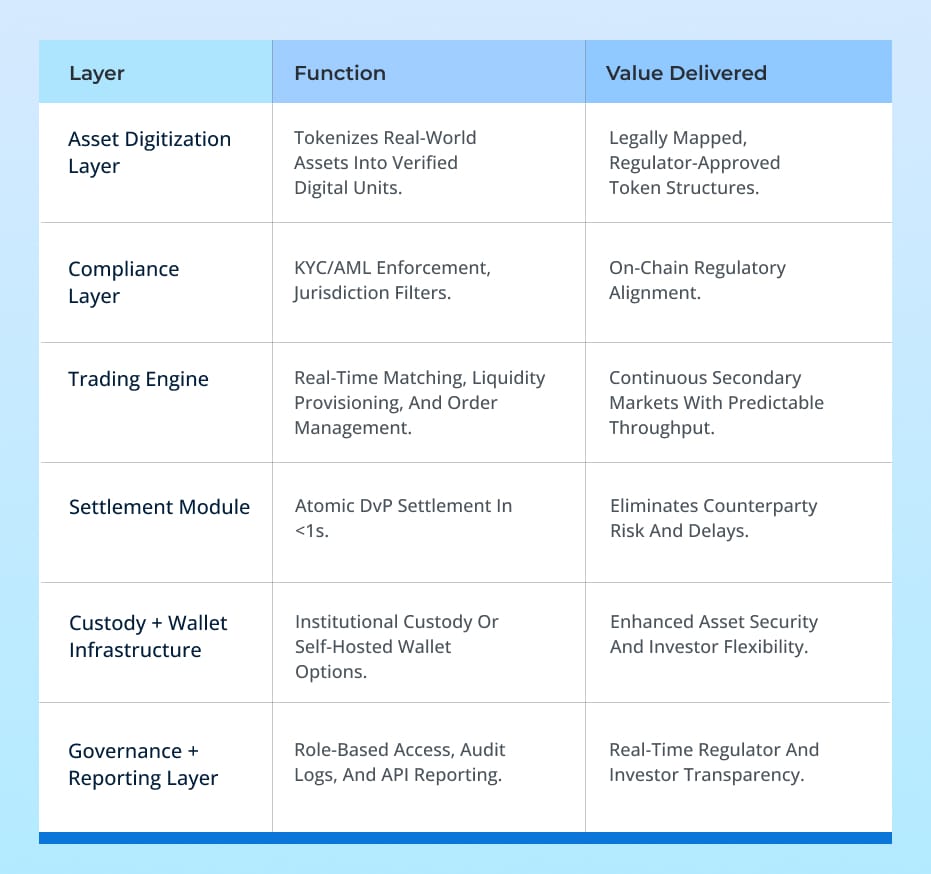
This stack enables end-to-end tokenization, issuance, trading, settlement, and compliance, all in one seamless system.
The Market Trajectory: Tokenization as the Next $20 Trillion Infrastructure Shift
By 2030, tokenized assets could account for up to 10% of global GDP, representing between $16–30 trillion in digital financial instruments.
Institutional momentum is accelerating as more funds and asset managers recognize tokenization not as innovation, but as modernization. The Sei + KAIO framework is central to this evolution, offering the performance of traditional markets with the programmability of blockchain.
Build an Exchange-Integrated Tokenization Infrastructure on SEI- KAIO Model
Takeaway
The Sei–KAIO ecosystem has proven that compliant, scalable tokenization is operational, profitable, and regulatory-ready. This creates a frictionless, transparent, and trusted ownership experience and delivers efficiency, liquidity, and measurable ROI. And for forward-looking institutions, it represents the infrastructure to lead the next era of digital finance.
Why Antier
Antier bridges institutional finance and blockchain technology with architectural precision and regulatory intelligence. Our Asset Tokenization Development Company designs tokenization platforms that merge Sei’s performance and KAIO’s compliance framework into one cohesive, market-ready product.
Our expertise includes:
- RWA Tokenization Platform Development – full lifecycle systems for asset issuance, trading, and settlement.
- Exchange Integration – liquidity modules and atomic settlement built into Sei’s native order layer.
- Smart Contract Auditing and Compliance Automation – regulatory-grade assurance for global markets.
- Institutional Custody and Reporting Systems – wallet infrastructure aligned with financial standards.
If your institution is ready to tokenize assets, issue funds, or build compliant digital exchanges, the infrastructure exists, and Antier can help you build on it.
Build Your Tokenization Platform with Antier. Get in touch with our experts today!
Frequently Asked Questions
01. What is the significance of the Sei Blockchain in RWA tokenization?
The Sei Blockchain is optimized for trading and capital markets, providing the speed, determinism, and transparency needed for efficient asset tokenization and trading in dynamic financial markets.
02. How does the KAIO Protocol enhance institutional-grade tokenization?
The KAIO Protocol offers a comprehensive infrastructure for institutional funds, managing everything from asset origination to investor participation while ensuring compliance with regulatory standards.
03. What benefits do businesses gain from using the Sei + KAIO model for RWA tokenization?
Businesses can achieve lower operational costs, expanded investor access, and faster ROI by leveraging the efficiency, compliance, and liquidity offered by the Sei + KAIO model.