
AI Summary
- Private equity markets, historically exclusive and inefficient, are undergoing a transformative shift through tokenization in 2026.
- Private equity tokenization involves creating blockchain tokens representing ownership interests, enabling faster capital deployment and global investor participation.
- This innovation utilizes smart contracts for automated operations, ensuring transparency and compliance.
- Benefits include fractional ownership, operational efficiency, and improved liquidity.
- Tokenized assets offer real-time visibility, automated distributions, and enhanced security.
Private equity markets, valued in trillions, have historically been constrained by illiquidity, exclusivity, and operational inefficiencies. In 2026, tokenization in private equity is addressing these limitations by converting ownership into programmable digital assets. Powered by blockchain in private equity, this shift is enabling faster capital deployment, transparent ownership, and global investor participation.
This transformation is fundamentally rooted in the ability to digitize and program ownership structures – an approach defined as private equity tokenization
What is Private Equity Tokenization?
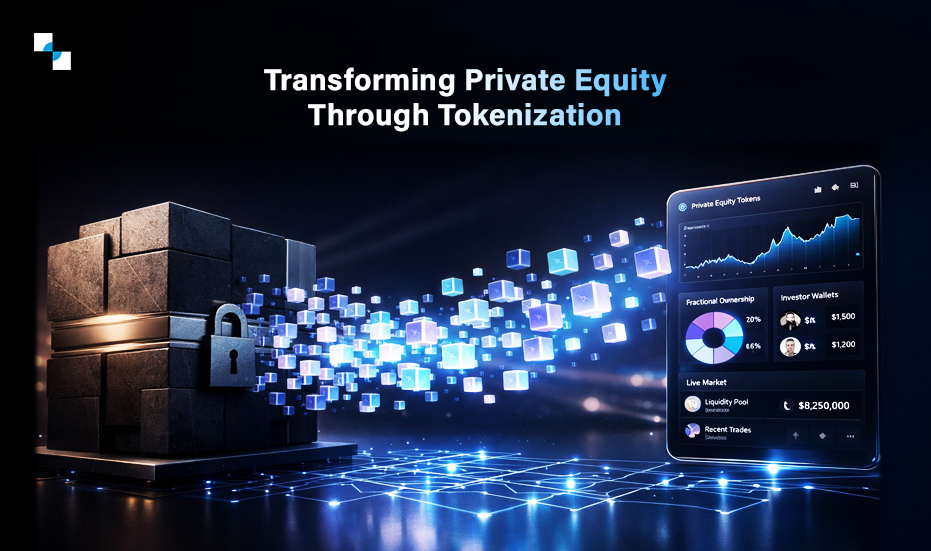
Private equity tokenization involves the creation of blockchain tokens that represent ownership interests in private equity investments or in the underlying assets themselves. The tokens are used as programmable digital tokens representing economic and ownership rights, which means that they are created using smart contracts. The process is different from conventional securitization since it is more automated and transparent in terms of how the asset lifecycle is managed.
Tokenized Ownership Representation
The stake or shares held by investors in any private equity firm are tokenized, thus creating tokens that embody the rights of profit sharing, voting power, and capital growth. This makes it easier for the investors to trade their stakes more flexibly than is done through conventional means.
Smart Contract Automation
Operations within the private equity fund are automated using smart contracts. Through automation, important tasks such as capital calls and dividend distribution can be automated by writing necessary logic within the contract. This leads to efficiency within the financial processes being conducted.
Greater Transparency
Through blockchain, all financial transactions are recorded on the blockchain. The blockchain ensures that there is transparency within the management of funds and the performance of the asset.
Programmable Compliance
Requirements for KYC/AML and investment eligibility have been embedded within token smart contracts. This makes sure that all transactions are compliant according to the laws without the need for external monitoring. Furthermore, it lowers the chances of committing any regulatory violations.
Cross-Platform Interoperability
Tokens can work on various blockchain networks and financial systems. This allows them to function seamlessly in centralized and decentralized financial systems.
Explore How Tokenization is Transforming Private Equity
Why Tokenization Matters for Private Equity Firms
The growing use of tokenization in private equity is an indication of how the market continues to evolve due to digital transformation trends. The current private equity systems are faced with issues of inefficiency, which include a lack of liquidity, expensive transactions, and limited investor access. With digital asset tokenization development, tokenization in development helps companies digitize their models and take advantage of the new opportunities that arise. Tokenization not only makes these firms more efficient but also allows them to attract international capital. With stiff competition, there is a need for companies to embrace digital transformation in order to survive.
Increased Investor Base
Tokenization makes it possible for investors to hold fractions of shares in assets. In this way, small investors can take part in private equity deals that would otherwise be unavailable to them. Investors are also able to gain access to investment markets that would not have been accessible otherwise.
Operational Efficiency
Automation through blockchain limits the extent of the involvement of intermediaries and human error in transactions, leading to the fast completion of transactions. Firms are able to operate in an efficient manner.
Global Capital Formation
Through blockchain platforms, it is possible for firms to attract capital across borders without obstacles.
Improved Transparency and Trust
Access to transactional data and performance in real-time increases trust among investors. Systems that are transparent help avoid disagreements and foster positive relations. Such systems promote trust and commitment in the long run.
Optimizing Costs
Since the blockchain reduces dependency on brokers and other financial institutions, firms would spend less on the operation of their businesses. They would achieve greater efficiency and profitability.
Benefits of Tokenization in Private Equity 2026
Asset tokenization benefits go much farther than simple improvement, making a fundamental change in private equity environments. Private equity tokenization makes programming possible, as well as scalability and improved accessibility for investors and fund managers alike. By employing digital asset tokenization, firms can improve the way they allocate their resources and invest in projects and securities.
Fractional Ownership Models
It is possible to purchase fractional ownership of assets that are highly valuable, thereby making the entry into investing in these assets less difficult for potential investors. More people will get an opportunity to invest in private equity through the use of tokens. Liquidity can be improved as it will become possible to make partial transfers of the assets.
Real-Time Asset Visibility
Blockchain ensures that information about asset performance and asset ownership is always available in real time, thereby offering a more effective way of monitoring performance and making decisions on whether to invest or withdraw. Such a system increases transparency throughout the investment process.
Automated Distributions
The use of smart contracts will enable automatic profit distribution from any project where investments have been made. Payments will not involve manual procedures that are prone to errors.
Reduced Intermediaries
Through tokenization, more intermediary parties will be minimized in order to reduce the transaction period while cutting down on costs.
Enhanced Security and Compliance
Cryptographic technology will ensure the security of the transaction while compliance mechanisms will ensure adherence to regulations.
Faster Settlement Cycles
Transactions are executed in near real-time, reducing delays associated with traditional systems. This improves liquidity and operational efficiency. Faster settlements enhance overall market responsiveness.
How Asset Tokenization Improves Liquidity in Private Equity
Traditionally, private equity is difficult to realize due to prolonged lock-ins. Private equity tokenization solutions help solve the liquidity problem by making assets tradable through tokenization. This makes the process flexible and allows assets to be easily transferred to other parties. The ability to trade through the integration of tokenized assets with online trading platforms is an improvement that positively impacts the process.
Secondary Market Creation
Tokenized assets can be listed on a secondary market for trading. This means that investors will get early exit opportunities from a fund before its maturity date. It will increase activity and liquidity in the market.
Fractional Exit Opportunities
Investors can choose to sell fractions of their portfolios rather than exiting all their portfolios. It will improve risk management and investment strategies.
Integration with Trading Platforms
Tokenized assets will integrate with online trading platforms where people can buy and sell assets more efficiently. In addition, it will create price discovery mechanisms in the market.
Reduced Lock-In Periods
There are techniques in tokenization that will reduce the lock-up period when compared with traditional private equity instruments. Investors will have less need to wait for their lock-in periods to expire.
Global Investor Participation
Increased accessibility attracts a diverse range of investors from different regions. This boosts demand and trading activity. Higher participation leads to improved liquidity conditions.
Transparent Price Discovery
Real-time trading data enables accurate valuation of assets. This reduces uncertainty and enhances investor confidence. Transparent pricing improves market efficiency.
Explore How Tokenized Equity is Your Ticket to Massive Gains!
Core Technology Stack Behind Private Equity Tokenization
A competent Digital asset tokenization platform development company develops an advanced, hierarchical technological stack to facilitate secure and efficient operations. This technological stack is the foundation of any successful digital asset tokenization Development project. Every level is vital for the proper functioning, compliance, and performance of a system. Together, they constitute a reliable ecosystem for digital assets management. A well-built stack is necessary for institutional integration and scalability.
Blockchain Layer
This level registers all transactions and ownership data on a blockchain ledger. It ensures data immutability, transparency, and security. The use of either a public or private blockchain has an effect on scalability and management.
Smart Contract Layer
This level performs automatic distribution and compliance control in the financial operations process. This minimizes manual actions and maximizes efficiency. Smart contracts play a significant role in tokenized assets’ programmability.
Smart Contract Layer
It defines the format and capabilities of tokens. It includes their transfer rules and compliance requirements.
Tokenization Trends in Private Equity Industry
The fast-changing nature of blockchain in the private equity sector is creating new trends that are revolutionizing the entire industry. With the growth of private equity tokenization, the trends showcase greater adoption and development within the field. The trends also reveal that there is now a move towards an institutional-grade solution that can scale globally. Being aware of these trends is crucial to staying ahead in business.
Key trends include:
Institutional Adoption
Large financial institutions are integrating tokenization into their operations. This validates the technology’s reliability and scalability. Institutional involvement accelerates market growth.
Regulatory Advancements
Governments are establishing clearer frameworks for digital assets. This enables compliant tokenization at scale. Regulatory clarity encourages broader adoption.
DeFi Integration
Tokenized assets are being linked with decentralized finance platforms. This unlocks new liquidity and yield opportunities. It bridges traditional and decentralized finance.
Cross-Chain Interoperability
Technologies enabling asset movement across blockchains are emerging. This enhances flexibility and scalability. It supports a more connected ecosystem.
AI-Driven Analytics
Advanced analytics tools are improving asset evaluation and risk assessment. This enhances investment decision-making. It adds intelligence to tokenized ecosystems.
Standardization of Protocols
Industry standards are being developed to ensure consistency and security. This improves interoperability and adoption. Standardization is key to long-term growth.
Tokenization Use Cases for Private Equity Firms
The application of private equity tokenization spans multiple asset classes and investment structures. This versatility makes it a powerful tool for modern financial ecosystems. By leveraging digital asset tokenization, firms can unlock new opportunities and optimize existing operations. Use cases continue to expand as technology evolves. These applications demonstrate the practical impact of tokenization in real-world scenarios.
Tokenization of Venture Capital Funds
New ventures can raise money via tokenized equity issuance. The process is faster and involves more participants. There will be more transparency and efficiency too.
Private Equity Funds Based on Real Estate
Expensive real estate assets can be split into tokenized units. This ensures fractional ownership and better liquidity. Real estate investments will become accessible to many people.
Investing in Infrastructure
Infrastructure projects can be financed easily via tokenization. It is easier to fund and build large projects. Tokenization also ensures more transparency and accountability.
Tokenization of Buyout Funds
Institutional investors can join buyout deals through tokenization. This is done to gain more flexibility. Tokenization promotes more transparency and liquidity.
Secondary Market Trading Platforms
Specialized trading platforms support trading of tokenized assets. More liquidity and market efficiency are ensured. Liquidity solutions for investors can be provided.
Hybrid Financing Structures
Equity and debt can be used together in tokenized financing. This helps in creating diverse financial products.
Unlock Institutional Value Through Digital Asset Tokenization
Heading Towards Future-Ready Private Equity Tokenization Platform
Given the increasing rate of adoption, it is important for businesses planning to adopt the process of tokenization of private equity investments to establish a scalable and compliant infrastructure. A forward-thinking platform should not only provide the capability to tokenize assets but should cover all processes including onboarding, compliance, distribution, and secondary trading. In light of the increasing significance of digital asset tokenization, the trend has made it necessary for businesses to adopt infrastructures that not only ensure security and flexibility but comply with regulations as well. Through the use of blockchain in private equity investments, platforms can achieve the seamless integration of legacy systems with the new digital world.
Architecture First Built for Compliance
A sound platform integrates regulations including KYC, AML, and investor accreditation in the very architecture of its construction. This guarantees that all interactions follow jurisdictional legal frameworks without the need for human supervision. A compliance-first approach mitigates risk while enabling convenient cross-jurisdictional operations.
Modular Construction
Futuristic platforms have modular building blocks that ensure futureproof designs through easy scalability and upgrades. In addition, the modularity allows easy integration with new technologies, regulations, and other requirements as needs arise.
Scalable Onboarding Procedures
For the creation of a large investor base, efficient onboarding procedures are crucial. Automated systems make the processes involved with identity verification, documentation submission, and wallet setup easy and hassle-free. This ensures convenience and compliance simultaneously.
High-Level Security Solutions
Security is paramount in any development of a Digital asset tokenization project. Multi-level encryption, multi-signature wallets, and continuous smart contract audits provide the necessary security against cyber-attacks and any vulnerabilities that might emerge in the process.
Compatibility with TradFi and DeFi
The ability to integrate with traditional and decentralized finance frameworks increases the value of a platform. Access to wider liquidity pools and greater functionalities can be achieved by ensuring interoperability.
Driving the Future with the Right Technology Partner
As there is an increase in the demand for solutions that offer liquidity for private equity and digital assets tokenization platforms, selecting a reliable technology partner becomes an important aspect of success. The organization needs to have experience in blockchain technology development as well as financial engineering and regulatory framework.
Antier has significant industry experience in digital asset tokenization development and has a track record in developing such enterprise level applications. By utilizing its services, organizations can leverage their experience and skills in designing and deploying a cutting-edge private equity tokenization platform.