





✨ AI Summary
- This blog post discusses the key worries for cryptocurrency exchange software operators in 2026, which include the threat of hacking, missing the market window, and regulatory risks.
- The post highlights the increasing threat of AI-powered attackers and the need for robust security infrastructure.
- It provides examples of successful security measures, such as Binance's interception of 22.9 million scam and phishing attempts, safeguarding $1.98 billion in user funds in Q1 2026.
- The post dives into the evolving crypto security landscape, the role of AI in amplifying crypto attacks, and the four dominant attack vectors in the age of AI.
- It also shares strategies for building defenses against AI threats, citing examples from leading crypto exchanges like Coinbase and Binance.
If you’re building or operating your cryptocurrency exchange software in 2026, you must know what’s keeping existing exchange operators up at night in 2026.
The first fear is getting hacked. Every founder who has read about a $100M+ breach knows that a single successful attack doesn’t just drain funds. It ends businesses, destroys user trust, and lands them in the regulatory crosshairs. No insurance, and the central authority is left to call, and the crypto exchange software operators are left to suffer and figure it out alone.
The second fear is missing the market window. Crypto cycles are unforgiving, and every month that a platform or a prominent feature is not live, a business loses users to competitors.
The third is building something that gets shut down. In the US, UK, UAE, EU, and APAC, regulatory scrutiny has been accelerating, and crypto trading platforms that don’t take regulatory requirements seriously have been increasingly facing shutdown risk.
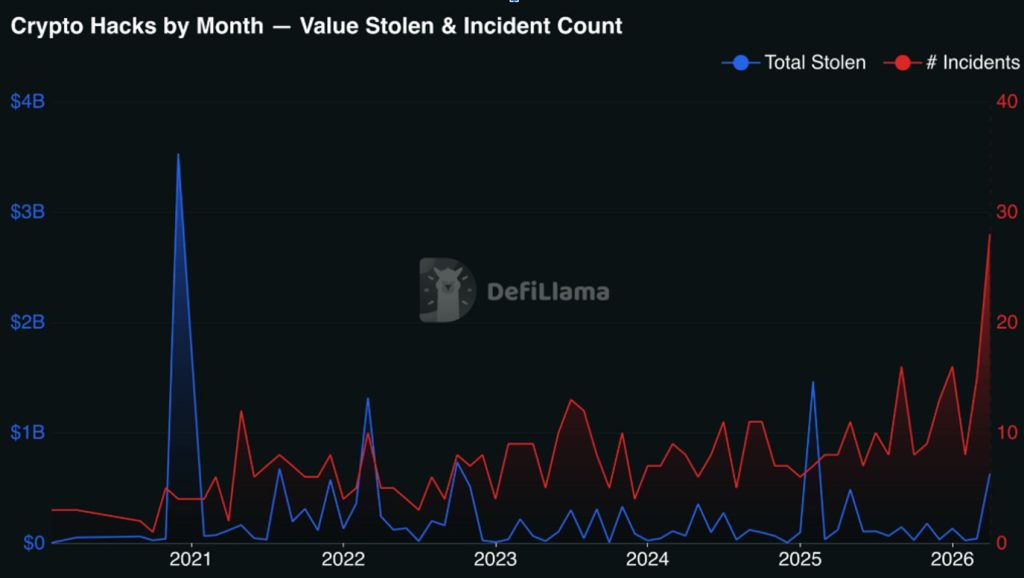
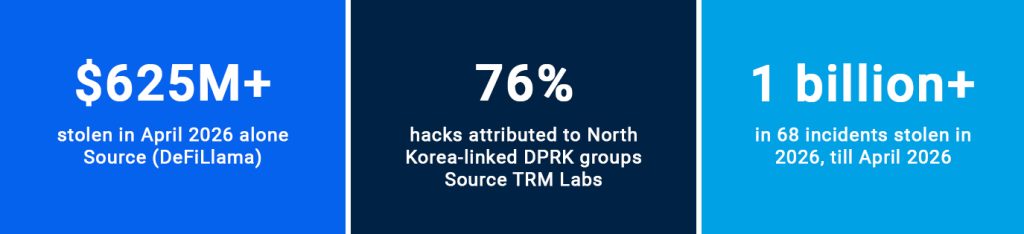
As per DeFiLama, April 2026 was one of the most alarming months in crypto history, with 30 exploits and 625M worth of losses. Till April 2026, more than 1 billion was stolen in more than 68 incidents. The aftermath of an attack even compounded to a major lending protocol crashing, triggering $13 billion in DeFi outflows, and a forced derivatives exchange emergency shutdown.
The artificial intelligence-powered attackers, nation-state-backed hacking groups, and newly discovered infrastructure vulnerabilities are attacking every layer of crypto exchange architecture. It is still a pessimistic narrative to consider AI-powered threats as mere risks. They are actually an opportunity in disguise that Binance understood very well. Between early 2025 and Q1 2026, Binance’s security infrastructure intercepted around 22.9 million scam and phishing attempts, safeguarding $1.98 billion in user funds in Q1 2026.
The core question facing every crypto exchange software operator in 2026 is whether their crypto exchange infrastructure can survive the encounter. This blog maps the threat landscape, dissects the four dominant attack vectors, and lays out a 10-point security hardening playbook for the safest crypto exchange development in 2026.
Why is It Urgent For Cryptocurrency Exchange Software To Harden Its Security?
The crypto security landscape underwent a structural inflection in early 2026, not just with the volume of exploits increasing, but also with the architecture of attacks changing. What cybersecurity researchers had warned about for years materialized in April when nation-state actors deployed AI to identify vulnerabilities, design exploits, and execute attacks at machine speed. TRM Labs, the blockchain forensics firm whose investigator Nick Carlsen served as an FBI analyst specializing in North Korean crypto crime, confirmed that the sophistication of April’s attacks makes it ‘highly likely the attackers used AI to select targets and design exploits’. He further emphasized the behavior change, saying, “This is all stuff North Korea never used to do”.
“DPRK’s share of global crypto hack losses has risen from below 10% in 2020 and 39% in 2024, to 76% in April 2026. The pattern, as noted by cybersecurity firms, is not just the increase in the number of attacks but more precise targeting.”
How Does AI Amplify Crypto Attacks?
Cryptocurrency exchange software operators must know that AI amplifies attacks in two ways:
- Lowers the cost and skill threshold for vulnerability discovery: Binance’s own security research found that ‘AI is currently better at exploitation than detection’ with the cost of attack dropping to $1.22 per contract. What required a team of five or six red teamers can now be done by an AI-equipped human over a weekend.
- Enables new attack categories: A developer named Vitto Rivabella proposed that North Korean attackers may now operate an autonomous AI model trained on years of exploit data. These agents are capable of scanning deployed contacts for known vulnerability patterns, including:
- Single admin Keys
- Missing Timelocks
- Upgradable Proxies
He further stated that they may execute drains before human auditors can even respond.
Schedule a Free Security Architecture Review
Top 4 Attack Vectors For Crypto Exchange Software In The Age Of AI
- AI-Augmented Social Engineering
Drift protocol, a Solana derivatives crypto exchange software, was drained of $285 million in roughly 12 minutes. But the attack took around six months to set up. Threat actors, later attributed to notorious North Korea’s TraderTraitor group, spent months posing as a legitimate quantitative trading firm. They leveraged AI to build a fake quant trading identity, generate convincing communications, and manage months of relationship cultivation across a distributed contributor network.
The crypto exchange software’s TVL collapsed from $550 million to $300 million within an hour. Drift shut down entirely and is rebuilding itself after securing a $148 million rescue package led by Tether. However, Carrot, which was a smaller protocol that had routed user funds through Drift-integrated vaults, announced that it was shuttering completely.
- Infrastructure Poisoning and DVN Single Points of Failure
On April 18, 2026, North Korea’s TraderTraitor group drained $292 million from the KelpDAO rsETH bridge, a cross-chain application built on LayerZero. The breach began on March 6, which was six weeks before money moved, when a LayerZero developer was socially engineered into installing macOS malware via a malicious GitHub repository. The attacker harvested session keys, spent six weeks infiltrating LayerZero’s RPC cloud environment, poisoned two internal Kubernetes nodes to return forged blockchain state, and launched a simultaneous DDoS on external fallback RPC providers. The DVN signed a valid attestation for a forged transaction, and $292M was released, enabled by a 1-of-1 DVN configuration that allows a single verifier to authorize a nine-figure transaction.
AI was potentially involved in the reconnaissance and target-selection phase, but not proven in the execution. The attackers deposited $200M of proceeds as collateral on Aave, triggering a crisis of confidence that pulled $9 billion from the lending protocol in two days and caused $13 billion DeFi TVL evaporation in 48 hours. Lombard Finance subsequently migrated $1B in bitcoin-backed assets from LayerZero to Chainlink CCIP, and Solv Protocol moved $700M in tokenized Bitcoin infrastructure away.
- AI Prompt Injection on Automated Trading Bots
Bankr, an AI-powered crypto trading agent letting users execute trades via natural language prompts, had 14 user wallets drained. Losses ranged up to $150,000 per wallet, and blockchain investigators traced attacker-controlled wallets holding $440,000 in crypto.
SlowMist founder Yu Xian attributed the breach to prompt injection, a technique where malicious instructions are fed to an AI to manipulate its behavior. In this case, the attacker exploited the trust layer between Grok (X’s AI) and Bankrbot, pushing through unauthorized transaction approvals by manipulating how the automated agents communicated. The breach mirrors an earlier incident where malicious prompts embedded in social interactions tricked Grok into launching a token and pulling funds to an attacker-controlled wallet.
As AI-agents gain direct financial execution authority to authorize trades, move funds, and deploy tokens, prompt injection attacks become a category-one threat that any existing or crypto exchange development project needs to address. Bankr’s architecture that enables auto creation of wallets for every X account interacting with the bot created a massive, low-friction attack surface. Therefore, those planning AI-enabled crypto exchange development must be very careful when creating such vulnerable components.
- Deepfake Identity Attacks and Wrench Attack Escalation
CertiK tracked around 34 ‘wrench attacks’ which include physical violence or coercion targeting crypto holders, between January and April 2026, causing approximately $101 million in losses.
THORChain co-founder JP Thor lost $1.3 million in a separate incident where attackers used a fake video feed impersonating a friend on a deepfake Zoom call before triggering a malicious script. The script copied files from his iCloud documents folder, exposing MetaMask credentials.
Binance CSO Jimmy Su flagged poisoned AI tool distributions as another 2026 escalation vector. Search engine ad results are being systematically hijacked to serve malicious AI tool downloads, and when users install them, malware silently exfiltrates private keys and account credentials. This vector is particularly dangerous because the user believes they are installing a legitimate productivity tool.
Apart from this, AI-generated deepfake KYC bypass attempts are also surging. Binance’s models now continuously update against ‘physical masks, static photo spoofing, deepfake video, and synthetic face swaps, a constant arms race in identity verification.
How Leading Crypto Exchanges Are Building Defenses Against AI in 2026?
Coinbase CSO Phillip Martin stated that the exchange is in ‘close communication’ with Anthropic for its Claude Mythos, which is deemed too dangerous for public release due to its hacker-level reasoning and automated vulnerability discovery capabilities. The exchange confirmed that it would be leveraging it to build an AI-immune crypto exchange ecosystem. Apart from the leading crypto exchange software, Binance and Fireblocks are in partial negotiations, but all of them found themselves outside Anthropic’s initial rollout that granted Amazon, Google, and JPMorgan early seats.
Crypto ISAC, with Coinbase and Ripple as leading contributors, also launched its automated threat intelligence API in early 2026. It distributes DPRK actor profiles, IOCs, and wallet blacklists in real-time via STIX/TAXII to member security operations centers. Ripple’s contribution includes contextually enriched DPRK IT worker details, which entail their LinkedIn profiles, email addresses, locations, and correlated campaign signals that allow member exchanges to detect infiltration attempts across the industry simultaneously.
Binance’s AI security report 2026 reveals that the secure crypto exchange software now runs around 24 initiatives powered by over 100 AI models. In just Q1 2026, it has identified 22.9 million deepfakes, phishing scams, and AI social engineering attacks. They have collectively dodged attacks on $10.53 billion worth of user assets, safeguarding more than 5.4 million users. The crypto exchange’s security approach centers on the Strategy Factory risk engine, which continuously recombines rules and machine-learning models to flag abnormal behavior at login, trading, and withdrawal stages. Binance also published in its report that its AI defense system successfully cut phishing rates by 8x, illicit fund exposure by 96%, and increased KYC processing throughput by 100x.
Apart from these leading exchanges and crypto firms, OpenAI, in May 2026, launched ‘Daybreak’, an AI-driven cybersecurity initiative offering continuous pre-deploy and runtime protections. It enables AI-assisted code review, threat monitoring, patch validation, and dependency analysis. For crypto exchange software accustomed to point-in-time audit certifications, Daybreak provides a model for transitioning to continuous operation security.
The US Treasury’s OCCIP April 2026 initiative extends the same cyber threat intelligence that traditional US financial institutions receive to eligible crypto firms at no cost. It includes real-time threat indicators, malicious IPs, and other known attack vectors. US-based cryptocurrency exchanges can now access nation-state threat intelligence on par with JPMorgan and Bank of America.
Build an Unshakable Crypto Exchange With Antier
2026 Crypto Exchange Security Playbook: The 10-Layer Defense Architecture
If you’re planning your crypto exchange development in 2026, these are some security primitives that you can’t miss.
| # | Defense Layer | What to Implement | Urgency |
| 1 | Multi-DVN Redundancy | Minimum 2-of-2 independent DVNs on all cross-chain bridges. Ideally, it should be 3-5. LayerZero’s new default is 3-of-3. Never rely on 1-of-1 configuration for any live bridge. | CRITICAL |
| 2 | MPC Wallet Architecture | Replace single-key hot wallets with an MPC custody solution to ensure the private key is never generated or stored in a single centralized location. Use Fireblocks/BitGo/Anchorage for cold tier if below $5B AUC. | CRITICAL |
| 3 | Zero Trust Architecture (ZTA) | Authenticate every API call, including internal ones. Implement the least-privilege RBAC model. Also, adopting short-lived credentials with JIT elevation and multi-person authorization for IAM changes is effective during crypto exchange development | HIGH |
| 4 | AI-Powered Threat Detection | Deploy real-time AI monitoring across logins, withdrawals, and trading on your crypto exchange software. Binance’s security architecture is ideal for any upcoming crypto exchange development project to adopt. | HIGH |
| 5 | Circuit Breakers | Automated pause or limit on transactions exceeding set thresholds buys response time during an exploit. Jupiter’s model is the 2026 industry benchmark. | HIGH |
| 6 | Multi-Source RPC Quorum | DVN signing services must read from multiple independent RPC sources with geographic diversity. Failover logic must never reduce security under DDoS pressure. | HIGH |
| 7 | AI Agent Sandboxing | Isolate all AI trading agents (including third-party bots). Crypto exchange software must implement strict authorization before any financial action. There should be no implicit trust between AI systems. The AI-agent modules in exchanges can also deploy post-Bankruptcy prompt injection guards. | MEDIUM |
| 8 | Employee Security Hygiene | Dedicated signing devices must be mandated for sensitive operations. Anti-deepfake verification for video calls and anomaly detection must be set up on all developer machines. The crypto exchanges can also consider Drift’s post-attack session key rotation policies. | MEDIUM |
| 9 | Withdrawal Protection Controls | Crypto exchange software can implement Binance-inspired user-controlled withdrawal delays and freeze options. Also integrate real-time pop-up alerts for withdrawal anomalies. | MEDIUM |
| 10 | Threat Intel Sharing | Enroll in Crypto ISAC. Integrate Coinbase/Ripple shared DPRK IOC feeds via STIX/TAXII. If you are a crypto exchange software operating in the US, you can enroll in Treasury OCCIP for bank-level threat intelligence. | MEDIUM |
Get Your Personalized Crypto Exchange Security Playbook
Conclusion: The Security Infrastructure Race Is No Longer Optional
April 2026 changed the calculus for every crypto exchange operator. When a single month produces $625M in losses from 30 coordinated attacks, with AI-equipped actors systematically targeting every layer of exchange infrastructure, security has moved from a competitive differentiator to an operational requirement.
Whether you are a
- Startup founder racing to market before the next bull run
- Fintech CTO adding crypto to product stack
- VARA-licensed operator expanding your offering
- Stock exchange exploring tokenized asset trading,
The threat environment you are building your crypto exchange software into is fundamentally more dangerous than it was twelve months ago. The crypto exchanges that survive and scale will be the ones that treat security as infrastructure and not as a compliance checkbox.
How Antier Helps
Antier has been building institutional-grade crypto exchange and DeFi infrastructure since the industry’s formative years. Our security engineering team works as per the 2026 threat landscape and not last year’s audit checklist.
We believe in designing crypto exchange software development with a hardened security architecture. We specialize in the following:
- MPC wallet architecture and multi-signature cold storage design (Fireblocks / BitGo / in-house)
- Zero Trust Architecture implementation for exchange APIs and internal systems
- AI-powered fraud detection and real-time anomaly monitoring across login, trading, and withdrawal layers
- Cross-chain bridge security audits with multi-DVN configuration and RPC quorum hardening
- Regulatory compliance engineering for US (SEC/CFTC/OCCIP), UK (FCA/FSMA), UAE (VARA), Australia (AUSTRAC)
- Circuit breaker and withdrawal protection system design
- AI agent sandboxing and prompt injection guard implementation for DeFi and AI trading integrations
Antier helps businesses overcome all three fears with secure crypto exchange development, legal compliance expertise, and pre-built modules for faster time-to-market. Get in touch to share your requirements.
Frequently Asked Questions
01. What was the biggest crypto exchange hack in 2026?
KelpDAO ($292–293M, April 18) and Drift Protocol ($285M, April 1), both attributed to North Korea's TraderTraitor group. Together they represent 76% of all crypto hack losses in 2026 through April. April 2026 overall saw 30 exploits and $625M+, the most-hacked single month in crypto history.
02. As a startup founder, what security must I have at launch?
Three non-negotiables at MVP launch: (1) MPC wallet architecture: no single-key operational wallets under any circumstances; (2) Multi-DVN configuration on every bridge: minimum 2-of-2, never 1-of-1; (3) Timelock on all admin key operations: even a 24-hour delay stops most drain scenarios. These three alone would have prevented five of the major 2026 incidents documented in this report.
03. How are AI agents being used to attack exchanges, and how do I defend?
In the Bankr breach (May 20, 2026), attackers used prompt injection to manipulate the trust layer between automated AI agents (Grok and Bankrbot), pushing unauthorized transaction approvals without user interaction. Defense: sandbox all AI trading agents in isolated environments with no implicit trust between systems; require explicit multi-step authorization before any AI agent can move funds; and implement prompt injection guards that reject instructions embedded in social feed content.
04. I tried building this in-house, and it failed. What should I ask a development partner?
Ask three questions: (1) 'Show me a client in my exact situation: same stage, same geography, same exchange type, and put me on a call with them.' Any credible partner can produce this reference. (2) 'Walk me through your security architecture: specifically MPC custody, DVN configuration on bridges, and admin key timelocks.' If they cannot answer in concrete technical detail, they are not production-ready. (3) 'What does your delivery timeline look like, and what modules are already production-tested vs. being built fresh for me?' Battle-tested modules reduce your security surface and your timeline simultaneously.