



✨ AI Summary
- Blockchain wallets have evolved beyond being simple Bitcoin tools to becoming strategic infrastructure for enterprises such as banks, crypto exchanges, and gaming studios.
- These wallets manage public and private keys for digital assets including cryptocurrencies, tokens, and NFTs.
- They differ from banking apps by offering self-custody, on-chain settlement, and global transfers without traditional banking cut-off times.
- Today's cryptocurrency wallets offer features like multi-currency support, enhanced security measures, interoperability with various blockchain networks, and improved user experience.
- They can be used for various enterprise use cases such as banking and fintech, gaming, and corporate treasury.
What Is a Blockchain Wallet and Why Does It Matter for Enterprises in 2026?
A blockchain wallet app is software or hardware that manages public and private keys to send, receive, and store digital assets such as crypto, tokens, NFTs, and tokenized RWAs. The assets do not physically live inside the wallet; they remain on blockchain platforms, while the wallet signs transactions and controls access.
A crypto wallet solution differs from a banking app because it enables self-custody, 24/7 on-chain settlement, programmable money, and global transfers without traditional banking cut-off times. USDC can move across borders quickly, tokenized bonds can distribute yield through smart contracts, and NFT-based tickets can represent ownership and access rights.
The market has evolved fast. In 2012–2014, a cryptocurrency wallet was often a simple Bitcoin tool. Today, a crypto wallet app may support staking, DeFi, decentralized applications, identity credentials, NFT wallets, and real-time transaction tracking across multiple chains. For enterprises, wallets are no longer retail trading accessories. They are strategic infrastructure for banks, neobanks, crypto exchanges, RWA issuers, gaming studios, and corporate treasury teams.
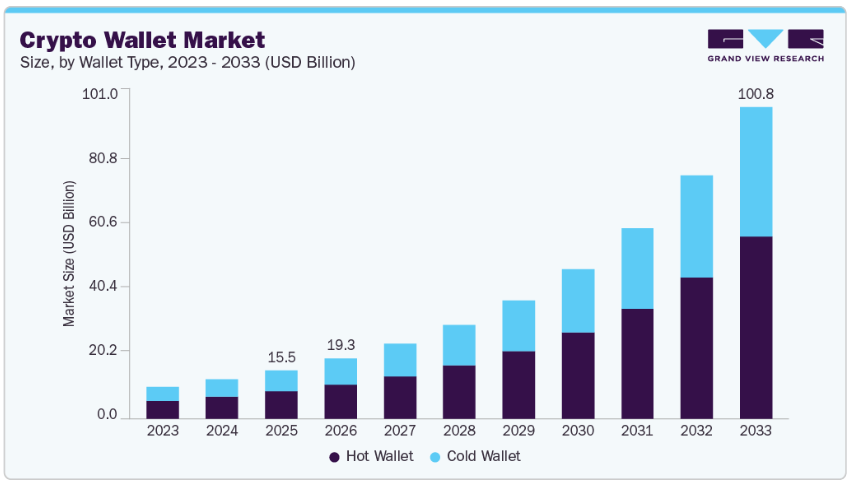
Source link: https://www.grandviewresearch.com/industry-analysis/crypto-wallet-market-report
Key 2025-2026 trends include the following:
- Greater regulatory clarity for stablecoins and custody, including frameworks such as MiCA in Europe.
- Rising institutional use of stablecoins for settlement and crypto payments.
- Interoperability with various blockchain networks and improved user experience through user-friendly designs are anticipated to be key features of future cryptocurrency wallets.
Types of Crypto Wallets: Custodial vs Non-Custodial, Hot vs Cold
Cryptocurrency wallet development design choices define your risk exposure, user experience, compliance workload, and operating model.
- Custodial crypto wallets are managed by a third party, which secures the keys for the user. These include exchange platforms, fintech apps, and bank-operated online wallets. The benefits are smoother onboarding, account recovery, support, and compliance control. The trade-off is liability: the provider becomes responsible for safeguarding crypto assets and meeting licensing expectations.
- Non-Custodial crypto wallets provides total ownership and control over private keys to the user. Non-custodial wallets reduce custody risk for the enterprise, but if a user loses their recovery phrase for a non-custodial wallet, their funds are permanently lost. That makes education, backup flows, and recovery design critical.
- Cryptocurrency wallets can be categorized into two main types: hot wallets, which are connected to the internet, and cold wallets, which are offline storage solutions. Hot wallets are typically used for everyday transactions due to their convenience, while cold wallets are preferred for long-term storage because they offer enhanced security against online threats.
- Cold wallets include hardware wallets and paper wallets, which provide a secure way to store cryptocurrencies without being exposed to the internet, thus minimizing the risk of hacking. Most experienced users utilize a hybrid approach: storing long-term investments in a cold wallet while keeping smaller amounts in a hot wallet for daily use.
For enterprises, hot and cold wallets usually work together:
| Use case | Typical model |
|---|---|
| DeFi wallet | Non-custodial hot wallet with strong transaction signing UX |
| Cryptocurrency exchanges | Custodial hot wallets plus cold storage treasury |
| Corporate treasury | Cold wallet, MPC, HSM, and multi-signature support |
| Web3 game | Embedded mobile wallet with gas abstraction |
| RWA platform | Hybrid custody with KYC, whitelists, and reporting |
Hybrid models such as MPC, warm wallets, and multi-signature setups balance speed with security layers for trading desks, payment flows, and decentralized platforms.
Core Features Modern Crypto Wallets Must Support
Feature requirements differ across retail wallets, institutional custody, and embedded fintech or gaming wallets. Still, every secure wallet in 2026 needs a clear feature baseline.
Key features include:
- Security features: end-to-end encryption, secure key generation, multi-factor authentication, two-factor authentication (2FA), biometric authentication, biometric login, MPC, HSMs, and regular audits.
- Multi-currency support: multi-currency wallets allow users to manage various cryptocurrencies like Bitcoin and Ethereum in a single interface, simplifying the process of sending, receiving, and storing digital assets.
- Broad asset support: support for multiple cryptocurrencies is essential for wallets, enabling users to transact with various digital assets without needing separate wallets for each currency.
- Chain coverage: Bitcoin, Ethereum, Polygon, Solana, BNB Chain, layer-2s, private EVM chains, and coin-specific wallets when needed.
- Token standards: ERC-20, ERC-721, ERC-1155, NFTs, stablecoins, and tokenized real-world assets.
- UX: clean onboarding, gas abstraction, QR payments, seed phrase alternatives, transaction explanations, and fiat on/off-ramps.
- Web3: DApp browser, WalletConnect-style connectivity, staking, swaps, NFT gallery, and integrations with decentralized applications.
- Compliance: KYC/AML, transaction monitoring, sanctions screening, wallet analytics, on-chain risk scoring, and exportable reports.
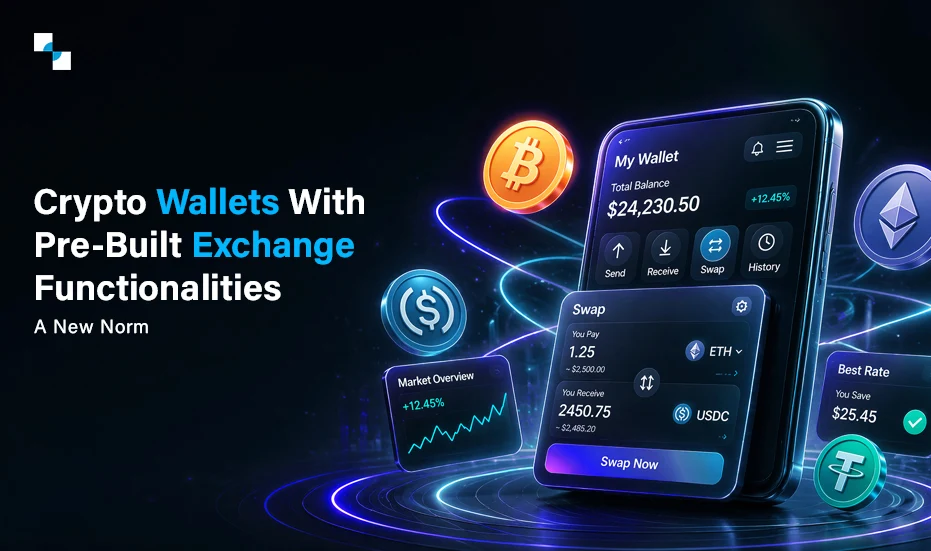
Many cryptocurrency wallet solutions now offer features like integrated exchanges, allowing users to trade between different cryptocurrencies directly within the wallet, enhancing usability and convenience. This enables users to manage multiple currencies in the same wallet instead of switching apps.
Enterprise Use Cases for Blockchain Wallets
A blockchain wallet can create revenue, reduce settlement friction, and support digital transformation.
- Banking and fintech: Banks can launch crypto accounts, stablecoin payment rails, loyalty token wallets, and yield-bearing products. These usually require custodial wallets, automated KYC/AML, core banking integration, and cold storage reserves.
- RWA tokenization: Wallets can hold tokenized bonds, real estate shares, carbon credits, invoices, and fund units. This requires KYC, transfer restrictions, smart contracts, reporting, and sometimes both custodial and non-custodial options.
- Gaming and metaverse: A game may need an in-game multi-currency wallet for tokens, skins, NFTs, and marketplace payments. Gas abstraction and mobile wallet UX are essential.
- Corporate treasury and B2B payments: Enterprises can use wallets for stablecoin settlement, programmable payouts, global supplier payments, and policy-based approvals.
- Identity and access management: Wallets can store decentralized identifiers, verifiable credentials, and access keys for enterprise applications.
How to Choose the Right Crypto Wallet Development Company?
Selecting a blockchain wallet development company is similar to selecting a cloud provider or core banking vendor. It affects your security, compliance, scalability, and customer experience for years.
However, here is a wide range of curated lists of specialized and experienced companies that excel in offering solutions designed to meet business’s needs. Explore and choose the best with the right approach>>>> https://www.antiersolutions.com/blogs/a-complete-enterprise-guide-on-the-top-blockchain-wallet-development-companies-of-2026/
Before choosing a cryptocurrency wallet development company, evaluate:
- Production experience in cryptocurrency wallet development since at least 2017–2018.
- Portfolio across custodial, non-custodial, mobile, web, browser extension, and hardware integrations.
- Multi-chain and multi-currency expertise across major and emerging ecosystems.
- Secure SDLC, penetration testing, dependency scanning, code review, and audit readiness.
- Familiarity with ISO 27001, SOC 2, PCI DSS, and institutional security practices.
- Regulatory awareness around AML, KYC, travel rule, MiCA, SEC/FINRA expectations, and local licensing.
- Capabilities beyond coding: blockchain consulting, UX research, tokenomics, DevOps, AI, and 24/7 support.
It is recommended that you always choose a white label crypto wallet development company that supports enterprises from concept to post-launch optimization.
Check Antier’s Blockchain Wallet Development Services
Antier and its vast team of certified and skilled professionals deliver enterprise-grade cryptocurrency wallet development services for banks, fintechs, exchanges, gaming platforms, RWA issuers, and Web3 startups. Our blockchain expertise spans wallet infrastructure, tokenization, DeFi, identity, gaming, AI agents, and enterprise blockchain development.
We design wallets as greenfield builds, embedded wallet modules, white label crypto wallet products, or customized solutions for faster launch. Antier’s development services cover custodial wallets, non-custodial wallets, hybrid MPC models, and customized solutions for regulated institutions.
Our blockchain wallet development services include:
- Discovery workshops and product strategy
- Wallet architecture and custody model design
- UI/UX for web, extension, and mobile wallet products
- Blockchain integration and smart contract development
- KYC/AML, analytics, custody, exchange, and payment integrations
- QA, security testing, deployment, and ongoing maintenance
The future of cryptocurrency wallets will likely include innovations such as cold storage advancements, biometric identification, and AI-powered security measures to enhance asset protection. Antier applies AI for fraud detection, anomaly detection, risk scoring, intelligent support copilots, and transaction monitoring under our “Trust Empowering Intelligence” philosophy.
Connect With The 100% Efficient Web3 Wallet Dev Team!
How To Develop A Blockchain Wallet In Simple Steps?
Our blockchain wallet development process is structured to reduce technical risk, accelerate launch, and support compliance from day one.
- Discovery and strategy: We define users, jurisdictions, revenue model, supported digital currencies, chain selection, and custodial vs. non-custodial requirements.
- Solution architecture: We choose wallet type, key management model, node infrastructure, indexers, APIs, monitoring, and security layers.
- UI/UX design: We design wallets with simple onboarding, QR payments, gas abstraction, clear confirmations, and regional localization.
- Development and integration: Our development team builds back-end services, front-end apps, smart contracts, exchange integrations, KYC/AML flows, and analytics connectors.
- Testing and security: We run unit tests, integration tests, load testing, penetration testing, and third-party audit preparation.
- Deployment and operations: We support cloud or on-prem deployment, CI/CD, incident response, SLAs, and product iteration.
As a renowned development company, Antier can design wallets for exchanges, enterprises, and decentralized platforms while keeping the development process transparent and procurement-friendly.
Security, Compliance, and Risk Management for Wallets
Security and compliance are non-negotiable for institutional crypto wallets. Past failures across the market show that weak key management, poor governance, and inadequate controls can destroy trust quickly.
Implementing two-factor authentication (2FA) and advanced encryption are essential security measures for cryptocurrency wallets to protect digital assets from unauthorized access. Multi-signature support in cryptocurrency wallets minimizes the risk of unauthorized spending by requiring multiple approvals for transactions, enhancing overall security.
Cold wallets, which are offline storage solutions, provide a higher level of security for cryptocurrency assets compared to hot wallets, which are connected to the internet. Technical controls should include HSMs, MPCs, encrypted databases, secure APIs, device binding, whitelisted addresses, spending limits, and continuous monitoring.
Compliance with regulations such as AML (Anti-Money Laundering) and KYC (Know Your Customer) is essential for cryptocurrency wallet providers to ensure legal operation and build user trust. The integration of automated KYC/AML features in cryptocurrency wallets enhances compliance and helps in identifying suspicious transactions effectively. Regulatory compliance in cryptocurrency wallet development is crucial for meeting national and international laws, which fosters end-user trust and ensures the product’s legal standing.
Technology Stack and Integration Options
Technology choices should follow business goals, target users, compliance, and ecosystem strategy.
Hire a company that holds years of experience in working with Bitcoin, Ethereum, Polygon, BNB Chain, Solana, Hyperledger Fabric, and private EVM networks. Front-end options include native iOS/Android, React Native, Flutter, web apps, and browser extension wallets.
Back-end stacks typically include microservices, REST/GraphQL APIs, cloud providers such as AWS, Azure, or GCP, containerization, orchestration, node infrastructure, monitoring, and wallet analytics. Enterprise integrations can include core banking, CRM, ERP, SSO, OAuth, SAML, payment gateways, custody providers, DeFi protocols, NFT marketplaces, and RWA tokenization platforms.
Cost, Timelines, and ROI Considerations
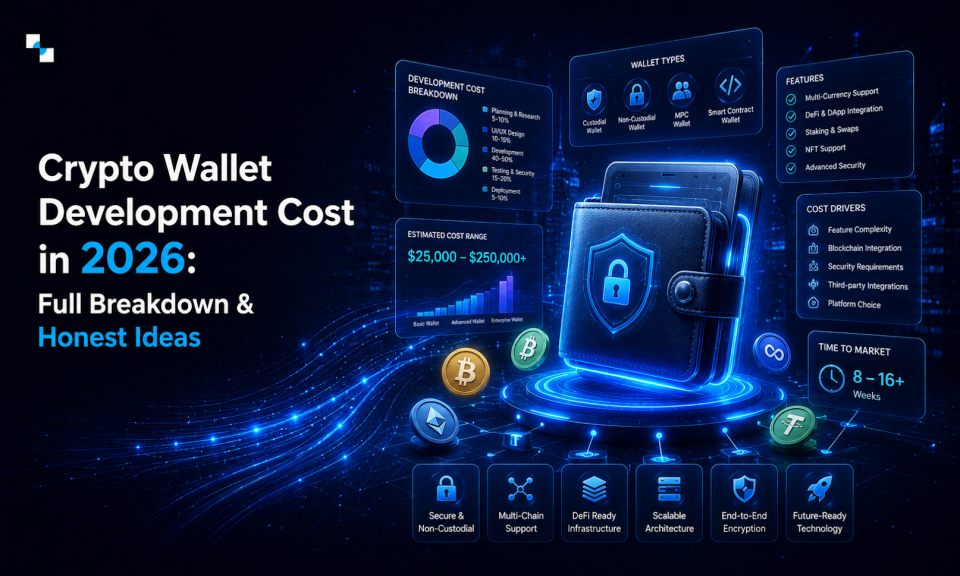
Budget and timelines depend on complexity, chain count, custody model, compliance scope, and expected transaction volume.
A focused MVP with send/receive, basic KYC, and one or two chains may take 12–20 weeks. A full institutional platform with DeFi, NFT support, policy engines, multi-chain routing, and advanced analytics often takes 6–9 months.
Cost drivers include custom cryptocurrency wallet vs. white-label, number of integrated chains, smart contract scope, compliance integrations, security audits, infrastructure SLAs, and ongoing support. ROI can come from trading fees, spreads, payment fees, lower settlement costs, faster cross-border payments, new tokenized products, and improved retention.
Antier can help create a business case with user growth, volume, and OPEX scenarios.
Why Do Enterprises Choose Antier as Their Wallet Development Company?
Enterprises choose Antier because we combine crypto development, blockchain solutions, AI, compliance thinking, and production delivery. We are positioned among the best blockchain development companies for organizations that need more than software solutions; they need a long-term execution partner.
Our cross-domain expertise includes cryptocurrency wallet development, RWA tokenization, DeFi, stablecoins, Web3 gaming, metaverse platforms, identity management, AI agents, and intelligent document processing. If you are planning a blockchain wallet roadmap, our team can help align technical execution with business outcomes.
Frequently Asked Questions
01. How long does it take to launch a production-ready enterprise crypto wallet?
A focused MVP with a mobile or web wallet, core send/receive, basic KYC, and one or two chains typically takes 12–20 weeks. Advanced DeFi, NFT, multi-chain routing, enterprise policy engines, and institutional governance can extend delivery to 6–9 months.
02. Can we integrate a new wallet with our existing banking or fintech application?
Yes. Most enterprise wallets Antier builds are API-first, using secure APIs for wallet operations, webhooks for transaction events, and connectors for KYC/AML, core banking, payments, and back-office systems. Depending on your product, Antier may recommend an embedded wallet, a white-label app, or a standalone product with SSO.
03. What level of control do we have over private keys and custody models?
You can choose full custodial control, user-controlled non-custodial wallets, or shared control through MPC or multi-sig. Antier designs private keys, transaction signing, recovery, and governance flows around your risk policy and regulatory obligations.