


AI Summary
Overview of how tokenization in the U.S. operates within established securities regulations and compliance frameworks
Detailed breakdown of platform layers, including legal structuring, licensing, and blockchain integration
Clear outline of key roles such as issuers, broker-dealers, custodians, and ATS in platform operations
Real-world example demonstrating how compliant tokenization models are structured and executed.
Tokenization has often been positioned as a force of disruption—challenging traditional finance by introducing decentralization, democratized access, and frictionless asset exchange. While this narrative holds relevance in emerging markets, it does not accurately reflect the operational and regulatory realities of the United States.
In the U.S., tokenization does not replace financial systems—it integrates into them.
At its core, tokenization is the process of representing ownership rights in real-world assets through blockchain-based digital tokens. However, these tokens are not independent instruments. They are digitized securities, governed by the same legal, financial, and compliance frameworks that regulate traditional instruments such as equities, bonds, and fund units.
This shifts the strategic lens entirely. The challenge is no longer about innovation alone—it is about engineering a compliant, scalable financial infrastructure layer that aligns with institutional expectations, regulatory scrutiny, and market maturity.
Organizations that recognize tokenization as infrastructure evolution rather than disruption are better equipped to design platforms that can sustain long-term adoption, attract institutional capital, and operate without regulatory friction.
Core Components of Tokenized Securities: A Deep Functional Breakdown
A tokenized securities platform is a multi-dimensional system where legal, financial, and technological components converge. Each layer must function cohesively to ensure compliance, scalability, and operational efficiency.
- Tokenization: Converting ownership rights in a real-world asset (building, bond) into a digital token on a blockchain.
- SEC: Securities and Exchange Commission — the U.S. federal body that regulates all securities. If your token qualifies as a security, they govern you.
- Broker-Dealer: A licensed firm that can buy and sell securities on behalf of clients. Required to legally distribute tokenized securities.
- Custodian: An institution that safekeeps assets on behalf of others. For tokenization, they hold both the underlying asset AND the digital tokens.
- KYC / AML: Know Your Customer / Anti-Money Laundering. Mandatory identity verification and transaction monitoring for all regulated financial products.
- Reg D / A+ / S: SEC exemptions for securities issuance. Reg D = accredited investors only. Reg A+ = up to $75M, broader audience. Reg S = non-U.S. investors.
- Security: A financial instrument — stock, bond, fund share — representing ownership or a claim. Regulated by the SEC.
- SPV: Special Purpose Vehicle — a separate legal company created to hold one asset. The legal wrapper between the real asset and the token.
- ATS: Alternative Trading System — a regulated venue for securities trading. Think of it as a specialized exchange. Required for secondary token trading.
- Transfer Agent: Records and maintains ownership of securities. On a blockchain, this function can be partially automated via smart contracts.
- Smart Contract: Self-executing code on a blockchain that automatically enforces rules — like “only transfer to KYC’d wallets” or “pay dividends on this date.”
- Accredited Investor: Under U.S. law, an individual with net worth >$1M (excluding home) or income >$200K/yr. Most tokenized securities restrict this group.
Tokenization Does Not Remove Regulation
A persistent misconception is that blockchain eliminates intermediaries and regulatory oversight.
In reality, tokenization operates within:
- Federal securities laws
- FINRA regulations
- State-level compliance requirements
- Mandatory identity verification systems
Attempting to bypass these layers introduces significant legal risk.
However, this complexity also creates a competitive moat. Platforms that successfully navigate regulatory requirements gain credibility, institutional trust, and long-term sustainability.
Talk to Our RWA Infrastructure Experts
The Five-Layer Stack: Engineering Tokenization Platforms
Before diving into execution, it’s important to understand that tokenization platforms are built through a structured, multi-layered approach, not just technology deployment. Each layer—from regulatory alignment to system design—must work cohesively to ensure compliance, scalability, and seamless integration with financial ecosystems.
Layer 1: Regulatory Structuring as the Foundation
Every platform begins with defining its regulatory pathway. This includes:
- Selecting SEC exemptions
- Structuring disclosures and compliance workflows
- Defining investor eligibility
This layer determines how the platform operates across its lifecycle.
Layer 2: Licensing and Role Alignment
Tokenization requires multiple regulated roles, each with licensing requirements. Platforms must either:
- Acquire licenses internally
- Partner with licensed entities
This layer ensures that every function—from issuance to trading—is legally compliant.
Layer 3: Federal-State Compliance Mapping
Navigating the dual regulatory structure of the U.S. requires:
- Aligning with federal securities laws
- Managing state-level financial regulations
- Structuring operations for multi-jurisdictional scalability
This adds complexity but ensures operational resilience.
Layer 4: Ecosystem Orchestration
Successful platforms function as interconnected ecosystems involving:
- Issuers
- Broker-dealers
- Custodians
- Marketplaces
- Compliance providers
The ability to integrate these entities seamlessly defines platform success.
Layer 5: Blockchain as an Efficiency Multiplier
Blockchain enhances:
- Settlement speed
- Transparency
- Automation
- Accessibility
However, it operates within the broader compliance framework, acting as an optimization layer rather than a replacement.
The Six Functional Roles: Driving Platform Operations
While the architectural layers define how a tokenization platform is structured, its real-world execution depends on a set of interdependent functional roles that collectively enable issuance, distribution, compliance, custody, and liquidity. These roles are not optional—they are foundational to ensuring that tokenized assets operate within regulatory boundaries while delivering institutional-grade performance.
Each role contributes to a specific operational responsibility, and together, they form a cohesive, regulated financial ecosystem capable of supporting the full lifecycle of tokenized securities.
- Issuer (SPV / Fund)
Legal entity that owns the underlying asset and issues the token. Must be an SEC-compliant SPV or registered fund. Every tokenized asset needs one.
Required: SEC filing, legal structure, audited financials
- Broker-Dealer
Licensed entity that can legally distribute the tokenized security to investors. Earns placement fees. Can be a partner or in-house subsidiary for large platforms.
Required: FINRA registration, net capital requirements
- Custodian
Safekeeps both the underlying asset AND the digital tokens. Must be a qualified custodian — bank, trust company, or special-purpose broker-dealer.
Required: Qualified custodian status, insurance
- Transfer Agent
Maintains the official record of who owns what. On a blockchain, smart contracts can partially automate this — but legal responsibility stays with a registered transfer agent.
Required: SEC Transfer Agent registration
- ATS / Marketplace
Operates the secondary market where token holders can buy and sell. Think of it as a regulated exchange specifically for securities. Requires ATS registration with FINRA.
Required: ATS registration, FINRA membership
- KYC / AML Layer
Verifies investor identity, accreditation status, and screens for money laundering. Can be built into the token itself via transfer restrictions. Not optional.
Required: AML compliance program, SAR filing capability
How it Works
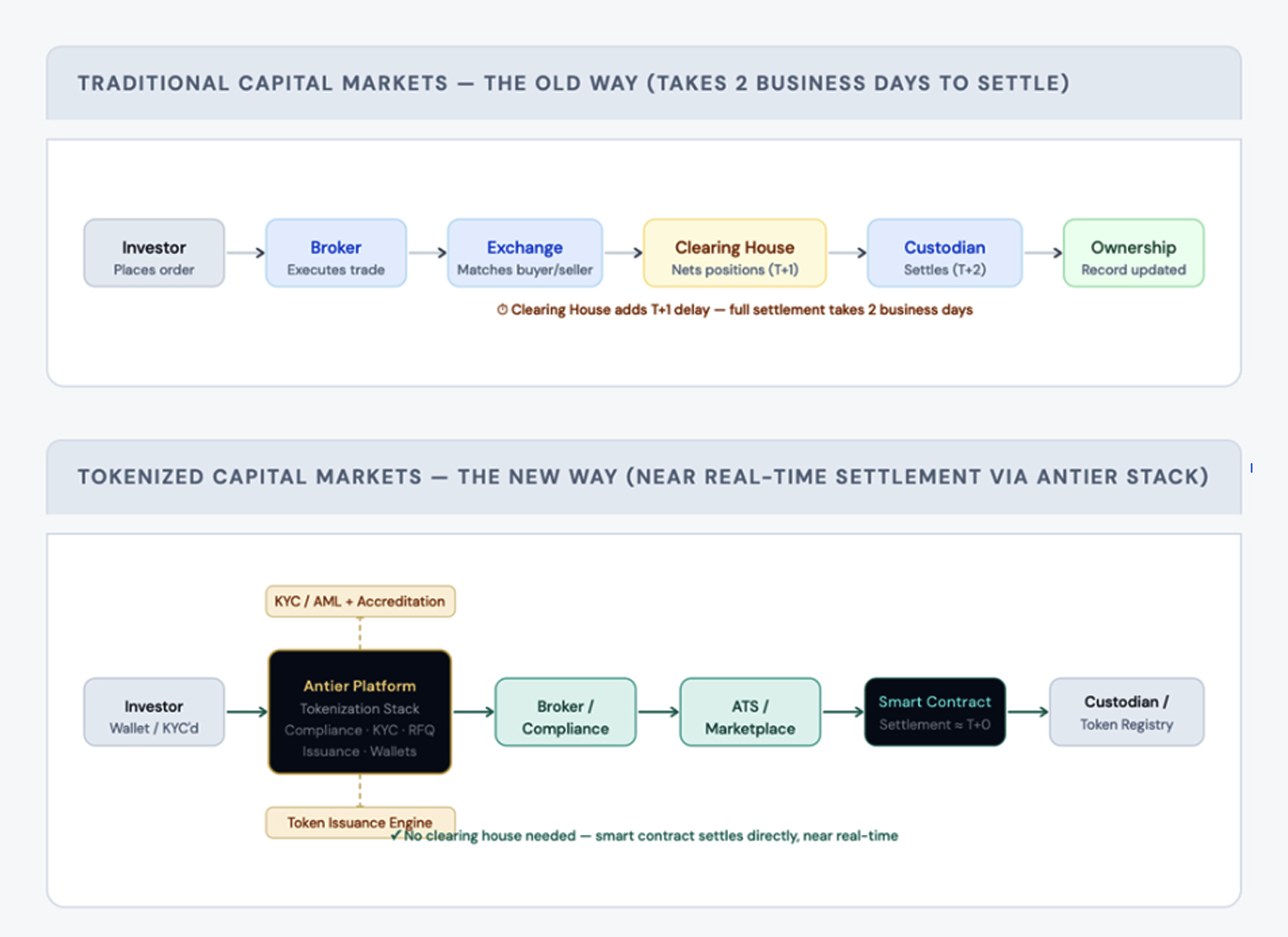
From Fragmentation to Integration: The Real Challenge
One of the biggest challenges in building tokenization platforms is not the availability of these roles—but their integration.
Disjointed systems can lead to:
- Data inconsistencies between on-chain and off-chain records
- Compliance gaps during asset transfer or trading
- Delays in settlement and reporting
- Increased operational complexity
To overcome this, platforms must adopt an integration-first approach, ensuring that all roles communicate seamlessly through unified infrastructure and standardized workflows.
How Ondo Finance Structured a Scalable Tokenization Model
01. Start with a High-Quality, Regulated Asset
Ondo focused on U.S. Treasuries—highly liquid, low-risk instruments trusted by institutions globally. This ensured immediate credibility, clear regulatory classification, and strong investor demand.
Lesson: Tokenize assets that already have institutional trust and liquidity.
02. Build the Legal Structure Before the Token
An SPV was created to hold the underlying assets and comply with SEC requirements. Investors gain exposure through the SPV, not direct asset ownership—making the structure legally sound.
Lesson: Legal structuring comes first; tokenization is layered on top.
03. Tokenize Legal Rights, Not Just Assets
Tokens represent economic interest in the SPV and include built-in compliance logic. Transfer restrictions ensure only eligible investors can hold or receive tokens.
Lesson: Embed compliance directly into the token contract.
04. Control Distribution Through Compliance
Access is limited to KYC-verified, accredited investors using wallet whitelisting. Smart contracts enforce these restrictions automatically.
Lesson: Controlled access is essential for regulatory alignment.
05. Enable Restricted but Real Liquidity
Secondary trading is allowed only among verified participants on compliant platforms, creating liquidity without violating regulations.
Lesson: Even restricted liquidity significantly enhances asset value.
Ondo succeeded by aligning with existing financial systems—delivering faster settlement, programmability, and liquidity within a compliant framework.
Antier’s Production-Ready Tokenization Ecosystems
Antier has built production-grade, compliance-embedded platforms for two distinct regulatory environments. Every module addresses a specific regulatory requirement — nothing is decorative.
United States Platform
ATS / Marketplace
A fully registered Alternative Trading System for secondary trading of tokenized securities. Allows token holders to buy and sell with other KYC’d investors — creating genuine liquidity without an exchange license. FINRA-compliant order management, trade reporting, and surveillance built in.
Transfer Agent Suite
SEC-registered transfer agent functionality built on-chain. Maintains the official cap table, processes transfers, handles corporate actions (dividends, splits, buybacks), and generates required regulatory reports.
Custody (3rd-party + Self)
Flexible custody architecture supporting both institutional third-party custodians (Fireblocks, BitGo, Anchorage) and self-custody via MPC wallets. Smart contract-enforced withdrawal controls. Qualified custodian API integrations.
Tokenization Suite
End-to-end asset issuance engine. Takes an asset from legal structuring (SPV creation support) through token minting, offering documentation, and investor distribution. Handles Reg D, Reg A+, and Reg S filings workflow.
Compliance Manager
Programmable KYC/AML at the token layer. Manages investor whitelists, accreditation verification, geographic restrictions, lock-up periods, and concentration limits — all enforced via smart contract.
RFQ Mechanism
Request-for-Quote engine for institutional block trades. When large investors want to buy or sell positions too large for the open order book, RFQ routes the order to a network of approved market makers for institutional-grade liquidity discovery.
Australia Platform
Marketplace
ASIC-compliant regulated asset trading venue. Handles both primary issuance and secondary trading of tokenized assets under Australian financial services law. Supports fractional ownership structures common in Australian real estate and infrastructure tokenization.
Investment Manager Suite
Portfolio and fund management layer for institutional investment managers. Supports multiple fund structures (managed investment schemes, wholesale funds), automated unit pricing, investor portal, and ASIC reporting. Handles performance fee calculations and waterfall distributions on chain.
Asset Manager Suite
Full lifecycle asset management across tokenized classes including property, infrastructure, and fixed income. Handles valuations, income distributions, capital calls, and investor reporting. Built to AFSL holder requirements.
Transfer Agent Suite
Regulatory-compliant ownership registry and transfer management adapted for Australian corporations’ law. Handles beneficial ownership tracking, stamp duty documentation support, and integration with CHESS requirements for listed instruments.
Antier’s Approach: Unifying Functional Roles into a Cohesive Ecosystem
Antier addresses this complexity by delivering fully integrated tokenization ecosystems, where all functional roles are aligned within a single, scalable framework.
Instead of treating each role as a separate component, Antier enables:
- Seamless orchestration between issuers, broker-dealers, and custodians
- Built-in compliance layers that operate across all workflows
- Automated synchronization between ownership records and blockchain data
- Marketplace-ready infrastructure for liquidity enablement
This unified approach reduces operational friction and allows enterprises to focus on scaling their offerings rather than managing fragmented systems.
Backed by deep expertise in blockchain engineering, financial systems, and regulatory frameworks, Antier enables organizations to translate complex tokenization models into real-world, scalable platforms—delivering both technical precision and institutional-grade execution.