




✨ AI Summary
- In a world where traditional equity trading is burdened by fragmentation, compliance hurdles, and operational delays, the rise of equity perpetual trading on blockchain is transforming the landscape.
- This innovative approach combines perpetual derivative exposure with wallet-native execution and embedded swaps to offer a modern, seamless trading experience.
- White-label crypto wallets with equity perpetual trading are now a strategic focus for enterprises and investors seeking to streamline market access and enhance liquidity.
- Antier, a leading player in this space, offers a comprehensive solution that includes cross-chain swaps, fiat integration, real-time market insights, and robust compliance features.
- By leveraging Antier's expertise, enterprises can navigate the complex regulatory landscape, optimize market entry, and revolutionize their equity trading journey.
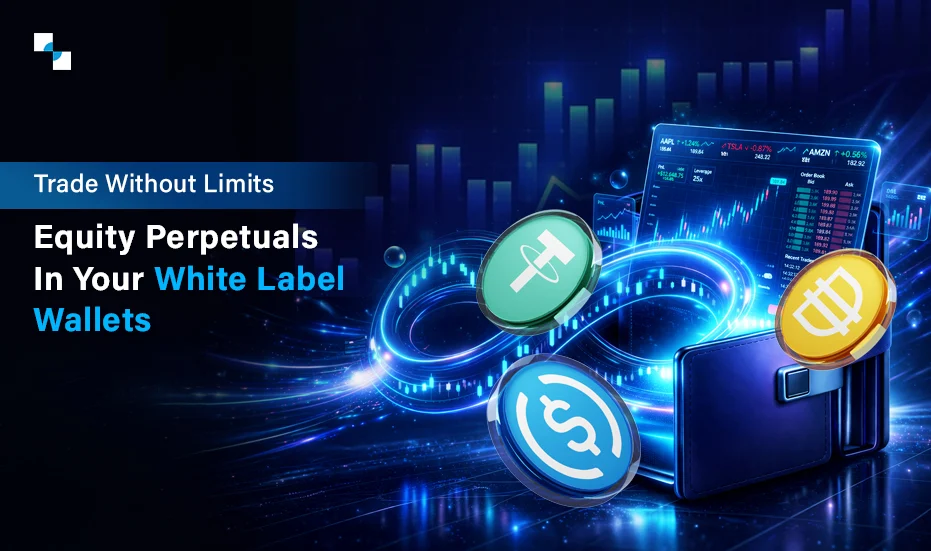
The old equity market was built for a different century: slower rails, heavier intermediaries, segmented access, and a trading experience that often feels more like navigating an institution than participating in a market. In 2026, the real shift is not just “stocks moving on-chain.” It is the fusion of equity-perpetual exposure, wallet-native execution, embedded swaps, and compliance-aware infrastructure into one flow that feels far closer to modern digital finance than legacy brokerage. That is why white label crypto wallets with equity perpetual trading are becoming such a strategic conversation for enterprises, fintechs, and investors alike.
What is Equity Perpetual Trading?
Equity perpetual trading usually refers to perpetual derivative exposure linked to equities or equity-like benchmarks. A perpetual contract is designed to continuously track the underlying asset, and its funding mechanism helps keep the contract price aligned with the benchmark price by transferring periodic payments between long and short positions. In other words, it gives traders ongoing market exposure without the fixed expiry date of a traditional futures contract.
In a tokenized or wallet-native environment, the instrument can sit closer to the user experience of a crypto asset while still referencing a traditional financial underlying. That matters because the SEC has made clear that tokenized securities may still be securities and, in some cases, can even raise security-based swap questions depending on the facts and structure.
The Problems Still Holding Traditional Stock Trading Back
Traditional stock trading is mature, but maturity is not the same as frictionless. The biggest barriers are no longer just access to a broker; they are fragmentation, layered costs, compliance overhead, and operational delays that make the experience less flexible than digital-native users now expect. SEC commentary on tokenized and digital trading has specifically pointed to fragmentation, execution quality, and the need for accurate disclosure of holistic costs.
Here are the main pain points enterprises and investors still deal with:
- Fragmented access: Users often move between separate apps for custody, trading, conversion, and reporting, which creates operational drift and drop-off. SEC market participants have warned that new tokenized trading models can fragment securities markets and affect spreads and execution quality.
- Multiple cost layers: Wallet-provider fees, network fees, liquidity fees, transfer costs, and brokerage-related costs can stack up quickly in digital trading models. The SEC has explicitly identified these cost components when evaluating tokenized U.S. equity trading.
- Custody complexity: Broker-dealers handling crypto asset securities, including tokenized equity or debt, must carefully consider custody rules and operational controls. The SEC issued custody guidance in 2025 to clarify this area.
- Disclosure gaps: Investors need clear information on structure, redemption rights, transfer restrictions, underlying custody, and the legal arrangement itself. The SEC has stressed that tokenized securities can carry the same risks as traditional securities, plus additional ones.
- Cross-border compliance pressure: Global projects must reconcile licensing, supervision, AML/CFT controls, and transfer rules across jurisdictions. FATF, the EU’s MiCA regime, and securities regulators all emphasize this.
How does a White Label Crypto Wallet With Equity Perp Trading And Swaps Solves This Issue?
The real value of a white label blockchain wallet is not just branding. It is orchestration. It can place trading, swap routing, custody logic, fiat rails, and compliance hooks inside a single user journey, reducing the number of systems a user must touch before acting. That changes the market experience in several important ways:
- Fewer handoffs: Trading and swapping happen inside one wallet interface instead of bouncing between exchange, bridge, broker, and bank. Antier describes unified multichain management and native swap routing in its wallet stack.
- Faster market entry: White-label architecture shortens deployment time because the foundation already exists; the enterprise customizes the front end, controls, and integrations. Antier’s white-label positioning explicitly centers on rapid deployment and customizable infrastructure.
- Better liquidity experience: Integrated swap logic and live market data help users find price-efficient execution without depending entirely on external venues.
- Cleaner onboarding: Fiat on/off-ramp support, KYC/AML modules, and compliance reporting endpoints reduce operational friction and support regulated growth.
- More intuitive derivatives access: Smart-contract wallets, transaction batching, and gas-sponsored flows can make advanced trading feel less technical and more consumer-grade.
In practical terms, the wallet becomes the control plane for modern market access: a place where equity perp exposure, swaps, settlement logic, identity checks, and reporting can live together instead of as isolated product layers. That is the real barrier removal.
Let us scroll through the blog to have a closer look at Antier’s own white label wallet development module, which highlights cross-chain and on-chain swaps, multichain support, fiat on/off-ramp, stablecoin conversion, smart-contract wallets, real-time market insights, compliance APIs, and 2FA/biometric protection as part of that stack.
Launch Your Equity Trading Wallet Now!
Antier’s Capabilities For White Label Crypto Wallet Development With Equity Perp Trading
Antier’s current Web3 crypto wallet and AI materials point to an enterprise-grade build philosophy: secure custody, compliance hooks, analytics, and extensibility. For a wallet that supports equity perpetual trading, the most relevant capabilities are the ones that make the product usable, governable, and scalable from day one.
Core features enterprises should expect from a renowned and experienced cryptocurrency wallet development company are:
- Cross-chain and on-chain swap routing for better execution flexibility.
- Multichain wallet architecture to manage assets across ecosystems from one interface.
- Fiat on/off-ramp integration to reduce onboarding and withdrawal friction.
- Stablecoin support and instant conversion for smoother treasury and trade settlement flows.
- Account abstraction / smart-contract wallet design for gas-sponsored actions, batching, and policy-based controls.
- Real-time market and trading insights so users can act on live data rather than static dashboards.
- 2FA and biometric authentication for stronger account protection.
- Secure key export/import and multi-wallet management for enterprise and retail segmentation.
- SDKs and browser/extension integration for deeper product embedding and ecosystem reach.
- In-Wallet Equity Perpetual Swaps: Direct access to equity derivatives without external platforms.
- AI-Driven Liquidity Routing: Intelligent order matching for minimal slippage and best-price execution.
- Customizable Leverage Controls: Institutional-level risk management and margin configuration.
- Proof-of-Reserves & Hybrid Custody Models: Transparency-first trust layer for regulators and consumers alike.
- Regulatory-ready Framework: Alignment with CFTC, ESMA, and MiCA obligations
- Enterprise Dashboard: Multi-role access for fund managers, compliance officers, and traders.
- Scalable Modular Architecture: Enables future integrations of tokenized securities or commodity perps.
Antier’s broader and vast offerings also position the firm around blockchain and AI consulting, regulatory awareness, and scalable architecture, which matters because equity perp products are not just a UI challenge; they are a risk, compliance, and systems challenge.
What Compliance & Regulations Must Be Kept In Mind Before Investing?
This is the aspect that can make or break the business. Equity perpetual trading sits at the intersection of securities law, derivatives thinking, custody controls, and virtual-asset compliance. The exact legal classification depends on the product structure and jurisdiction, so the first rule is not to assume that “on-chain” means “lighter regulation.” The SEC has made clear that tokenized securities still fall within federal securities law analysis, and in some cases, may also involve security-based swap questions.
For a serious enterprise-level crypto wallet launch, the checklist usually includes:
- Securities classification analysis: Determine whether the equity-linked instrument is a security, a security-based swap, or another regulated product. The SEC has stated that tokenized securities can sit in multiple regulatory categories depending on structure.
- Registration and disclosure: Where securities laws apply, registration, prospectus delivery, and ongoing disclosure obligations may follow. The SEC has stressed that tokenized securities require clear information on the legal arrangement, custody, redemption, parties involved, and transfer restrictions.
- Custody and broker-dealer controls: Broker-dealers dealing with crypto asset securities must align with SEC custody expectations, including the 2025 statement on physical possession treatment in defined circumstances.
- AML/CFT and travel rule readiness: FATF requires countries to license or register virtual asset service providers, supervise them, and apply travel-rule expectations and other AML/CFT measures.
- EU market access considerations: Under MiCA, crypto-asset issuers and service providers face harmonized EU transparency, disclosure, authorization, and supervision rules.
- Execution quality and market integrity: Digital trading models should be designed with anti-fraud, fair access, and execution-quality transparency in mind. The SEC and related market commentary repeatedly emphasize these points.
- Consumer risk disclosure: FINRA warns that crypto assets and related products carry traditional investing risks plus unique risks, and firms should treat that reality seriously in product design and investor education.
For enterprises, the safest path is to treat legal design as a core product layer, not a post-launch patch. That means involving counsel early, building jurisdiction filters into onboarding, and ensuring the wallet can prove controls rather than merely claim them. And this can only be achieved by hiring a certified and skilled team of crypto wallet development experts holding years of experience in designing and deploying solutions.
Plan The New Blueprint for Borderless Equity Trading With Antier
Equity perpetual trading in a white label crypto wallet app is attractive because it collapses a fragmented financial journey into a more direct, programmable, and user-friendly one. Instead of separate systems for custody, swaps, market data, and compliance, the enterprise can create one coherent market-access layer. That is how traditional barriers begin to fall: not by removing regulation, but by redesigning the path around it.
For enterprises that want to launch with speed, discipline, and institutional credibility, Antier is positioned around blockchain and AI consulting, regulatory awareness, secure wallet architecture, and enterprise-grade integration. Its wallet stack highlights multichain access, fiat rails, compliance APIs, biometric security, and smart-wallet flows, while its company materials emphasize regulatory alignment and scalable delivery. That makes it a compelling partner for teams building the next generation of equity-linked trading experiences. Connect today!
Frequently Asked Questions
01. What is equity perpetual trading?
Equity perpetual trading refers to perpetual derivative exposure linked to equities, allowing traders to maintain ongoing market exposure without a fixed expiry date, unlike traditional futures contracts.
02. What are the main challenges facing traditional stock trading?
Traditional stock trading faces challenges such as fragmented access, multiple cost layers, compliance overhead, and operational delays, which hinder flexibility and user experience.
03. Why are white-label crypto wallets with equity perpetual trading gaining attention?
They are gaining attention because they integrate modern digital finance elements, offering a more streamlined trading experience that aligns with current user expectations compared to legacy brokerage systems.