




✨ AI Summary
- In 2026, enterprises are leveraging AI agents in automation to create dynamic, self-optimizing ecosystems.
- These agents analyze data, predict outcomes, and make real-time decisions, transforming industries like customer support, finance, supply chain management, sales, HR, IT operations, marketing, decision intelligence, document processing, and healthcare.
- AI agents enable enterprises to respond faster, gain contextual intelligence from complex data, achieve operational efficiency at scale, anticipate market trends, and seamlessly integrate into digital ecosystems.
- They mitigate risks, augment the workforce, drive innovation, and improve time-to-market speed.
- The blog explores how AI agents are revolutionizing business operations and decision-making, making them a strategic necessity in today's data-rich and fast-paced business landscape.
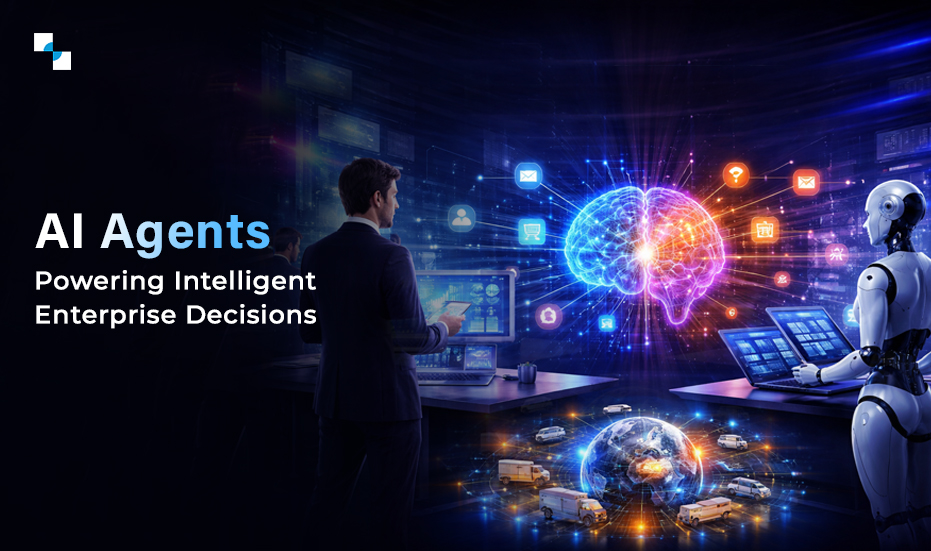
In 2026, enterprises are no longer just automating tasks; they are building intelligent systems that think, decide, and act. The rise of AI agents in enterprise automation has fundamentally shifted how organizations operate, enabling them to move beyond static workflows toward dynamic, self-optimizing ecosystems. These agents are not just tools; they are digital collaborators capable of analyzing complex data, predicting outcomes, and executing decisions in real time.
As enterprises handle increasing volumes of data and complex workflows, the demand for intelligent, autonomous systems is skyrocketing. Many organizations are now partnering with an AI Agent development company to build scalable enterprise AI automation solutions that can analyze, decide, and act in real time. From optimizing finance and healthcare operations to streamlining supply chains and enhancing customer engagement, AI agents are transforming the way businesses operate. This blog dives into the most powerful use cases that are defining the future of intelligent automation and decision intelligence.
What Are AI Agents in Enterprise Automation?
Before diving into use cases, it’s important to understand what makes AI agents different from traditional automation.
AI agents are autonomous systems that can:
- Perceive data from multiple sources
- Reason using machine learning models
- Take actions based on predefined or learned goals
- Continuously improve through feedback loops
AI agents for business workflows adapt in real time, handling complex and dynamic environments that traditional automation cannot. This ability to learn, respond, and optimize makes them essential for modern enterprises, which are increasingly investing in AI Agent development services to build intelligent, scalable systems.
1. Autonomous Customer Support and Experience Optimization
Customer support has evolved dramatically with AI agents. Today’s systems go far beyond chatbots.
What AI Agents Do:
- Resolve complex queries without human intervention
- Analyze customer intent in real time
- Offer hyper-personalized recommendations
- Seamlessly escalate to human agents when needed
For example, AI agents can analyze a customer’s purchase history, sentiment, and behavior to proactively suggest solutions, turning support into a revenue-generating function.
Businesses adopting intelligent automation solutions in customer experience are seeing exponential improvements in retention and engagement.
2. Intelligent Financial Operations and Fraud Detection
Finance is one of the most powerful areas where AI agents are transforming enterprise workflows.
Key Use Cases:
- Real-time fraud detection using behavioral analytics
- Automated invoice processing and reconciliation
- Risk assessment and credit scoring
- Dynamic financial forecasting
How It Works:
AI agents continuously monitor transactions, flag anomalies, and adapt to new fraud patterns without manual intervention.
Business Impact:
- Detects fraud in milliseconds instead of hours
- Reduces financial losses significantly
- Enhances regulatory compliance
Enterprises are increasingly working with an AI Agent development company to deploy robust enterprise AI automation solutions that ensure financial accuracy and security at scale.
3. Supply Chain Optimization and Demand Forecasting
Supply chains today are highly complex and require real-time intelligence to operate efficiently.
AI Agent Capabilities:
- Predict demand fluctuations using historical and real-time data
- Optimize inventory levels dynamically
- Identify bottlenecks and disruptions proactively
- Automate supplier coordination
Real-World Impact:
AI agents enable:
- Reduced stockouts and overstock situations
- Improved logistics efficiency
- Lower operational costs
With AI agents in enterprise automation, companies can build self-healing supply chains that adapt to disruptions such as global shortages or demand spikes.
4. Sales and Revenue Intelligence Automation
AI agents are revolutionizing how enterprises generate and close deals.
Use Cases:
- Lead scoring and qualification
- Predictive sales forecasting
- Automated outreach and follow-ups
- Real-time deal intelligence
Advanced Capabilities:
AI agents analyze:
- Buyer behavior
- Market trends
- CRM data
- Engagement signals
Impact:
- Increased conversion rates
- Shorter sales cycles
- Higher revenue per lead
Sales teams powered by AI agents for business workflows can focus on high-value interactions while AI handles repetitive and data-driven tasks.
5. Human Resources and Talent Intelligence
HR departments are using AI agents to transform hiring, onboarding, and employee engagement.
Key Applications:
- Automated resume screening using NLP
- Candidate matching based on role requirements
- Employee sentiment analysis
- Personalized learning and development recommendations
Outcomes:
- Faster hiring cycles
- Improved talent quality
- Higher employee retention
AI agents also help create personalized employee experiences by analyzing performance, behavior, and engagement patterns, making HR more strategic than ever before.
6. IT Operations and Autonomous Infrastructure Management
Modern IT environments are complex and require continuous monitoring and optimization.
AI Agent Functions:
- Detect system anomalies in real time
- Predict system failures before they occur
- Automatically resolve incidents
- Optimize cloud resource usage
Example:
An AI agent can detect a spike in server load, automatically scale resources, and prevent downtime; all without human intervention.
Benefits:
- Reduced downtime
- Improved system reliability
- Lower infrastructure costs
This is a key area where intelligent automation solutions are becoming indispensable for enterprise resilience.
7. Marketing Automation and Hyper-Personalization
Marketing has become data-driven, and AI agents are at the center of this transformation.
Capabilities:
- Real-time customer segmentation
- Personalized content generation
- Campaign optimization based on performance data
- Customer journey orchestration
How AI Agents Help:
They analyze user behavior across multiple touchpoints and deliver personalized messages at the right time through the right channel.
Impact:
- Increased engagement rates
- Higher ROI on campaigns
- Improved customer lifetime value
AI-driven marketing powered by enterprise AI automation solutions ensures that every interaction is relevant and impactful.
8. Decision Intelligence and Strategic Planning
One of the most powerful use cases of AI agents is in decision intelligence.
What It Means:
Decision intelligence combines data, AI, and human judgment to support better business decisions.
AI Agent Capabilities:
- Simulate multiple business scenarios
- Predict outcomes based on data models
- Recommend optimal strategies
- Continuously learn from outcomes
Example:
An AI agent can analyze market conditions, competitor data, and internal metrics to recommend pricing strategies or expansion opportunities.
Business Impact:
- Faster decision-making
- Reduced uncertainty
- Improved strategic outcomes
This is where AI Agent development services truly add value by building systems that don’t just automate but think and recommend.
9. Document Processing and Knowledge Management
Enterprises deal with massive amounts of unstructured data, contracts, reports, emails, and more.
AI Agent Functions:
- Extract key information from documents
- Classify and organize data
- Enable semantic search across enterprise knowledge bases
- Automate compliance checks
Benefits:
- Reduced manual effort
- Improved data accessibility
- Faster decision-making
AI agents transform static document repositories into intelligent knowledge systems.
10. Healthcare and Patient Journey Automation
Healthcare is witnessing a massive transformation with AI agents.
Use Cases:
- Patient triage and diagnostics support
- Automated medical documentation
- Personalized treatment recommendations
- Remote patient monitoring
Impact:
- Improved patient outcomes
- Reduced administrative burden
- Enhanced clinical efficiency
With AI agents in enterprise automation, healthcare providers can deliver faster, more accurate, and patient-centric care.
Get Started with Intelligent Enterprise Automation Now!
Why Enterprises Are Investing in AI Agents
The adoption of AI agents is no longer a futuristic experiment; it has become a strategic necessity for modern enterprises. In 2026, organizations are operating in highly volatile, data-rich environments where traditional automation and rule-based systems simply cannot keep up. This is where AI agents in enterprise automation are fundamentally changing the game.
Unlike legacy systems, AI agents are context-aware, adaptive, and autonomous, enabling enterprises to move from reactive operations to proactive and predictive intelligence. Organizations are increasingly collaborating with an AI Agent development company to design systems that integrate seamlessly into existing ecosystems while delivering measurable business impact.
Let’s explore the key drivers behind this rapid adoption:
1. Real-Time Decision-Making in a High-Velocity World
Modern enterprises operate in environments where milliseconds matter—whether it’s financial trading, supply chain adjustments, fraud detection, or customer engagement.
- AI agents continuously process live data streams from multiple sources (transactions, sensors, user interactions, market signals).
- They can analyze, decide, and act in real time, without waiting for human intervention.
- Decisions are no longer batch-based or delayed; they are event-driven and instantaneous.
Example: In e-commerce, AI agents dynamically adjust pricing based on demand, competitor pricing, and user behavior within seconds.
Impact: Enterprises gain the ability to respond faster than competitors, reduce decision latency, and capitalize on real-time opportunities, making real-time intelligence a core business capability.
2. Explosive Data Complexity and the Need for Contextual Intelligence
In 2026, organizations are dealing with unstructured, multi-modal, and high-velocity data like never before – spanning text, voice, video, IoT signals, and behavioral data.
- Traditional analytics tools struggle to derive meaningful insights from this complexity.
- AI agents use advanced reasoning, LLMs, and multimodal AI models to interpret data in context.
- They connect the dots across datasets to uncover hidden patterns, risks, and opportunities.
Example: A healthcare AI agent can combine patient history, real-time vitals, and diagnostic data to recommend personalized treatment pathways.
Impact:
AI agents transform raw data into actionable intelligence, enabling enterprises to move from data overload to data-driven decision intelligence.
3. Demand for Autonomous and Scalable Operational Efficiency
Enterprises today are under constant pressure to do more with less—reduce costs, increase output, and maintain quality at scale.
- AI agents automate not just tasks, but entire workflows and decision chains.
- They orchestrate processes across systems like ERP, CRM, and supply chain platforms.
- They operate 24/7 with consistent performance and zero fatigue.
Example: In logistics, AI agents can autonomously manage inventory, route optimization, vendor communication, and delivery scheduling.
Impact:
- Reduced operational overhead
- Improved process efficiency
- Scalable operations without proportional cost increase
This is where enterprise AI automation solutions are proving critical for long-term growth and resilience.
4. Competitive Advantage Through Intelligence, Not Just Automation
Automation alone is no longer a differentiator – intelligent automation is.
- AI agents enable enterprises to anticipate market trends, customer needs, and operational risks before they occur.
- They provide predictive and prescriptive insights, not just descriptive analytics.
- Businesses can simulate scenarios and optimize strategies before execution.
Example: A retail company can use AI agents to predict demand spikes, optimize supply chain readiness, and personalize marketing campaigns simultaneously.
Impact: Organizations leveraging AI agents for business workflows gain a significant competitive edge by:
- Making smarter decisions faster
- Reducing uncertainty in operations
- Unlocking new revenue opportunities
In 2026, competitive advantage is defined by how intelligently a company operates; not just how fast.
5. Seamless Integration with Digital Ecosystems and AI-First Architectures
Modern enterprises are shifting toward AI-first architectures, where intelligence is embedded into every layer of the system.
- AI agents integrate seamlessly with APIs, cloud platforms, data lakes, and enterprise software.
- They act as orchestrators across systems, eliminating silos and improving interoperability.
- Enterprises are building modular, agent-driven ecosystems that can scale and evolve continuously.
Example: A single AI agent can interact with CRM, ERP, and analytics platforms to provide a unified operational view and trigger automated actions.
Impact:
- Reduced system fragmentation
- Improved data consistency
- Enhanced operational visibility
This is why organizations are increasingly investing in AI Agent development services to build future-ready, integrated ecosystems.
6. Risk Mitigation, Compliance, and Governance at Scale
As enterprises grow, so do risks related to compliance, security, and operational governance.
- AI agents can continuously monitor transactions, access patterns, and workflows for anomalies.
- They enforce compliance policies automatically and generate audit trails in real time.
- Advanced AI governance frameworks ensure transparency, explainability, and control.
Example: In banking, AI agents can detect suspicious activity, flag anomalies, and trigger compliance workflows instantly.
Impact:
- Reduced regulatory risks
- Improved security posture
- Real-time compliance enforcement
In industries like finance, healthcare, and insurance, this capability is becoming mission critical.
7. Workforce Augmentation and Intelligent Collaboration
AI agents are not replacing humans; they are augmenting human capabilities.
- Employees can delegate repetitive and data-heavy tasks to AI agents.
- Agents act as intelligent assistants, providing recommendations, insights, and automation support.
- This leads to a shift from task execution to strategic decision-making roles for humans.
Example: In sales, AI agents can handle lead qualification, while sales teams focus on relationship building and closing deals.
Impact:
- Increased productivity per employee
- Better decision quality
- Improved employee satisfaction
Enterprises adopting this model are creating a human and AI collaborative workforce, which is becoming the new operational standard.
8. Continuous Innovation and Faster Time-to-Market
In today’s fast-paced market, speed is everything.
- AI agents accelerate product development, testing, and deployment cycles.
- They enable rapid experimentation and iteration through automated insights and feedback loops.
- Businesses can quickly adapt to changing customer demands and market conditions.
Example: A SaaS company can use AI agents to analyze user behavior and continuously refine features based on real-time feedback.
Impact:
- Reduced time-to-market
- Faster innovation cycles
- Increased agility in product development
This agility is crucial for staying ahead in highly competitive markets.
Enterprises are investing in AI agents in enterprise automation not just to improve efficiency, but to fundamentally redefine how decisions are made, how systems operate, and how value is created. By partnering with a forward-thinking AI Agent development company, organizations can build intelligent ecosystems powered by enterprise AI automation solutions that scale with complexity, adapt to change, and deliver continuous business value.
Future Trends in AI Agents (2026 and beyond)
The next phase of AI agents in enterprise automation is not just about incremental improvements; it’s about building fully intelligent ecosystems that can reason, collaborate, and evolve. Enterprises adopting advanced intelligent automation solutions are already witnessing a shift from reactive systems to proactive, self-driving architectures. Let’s explore the most powerful trends shaping the future of AI agents for business workflows in detail.
1. Multi-Agent Systems: From Single Intelligence to Collaborative Ecosystems
The future of AI is not a single, all-powerful model; it is a network of specialized agents working together. Multi-agent systems represent one of the most transformative shifts in enterprise AI.
How It Works:
Instead of one AI handling all tasks, multiple agents are assigned specific roles:
- A data analysis agent processes raw information
- A planning agent defines strategies
- An execution agent carries out actions
- A monitoring agent evaluates performance
These agents communicate, coordinate, and even negotiate with each other to achieve shared goals.
Enterprise Impact:
- Solves complex, multi-step workflows autonomously
- Enables cross-department collaboration (finance, HR, operations)
- Reduces dependency on centralized systems
For example, in supply chain management, one agent can predict demand, another can optimize inventory, and a third can manage logistics, working together in real time.
Organizations leveraging AI Agent development services are already building these collaborative systems to create highly efficient, distributed intelligence networks.
2. Autonomous Enterprises: Operating with Minimal Human Intervention
We are moving toward a future where enterprises operate with minimal manual oversight for routine and even semi-complex decisions.
What Defines an Autonomous Enterprise:
- AI agents make decisions based on real-time data
- Systems self-execute tasks without human approval loops
- Continuous monitoring and correction happen automatically
- Human involvement is focused on strategy, not execution
Real-World Examples:
- Financial systems automatically reallocate budgets based on performance
- Marketing systems adjust campaigns in real time based on engagement
- IT systems detect, diagnose, and resolve issues without human input
Why This Matters:
- Eliminates operational bottlenecks
- Reduces human error
- Enables 24/7 uninterrupted business operations
Enterprises investing in enterprise AI automation solutions are building infrastructures where AI agents act as the operational backbone transforming organizations into adaptive, self-optimizing systems.
3. Self-Improving Systems: Continuous Learning Without Manual Intervention
Traditional AI systems require periodic retraining by data scientists. The future of AI agents eliminates this limitation.
How Self-Improvement Works:
- Agents continuously learn from new data and interactions
- Feedback loops are built into every action
- Reinforcement learning enables systems to refine strategies over time
- Performance metrics guide optimization automatically
Key Capabilities:
- Dynamic model updates in production environments
- Real-time adaptation to changing user behavior
- Error correction without human intervention
Business Value:
- Eliminates downtime associated with retraining
- Improves accuracy continuously
- Reduces dependency on large AI/ML teams
With advanced AI agents in enterprise automation, businesses can deploy systems that not only perform tasks but also evolve with every interaction, becoming smarter over time.
4. AI and Edge Computing: Intelligence at the Source
As enterprises generate massive volumes of data from IoT devices, sensors, and distributed systems, relying solely on cloud-based AI becomes inefficient.
What Is Changing:
AI agents are increasingly being deployed at the “edge”; closer to where data is generated.
Why Edge and AI Matter:
- Reduces latency in decision-making
- Enables real-time responses without cloud dependency
- Improves data privacy and security
- Reduces bandwidth and infrastructure costs
Use Cases:
- Manufacturing: AI agents detect equipment failures instantly on the factory floor
- Healthcare: Real-time patient monitoring with immediate alerts
- Autonomous vehicles: On-device decision-making for safety-critical actions
Enterprise Impact:
- Faster operational decisions
- Increased system reliability
- Enhanced real-time intelligence
By integrating intelligent automation solutions with edge computing, enterprises are creating highly responsive systems that operate in milliseconds rather than seconds.
5. Hyper-Personalization at Scale: Real-Time Individualized Experiences
Personalization is evolving from segment-based targeting to real-time, one-to-one experiences powered by AI agents.
What Hyper-Personalization Means:
Every user interaction is uniquely tailored based on:
- Behavioral data
- Contextual signals
- Historical interactions
- Predictive insights
How AI Agents Enable This:
- Analyze user behavior in real time
- Predict intent before the user acts
- Dynamically adjust content, offers, and recommendations
- Continuously refine personalization models
Applications:
- E-commerce platforms recommend products uniquely for each user
- Streaming platforms curating content dynamically
- Financial services offering personalized investment advice
- Healthcare platforms tailoring treatment journeys for each patient
Business Impact:
- Increased conversion rates
- Higher customer engagement
- Improved retention and lifetime value
Enterprises using AI agents for business workflows are achieving personalization at a level that was previously impossible, turning every customer interaction into a highly relevant, data-driven experience.
The future of AI agents is not about automation alone; it’s about intelligence, adaptability, and autonomy at scale. Enterprises that embrace these trends early will not only optimize operations but also unlock entirely new business models. The shift toward AI agents in enterprise automation is accelerating, and organizations that invest in these intelligent systems today will define the competitive landscape of tomorrow.
Intelligence That Never Stops Evolving
The evolution of AI agents in enterprise automation marks a defining shift in how businesses operate, compete, and grow. From intelligent customer support to autonomous decision-making, AI agents are enabling organizations to move beyond automation into true intelligence. By using advanced AI Agent development services, enterprises can build scalable, adaptive, and future-ready systems that transform every function.
In 2026 and beyond, success will belong to organizations that embrace AI agents for business workflows and invest in intelligent automation solutions that continuously learn and evolve. The future is not just automated; it is intelligent, autonomous, and powered by AI agents that think, act, and deliver real business value.
Frequently Asked Questions
01. What are AI agents in enterprise automation?
AI agents are autonomous systems that can perceive data from multiple sources, reason using machine learning models, take actions based on goals, and continuously improve through feedback loops, enabling dynamic and self-optimizing workflows.
02. How do AI agents enhance customer support?
AI agents enhance customer support by resolving complex queries without human intervention, analyzing customer intent in real time, offering hyper-personalized recommendations, and seamlessly escalating issues to human agents when necessary.
03. Why are enterprises investing in AI agent development services?
Enterprises are investing in AI agent development services to build intelligent, scalable systems that can handle complex workflows, analyze large volumes of data, and optimize operations across various sectors, including finance, healthcare, and customer engagement.