



AI Summary
- In today's business landscape, enterprises are facing a challenge in effectively implementing AI beyond pilots and prototypes.
- The struggle lies in executing AI at scale within core decision-making and operations.
- With data fragmentation, disconnected workflows, and failed AI initiatives, many organizations are turning to AI software development services to bridge the gap between intention and implementation.
- Rather than standalone tools, enterprises are now focusing on building intelligent systems integrated into their business infrastructure.
- From autonomous process systems to predictive intelligence engines and adaptive recommendation systems, AI is revolutionizing how businesses operate.
Enterprises today are not struggling to access AI; they are struggling to make it work beyond pilots and prototypes. Most organizations already have tools, dashboards, and automation systems in place, yet very few have successfully embedded AI into core decision-making and operations.
The real challenge is not adoption; it is execution at scale. Data remains fragmented across systems, workflows are disconnected, and AI initiatives often fail to move beyond experimentation stages. This gap between intention and implementation is where most enterprise AI strategies break down.
This is why AI software development services have become critical not as isolated solutions, but as a structured way to bridge business strategy with real-world execution.
Why Enterprises Are Rapidly Adopting AI Software Development Services?
The shift toward AI is no longer driven by innovation teams; it is driven by operational pressure. Enterprises are now operating in an environment where:
- Market cycles are shorter and more volatile
- Customer expectations are real-time and personalized
- Decisions need to be made in minutes, not days
- Competitors are already embedding intelligence into core operations
In such conditions, traditional systems slow businesses down instead of supporting them. As a result, organizations are turning to AI software development services not as an upgrade, but as a response to structural limitations in legacy systems that can no longer support modern business speed.
What Enterprises Are Actually Building with AI Today?
Instead of adopting AI as standalone tools, enterprises are now building intelligent systems that operate as part of the business infrastructure.
The focus has shifted from automation to intelligence-driven architecture:
- Autonomous Process Systems
Workflows that execute end-to-end operations with minimal human intervention, reducing dependency on manual triggers and approvals.
- Predictive Intelligence Engines
Systems that analyze historical and real-time data to anticipate demand, risks, and operational disruptions before they occur.
- Conversational AI Layers
AI-driven interfaces that interact with customers and internal teams, enabling task execution rather than just responses.
- Adaptive Recommendation Systems
Platforms that continuously learn from user behavior to refine personalization in real time.
- Embedded Risk Detection Systems
AI layers are integrated into enterprise systems to detect anomalies and risks as they happen, not after reporting cycles.
These solutions are not standalone applications; they are part of a larger enterprise architecture built using advanced AI software development services.
What AI Software Development Services Actually Deliver in Enterprises?
Modern AI development service offerings are not limited to model creation. They focus on building an end-to-end intelligence ecosystem.
- Data Engineering Foundation
Enterprises often fail at AI because of poor data readiness. Structured pipelines, clean datasets, and real-time data processing form the backbone of any AI system.
- Custom AI Model Engineering
Each enterprise has a unique operational logic. This is where a custom AI development company builds tailored ML, NLP, and deep learning models aligned with specific business workflows.
- Enterprise System Integration
AI becomes valuable only when connected to existing systems like ERP, CRM, and internal platforms. Integration ensures AI is not isolated but embedded into operations.
- Deployment and Scaling Architecture
A strong AI software development company ensures AI systems are scalable across cloud, hybrid, or on-prem environments with continuous optimization.
Enterprise AI Readiness: Key Factors to Consider Before Adoption
One of the biggest reasons AI initiatives fail isn’t the technology; it’s starting without the right foundation. Many enterprises jump into AI software development services expecting quick results, only to realize their systems, data, or goals aren’t fully aligned.
Before moving forward, it’s important to step back and ask a few critical questions:
Is your data actually usable?
Most organizations have large volumes of data, but it’s often scattered, unstructured, or inconsistent. Without clean and accessible data, even the best AI models won’t deliver meaningful results.
Can your infrastructure support AI at scale?
AI systems require flexible, scalable environments, whether cloud, on-premise, or hybrid. If your current setup can’t handle real-time processing or large workloads, it becomes a bottleneck.
Are your business goals clearly defined?
AI works best when it’s tied to a specific outcome, thus reducing costs, improving efficiency, or enhancing customer experience. Vague goals often lead to underwhelming results.
Do you have the right expertise in place?
Building and scaling AI requires specialized skills. This is where partnering with an experienced enterprise AI solution development company can make a significant difference.
A strategic partner doesn’t just build solutions; they help you evaluate readiness, identify gaps, and create a roadmap that ensures your AI investment delivers real business value.
Common Mistakes Enterprises Make in AI Adoption
Even with strong investment in AI software development services, many enterprises struggle to see real impact, not because of technology limitations, but because of avoidable strategic mistakes made during adoption. Below are some of the most common pitfalls that slow down or derail enterprise AI initiatives:
- Starting with tools instead of business use cases
Many organizations begin their AI journey by selecting tools or platforms first, instead of clearly defining the business problem. This leads to solutions that look advanced but fail to deliver real operational value.
- Ignoring data readiness before model development
AI systems depend heavily on data quality. When enterprises skip data cleaning, structuring, or governance, even the most advanced models produce unreliable or inconsistent outcomes.
- Treating AI as a one-time implementation
AI is often approached as a project with a fixed delivery timeline, instead of an evolving system. Without continuous learning and iteration, performance naturally degrades over time.
- Poor integration with existing enterprise systems
AI delivers value only when it is connected to real workflows. Lack of integration with ERP, CRM, or legacy systems results in isolated models that don’t influence decision-making.
- No post-deployment optimization strategy
Many enterprises stop after deployment, assuming the job is done. In reality, AI systems require ongoing monitoring, retraining, and tuning to maintain accuracy and relevance.
High-Impact AI Solutions Enterprises Are Building Today
With the rapid adoption of AI software development services, enterprises are no longer experimenting with isolated AI tools; they are building end-to-end intelligent systems that directly improve efficiency, decision-making, and customer experience. These solutions are becoming central to how modern businesses operate, compete, and scale.
- Intelligent Process Automation (IPA)
Intelligent Process Automation goes beyond basic rule-based automation. It combines AI, machine learning, and workflow automation to handle complex business processes.
- Automates repetitive and time-consuming tasks across departments like HR, finance, and operations
- Reduces dependency on manual intervention and minimizes human errors
- Speeds up approvals, documentation, and operational workflows
- Improves overall productivity by allowing teams to focus on strategic work
- Predictive Analytics Platforms
Enterprises are shifting from reactive decision-making to predictive intelligence using AI-driven analytics systems.
- Analyzes historical and real-time data to identify patterns and trends
- Helps forecast demand, customer behavior, market shifts, and potential risks
- Supports leadership teams in making faster and more accurate decisions
- Enables proactive planning instead of reactive problem-solving
- AI-Powered Chatbots & Autonomous Agents
Customer engagement is being redefined with intelligent conversational systems powered by AI.
- Provides instant, 24/7 customer support across channels
- Handles complex queries with contextual understanding
- Reduces workload on human support teams
- Enhances user experience through faster and more accurate responses
- Autonomous agents can even execute tasks like bookings, updates, or transactions
- Recommendation Engines
Personalization has become a key growth driver for digital businesses, and AI makes it possible at scale.
- Delivers personalized product, content, or service recommendations
- Learns from user behavior, preferences, and interactions
- Increases engagement, retention, and conversion rates
- Widely used in eCommerce, OTT platforms, fintech, and SaaS products
- Fraud Detection & Risk Management Systems
Security is a critical concern for modern enterprises, and AI is strengthening defense systems significantly.
- Detects unusual patterns, anomalies, and suspicious activities in real time
- Helps prevent fraud in financial transactions and digital operations
- Improves compliance with regulatory standards
- Reduces financial losses and operational risks
- Scalable Enterprise AI Systems
All these solutions require more than just development; they require the right architecture and strategy.
An experienced enterprise AI development company ensures:
- Seamless integration with existing enterprise systems (ERP, CRM, legacy tools)
- Scalable and secure architecture for long-term growth
- High model accuracy through continuous training and optimization
- Alignment of AI solutions with real business objectives and ROI
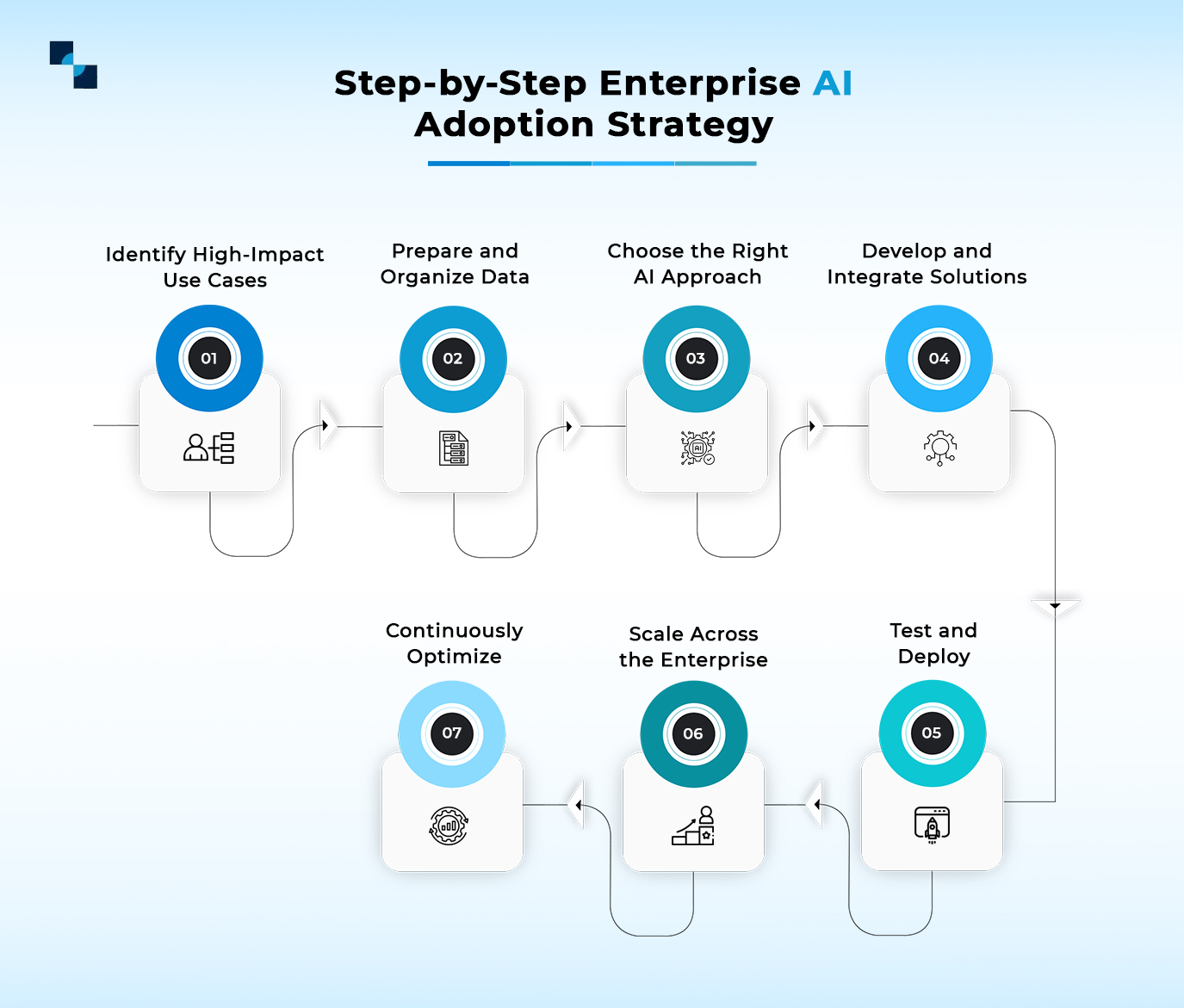
The Real Shift: From AI Use Cases to Enterprise-Ready AI Systems
As enterprises move forward with AI software development services, the focus is no longer limited to exploring individual use cases. The real transformation lies in building AI that can operate as part of enterprise-wide systems and support adoption at scale.
Instead of treating AI as a collection of separate tools, organizations are now embedding intelligence directly into business processes where it can influence decisions, automate workflows, and connect seamlessly with existing enterprise infrastructure.
This shift is what defines successful enterprise AI adoption. It moves businesses from experimentation to execution, where AI becomes a functional layer within core operations rather than an external add-on.
In this journey, an experienced AI software development company plays a critical role by designing solutions that are not just technically sound but aligned with enterprise architecture, scalable across departments, and built for long-term adoption rather than short-term deployment.
Cost and ROI of AI Software Development Services: What Enterprises Should Really Expect
When enterprises explore AI software development services, one of the first questions that comes up is cost, and that’s natural. But in reality, the cost isn’t a fixed number; it varies based on how complex the problem is and what kind of intelligence the business is trying to build.
For example, a simple automation use case will require far less investment compared to a large-scale predictive system or an enterprise-wide AI platform. The final cost usually depends on factors like project complexity, quality and availability of data, level of model sophistication, and the type of infrastructure needed for deployment (cloud, on-premise, or hybrid). But focusing only on cost misses the bigger picture – what really matters is the return.
Well-implemented AI doesn’t just save money; it changes how the business operates. It helps reduce repetitive manual work, speeds up decision-making with real-time insights, improves overall productivity across teams, and in many cases, even opens up entirely new revenue streams that didn’t exist before.
That’s why a strong AI development service isn’t just about building systems; it’s about making sure those systems create measurable business impact over time. The goal is always long-term value, not just short-term implementation.
How to Choose the Right AI Software Development Company?
Selecting the right partner for AI software development services directly impacts how successfully your enterprise adopts and scales AI. It’s not just about building a solution; it’s about choosing a team that understands your business, challenges, and long-term goals.
- Proven Experience in Enterprise AI
A reliable partner should have hands-on experience delivering AI solutions for large-scale enterprise environments. This ensures they understand real-world complexities like data volume, system integration, and performance at scale.
- Strong Technical Expertise
The right AI software development company must have deep expertise in machine learning, deep learning, NLP, and data engineering. Strong technical skills ensure your AI solutions are accurate, efficient, and built for real business impact.
- Industry-Specific Knowledge
Every industry works differently, and AI needs to reflect that. A company with domain expertise understands your workflows, challenges, and compliance needs, making solutions more practical and relevant.
- Scalable and Secure Architecture
AI systems must grow with your business. A strong custom AI development company builds secure, flexible, and scalable architectures that can handle increasing data, users, and operational complexity over time.
- Continuous Support and Optimization
AI systems require ongoing improvements to stay effective. Regular monitoring, updates, and model optimization ensure your solution continues to perform accurately as business needs evolve.
- Strategic Partnership Mindset
The best Ai Software Development Company doesn’t just deliver a product; they act as a long-term partner. They help refine your AI roadmap, scale solutions across functions, and ensure continuous business value from your investment.
Where AI Takes You Next?
AI is no longer something enterprises can afford to delay; it’s becoming a core part of how modern businesses operate and grow. But the real value doesn’t come from adopting AI for the sake of it; it comes from using it to solve the right problems and scale what actually works.
With the right AI software development services, businesses can move from scattered experiments to structured, outcome-driven implementation. Choosing an experienced AI software development company ensures you’re not just building AI systems, but building solutions that fit your processes, data, and long-term goals.
At Antier, we help enterprises turn AI into a practical advantage by designing and delivering solutions that are scalable, reliable, and aligned with real business needs.