




✨ AI Summary
- Discover how Sci-Fi P2E games are revolutionizing Web3 gaming by offering immersive worlds, advanced technology, and robust tokenomics.
- Learn how these games address key challenges like scalability, poor game experiences, and fragmented player communities through next-gen graphics, AI-powered gameplay, and interoperable NFT assets.
- By engaging players in collaborative governance and social features, Sci-Fi P2E games create a sense of ownership and purpose, leading to deeper engagement and loyalty.
- Positioned to lead the future of Web3 gaming in 2026, Sci-Fi P2E games provide a unique opportunity for developers to shape innovative gaming experiences while offering investors revenue potential and long-term growth.
- Embrace the transformative power of Sci-Fi P2E games to drive the evolution of Web3 gaming and create compelling, sustainable player incentives.
With the rapid growth of Web3 gaming, players are increasingly demanding more than simple rewards—they want engaging worlds, dynamic gameplay, and long-term value. Yet, many P2E games struggle to deliver these experiences, leaving gamers frustrated and developers seeking solutions. Could Sci-Fi P2E games be the answer? By combining futuristic narratives, advanced technology, and robust tokenomics, they offer a transformative approach to P2E game development.
Explore Use Cases of P2E Game Development Across Casino, Strategy, and RPG Genres.
Technology Issues with Current Web3 Games
Because of inherent technological problems, many Web3 games are unable to retain players or give a seamless experience. The nature of the technology limits game scalability, lowers engagement, and prevents communities from growing.
1. Scalability
As powered by the blockchain, some games cannot effectively support large player bases. Transactions are slow, the network is congested, and servers may bottleneck users. Users can quickly become frustrated, especially when they are experiencing delayed NFTs or have received rewards. Without a basic level of dependable infrastructure, players will not stay engaged, no matter how strong the economy is, pinpointing a glaring pain point in P2E ecosystems.
2. Poor Game Experiences
Game mechanics can become too predictable, and the graphics outdated. A lack of variety can lead to the same tasks over and over without evolving character or playing challenges, which lowers excitement and discourages, especially the new player. Players today are demanding unique immersion experiences with gameplay that evolves; current play to earn games fail to provide such an experience.
3. Dispersed Player Communities
Segments of assets and related rewards are regularly isolated between individual games, restricting the utility of NFTs over multiple games and disrupting community cohesiveness. Without the option of interoperability, players are disincentivized from spending time or resources in the game long-term.
These challenges create an opportunity for every play to earn NFT game development company to develop innovations utilizing technology and storytelling in Sci-Fi games.
Solution – Utilizing Sci-Fi Technology in Play to Earn Games
Sci-Fi play to earn games provide an element of innovation in the technological development and player engagement problems that were challenging in P2E gaming. The evolution of the combination of technologies built into Sci-Fi creates a multitude of immersive environments to shape AI and gameplay from a family of ‘games’ into an immersive, rewarding player experience.
1. Next-Gen Graphics Engines & AR/VR
To a large extent, player engagement is driven by immersion. Utilizing next-gen graphics with AR/VR technology creates synthesized and fully-realized immersive worlds, rendering our environment beautifully, whether designed to be an alien planet or an intergalactic civilization. In other words, what you see on the screen has been beautifully rendered and is interactive. A visually immersive experience increases gameplay time and encourages participation again.
2. AI-Powered Gameplay & Custom Missions
By integrating AI, NPCs and in-game experiences will respond to player actions intelligently, leading to missions that are reactive and consequential, providing each player with a distinct gameplay experience. Sci-Fi play to earn games are perfect for setting the stage for AI-specific gameplay, as they are often rich with storylines and generally complex gameplay mechanics, inserting AI-driven challenges to keep players engaged.
3. Scalable blockchain
Scalable blockchains are essential to allow seamless gameplay. Current and future Sci-Fi P2E game development relies on high-performing blockchains to carry out thousands of transactions per second. These blockchains allow players to transfer assets instantly, trade NFTs within minutes rather than days, and receive rewards immediately while preserving security and transparency. When blockchains work reliably for players, user experience improves. It is vital to avoid any drop-off in usability since it can lead to poor retention rates.
Build Your Sci-Fi P2E Game in Just 2 Weeks – Start Today
Challenge – Disconnect in Community and Low Interoperability
Even when the gameplay is satisfying, a fragmented yet passionate community playing a game leads to low participation, and ultimately, the game could fail. Players want to feel connected in a meaningful way and shape the ecosystem.
1. Siloing of assets
NFTs and in-game asset ownership within a game are typically only platform-specific to the game. This makes it difficult for players to leverage their high-value classes of assets anywhere but in that one specific game. This proactive experience can often limit the expected participation a game might generate in the long term.
2. No Collaborative Governance
Players do not routinely have an opportunity to have a participatory model or co-create games or game content. Without opportunities for participatory governance, players are relatively passive, and the community is no longer engaged.
Solution – Sci-Fi P2E Worlds Driven by Community
Sci-Fi P2E game development seeks to build social ecosystems that engender a sense of ownership and purpose for players.
1. Interoperable NFT Assets
NFT assets that are interoperable across titles allow players to carry value across multiple games. This increases in-game value, deepens loyalty to the ecosystem, and encourages players to play longer. Interoperable assets also generate a continuous loop of rewards that deepens the emotional and financial stakes of the game.
2. Guilds, Social Missions, and Shared Governance
When games include social features, like guilds, cooperative missions, and governance structures, communities are empowered. Players have a vested interest in the game world through their actions. With these social features, players feel a greater sense of belonging, are incentivized to cooperate, and deepen their loyalty to the game and community, all of which contribute to a robust Web3 gaming ecosystem.
Why Sci-Fi P2E Games Will Lead Web3 Gaming in 2026
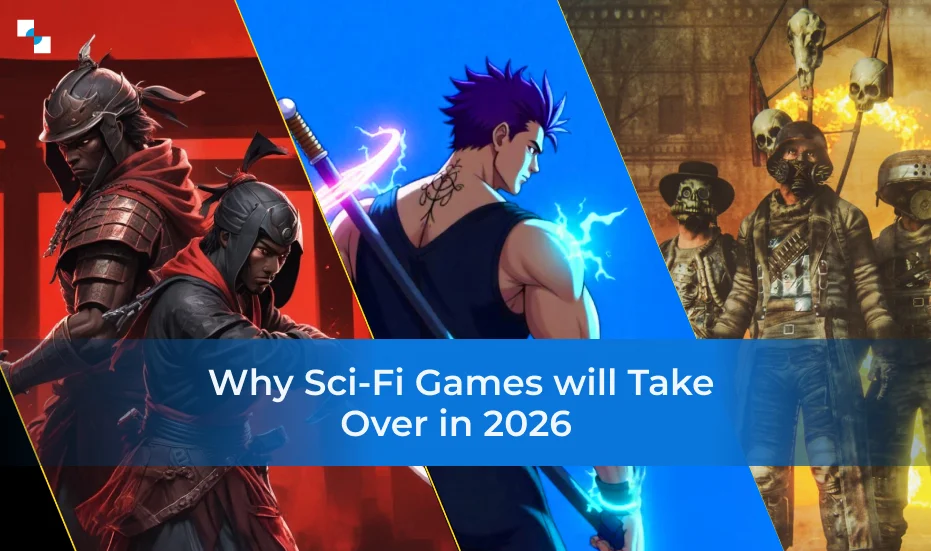
As Web3 gaming continues to advance, Sci-Fi P2E games stand to be on the front lines due to their full-spectrum scope.
In many occasions, these experiences have a performance that traditional P2E gaming experiences do not. Players are able to get lost in a storyline, and in return, earn benefits that make their time in the game rewarding as well as entertaining.
For play to earn NFT game development companies, Sci-Fi P2E games are an opportunity to shape the next generation of. Developers can embrace technology and create engaging worlds, while investors can capitalize on large revenue markets and retention potential, and long-term growth. When you think about computing technology and everything happening behind the scenes in those immersive games, compelling gameplay, and game mechanics, then, they can be built with a community in mind and scalable not only for business but with the introduction of Web3. Sci-Fi P2E are sure to make an impact on the future of Web3 gaming in 2026.
Sci-Fi P2E games are not just a trend; they are solving some really big issues in Web3 gaming. We have scalability, engagement, tokenomics, and community fragmentation all being addressed in Sci-Fi P2E games with our immersive gameplay and AI-driven experiences that also have a real impact on player incentives.
Collaborating with a play-to-earn NFT game development company that focuses on developing Sci-Fi worlds is not optional; it has become a strategic imperative for brands and developers who want to take control of the market. Those who adapt this concept will spearhead the next frontiers of Web3 gaming, creating experiences that excite players while ensuring long-term sustainability for the ecosystem.
Frequently Asked Questions
01. What are the main challenges faced by current Web3 P2E games?
Current Web3 P2E games face challenges such as scalability issues, poor game experiences, and dispersed player communities, which hinder player retention and engagement.
02. How can Sci-Fi P2E games address these challenges?
Sci-Fi P2E games can address these challenges by leveraging futuristic narratives, advanced technology, and robust tokenomics to create engaging worlds and dynamic gameplay that enhance player experiences.
03. Why is player engagement important in P2E gaming?
Player engagement is crucial in P2E gaming because it directly impacts player retention and the overall success of the game; without engaging experiences, players are likely to become frustrated and leave.