



✨ AI Summary
- Discover how to revolutionize your brand's payment experience by offering a "No KYC" crypto card program that allows users to seamlessly spend cryptocurrencies without traditional verification hassles.
- In the era of embedded finance, white-label crypto banking empowers businesses to pilot bold payment products under their brand, catering to Web3 customers valuing simplicity, speed, and privacy.
- Learn about the concept of a crypto card without KYC in neo-banking, highlighting enhanced privacy, faster onboarding, and increased accessibility for users prioritizing financial autonomy.
- Dive into the comparison between KYC-free crypto cards and traditional options, market trends, and key drivers of the crypto card development market.
- Explore how enterprises can integrate privacy-first crypto cards into their white-label neo-banking solutions to differentiate, attract Web3 users, and drive growth.
Have you ever wondered how your brand could let customers spend crypto as easily as tapping a card, without turning away privacy-minded users? Consider creating a payment experience that feels instantly familiar while also speaking directly to Web3 customers who value simplicity, speed, and privacy. In the age of embedded finance, white-label crypto banking enables businesses to pilot bold payment products under their own brand, quickly test user demand, and iterate with real metrics, all while maintaining control over the customer journey. If you are exploring new revenue streams, audience differentiation, or faster product-market fit, a “No KYC” crypto card program can be the practical experiment that scales.
Read on to see how to design one that wins both users and enterprise partners.
What does “Crypto Card Without KYC in Neo-Banking” mean?
A crypto card without KYC in neo-banking refers to a digital or physical payment card linked to a user’s crypto wallet that enables seamless spending of cryptocurrencies without undergoing traditional Know Your Customer (KYC) verification. In simpler terms, it allows users to convert and use their crypto funds instantly for daily transactions, just like a debit or credit card, but with minimal personal data sharing. Integrated into a white-label neo-banking ecosystem, these cards offer enhanced privacy, faster onboarding, and greater accessibility for users who prioritize financial autonomy. Instead of lengthy verification or document uploads, users can activate and start using their cards instantly, making them ideal for Web3-native individuals and businesses seeking a balance between privacy, speed, and convenience in digital finance.
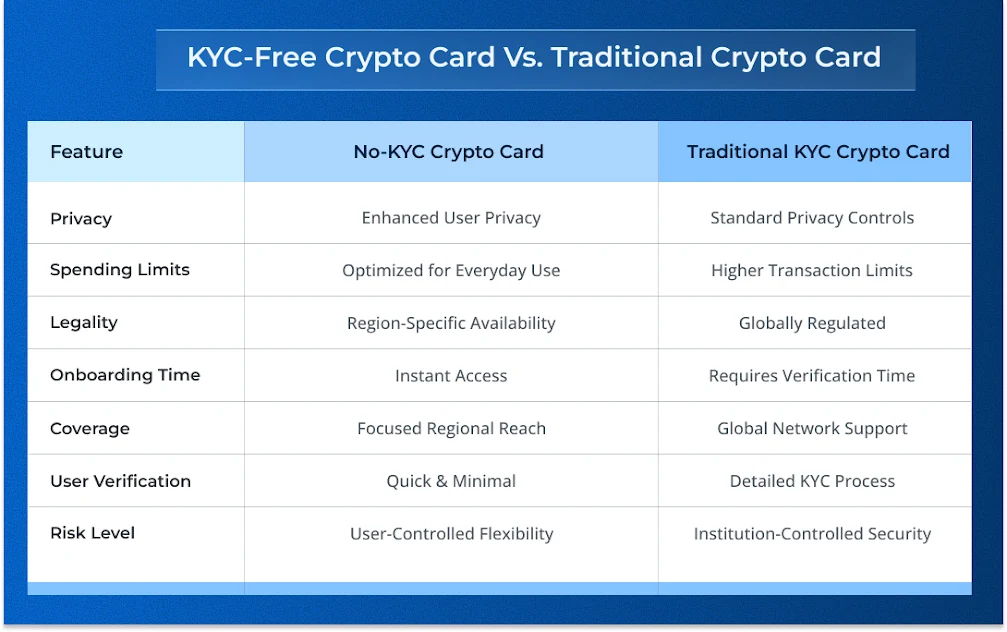
Crisp comparison Of KYC-Free Crypto Card & Traditional Crypto Card
The Crypto Card Market Trends You Must Know
- Regulators and card networks have tightened rules around identity and anti-money laundering, so card programs must embed compliance capabilities. Visa and Mastercard rulebooks emphasize AML requirements and program controls that program managers must enforce.
- Despite this, demand for privacy and instant access remains strong among Web3 users. No KYC or light KYC offerings still attract use cases where convenience and privacy are key, especially when offered with sensible limits and clear terms. Industry primers and platform listings show continued interest in no KYC options but note that policies are evolving by jurisdiction.
- White-label neo-banking development vendors accelerate launches. Modern platforms can issue cards and embed conversion rails quickly while layering compliance and fraud controls. This makes the white-label route the fastest way to test privacy-first card propositions.
- Privacy-preserving identity technologies such as zk-KYC are maturing. These allow users to present verifiable attestations without exposing raw identity data and are gaining momentum as a privacy-friendly compliance path.
Key Drivers Of The Crypto Card Development Market
- Growing everyday adoption of crypto : users want simple, instant ways to spend digital assets.
- Partnerships with major payment networks increase acceptance and boost user trust.
- Crypto cards give unbanked and underserved users access to payments and stored value.
However, knowing just the trends of the market isn’t enough. A smart and visionary investor must be aware of the advantages the BaaS platform with KYC-free crypto card integration is going to offer to their business and the end customers.
Build Your Own Privacy-First Neo Banking Solution Today!
Why Do Visionary Enterprises Prefer Crypto Cards Without KYC in Their White Label Neo Banking App?
Visionary enterprises favor co-branded crypto virtual cards without KYC as a strategic response to shifting consumer expectations around privacy and instant access. Within a white-label bank platform, these cards offer a practical way to pilot privacy-first payment models and test market fit.
- Faster user onboarding and instant activation to reduce drop-offs and speed growth.
- Enhanced user privacy that appeals to privacy-conscious customers.
- Higher conversion rates thanks to lower friction during signup.
- Lower customer acquisition costs through simpler flows and reduced support needs.
- Market differentiation with a privacy-first positioning that attracts Web3 native users.
- Rapid go-to-market suitability for pilots and minimum viable products.
- Cost-efficient operations with less manual verification and easier scaling.
- Strong product market fit for digital native customers who expect seamless crypto spending.
- Flexible business models that support prepaid and low-tier offerings with upgrade paths.
- Better user experience and retention as convenience encourages repeat spending.
How Does a Crypto Card Without KYC in Neo-Banking Work?
1. Wallet to Card Wallet Mapping – A user holds crypto either in a non-custodial or a custodial wallet. The white-label neo-banking app links a card wallet to that account/wallet. When the user spends, the platform converts crypto to fiat (on-chain swap or via a liquidity provider) and funds the card transaction.
2. Conversion & Settlement – Conversion can be real-time (on-demand conversion) or via internal float. Settlement occurs through the white-label crypto card service provider and card network (Visa/Mastercard/UnionPay) into fiat rails. Card networks and issuing banks are central: they require program rules and AML controls.
3. KYC / Risk Control – “No-KYC” versions typically rely on product design: non-reloadable cards, low limits, merchant filtering, and transaction monitoring rather than identity capture. Enterprise programs commonly use tiered KYC (soft KYC for low tiers, full KYC for higher tiers).
4. Card Issuance via BaaS / White-label – The enterprise partners with a BaaS development company that integrates with an issuing bank and card scheme and provides fraud/KYC modules. The vendor may offer SDKs, API endpoints, and a compliance stack.
How Can Enterprises Get a Crypto Card with “No-KYC” In a White-Label Neo-Banking Solution?
Collaborate with the best team and get your KYC-free crypto virtual card into your neo-banking app in just a few steps:
Step A: Product & legal design
- Decide on the product model : non-reloadable prepaid gift cards vs reloadable consumer debit cards. Prepaid gift/single-load cards are the most likely to permit limited or lighter KYC.
- Engage legal & compliance counsel to map jurisdictional KYC/AML obligations and card-scheme rules (Visa/Mastercard have strict program rules). This is non-negotiable.
Step B: Choose the right White Label Crypto Card Service Provider
Look for reputable crypto-friendly neo banking solution providers that offer:
- Card issuance and scheme relationships (Marqeta, Verestro, Railsr, etc. check global coverage).
- Built-in compliance modules with tiered onboarding and transaction monitoring.
- Crypto rails & liquidity partners for conversion (on-chain swap integrations).
Step C: Product architecture options
- Tiered onboarding : low friction for micro-users (soft KYC, low limits); full KYC for higher tiers. This is the most practical design.
- Prepaid single-use cards : launch quickly with low compliance burden and clear user expectations.
- Privacy-preserving KYC (zk-KYC) : Integrate with SSI / ZK credential issuers so users present cryptographic attestations instead of raw documents. This can be a differentiator for enterprises seeking privacy while maintaining auditability.
Step D: Operational & risk controls
- Transaction monitoring & sanctions screening (automated).
- Limits & merchant controls to reduce AML risk.
- Clear T&Cs and refund/chargeback rules are critical for enterprise partners.
Step E: Launch & iterate
- Start with a pilot market where regulatory interpretation supports the chosen model; scale only after legal validation.
Why is this the right approach? It avoids unlawful anonymity, preserves enterprise relationships, and gives you a defensible, privacy-focused product that can attract serious customers and partners. Thus, it is always recommended to connect with a renowned crypto-friendly bank development company that helps you develop solutions with the right and legal approach.
Hire The Certified Customized Crypto Virtual Card Development Team
Adopting privacy-first crypto virtual cards within a white-label neo-banking strategy is a timely, high-leverage investment. Market demand for seamless crypto spending and privacy-conscious experiences is growing, while modern BaaS platforms and privacy-preserving identity tools make secure, auditable implementations feasible at scale. Enterprises that move now capture early adopter audiences, accelerate customer acquisition with low-friction onboarding, and create new revenue streams through card fees. To gain success in the highly competitive Web3 finance market, you must launch an eye-hooking product. Thus, connect with Antier, an experienced blockchain and Web3 firm to design a compliant, privacy-first card program tailored to your market. Our team combines deep Web3 expertise and proven banking tech to offer the most comprehensive white-label crypto card services.
Talk to Our Experts Today!
Frequently Asked Questions
01. What is a crypto card without KYC in neo-banking?
A crypto card without KYC in neo-banking is a payment card linked to a user's crypto wallet that allows spending cryptocurrencies without traditional Know Your Customer (KYC) verification, enabling instant access and enhanced privacy.
02. How does a no-KYC crypto card differ from a traditional crypto card?
A no-KYC crypto card offers enhanced user privacy, instant onboarding, and optimized spending limits for everyday use, while a traditional crypto card requires detailed KYC processes and has higher transaction limits.
03. Why might businesses consider implementing a no-KYC crypto card program?
Businesses may consider a no-KYC crypto card program to explore new revenue streams, differentiate their audience, and achieve faster product-market fit while maintaining control over the customer journey.