




✨ AI Summary
- In a blog post discussing the rise of decentralized prediction markets, Bernstein's analysts highlight the convergence of blockchain technology, AI analysis, and news feeds in the crypto marketplace.
- Prediction platforms allow users to trade shares on various future events, from politics to celebrity trials.
- These markets offer more than just gambling opportunities, with businesses using them for forecasting and data monetization.
- The post outlines key layers necessary for building a functional on-chain prediction marketplace, including smart contracts, liquidity management, user experience optimization, governance, compliance, and AI integration.
- The potential for revenue generation through trading fees, event creation fees, data licensing, and token utility is also discussed.
When one of the biggest financial outfits starts writing about “decentralized prediction markets”, you know that they’ve moved past niches. Bernstein’s analysts now argue that “blockchain rails, AI analysis and news feeds” aren’t just adjacent trends, but they’re merging inside a crypto marketplace category known as “prediction platforms”. That’s not just a hype that rose during the US presidential elections and faded, but is an opportunity, sooner tapped, better. The explosive growth has been driven by increased adoption of crypto, stocks, and event-based betting.
What are Prediction Markets?
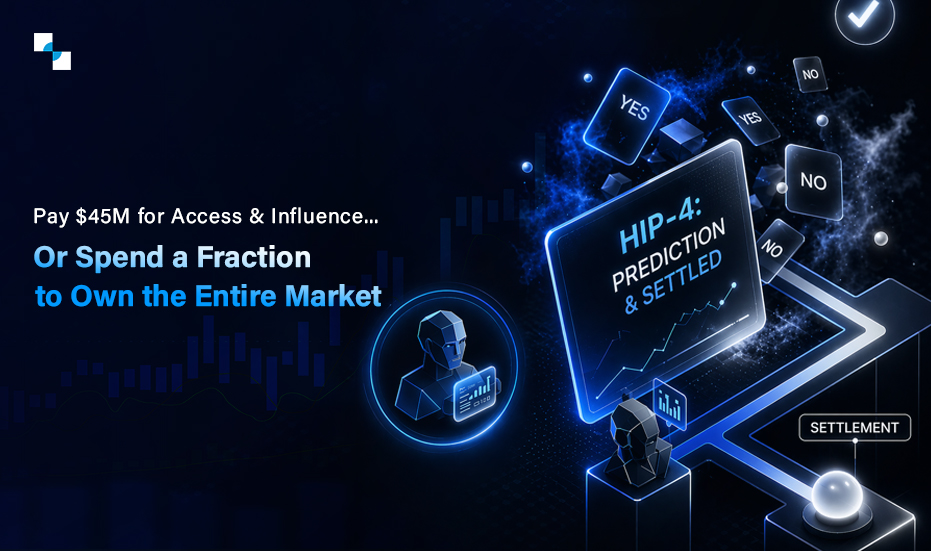
Prediction marketplaces let users trade shares on future events, including politics, crypto prices, sports, Fed rate hikes, celebrity trials, affairs, pregnancy, and whatnot. Instead of buying stock in a company, participants buy “Yes” or “No” shares tied to an outcome.
- If the event happens, “Yes” shares settle at $1.
- If not, “No” shares settle at $1.
- Prices in between reflect the probability the market assigns to that event.
Example:
- A Liquid Market On Exchange Could Be: Will Bitcoin close above $115k on 30 October
- If you buy a YES share and Bitcoin does close above $115k, your share pays out $1
- If it doesn’t, your YES share is worth $0 (and the NO share holders receive that $1 instead).
- The market price of YES shares (say $0.65) reflects the probability traders assign to that event happening.
- $0.65 = 65% chance of YES.
- $0.35 = 35% chance of NO (since they always add up to $1).
Also Read: Prediction Platforms: The Game-Changer for Exchange Software Development
Why Build Decentralized Prediction Marketplaces Like Polymarkets, Kalshi, Robinhood?
- Proven Market Demand: Polymarket regularly sees tens of millions in monthly volumes. What started as simple side bets is now merging with macro, markets, and media. Over $200 million on Polymarkets and $85 million on Kalshi were traded on the Fed rate cut decision and whether or not Taylor Swift announces pregnancy this year. There are many such sports, celebrity events, or crypto price-based liquid markets that are gaining momentum.
- Beyond Gambling: As just said, decentralized prediction marketplaces aren’t only the other betting apps. Many businesses and markets are being fed by these platforms that are actually unleashing the truth. Enterprises also use prediction markets internally to forecast sales, product success, or even project timelines.
- Data Monetization: Outcome pricing is itself a valuable data point that hedge funds, researchers, and media outlets rely on. This data can be monetized and sold to relevant businesses, generating millions of dollars.
- DeFi Integration: Prediction markets can be integrated with lending, collateral protocols, staking, and other protocols for enhanced liquidity. “YES” or “NO” shares are just tokens lying on the chain, and like any other tokens, they can be
- Staked in a liquidity pool for a yield or passive income
- Used as collateral to borrow stablecoins
- Traded in secondary markets for liquidity
By being plugged into the wider DeFi economy, they do more than just being held in wallets till settlement.
- Regulatory Tailwinds: These markets might not be as common as the crypto markets, but Bernstein and other institutions are openly discussing prediction markets. It signals incoming regulatory clarity, which entrepreneurs can ride early if they start building today.
- Sticky Engagement: Unlike spot or futures trading, prediction markets tie users to ongoing narratives such as elections, sports seasons, policy cycles, and much more, bringing repeated participations and check-ins.
A Gateway For Institutional Users: Hedge funds already use Polymarket data to track possibilities. This is a gateway for B2B data products, making a great revenue stream.

How to Build Your On-Chain Prediction Marketplace
Reminder: You’re not building another betting website, but it is going to be a stack of coordinated systems that make trading outcomes reliable, trustworthy, and liquid. Whether you’re leveraging a white label prediction platform or getting it built from the ground up, it must have these four key layers to be functional:
1. Smart Contracts:
This core logic layer validates and automates the following:
- Yes/No Tokenization: Each outcome is tokenized into tradeable assets that settle to $1 or $1.
- Event Resolution With Oracle Integration: Smart contracts must reference a trusted oracle to determine outcomes and automate the rest of the process. Chainlink, UMA, or custom oracle frameworks feed verifiable truth into the contract.
- Settlement: As said earlier, contracts have to auto-settle winners and release liquidity instantly on the conclusion of the event.
2. Liquidity Layer:
Markets without liquidity die in no time. These decentralized prediction markets need deep and dynamic liquidity to be usable. They ensure users can enter and exit positions at fair prices.
- Automated Market Maker (AMMs): Outcome shares are priced and rebalanced using formulas like LSMR (Logarithmic Market Scoring Rule) or constant product AMMs adapted for binary assets.
- Liquidity Incentives: In pool-based liquidity mechanisms, LPs are rewarded with fees or token incentives for locking funds into the liquidity pools. These tokens, in the case of decentralized prediction marketplaces, may be the YES or NO shares that depict a probability of a liquid market.
- Dynamic liquidity Reallocation: To handle popular vs. niche events, liquidity engines must adapt in real time, preventing “think” markets.
- Hybrid DEX Models: Smart decentralized prediction platforms adopt advanced liquidity mechanisms that merge order books with AMMs, enabling pro traders to place large directional bets within tight-spread markets.
- Cross-margin liquidity models: Shares could be composable across different events, e.g., hedging “Yes” on BTC ETF approval in the UK with “No” on US Fed Hike.
3. User Experience:
Without a frictionless user experience, your prediction marketplace may be technically brilliant but unstable. This layer of prediction platform development, therefore, brings:
- Event Creation Portal: This presents a stage on the platform where any approved user or governance token holder can create new markets with metadata that includes event description, closing time, oracle source, etc.
- Mobile-First Fast Trading With Smooth Onboarding: During your prediction platform development, you must ensure that you’re building a one-click entry with non-custodial wallet or web3 authentication and quick “Yes”, “No” button trading. However, charts should be available, but only for the users who want to see them. Quick Buy/sell sliders with instant probability feedback, like “You’re buying YES at 68%”, are also a good catch for users.
- Gas Abstraction: Using L2s and meta descriptions, platforms can let users dodge gas while they trade, improving the on-chain adoption rates and the prediction platform’s user base.
- Transparent Dashboards: Show liquidity depth, open interest, and market history, to captivate users and gain their trust.
PRO TIP: At the end, make sure that on-chain prediction platforms are exchanges built for non-crypto native users. So, its UX should be like an entertainment application, not a tech-heavy platform that is just trying to figure out if Taylor Swift is pregnant.
4. Governance and Compliance:
- Token-Based Governance: Community and DAO votes should decide which markets get listed, ensuring reduced spam and illegal proposals. Prediction platforms can also impose staking requirements to ensure that proposers are serious.
- Dispute Resolution: Arbitration committees, hybrid human/AI judges, or token-weighted juries on prediction platforms must be able to review contested results. Slashing penalties should be in place for malicious actors who submit false resolutions.
- Compliance Strategies: These could include Geo-fencing for restricted jurisdictions and attaining licenses for certain regions with the help of legal teams at your prediction platform development company. Not just some countries but some events may also be classified as gambling or derivatives, so platforms need modular compliance frameworks.
5. AI and Intelligence Layer:
AI layers with proactive intelligence systems differentiate betting prediction platforms from just reactive betting platforms.
- Real-time News and Data Feeds: AI scrapes headlines, social feeds, and economic releases to generate structured signals. ( e.g., “CPI below forecast could mean an increase in Fed cut probability.
- AI-driven Market Making: Bots adjust outcome prices dynamically using machine learning, ensuring liquidity pools react instantaneously to breaking information.
- Fraud and Manipulation Detection: AI tracks and flags abnormal wallet behaviors or coordinated trades, catching any manipulations before they disrupt the markets or cause loss of users’ funds in any way.
- User Insights: AI could also float personalized alerts on major probability shifts or AI-assisted queries (What’s the market’s implied chance of ETH ETF approval?”) and portfolio optimization suggestions.
- Enterprise Forecasting: Corporations can integrate AI-powered prediction feeds into dashboards for internal risk and sales forecasting, while institutions license enriched market data as alpha.
Who Should Integrate Prediction Markets?
The next wave of crypto apps isn’t standalone applications but superapps that blend trading, custody, staking, lending, entertainment, and whatnot. So, prediction platforms can be plugged into existing ecosystems. These are the platforms that can integrate prediction markets:
- Cryptocurrency Exchange Software: Any existing or emerging crypto exchange software, centralized or decentralized, can offer prediction markets as new trading verticals. They can also make it a tap-to-earn prediction game with tied rewards integrated into their grand trading module.
- Media Platforms: News portals (financial, political, entertainment) can embed prediction tickers to show “live odds” from the crowd.
- Sports and Entertainment Apps: Beyond sportsbooks, fan-driven apps could integrate decentralized prediction platforms for a transparent approach and increased engagement.
- DeFi Protocols: Lending, staking, and derivatives platforms can collateralize outcome shares or use them as hedges.
- Enterprise SaaS Tools: The corporation could deploy closed on-chain prediction markets for internal forecasting and decision making.
Revenue-Generation Models For Those Integrating Prediction Marketplaces
Entrepreneurs launching prediction marketplaces can generate revenue through:
- Trading Fees: Small % fee on outcome share trading.
- Event Creation Fees: Paid by entities to list new markets.
- Data Licensing: Selling aggregated prediction data to institutions.
- Token Utility: Staking for governance, fee discounts, or liquidity incentives.
Final Word
Prediction markets aren’t just about betting on elections, but they’re the DeFi-native mechanism for turning information into capital. They’re also the “Bloomberg terminal of collective beliefs: where markets price in future reality better than polls or analysts.
Given the trends, people will trade trust in the right platforms. Now, it’s time to not clone the betting or gambling apps but build reliable and trustless prediction infrastructures that power finance, governance, and enterprise forecasting.
Have a unique prediction platform development plan in mind? Partner with Antier, a trusted and experienced DeFi development company that delivers scalable, compliant, and liquid platforms, ready for the next cycle of adoption.
Frequently Asked Questions
01. What are decentralized prediction markets?
Decentralized prediction markets are platforms where users can trade shares on the outcomes of future events, such as political elections, cryptocurrency prices, and sports results, by buying "Yes" or "No" shares tied to those outcomes.
02. How do shares in prediction markets work?
In prediction markets, if an event occurs, "Yes" shares settle at $1, while "No" shares settle at $1 if the event does not happen. The market price of shares reflects the probability traders assign to the event occurring.
03. Why are decentralized prediction marketplaces gaining popularity?
They are gaining popularity due to proven market demand, with significant trading volumes, and their applications beyond gambling, such as helping businesses forecast sales and project timelines.