


✨ AI Summary
- Unveiling the revolution of Stablecoin 2.0 – a game-changer in global finance!
- Imagine money on the internet that's stable, fast, and smart.
- This innovative development is reshaping remittances, offering faster transactions, lower fees, regulatory compliance, and more.
- Discover how Stablecoin 2.0 is fixing the broken remittance system, making cross-border payments instant, low-cost, and transparent.
- Smart businesses are racing to capture the $1 trillion+ opportunity in the stablecoin market, positioning themselves as market leaders for the next decade.
Some revolutions start quietly. No chaos, no headlines, just small moments that change everything: a worker’s wage arriving instantly, a family receiving funds with no delay, a startup scaling payments across continents without barriers.
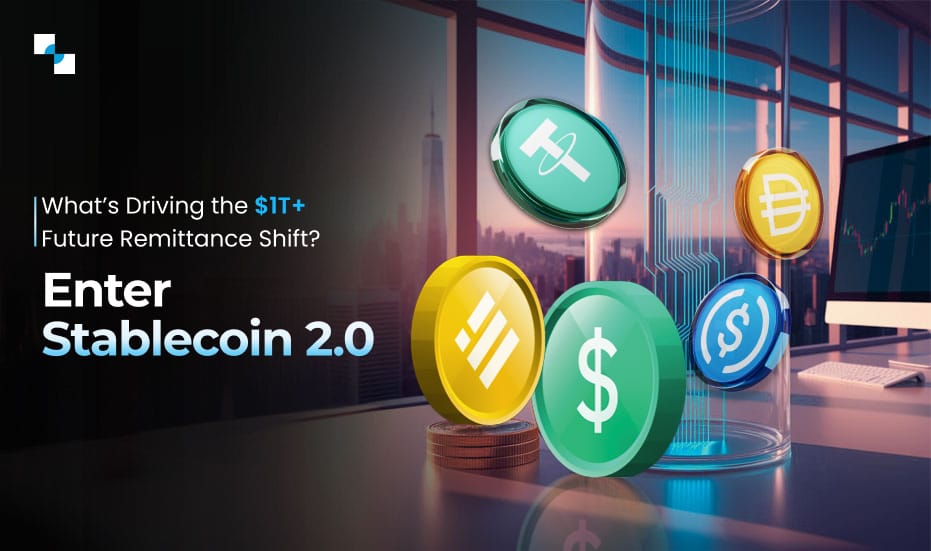
That is Stablecoin 2.0 development in action. We’re standing at the edge of a massive financial shift. Standard Chartered recently predicted that a stablecoin payment platform could attract over $1 trillion in inflows from emerging markets, as users and businesses seek faster, cheaper, and more transparent ways to transfer money globally. In this blog, we’ll explore how Stablecoin 2.0 is redefining remittances, solving long-standing inefficiencies, and unlocking billion-dollar opportunities for early adopters in the cross-border payment space.
What Is Stablecoin 2.0?
Think of money on the internet. Regular digital cash like Bitcoin can be very volatile. Its price goes up and down constantly. That makes it difficult to use for everyday payments or sending money without worrying about significant fluctuations.
What are stablecoins?
A stablecoin is a type of cryptocurrency that maintains a stable value. It is usually tied to real-world assets like the US dollar, euro, or gold.
What makes Stablecoin 2.0 different?
Stablecoin 2.0 improves on regular stablecoins in several ways. Businesses and fintech innovators focusing on Stablecoin 2.0 development are creating solutions with:
- Faster transactions, so money can move instantly across borders
- Lower fees compared to traditional banking or remittance services
- Built-in regulatory compliance to operate safely within laws
- Programmable features using smart contracts for automatic rules
Stablecoin 2.0 is not just about storing value. Through advanced Stablecoin 2.0 development, it enables the next generation of global payments, remittances, and financial services. It is a digital version of money that is reliable, fast, and smart.
This brings us to the remittance market, which is outdated, expensive, and slow. Stablecoin 2.0 is fixing these inefficiencies by making cross-border payments instant, low-cost, and transparent. Proper Stablecoin 2.0 development is turning the broken remittance system into a modern, efficient alternative that is already reshaping global financial flows.
Is Global Remittance Broken? Here’s How Stablecoin 2.0 Fixes it
Traditional remittance corridors often face delays, high costs, and a lack of transparency. Stablecoin 2.0 directly addresses these challenges. Here is a comparison of common issues and how next-generation stablecoin payment platforms solve them:

Stablecoin 2.0 is already reshaping global payments and remittances through innovative solutions. Leading examples include:
- BCRemit uses USDC for US-Mexico transfers, cutting fees from 7% to just over 1%
- Visa and Bridge launched stablecoin-linked cards across Latin America.
- OKX and GrabPay enable instant payments in Singapore, converting USDC/USDT to local currency
- Flutterwave and Chipper Cash support wallet-to-wallet remittances in Africa
- FV Bank in Puerto Rico offers USDC, USDT, and PYUSD.
Recent 2025 updates: Onafriq & Circle, Mastercard & Circle, and Crossmint & MoneyGram expanded USDC remittances globally.
These examples show how the stablecoin payment rail is fixing the broken remittance market.
Discover how Stablecoin 2.0 can give your business a competitive edge globally.
The $1T+ Opportunity Smart Businesses Are Racing to Capture
The cryptocurrency and Web3 ecosystem has evolved into a multi-trillion-dollar market that is fundamentally reshaping global finance. Smart businesses see blockchain, DeFi, and stablecoins not as experiments, but as strategic levers to capture unprecedented value. With the global crypto market at $4.2 trillion and stablecoins processing billions daily, the runway for growth is immense. Cross-border payments alone process $200 trillion annually, yet stablecoins capture only a fraction. Stablecoin remittance platforms offer:
- 24/7 settlement
- Lower transaction costs
- Transparent, on-chain operations
Early movers using these platforms gain a clear competitive edge and unlock the ability to capture high-value transaction flows.
Growth Trajectory
- Conservative stablecoin market projection for 2030: $1.9 trillion
- Aggressive scenarios: $4 trillion
Growth drivers: regulatory clarity, enterprise adoption, Layer-2 scalability, AI, and IoT integration
The Early Mover Advantage
Less than 1% of businesses currently leverage crypto at scale. Companies building stablecoin development infrastructure, payment rails, and DeFi-enabled platforms today:
- Capture immediate revenue from transaction flows.
- Position themselves as market leaders for the next decade.
- Diversify portfolios and gain asymmetric return potential.
The $1T+ opportunity is real, measurable, and accelerating. Businesses that integrate Stablecoin 2.0 solutions today are not just participating; they are defining the future of global finance. The real question isn’t whether the market will shift; it’s who will claim the lion’s share.
How to Capture the $1T+ Market with Stablecoin Payment Platform Development

- Instant Settlements: Build stablecoin payment rails to enable 24/7, real-time cross-border transactions. Instant settlements reduce operational delays, lower costs, and improve the experience for both senders and recipients, making your platform a preferred choice in the global remittance market.
- Regulatory Compliance: Ensure your platform integrates AML/KYC protocols and compliance-ready smart contracts. This provides institutional-grade security and regulatory adherence, helping businesses confidently adopt your stablecoin remittance platform while avoiding costly compliance risks.
- Multi-Currency Support: Enable seamless transfers between multiple fiat and cryptocurrencies. Supporting diverse currencies and cross-border transactions positions your platform as a versatile, global-ready solution, ready to capture the growing demand in remittance flows.
- Scalable Infrastructure: Deploy high-performance, enterprise-grade architecture capable of handling large transaction volumes without downtime. Scalability ensures reliability for high-value clients and prepares your platform for rapid market growth as adoption accelerates.
- Transparency & Reporting: Provide full visibility into transactions with real-time dashboards, audit trails, and detailed analytics. This transparency builds trust with corporate clients and institutional investors while demonstrating your platform’s professionalism and operational maturity.
- Strategic Partnership: Go beyond technology delivery by offering consulting, token strategy, and tailored platform customization. Helping businesses align their stablecoin development services with growth strategies ensures they capture market share, generate revenue, and stay ahead in the competitive remittance landscape.
Conclusion
The global remittance market is broken, slow, costly, and lacking transparency. Stablecoin 2.0 development is transforming it by enabling instant, secure, and efficient cross-border payments. Real-world examples from BCRemit, Visa, OKX, Flutterwave, and FV Bank show that this transformation is already happening.
Businesses that embrace stablecoin development today gain a decisive competitive advantage. They can capture emerging opportunities, build trust with users through transparency and speed, and position themselves as leaders in the next generation of global finance. When it comes to implementing these solutions, Antier, a renowned stablecoun remittance development company, stands out as the best partner. With proven expertise in building scalable, compliant, and cutting-edge stablecoin platforms, we help businesses unlock the full potential of Stablecoin 2.0 and dominate the evolving remittance landscape.
We make what’s complex feel effortless. By leveraging stablecoin development, we transform cross-border payments into fast, transparent, and reliable experiences. Join us and lead the change.
Frequently Asked Questions
01. What is Stablecoin 2.0?
Stablecoin 2.0 is an advanced form of stablecoin that enables faster, cheaper, and more transparent cross-border payments, improving upon traditional stablecoins by incorporating features like instant transactions and built-in regulatory compliance.
02. How does Stablecoin 2.0 improve remittances?
Stablecoin 2.0 enhances remittances by making cross-border payments instant, low-cost, and transparent, effectively addressing the inefficiencies of traditional remittance systems.
03. Why are stablecoins important for global payments?
Stablecoins are important for global payments because they maintain a stable value, allowing for reliable transactions without the volatility associated with regular cryptocurrencies, thus facilitating everyday payments and remittances.