


✨ AI Summary
- Real-world asset tokenization has exceeded $24 billion, driven by institutional interest in digitizing illiquid holdings.
- While current tokenization systems don't fully address traditional finance inefficiencies, integrating AI can revolutionize the sector.
- AI-powered platforms synchronize data in real time, automate compliance, and enable instant settlements.
- This transformation enhances efficiency, reduces costs, and increases liquidity.
- For investors, AI-driven tokenization offers higher yields and lower barriers to entry, while enterprises benefit from improved liquidity and risk control.
Real-world asset tokenization has surpassed $24 billion in on-chain value, driven by growing institutional allocations into tokenized treasuries and private credit. The ability to fractionalize and digitize illiquid holdings has attracted widespread attention.
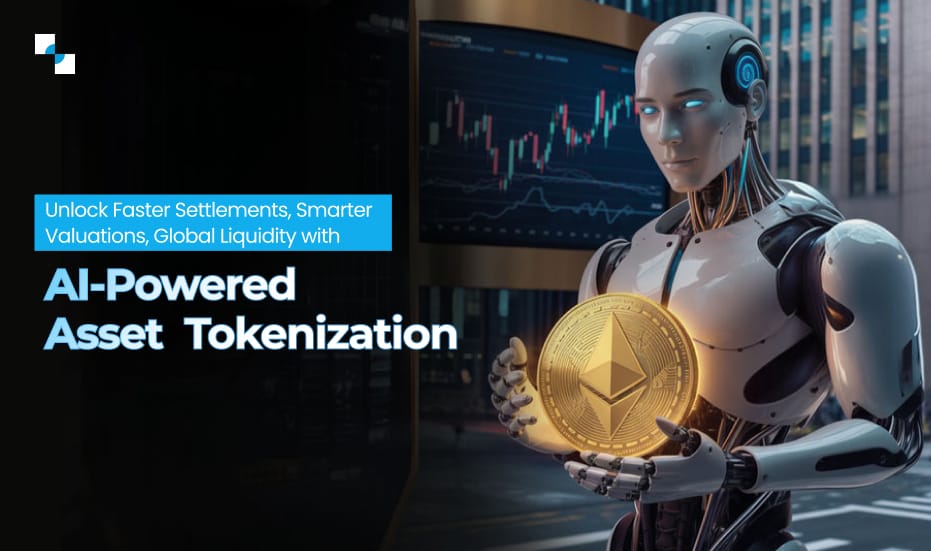
However, tokenization in its current form does not fully eliminate the structural inefficiencies of traditional finance. Settlement delays, high intermediary costs, limited liquidity, and opaque asset valuations continue to constrain adoption and performance. This is where AI integration becomes critical. By embedding artificial intelligence into tokenization platforms, data flows are synchronized in real time, risks are modeled proactively, compliance is automated across jurisdictions, and settlements are executed instantly.
As a result, AI transforms the tokenization from being a digitization exercise to a scalable financial infrastructure capable of supporting trillions in daily transactions.
This article examines how AI for asset tokenization delivers measurable efficiency gains and explores why it is becoming the defining factor for the future of tokenized finance.
Why Do We Need AI in Asset Tokenization?
Traditional business processes often operate on T+2 or T+3 settlement timelines, which create liquidity gaps and counterparty risks. While the tokenization process itself reduces some inefficiencies, it still depends on delayed reconciliation processes.
AI-enabled asset tokenization platforms enable the settlement systems to synchronize off-chain and on-chain data in real time, enabling T+0 atomic settlement where asset and cash transfers occur simultaneously through smart contracts.
This reduces intermediary dependence and eliminates transaction costs associated with legacy structures. Here is how it can benefit the investors and businesses:
For Investors: Higher Yields, Lower Barriers
- Investors lose 20–30% of transaction value to intermediaries in traditional markets. AI-powered tokenization eliminates much of that through instant, atomic settlements.
- Fractionalization powered by AI opens up markets. Instead of needing $1 million to invest in fine art, someone can invest $100, with confidence that the valuation and provenance are AI-verified.
For Enterprises: More Liquidity, Better Risk Control
- Private credit, real estate, and commodities markets often suffer from illiquidity. AI matching engines create 24/7 liquidity pools, pairing buyers and sellers across global platforms.
- AI risk models flag anomalies in on-chain behavior with accuracy, reducing fraud, money laundering, and compliance headaches.
- Asset Tokenization Development Companies using AI can cut operational costs by automating reconciliation, valuation, and compliance.
- Businesses can build platforms that scale globally with AI-powered compliance agents that map regulatory requirements across jurisdictions, updating rules in real-time.
Built an AI-Powered Tokenization Platform!
Key Business Challenges Resolved Through AI-Enabled Asset Tokenization
The integration of AI into tokenization platforms solves persistent financial inefficiencies that limit adoption and scale. The following areas demonstrate how combining tokenization with advanced analytics delivers tangible outcomes:
- Settlement Delays and High Transaction Costs
Traditional markets operate on settlement cycles of T+2 or T+3, locking up capital and creating counterparty risk. Even tokenized markets without advanced data synchronization often face reconciliation delays.
The Solution: Platforms that integrate AI models with smart contracts can achieve T+0 atomic settlement, where cash and assets are exchanged simultaneously. This approach eliminates intermediary costs, reduces settlement risk, and accelerates access to capital. JP Morgan’s Kinexys platform illustrates this model at scale, processing more than $1.5 trillion in settlements using predictive synchronization.
- Data Reliability and Provenance
The Challenge: Tokenization depends on trusted data for asset representation and ownership records. Single-source or static feeds can be manipulated, undermining confidence in valuations.
Platforms can use consensus-based oracles supported by AI analytics, combining inputs from IoT devices, financial markets, and institutional sources. Data is cross-checked across multiple channels to ensure integrity. Verified records build confidence among investors and issuers, while disputes are significantly reduced.
- Inefficient Fund Administration and Collateral Management
Conventional smart contracts are rigid. They cannot adjust to yield fluctuations, collateral reuse, or redemption timing, leading to administrative delays and inefficiencies.
Platforms can adopt adaptive smart contracts that integrate predictive analytics. These adjust to real-time conditions, automating dividend distributions, optimizing collateral, and executing redemptions. This decreases the Operational costs and enables investors to gain faster access to payouts.
Franklin Templeton’s $1.1 billion OnChain U.S. Government Money Fund illustrates this efficiency, with AI-enhanced automation eliminating custodian delays.
- Inconsistent Valuation of Illiquid Assets
Illiquid assets, such as real estate, infrastructure bonds, and fine art, are difficult to value. Manual surveys are costly, slow, and often biased.
Platforms can implement AI-driven digital twins, which replicate physical assets digitally and update continuously with IoT data, satellite imagery, and macroeconomic indicators. This makes the valuations transparent and bias-resistant, increasing accuracy compared with manual assessments.
- Rising Compliance Costs and Regulatory Burden
Compliance in tokenization is fragmented across jurisdictions. Rule-based monitoring is reactive, costly, and often misses early-stage risks.
AI-integrated platforms can deploy AI-powered monitoring systems that apply anomaly detection and integrate privacy-preserving tools such as zero-knowledge proofs. Regulators can verify compliance without accessing sensitive business data. This will improve the detection accuracy, remediation costs, and decrease compliance overheads.
Hedera-based RWA platforms already demonstrate this model, enabling scalable, regulator-friendly ecosystems.
- Limited Liquidity in Private and Alternative Markets
Illiquidity remains one of the largest barriers in private credit, real estate, and alternative asset classes. Limited participants reduce transaction flow and investor confidence.
Platforms can adopt AI-enabled matching engines that analyze trading patterns and investor demand, pairing buyers and sellers with greater precision. Combined with fractional ownership models, this expands market access. Secondary trading volumes increase, participation broadens, and market depth strengthens.
RealT’s property tokenization platform reported a rise in secondary market activity after introducing AI-driven matching for fractional tokens.
Strategic Applications of AI in Asset Tokenization Across Industries
AI’s integration into asset tokenization goes beyond sector-specific efficiencies. It reshapes how industries issue, trade, and manage tokenized assets, introducing new market structures that were previously unfeasible. The following advanced applications highlight the transformative potential across multiple verticals.
1. Real Estate
Tokenized real estate platforms can go beyond one-off property assessments by embedding AI systems that forecast neighborhood-level appreciation, rental yield trajectories, and climate-driven risk exposure. Instead of simply reflecting today’s value, tokenized assets can be continuously repriced against predictive models, enabling investors to buy fractions of real estate portfolios with dynamic, real-time yield projections. This changes property tokens from static representations into living financial instruments that behave more like actively managed funds.
2. Commodities
In commodity markets, the integration of IoT and AI does more than verify shipments. Tokenization platforms can transform supply chain data itself into a tradable asset class. For example, real-time temperature, shipment speed, and sustainability metrics can be tokenized into performance-linked securities. This allows investors not only to back physical commodities but also to speculate or hedge on logistical performance, energy efficiency, or environmental compliance, creating new revenue streams for supply chain operators.
3. Art and Collectibles
AI’s role in tokenized art extends past authentication. By analyzing auction results, collector behavior, and cultural sentiment, tokenization platforms can embed market intelligence dashboards into fractional ownership tokens. This provides investors with predictive insights into future value appreciation and allows issuers to structure performance-based tokens that evolve as an artwork’s cultural relevance grows. For collectors, the ability to track real-time demand signals adds a new layer of liquidity to markets that were once illiquid and opaque.
4. Carbon Credits
AI validation ensures the credibility of carbon credits, but the next phase involves dynamic pricing mechanisms. Platforms can integrate AI that continuously reassesses sequestration performance, energy intensity, or compliance with climate targets, automatically adjusting token prices. This creates a real-time ESG marketplace, where carbon credits behave more like derivatives tied to sustainability metrics. For corporations, this introduces a transparent system for meeting obligations; for investors, it generates a liquid market for climate-linked financial products.
5. Private Credit
Traditional credit scoring is static and backward-looking. AI allows tokenized private credit platforms to run continuous borrower risk assessments, using live transaction data, supply chain signals, and industry benchmarks. This not only broadens access for SMEs but also allows investors to rebalance exposure instantly based on changing risk profiles. Over time, this creates self-adjusting private credit tokens, offering real-time yield adjustments instead of rigid repayment schedules.
6. Infrastructure and Bonds
AI does not just forecast cash flows; it can simulate macro scenarios across decades, stress-testing tokenized infrastructure and sovereign bonds against interest rate shifts, demographic changes, or climate events. Tokenization platforms can embed these simulations into bond metadata, giving investors a transparent, scenario-driven view of future returns. This reduces the uncertainty that often makes infrastructure debt illiquid and opens the market to a broader base of institutional capital.
Beyond Sectors: Cross-Industry Implications
What makes AI-driven tokenization transformative is not only its sector-specific use but also its ability to create converging asset ecosystems:
- Blended Portfolios: A single platform can tokenize and trade real estate, carbon credits, and commodities together, with AI managing correlations and hedges automatically.
- Data as an Asset Class: IoT and operational data from industries like logistics, energy, or agriculture can itself be tokenized, turning data reliability into tradable value.
- Programmable Liquidity: Liquidity is no longer sector-bound; AI-enabled matching engines can route flows between unrelated asset classes (e.g., surplus liquidity from tokenized bonds flowing into carbon credit markets).
This convergence positions AI as the foundation of a multi-trillion-dollar tokenized economy, where assets trade in real time across industries with dynamic pricing, adaptive compliance, and predictive risk management.
Build a custom AI-Integrated Asset Tokenization Infrastructure!
The Future of AI in Asset Tokenization
- Autonomous Agents as Market Participants
By 2033, tokenized assets could surpass $18.9 trillion. Platforms will increasingly rely on AI agents capable of executing trades, enforcing compliance, and managing risks in real time. These systems reduce human dependency and operational inefficiencies.
- Zero-Latency Execution Across Liquidity Pools
Global liquidity will become programmable. AI-powered matching engines will route transactions instantly across asset classes and jurisdictions, creating continuous markets where settlement delays and liquidity gaps disappear.
- Bridging Decentralized and Traditional Finance
AI will act as the connective layer between DeFi and traditional markets. From collateral optimization to automated repo trading, tokenized assets will combine institutional compliance standards with the agility of decentralized execution.
- Dynamic Market Intelligence Embedded in Assets
Tokens will evolve from static representations into adaptive instruments. AI will embed predictive analytics into token metadata, enabling assets to carry forecasts of risk, yield, and performance directly within their structure.
- Establishing AI as the Core of Tokenized Finance
In the coming decade, AI will shift from being an enhancement to becoming the operating layer of tokenization. Platforms that integrate early will set new standards for efficiency, compliance, and investor confidence.
Takeaway
AI is making the Real World Asset Tokenization Platforms practical, profitable, and scalable. This unlocks the fairer valuations and better access for investors, higher liquidity and efficiency for developers through infrastructure that competes on speed, trust, and compliance. Businesses opt for AI-driven RWA Tokenization Development Services today, going to lead in a financial ecosystem projected to expand into the tens of trillions in upcoming years.
Antier, a leading Asset Tokenization Development Company, delivers end-to-end RWA Tokenization Development Services, helping enterprises design, develop, and launch platforms that are future-ready, compliant, and investor-focused. Partner with our experts to build a scalable and compliant tokenization infrastructure.
Frequently Asked Questions
01. What is the current value of real-world asset tokenization on-chain?
Real-world asset tokenization has surpassed $24 billion in on-chain value.
02. How does AI integration improve asset tokenization?
AI integration synchronizes data in real time, enables T+0 atomic settlements, reduces intermediary dependence, and automates compliance, enhancing efficiency and liquidity.
03. What benefits does AI-powered tokenization offer to investors and enterprises?
For investors, it provides higher yields and lower barriers to entry, while for enterprises, it offers increased liquidity and better risk control through 24/7 matching engines.