



AI Summary
- Peer-to-peer lending software is transforming traditional finance by connecting borrowers and lenders directly, with the market set to reach $1.38 trillion by 2034.
- Launching a P2P lending platform in 2026 requires a competitive edge to stand out.
- Trends include AI integration for faster loan approvals, blockchain-based lending for lower costs, and embedded finance for mobile accessibility.
- Features essential for P2P lending platforms include KYC, smart contracts, risk management, and compliance modules.
- Steps to launch a platform involve market research, choosing a software model, building core architecture, UI/UX development, and scaling.
Peer-to-peer lending software has been evolving as a compelling alternative to traditional finance by connecting borrowers and lenders directly through platforms, bypassing the intermediaries. These platforms enable individuals to secure loans without visiting banks or negotiating with traditional lenders by connecting them with people interested in investing in their needs or business.
By 2034, the P2P lending market, currently valued at $176.5 billion, is going to touch $1.38 trillion, riding the 25% CAGR.

That’s a massive growth and a steep curve, but launching just another lending application won’t cut it anymore. If you’re thinking of building a peer-to-peer lending platform software in 2026, you need to have a competitive edge that marks you differently from “me too” platforms. Understanding the trends, must-have features, and right development path helps you future-proof your P2P lending software development strategy.
Why 2026 is the Right Time to Launch Your P2P Lending Software
Recently, a Sygnum executive advocated for collateral-based crypto loans. Since crypto loans are being advocated by leading banks’ executives and funded and facilitated by leading cryptocurrency exchanges like Coinbase, it’s time that peer-to-peer lending software makes a comeback with robust features.
- Shifting Investors’ Appetite: Traditional lending and borrowing costs are fluctuating a lot. For borrowers, it means that banks aren’t consistent or cheap, while traditional lending models aren’t rewarding enough. As per research, more than 60% lenders on peer-to-peer lending platform software made more than 20% on their investments, compared to 3-5% government bond or savings account earnings.
- Faster, Convenient Loans: Even after constant evolutions, conventional credit approval processes are clunky and slow. P2P lending software facilitates loan approvals in minutes with just one-time KYC during onboarding. This helps dodge the repetitive and effort-intensive credit scoring and background checks required in tradFi credit means.
- Tech Stack Maturity: AI, blockchain, and regtech tools have evolved enough for platforms to be both compliant and scalable. AI-based credit scoring, predictive risk modeling, AI/ML enhanced fraud detection, and portfolio optimization implemented along with smart contract loans, collateralized lending, immutable audit trail,s and tokenized investments can build next-gen peer-to-peer lending software solutions. Other technologies that enhance user experience on P2P lending platforms include DID wallets, ZK-based KYC, reusable digital credentials, transaction screening, open banking, and other APIs.
- Clear regulations: Regulations around peer-to-peer lending are evolving. Earlier this year, India introduced some regulatory changes that impacted P2P lending platforms. As a result, Cred tweaked its P2P lending software Mint to adhere to the latest norms. Similarly, China’s P2P crackdown, Europe’s tightening rules around decentralized platforms and lending systems, and other regional rules have defined paths for the legal operations of peer-to-peer lending platform software.
Since the decentralized, peer-to-peer lending platforms are in their maturation phase, tech-forward players can launch their standout platforms and lead the market.
What Are Trends Defining P2P Lending Platform Software in 2026
As said before, the next wave of P2P credit platforms won’t look like the early P2P experiments. They’ll emerge into superapps or merge into larger tradFi systems. Here are the top trends driving innovation in peer-to-peer lending software solutions.

- AI and Automation Integration:
As discussed above, AI and ML are automating loan approvals, risk assessments, fraud detections, and borrower behavior analysis, effectively and effortlessly, while facilitating predictive analytics and AI agent-enabled portfolio management. These integrations enable faster processing, reduce defaults by 20% and personalize offerings. Open banking APIs further allow real-time data sharing for seamless verifications.
- Blockchain-Based Lending:
P2P lending software solutions are being deployed on blockchains such as Apechains, enabling yield farming, stablecoin-backed, and collateralized lending through smart contracts. Furthermore, peer-to-peer lending models with smart contract-based escrow services and biometric KYC will facilitate lower costs, streamlined onboarding, globalized access, and boost yields by up to 16% annually.
- Embedded Finance and Mobile Accessibility
The future of lending services is outside the financial applications. Their inclusion in mobile-first e-commerce, ride-sharing, and other such models, where credit meets users at the point of need, increases conversion rates by more than 30%. P2P lending software models are also popular in underbanked and emerging populations where other credit sources are expensive and inaccessible.
- Alternative Credit Data and Personalization
Peer to peer lending platform software is integrating non-traditional data (e.g., utility payment records, social media, etc.) alongside AI for credit scoring, enabling tailored loan terms for thin-file borrowers. This improves inclusion for MSMEs, gig workers, etc.
- Sustainability and Green Financing:
P2P loans are increasingly funding ecological projects like renewable energy, with ESG criteria integrated into the offerings to attract and impact investors. This aligns with the demand of the market that is projected to touch $28.7 trillion by 2033. According to credible sources, platforms offering green loans are experiencing 15% higher investor interest.
- Enhanced Security and Transparency:
Peer to peer lending software development projects have been emphasizing on implementing buyback guarantees, diversification tools, and blockchain audits to protect funds. These, along with real-time performance dashboards for investors, build trust amid regulatory scrutiny. Secure white label P2P lending platforms have proven to minimize defaults by 11-14%.
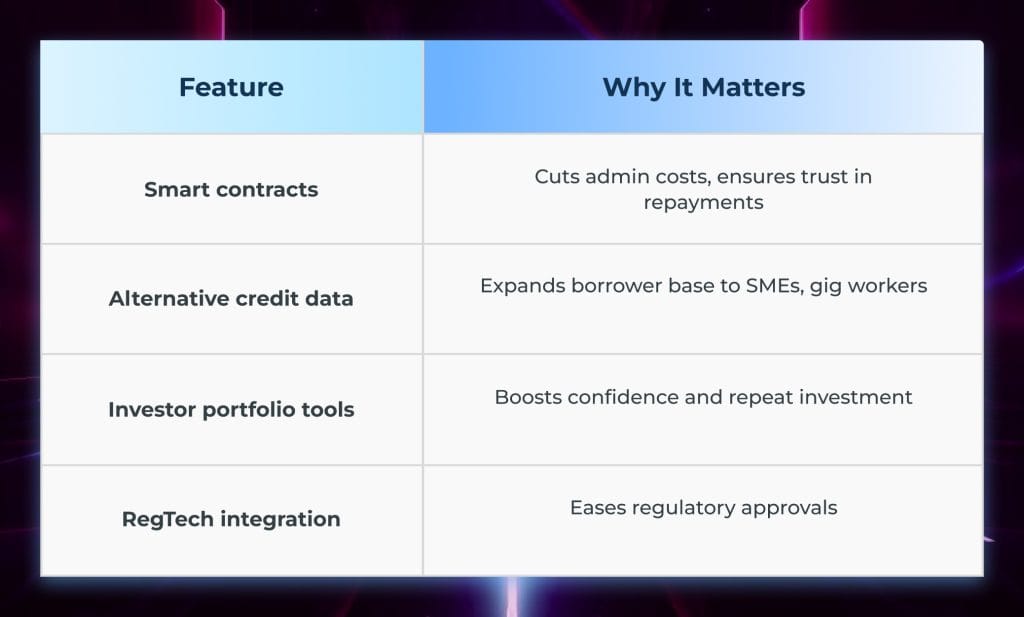
What Are the Essential Features For White Label P2P Lending Platform Development?
Whether you’re building your peer to peer lending software from scratch or leveraging a turnkey solution, you must integrate bank-grade functionality into your platform, as that’s what investors and borrowers expect. At a minimum, your P2P credit platform should include:
- Borrower Onboarding and KYC
- Investor Dashboards
- Smart Contract-Enabled Automations
- Risk Management Features
- Mobil-First UX
- Compliance and Transparency Modules
What are the Steps Required To Launch a P2P Lending Platform In 2026?
If you want to revolutionize lending with blockchain-based peer-to-peer lending models, your strategy needs more than just coding because that’s what you can mostly dodge with white label P2P lending platform development. Here’s all you’ll need:
1. Market & Regulatory Research
- Learn the rules before you enter the game. After you’re clear about your target geography, thoroughly research the laws and regulations that apply to your business model. Know how you can comply with AUSTRAC and AFSL in Australia, MiCA in Europe, SEC in the US, and other regional bodies. Your white label P2P lending platform development company can help you navigate this front.
- Also, decide if you’ll target retail investors, SMEs, or institutional capital. When you know this, you can begin your research on what your top competitors are doing.
Best Peer-to-Peer Loan Providers in 2025, in terms of loan cost, accessibility, and customer experience, include:
- Prosper
- SoFi
- Upgrade
- LightStream
- LendingClu
- PenFed
- Happy Money
- Upstart
- Lending Point
2. Pick Your Peer to Peer Lending Software Model
- After completely assessing the peer-to-peer credit market, you must decide whether you want to build:
- Centralized P2P lending software where platforms act as intermediaries
- Decentralized P2P lending platform where loans are executed via smart contracts
- A hybrid P2P lending platform software that combines both models.
- Crypto or non-crypto P2P lending platforms. You can allow customers to lend and borrow in fiat, crypto, or stablecoins, depending on your requirements.
3. Build Core Architecture With Security and Compliance Layer
- At this step, you merge and implement the technologies that would form the base of your peer-to-peer lending software. They include:
- Blockchain layer for transparency and automation
- API-first backend and oracles for real-time information gathering
- AI-powered credit scoring engine, fraud detection, and other modules discussed earlier in the blog.
- AML/KYC modules to ensure your P2P lending platform complies with most jurisdictions.
- Multi-factor authentication to ensure security and gain users’ and regulators’ trust.
- Regular blockchain-based audit trails to ensure flawless functionality and impenetrable security.
Build Your P2P Lending Empire With Antier
4. UI/UX Development
At this stage, you’ll need to put in extra efforts as this interacts with your end-user. Whether you’re leveraging a white label P2P lending platform development solution or building from scratch, you’ll need to spend handsome amounts of time and money here to ensure a high-end user experience. Some essential UI/UX development for peer-to-peer lending software includes:
- Mobile-first design.
- Multi-language support for cross-border reach.
- Investor tools with gamified portfolio views.
5. Pilot and Scale
At last, you can conduct sandbox testing with a limited borrower-lending pool, and then obtain regulatory approvals where available and necessary, before scaling up in your territory or globally with cross-border payment rails.
What are the Costs Associated with P2P lending Platform Software Development?
It depends on what development methodology you choose and how feature-rich and user-friendly you want your peer-to-peer lending software to be. A white label P2P lending software development may fall in the range of $40k – $80k, whereas custom development costs anywhere around $60k to $400k. Your exact cost estimate depends on scale, features, and compliance modules requirements. Here’s a rough cost breakdown that may vary region-to-region.

Note: These features aren’t set in stone. Compliance-heavy regions like Europe or the US may add to compliance costs.
Future Outlook of Peer to Peer Lending Software
As said above, it’s not going to be about connecting borrowers and lenders anymore. By inculcating innovative approaches, compliance modules, and high scalability into the core stack, the next-generation P2P lending platforms and white label peer-to-peer credit and lending models will feature:
- Hybrid P2P–DeFi models that blend regulated fiat lending with crypto collateral.
- Institutional entry through pension funds and asset managers that are eyeing P2P as a stable yield play.
- Globalization of lending with stablecoins facilitates seamless cross-border lending and borrowing with faster settlements.
- ESG-first P2P lending models will become mainstream and drive impact.
Ready To Lead The $1.3 Trillion Opportunity? Here’s Your Roadmap
Launch your peer-to-peer lending MVP in 7 days with a white label P2P lending platform development solution. Add features in phases, as it’s not a rush. Focus on improving the basics of lending one-by-one and keep:
- Understanding trends (AI, blockchain, embedded finance).
- Building features that inspire investor trust.
- Following a step-by-step development roadmap suggested by your white label P2P lending platform development company.
- Planning for compliance and long-term scale.
This way, you can set yourself up to capture a market that’s just starting to mature. Antier, a leading peer to peer lending software development company, can assist you with the right mix of technology, regulation, and investor-first design.
Launch faster, scale smarter, with Antier. Schedule your call today!
Frequently Asked Questions
01. What is peer-to-peer lending software?
Peer-to-peer lending software connects borrowers and lenders directly through platforms, allowing individuals to secure loans without traditional banks or intermediaries.
02. Why is 2026 considered a good time to launch a P2P lending platform?
By 2026, the P2P lending market is expected to grow significantly, and advancements in technology, such as AI and blockchain, will enable platforms to offer robust features and faster loan approvals.
03. How does P2P lending compare to traditional lending in terms of returns for lenders?
Research indicates that over 60% of lenders on peer-to-peer lending platforms earn more than 20% on their investments, compared to the 3-5% typically offered by government bonds or savings accounts.