



✨ AI Summary
- India's digital finance landscape is rapidly evolving with the Reserve Bank of India's launch of the Retail CBDC Sandbox.
- This platform allows fintechs and banks to experiment with the digital rupee in real-world conditions, fostering innovation, streamlining payments, and preparing for a digital-first future.
- The sandbox supports millions of users and facilitates the development of CBDC-enabled products, compliance with regulatory standards, and secure, high-volume transactions.
- Participants can explore retail payments, cross-border remittances, programmable payments, and loyalty systems, utilizing APIs, digital wallets, and smart contracts.
- The sandbox serves as a launchpad for innovative CBDC solutions, empowering fintechs and banks to create secure and compliant products.
India’s digital finance landscape is evolving at a faster pace than ever. The RBI’s launch of the Retail CBDC Sandbox has created a high-impact platform where fintechs and banks can experiment with the digital rupee in real-world conditions.
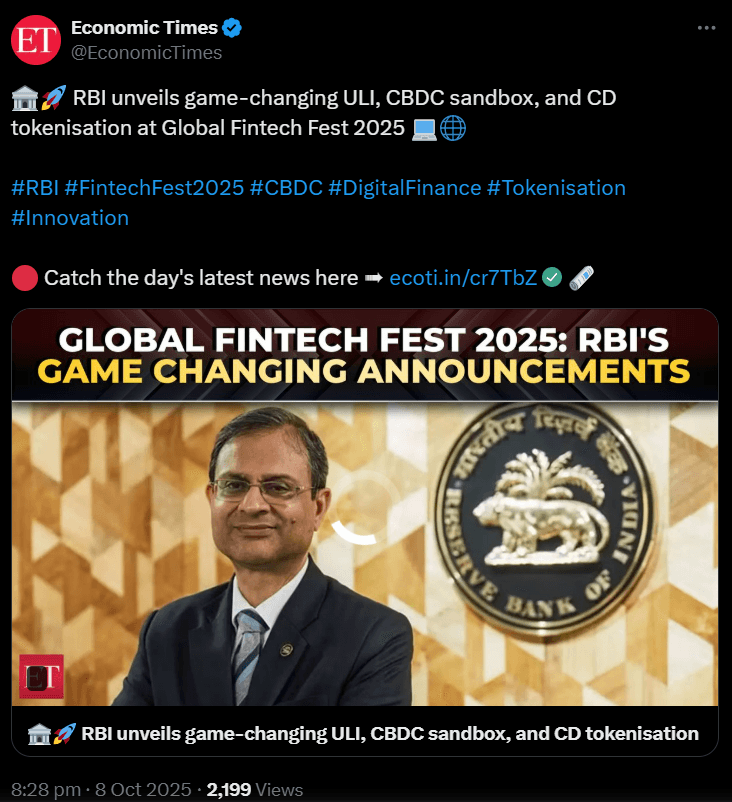
As highlighted by The Economic Times on X, this sandbox is not just a pilot; it is a strategic move to foster innovation, streamline payments, and prepare India’s financial ecosystem for a digital-first future.
Source: Economic Times
For fintech innovators and banks, this is a rare opportunity to test CBDC-enabled products, integrate blockchain-based payment systems, and design solutions that comply with regulatory standards.
Let’s explore what you can build inside the RBI Retail CBDC Sandbox and how to leverage it to create next-generation digital currency solutions.
RBI Retail CBDC Sandbox: India’s Digital Finance Laboratory in Action
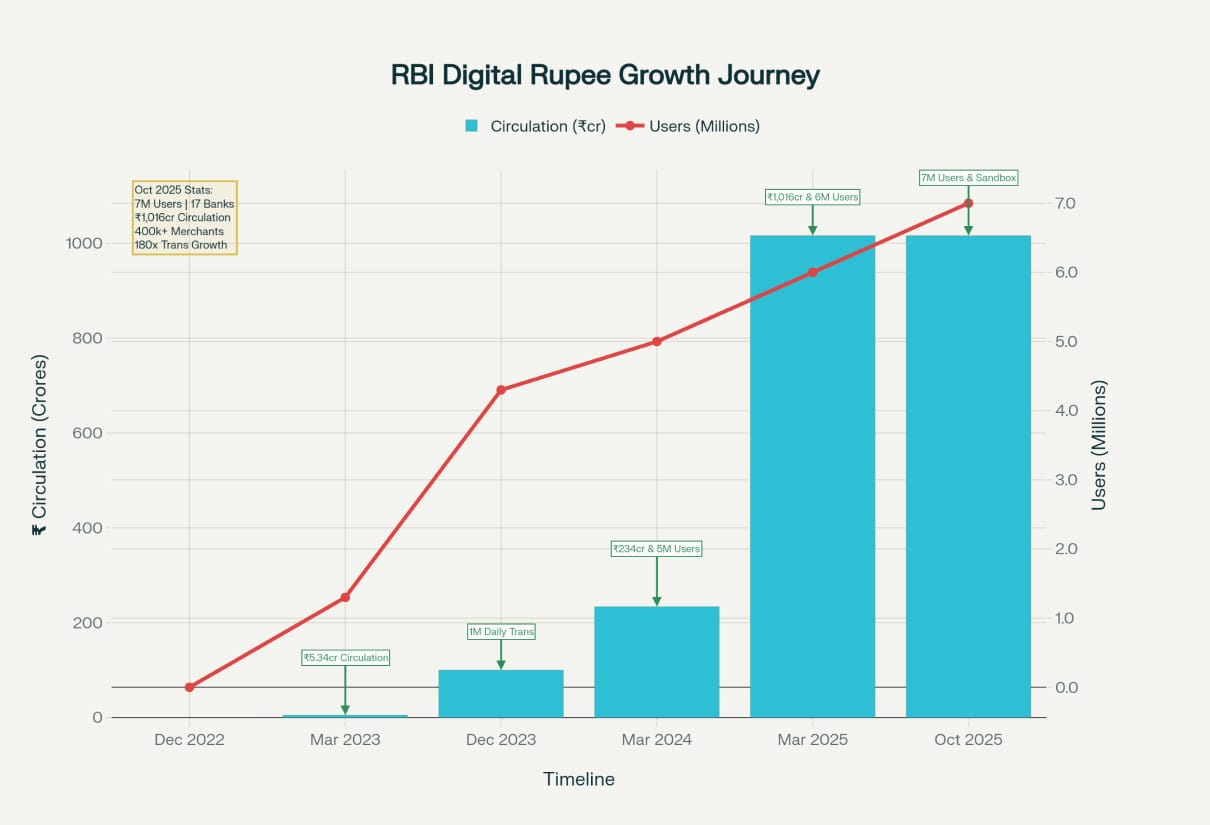
The Reserve Bank of India’s launch of the Retail CBDC Sandbox on October 8, 2025, marks a pivotal moment in India’s digital currency journey. What began as a limited pilot program has evolved into a robust and comprehensive testing environment. Today, the sandbox supports 7 million users across 17 participating banks and over 400,000 merchants, making it a central hub for experimentation with the digital rupee.
This initiative builds on the remarkable growth of India’s digital rupee, whose circulation value surged from ₹234 crore in March 2024 to ₹1,016 crore by March 2025, a staggering 334% increase. Clearly, the adoption of digital currency is accelerating at an unprecedented pace.
Source: Perplexity
But the sandbox is more than just a testing ground. It is a carefully orchestrated digital finance laboratory, designed to:
- Foster innovation by allowing fintechs and banks to develop and test CBDC-enabled products.
- Ensure regulatory compliance with AML and KYC standards.
- Maintain security and resilience for high-volume digital transactions.
Participants, including fintech startups, banks, technology providers, and even e-commerce platforms, can experiment with applications like retail payments, cross-border remittances, programmable payments, and tokenized loyalty systems. The sandbox also provides access to APIs, digital wallets, and smart contract frameworks, giving developers the tools to create innovative solutions while staying within a secure, monitored environment. In short, the RBI Retail CBDC Sandbox is a strategic enabler that not only accelerates CBDC development but also prepares India’s financial ecosystem for a digital-first future, balancing innovation with risk management and regulatory oversight.
Building on this foundation, the RBI Retail CBDC Sandbox serves as a powerful launchpad for innovation. It allows fintechs and banks to build, test, and refine CBDC-enabled products within a secure and compliant ecosystem. With blockchain-based frameworks, real-time simulations, and API access, innovators can explore new digital payment models while maintaining full regulatory alignment.
This is where technology and compliance move in sync, allowing real-world experimentation with the digital rupee. Now, let’s explore the types of CBDC-enabled products that can be created within this evolving ecosystem.
Ready to Build Your CBDC Solution? Get Free Consultation
8 Innovative Digital Currency Products Fintechs and Banks Can Launch
The RBI Retail CBDC Sandbox empowers fintechs and banks to experiment with a wide range of CBDC-enabled products, transforming how payments, finance, and digital services are delivered.
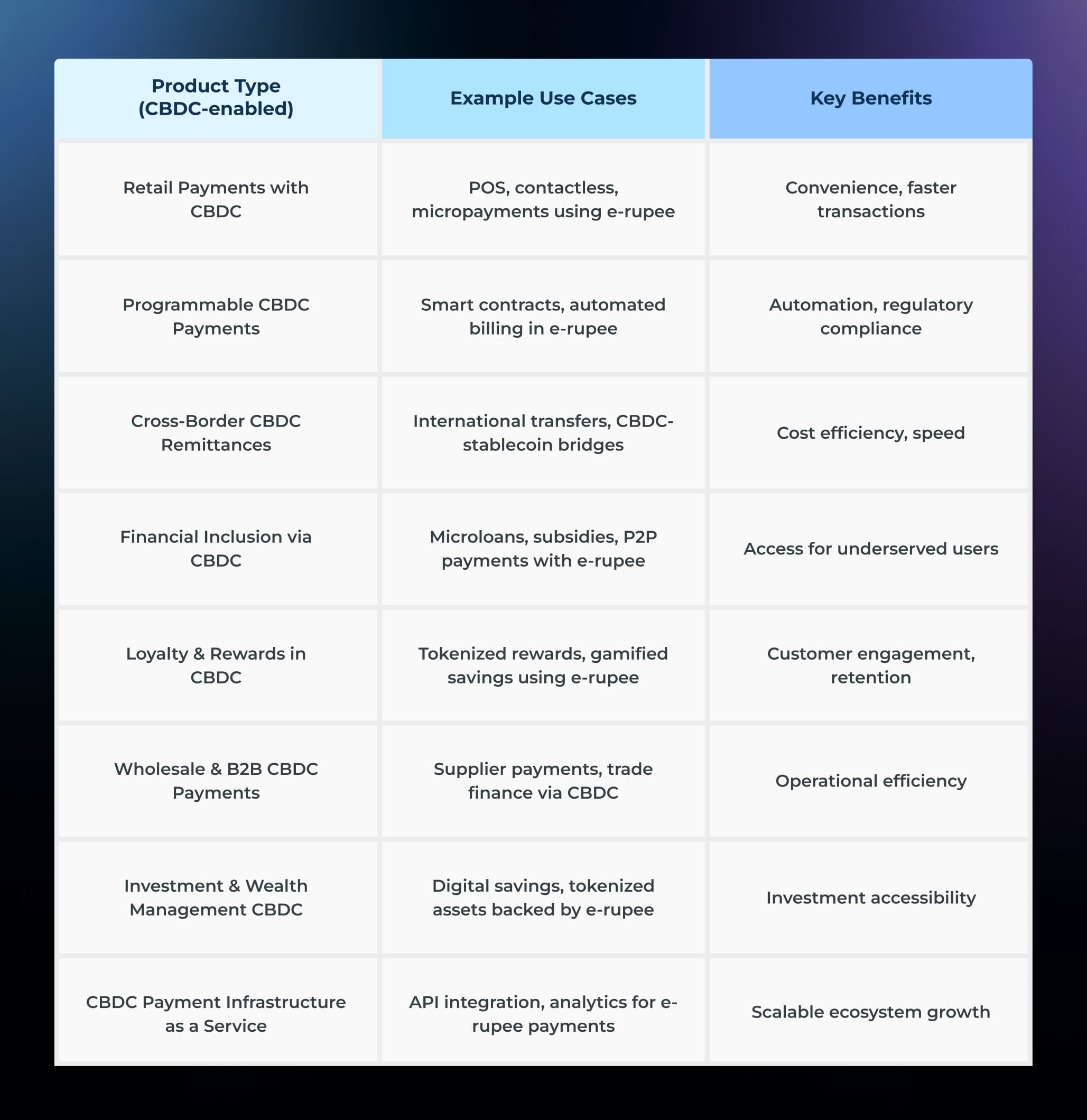
To successfully build and deploy all these CBDC-enabled products, fintechs and banks require deep technical expertise and robust crypto development capabilities.
Technical Essentials for CBDC-Enabled Product Development
Secure Wallet Architecture
- Design digital wallets that store and transact e-rupees securely.
- Include multi-factor authentication, encryption, and tamper-proof storage.
API & Integration Frameworks
- Provide APIs for banks, fintechs, and third-party apps to interact with CBDC.
- Ensure smooth integration with existing banking and payment systems.
Scalable Payment Infrastructure
- Build systems capable of handling high transaction volumes.
- Ensure low latency and high uptime for retail, wholesale, and cross-border payments.
Programmable Payment Logic
- Implement smart contracts for automated, conditional transactions.
- Support recurring payments, escrow, and micropayment solutions.
Regulatory Compliance & Monitoring
- Integrate AML, KYC, and transaction monitoring systems.
- Enable audit trails for regulatory reporting and transparency.
Data Privacy & Security Protocols
- Encrypt transaction data and user information.
- Implement tokenization, secure key management, and fraud detection systems.
Cross-Border Interoperability
- Ensure CBDC can work with foreign digital currencies or stablecoins.
- Support settlement protocols that comply with international standards.
Analytics & Insights
- Build dashboards for transaction monitoring, user behavior, and product performance.
- Use analytics to optimize payment flows and enhance decision-making.
Testing & Sandbox Simulation
- Conduct extensive simulations in a controlled sandbox environment.
- Test performance, security, and integration before live deployment.
Continuous Updates & Scalability
- Plan for system upgrades, patches, and evolving technical standards.
- Ensure architecture can scale with growing adoption and transaction volumes.
Speak to our blockchain development team and make your CBDC products market-ready.
Why Hire a Blockchain Development Company for CBDC Products?
Building a CBDC-enabled product is not just about creating digital payment systems. It requires deep technical knowledge, strong security practices, and compliance with complex financial regulations. This is where a blockchain development company plays a crucial role.
- Expertise: They understand distributed ledgers, smart contracts, and tokenization for CBDC use cases.
- Compliance: Built-in AML, KYC, and audit systems ensure RBI-ready deployment.
- Security: Advanced encryption and identity management protect transactions and data.
- Scalability: Systems are optimized for millions of secure, real-time transactions.
- Integration: Seamless interoperability with banks, payment networks, and stablecoin systems.
- Support: End-to-end development, maintenance, and updates for evolving needs.
Partnering with a crypto development company helps fintechs and banks move from concept to compliant, scalable CBDC products with confidence.
Conclusion
The RBI Retail CBDC Sandbox is shaping the next chapter of India’s digital finance revolution. It gives fintechs and banks the opportunity to experiment, innovate, and build real-world solutions powered by the digital rupee. Yet, turning those ideas into reliable, compliant, and scalable systems requires deep blockchain expertise.
This is where Antier stands apart. As a global leader in blockchain development, Antier has been at the forefront of CBDC development, helping central banks, financial institutions, and fintechs build secure digital currency frameworks. Our teams design CBDC payment rails, programmable transaction systems, and wallet infrastructures that meet the highest standards of security, interoperability, and performance.
If you are ready to explore CBDC innovation within the RBI Retail Sandbox, we can help you move from concept to deployment with clarity, precision, and confidence.
Let’s start building the future of money together.
Frequently Asked Questions
01. What is the RBI Retail CBDC Sandbox?
The RBI Retail CBDC Sandbox is a testing environment launched by the Reserve Bank of India on October 8, 2025, allowing fintechs and banks to experiment with the digital rupee in real-world conditions.
02. How does the RBI Retail CBDC Sandbox support innovation in digital finance?
The sandbox fosters innovation by enabling participants to develop and test CBDC-enabled products, ensuring regulatory compliance, and maintaining security for high-volume digital transactions.
03. Who can participate in the RBI Retail CBDC Sandbox?
Participants include fintech startups, banks, technology providers, and e-commerce platforms, all of whom can experiment with various applications like retail payments and programmable payments.