






✨ AI Summary
- Summary:
Launching a retail-focused crypto exchange in Spain can be highly profitable due to the country's growing crypto adoption and regulatory support. - The blog emphasizes the benefits of white label cryptocurrency exchange development for businesses looking to enter the market quickly.
- To succeed, it's crucial to partner with a reliable white label crypto exchange development company offering Spain-specific compliance readiness, customizable features, and robust security measures.
- The post provides a checklist for choosing the right vendor and outlines key considerations such as user onboarding experience, UI/UX design, trading engine performance, and integration of fiat on/off ramps.
- Security features like cold wallet custody and 2FA are essential for protecting retail users' funds.
White label cryptocurrency exchange development simplifies the launch of your crypto exchange for retail users. By offering a plug-and-play, feature-rich trading platform offered by a top-notch white label crypto exchange development company, businesses can get into the crypto trading business and tap into the hype. This blog breaks down everything you need to consider while launching your trading platform using these ready-made solutions. But before that, let’s have a look at why launching a retail-focused crypto trading platform in Spain is profitable.
Why Launch Your Crypto Exchange For Retail Users in Spain?
1. Spain’s Soaring Crypto Adoption
With over 10% of the internet users engaging with crypto and 350+ blockchain startups, Spain ranks among the top EU countries for blockchain adoption. The earlier stated research from market size and trends also reveals some other notable stats that highlight the country’s crypto adoption.
- More than €60 billion in crypto transactions in 2024
- 3 million active users in 2025 Q1, and Statista predicts total users to reach 25.14 million by 2026.
2. Regulatory Push:
The sandbox initiatives backed by the government and Catalonia’s blockchain push rev up the growth of crypto platforms. Apart from this, the country’s transition to the EU’s MiCA regulation represents regulatory clarity for crypto-asset service providers.
- Spain’s National Securities Market Commission (CNMV) has also recently laid out clear crypto advertising regulations that balance consumer protection and innovation.
- Many regional governments have also partnered with fintechs to develop localized blockchain testing environments.
3. Not Just Fintechs But Banks Betting Big On Crypto:
OKX and Robinhood entering the Spanish markets with regulated trading platforms were just the starters. Spain’s second-largest bank, BBVA, now offers BTC and ETH trading to retail customers. They’ve already seen where the puck’s headed; you just need to follow the lead.
4. Retail Adoption:
Spanish users are more mobile-first and trading-savvy, underlining the growing demand for retail-customer-focused crypto platforms and services. Since crypto has also been gaining traction as a form of payment in the country, its usage among retail users will rise significantly.
Spain is not just crypto-friendly, but it is crypto-ready from the demand and compliance standpoint. Moreover, it’s not saturated, so a robust white label cryptocurrency exchange development solution can take you to great heights.
How do you choose the right white label crypto exchange vendor?
No doubt, launching your crypto trading platform targeting Spain’s retail market requires you to partner with a reliable white label crypto exchange development company. That’s the most crucial decision, and everything else depends on how scalable, feature-rich, and robust the ready-made exchange solution is. Here’s your checklist for choosing the right white label crypto exchange provider:
- Ready-to-deploy platform with Spain-specific compliance readiness
- Custom branding, modular features, and multi-language support
- Proven experience in crypto exchange white label software development
- Built-in liquidity, wallets, and fiat ramps integrations
- Customizable frontend and admin dashboards
Don’t just go for a team that can go from MVP to full-scale exchange in 8 weeks. See what technology, features, and functionalities are being provided by the white label crypto exchange development company after 2 months. You must have some serious questions ready during your live demo call with the technology provider.
What are some questions you must ask your crypto exchange white label software development company?
- Can you show live order execution speed under load?
- Is the platform MiCA-compliant and registered with any EU regulators (like CNMV)?
- Can I fully customize the frontend, including its UI, language, and branding, without backend limits?
- What KYC/AML tools are integrated, and can I modify them per jurisdiction?
- Can you show the admin panel: fee management, user controls, and P&L dashboards?
- Does the white label crypto exchange include fiat on/off-ramps, SEPA, IBAN, or card support?
- What’s the go-live timeline from contract signing to production?
- Can you demonstrate how easy it is to add a new token or trading pair?
- Do you provide ongoing technical support, upgrades, and emergency response post-launch?
What do you need to consider before launching your retail exchange in Spain?
Before you touch the white label cryptocurrency exchange development tech, you must get clear on your launch strategy. After BBVA’s BTC and ETH custody and trading launch, users can buy and store these digital assets on the mainstream banking application. It normalizes crypto at the street level. So, you must carefully consider the following before launching your retail traders-focused trading platform leveraging crypto exchange white label software development solution:
1. Onboarding should feel like Stripe, not a spreadsheet.
Ask for a real-time walkthrough of how users sign up, verify identity (if needed), and deposit funds, and ensure there’s zero friction. After all, this is going to be the first impression for your users. So, the onboarding process should be brief and seamless.
2. UI/UX must match what users expect from Web2 apps
No matter how sophisticated the Spanish user is, the user-friendliness of white label cryptocurrency exchange development solutions still matters, as trading platforms need to grab a huge share of web2 applications. See if the dashboard is intuitive, mobile-friendly, and fast, or if it looks like 2017 DeFi.
3. Check how the trading engine performs under stress
While your crypto exchange white label software development solution provider promises near-instantaneous transaction speeds, confirm how many trades per second it can handle regularly and during load spikes.

4. Make sure fiat on/off ramps are integrated.
Institutional investors need fiat/crypto trading pairs, easy crypto purchases with banks, cards, or local payment gateways, and stablecoin/crypto pairs. If your white label crypto exchange doesn’t have these features, it’s not ready for the retail reality.
5. Understand how fees are set, managed, and displayed
Your users come and stay only if you’re offering competitive fees. So, ask your white label crypto exchange development company if you can customize maker/taker fees later on based on the Spanish market fluctuations? Also, check if these fees are visible to users at checkout.
Other than this, your Spanish crypto exchange for retail users, you must verify
- Built-in risk control features.
- How updates and patches are rolled out
- How the admin panel works.
- If compliance tools are functional.
What features must your retail crypto exchange include?
Retail users expect CEX-grade polish and features. Here’s what your white label crypto exchange needs other than
- Intuitive user onboarding
- Mobile-first UI with dark mode and gesture support
- Spanish language support and Euro fiat compatibility
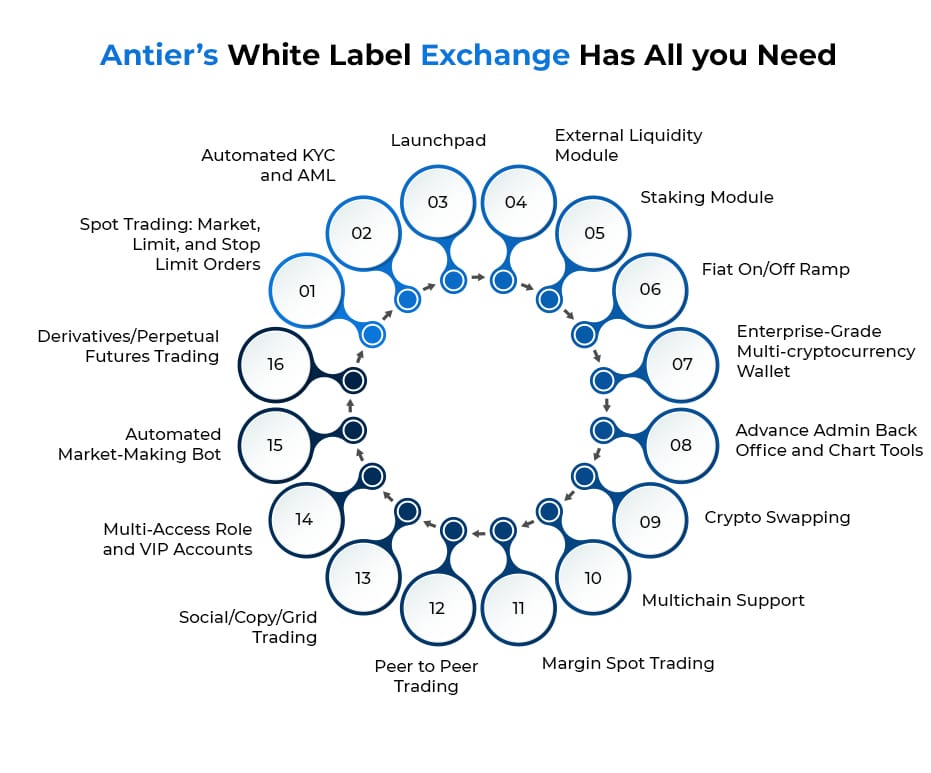
No bloat. No complexity. Just the features that matter. After launching with these features within a few weeks, you can expand later and add more premium AI-enhanced crypto exchange development features.
What are the security features that your white label crypto exchange must have?
For offering BBVA-level safety, your ready-made trading platform must implement security-first crypto exchange development practices as per the latest emerging threats. Half of 2025 has passed, and crypto heists have already looted more than $2.17 billion worth of crypto. It is already breaking records, and there can be no other sign to switch to a security-first approach. These are some of the security features that any exchange might not miss, considering the rapidly evolving crypto thefts.
- Cold wallet custody with multi-signature
- Two-factor authentication (2FA) and biometric login
- Anti-phishing codes
- Withdrawal address whitelisting
- Time-locked withdrawals
- Smart contract audits
- Real-time transaction monitoring
- DDoS protection and rate limiting
- Role-based admin access controls
- Regular key rotation
- Encrypted data storage
- Formal incident response plan
But since you’re launching in Spain’s crypto market, and that too for retail users, you must also have these features integrated into your security layers. (If your retail-focused crypto exchange white label software development provider includes them, it’s a jackpot!!)
- Session timeout auto-logout (to protect inactive retail accounts)
- Login anomaly detection (flagging logins from unusual devices/locations)
- Deposit confirmation alerts via SMS/email
- Account recovery with KYC fallback (in case users lose 2FA)
- CAPTCHA & bot prevention on signups, logins, and withdrawals
- Rate limits per user to prevent front-end abuse
- UI-level security nudges (e.g., alerts if funds are being withdrawn to a new address)
- Basic trading lock on suspicious accounts
- Live customer support escalation for fraud suspicion
What are the legal requirements for launching in Spain?
With comprehensive legal counsel, your white label crypto exchange vendor should offer guidance for the following:
- Registration as a VASP (Virtual Asset Service Provider) with the Bank of Spain covers trading, custody, and staking under MiCA.
- Implementation of AML5 and MiCA-compliant KYC/transaction monitoring during white label cryptocurrency exchange development
- Capital ranges €50,000 to €150,000, plus an EU-resident director and a Spanish SL company
- CNMV’s 100-page application manual walks you through every exhibit, a blessing in disguise as everything is straightforward and clear.
- Your MiCA-compliant white label crypto exchange must support GDPR-compliant data handling.
Build Your Retail Crypto Exchange for Spain, The Right Way with Antier
BBVA entered Spain’s crypto retail scene. So did Robinhood and OKX by getting their exchanges regulated in a crypto-positive country.
At Antier, we don’t just offer white label crypto exchange solutions, but we tailor them for real markets and real users so they offer real value and not just features. From security layers that work to compliance-ready infra and retail-first UX interfaces, your users won’t ditch. We’ve got you covered.
Let’s build a localized, secure, scalable, and ready platform for Spain’s retail. Connect today!
Frequently Asked Questions
01. What is white label cryptocurrency exchange development?
White label cryptocurrency exchange development provides businesses with a ready-made, feature-rich trading platform that simplifies the launch of a crypto exchange for retail users.
02. Why is launching a crypto exchange for retail users in Spain profitable?
Spain has a high crypto adoption rate, with over 10% of internet users engaging in crypto, significant transaction volumes, and a growing number of active users, making it a lucrative market for retail-focused crypto platforms.
03. What regulatory support exists for crypto exchanges in Spain?
Spain's government supports crypto growth through sandbox initiatives and clear regulations, including the EU's MiCA regulation and specific advertising guidelines from the National Securities Market Commission (CNMV), fostering a favorable environment for crypto-asset service providers.