




✨ AI Summary
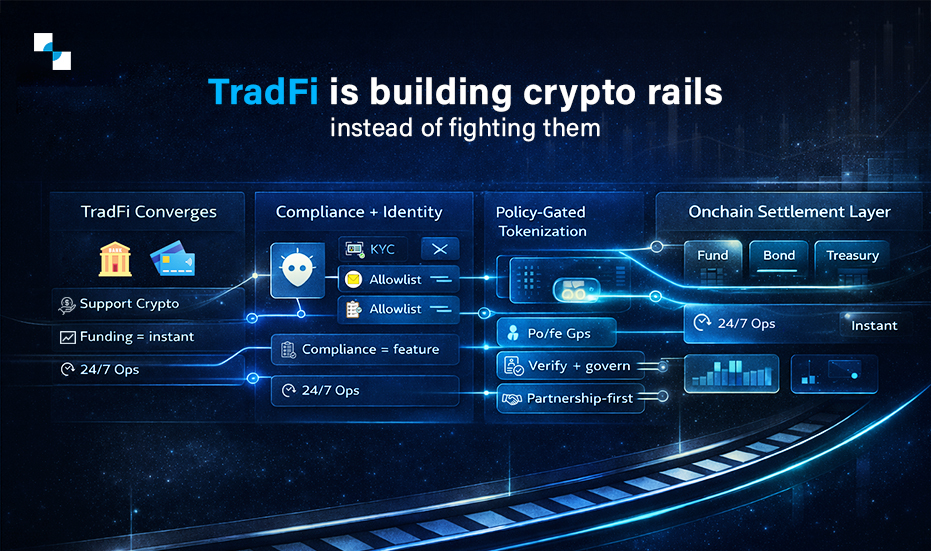
- 1Inch underwent a rebranding at token2049, signaling a shift towards merging Traditional Finance with Decentralized Finance.
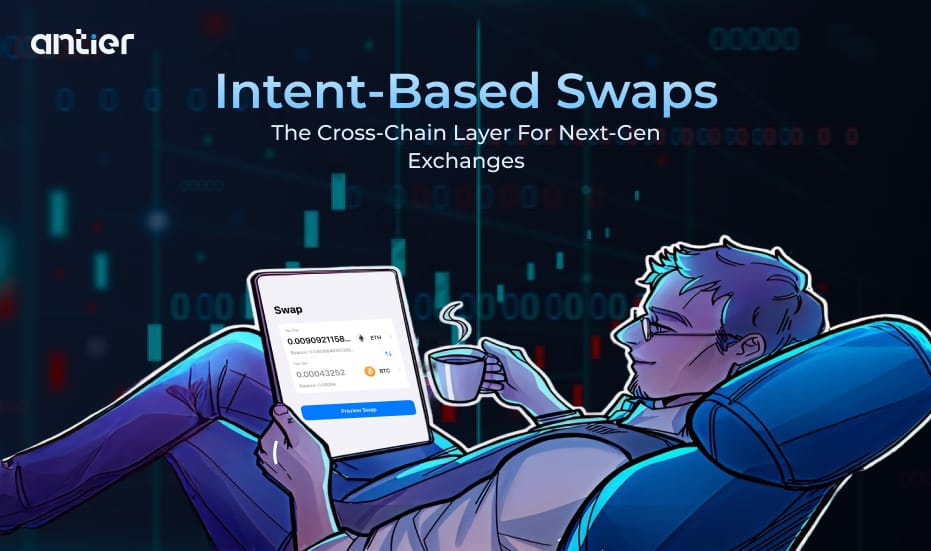
- The introduction of Intent-based swaps revolutionized user experience by allowing users to define their trading goals, leaving the platform to handle the rest.
- Intent-based swaps simplify trading by enabling users to set parameters like token pairs, return expectations, and chain preferences, streamlining the process and reducing complexity.
- This innovative approach has attracted attention from major exchanges like CoW Swap, Connext, and UniswapX, showcasing its impact on DEX development.
- By neutralizing MEV attacks, offering gasless transactions, enhancing cross-chain liquidity, and utilizing AI for optimized routing, intent-based swaps are reshaping the future of decentralized markets.
1Inch recently rebranded itself in token2049 to reflect its broader vision of uniting TradFi with DeFi. From DEX aggregation to cross-chain expansion and intent-based swaps, the leading decentralized crypto exchange software has improved user experience with every move.
Intent-based swaps were a pivotal shift that helped the business crack the complex code of user experience. The core concept, originally introduced by the Anoma protocol, addresses a pain point that has afflicted decentralized trading for a decade, i.e., poor user experience. It enables users to set and dictate their money-making goals, and the platform handles the rest of the trades afterwards.
What are Intent-Based Swaps?
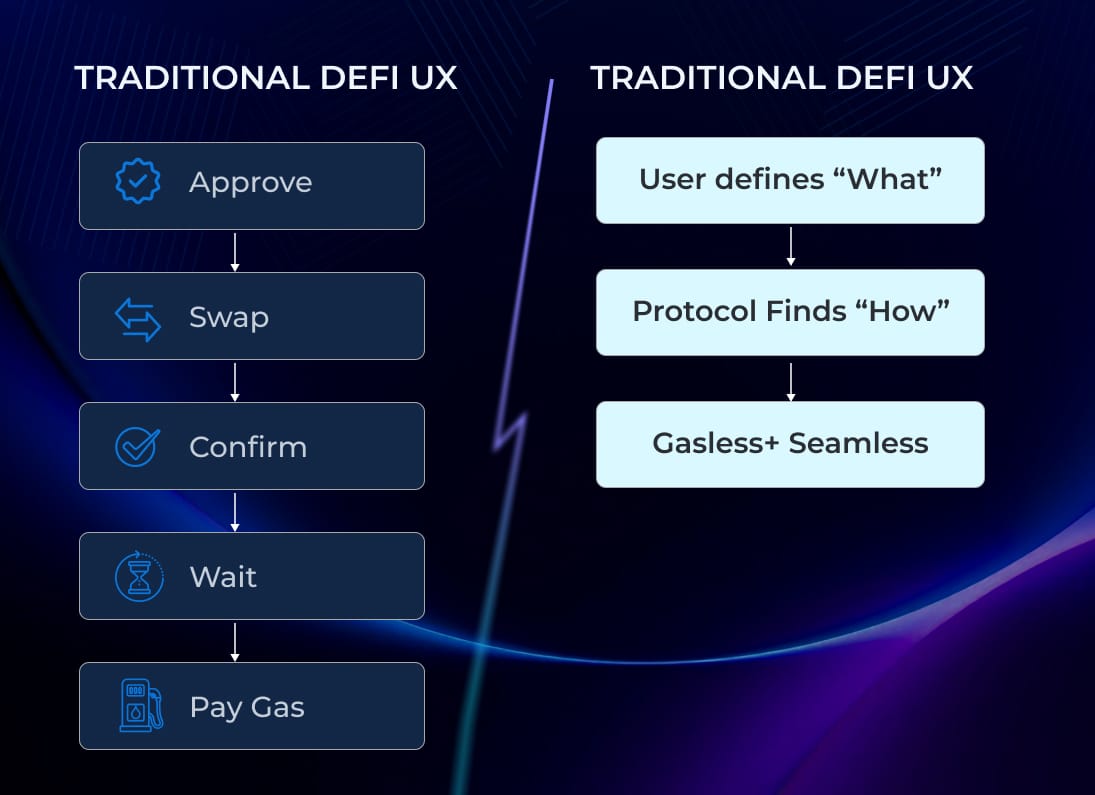
Traditional DEXs rely on AMMs or order books, where users define how trades happen (which pools, which slippage, which path). Intent-based DEX development flips the game. Users define what outcome they want. With an AI-powered voice command, they may just say:
“Swap 10 ETH for USDC at best rate, across any chain, gas-free”
This triggers a network of solvers who then compete to fulfill that intent.

This design relieves users from the complicated process of finding the best liquidity and gas-optimization paths. Instead of signing multiple transactions or bridging manually, users sign one intent off-chain, and the protocol handles the rest of the execution through solvers who race to get the best result.
For founders and developers, Intent-based DeFi exchange development brings the following benefits:
- Fewer steps for the user: Higher user-conversion rates
- Lower MEV exposure: Helps platforms gain user trust
- Composability: Effortless deployment of new trading features
Intent-based swaps aren’t just another fading trend because it would have disappeared till now if it was. They’re bringing evolution in how decentralized markets operate.
How Do Intent-Based Swaps Actually Work?
At a glance, intent-based swaps seem like magic, as only a text, voice command, or a few clicks make the complex trades happen on a decentralized crypto exchange software. But a lot is happening under the hood.
- User Defines and Signs an Intent
The user creates an off-chain message specifying parameters such as:
- Token In/ Token Out
- Minimum Acceptable Return
- Deadline
- Chain or Multi-Chain Scope
- Optional Gas Preferences (Gasless, Subsidized, or Standard)
This intent is signed by the user using EIP-712 structured data, and the message then gets broadcast to a solver network.
- Solver Network Competes To Execute
Multiple solvers (independent bots, entities, or nodes) subscribe to the intent pool. Each solver analyzes the following:
- Liquidity across DEXs, bridges, CEX APIs, or private order books
- Optimal execution routes
- Gas efficiency and bridge latency
- Profitability (since solvers offer liquidity at first to make the transaction instant, they make money through execution fees and arbitrage margins)
They then bid to execute the intent, either through open auction (as in CoW Protocol) or private solver competition (the UniswapX model).
- Best Execution is Selected and Settled On-Chain
Once a solver wins the execution race in terms of the parameters specified by the platform, the solvers on the intent-based decentralized crypto exchange software do the following:
- Execute the swap off-chain (or cross-chain).
- Submit proof and settlement transaction on-chain.
- Receive a reward from (fee or arbitrage margin) if validated successfully
The protocol contract verifies all conditions (price, slippage, deadlines) and releases funds.
Top Exchanges That Integrated Intent-Based Swaps
- CoW Swap
- Connext
- 1inch Fusion
- UniswapX
How Intent-Based Swaps Are Redefining DEX Development in 2026
- MEV Resistance:
Intent-based decentralized exchange development neutralizes sandwich and front-running attacks by removing public memepool exposure. Solvers execute privately, and the protocol determines the outcome through sealed-bid or batched auctions, reducing slippage by 20-50%.
- Gasless UX:
Users sign the intents off-chain. Gas costs can be subsidized or paid by solvers. Using ERC-4337 and Gas Station Network (GSN), developers can easily implement this gasless mechanism through paymaster contracts.
Also Read>>> A New Era For DEX Development: Exploring Gas-Less Transactions
- Cross-Chain Liquidity:
Intents abstract away bridging, making cross-chain swaps effortless for the traders. A user can swap between 10+ chains (ETH → ARB → BASE → Polygon) without needing gas tokens, powered by chain abstraction frameworks such as LayerZero, Axelar or Tria.
- Institutional Compatibility:
Combining intents with RWA tokenization (US treasury tokens, bank deposits, or stablecoin bonds) creates borderless liquidity rails between TradFi and DeFi, unlocking a trillion-dollar opportunity for those seeking decentralized exchange development.
- AI-Optimized Routing:
Solvers now use artificial intelligence and machine learning models to predict slippage, latency, and arbitrage paths. This gives 30% better routing efficiency than static AMM paths.
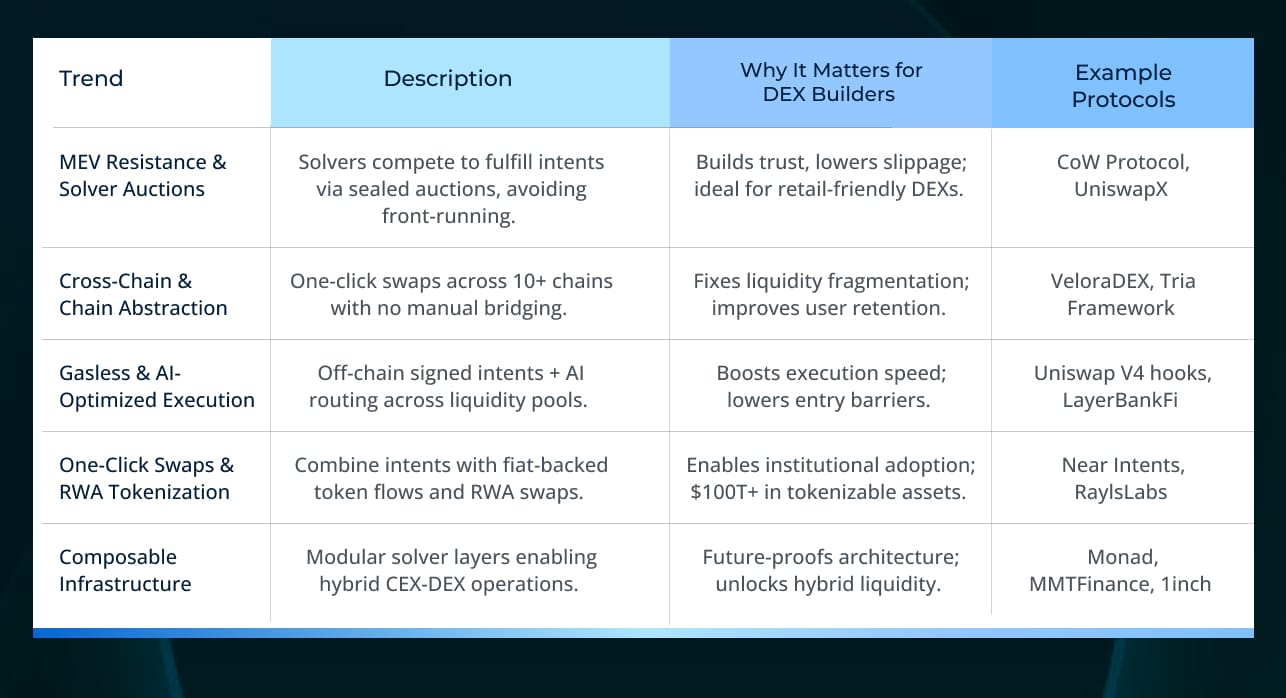
Top Intent-Based DEX Development Trends 2026
How To Launch Intent-Based Swaps in 4 Weeks?
Whether you’re planning an intent-based decentralized cryptocurrency exchange development or integrating intent-based swaps to your existing DeFi protocol, you’d need a pick an experienced DEX development company.
Here’s your roadmap to launching intent-based swaps:
- Choose the Right Tech Stack
- Smart Contracts: Solidity (for EVM), CosmWasm (For Cosmos SDK), Move (for SUI/Aptos).
- Testing: Foundry or Hardhat with Anvil for cross-chain simulations.
- Data Layer: Store intents using IPFS, subgraphs, or an in-house intent relayer.
- Define Intent Schema
Collaborate with your DeFi exchange development company to design a flexible structure:
struct Intent {
address user;
address tokenIn;
address tokenOut;
uint256 amountIn;
uint256 minReturn;
uint256 expiry;
bytes metadata;
bytes signature;
}
The use of EIP-712 typed data signing ensures compatibility with wallets.
- Build Solver Network
- Integrate existing solver SDKs like CoW Protocol’s CoWSDK or UniswapX filler framework.
- Define your solver reward logic (auction, first-come, random assignment).
- Create APIs for off-chain liquidity discovery.
- Integrate Cross-Chain Layer
- Collaborate with your DEX development company to integrate a cross-chain layer like LayerZero or Axelar, which acts as a secure communication bridge between blockchains.
- It verifies that funds move safely on both sides, so swaps are always all-or-nothing, never stuck halfway.
Also Read>>> Launch Your Cross-Chain Bridge Platform Solutions in 7 Days
- Optimize Gas and UX
- Join forces with your decentralized exchange development company to add account abstraction (ERC-4337).
- You can use meta transactions to enable gasless swaps or let solvers prepay gas and recoup via protocol reward.
- Simulate and Audit
When you’re implementing intent-based swaps, ensure to test the network thoroughly with multiple solver types:
- Honest solvers
- Lazy solvers (slow fill)
- Malicious solvers (wrong execution)
You may also perform audits for:
- Collusion resistance
- Replay attacks
- Reentrancy
- Proof verification
- Launch and Incentivize
- You may start with a closed solver beta, then expand to open participation as your decentralized crypto exchange software gains the public’s attention.
- Strategize with your DeFi exchange development company to add token incentives so solvers stay motivated by earning points or governance weight for verified fills.
Build Future-Proof Intent-Based Swaps
The intent-based decentralized exchange development won’t be the same as Uniswap, a few years from now. It’ll look like an AI-driven marketplace where users describe outcomes and agents compete to fulfill them.
You can expect:
- Autonomous agents competing for execution rights.
- Assets moving natively via chain abstraction.
- Centralized exchanges integrating intent solvers for hybrid liquidity and trade execution.
Whether you’re a DEX founder, protocol developer, or infrastructure builder, understanding intent-based DeFi exchange development will help you define the framework for future trading platforms.
At Antier, we enable businesses to architect and launch intent-driven DEX ecosystems from the ground up. Our teams specialize in UniswapX-style architectures, ERC-4337 account abstraction, and multi-chain interoperability that make intent-based swaps not only technically sound but commercially scalable.
Get in touch today!
Frequently Asked Questions
01. Q1. What makes intent-based swaps better than AMMs?
They abstract complexity, prevent MEV front-running, and enable off-chain price discovery for more efficient trades.
02. Q3. How do solvers earn profits?
Solvers earn from arbitrage margins or small protocol-defined fees for successful fills.
03. Q5. What’s the ROI for launching an intent-based DEX?
On average, intent models increase user retention by ~35% and cut slippage losses by up to 50%, improving liquidity and volume metrics across the board.