




✨ AI Summary
- Discover the game-changing world of Tokenized Cash Platforms!
- Investors worldwide are embracing this innovative solution for lightning-fast payments and seamless cross-border transactions.
- By integrating programmable finance with top-tier compliance, these platforms eliminate traditional hurdles and ensure instant, automated cash settlements that are as auditable as they are redeemable.
- Explore how tokenized cash operates and the platform architecture fueling its success in empowering enterprises, facilitating cross-border payments, and enabling yield-bearing collateral systems.
- Unlike volatile cryptocurrencies, tokenized cash mirrors traditional fiat currencies on a blockchain, offering stability and transparency.
Tokenized Cash Platforms are becoming the first choice of investors worldwide to make real-time payments and cross-border transactions. These platforms overcome the traditional friction errors by combining programmable finance with regulatory-grade compliance. Tokenized cash settlements are instant and automated, offering complete auditability while being redeemable like regular cash. This guide explores how tokenized cash works to make real-time payments, and its platform architecture to enable enterprises, cross‑border payments, and yield-bearing collateral systems.
Understanding Tokenized Cash
Tokenized cash is digital money that represents real fiat currency, such as USD, EUR, or GBP, on a blockchain. It’s issued 1:1 by regulated financial institutions. Unlike cryptocurrencies, these tokens are stable, auditable, and built to mirror traditional finance. Tokenized assets in payments take what was slow, opaque, and manual to turn it into a fast, programmable, compliant system.
- For banks, it improves settlement and risk management.
- For fintechs, it powers real-time payouts and capital efficiency.
- For investors, it delivers yield and 24/7 liquidity.
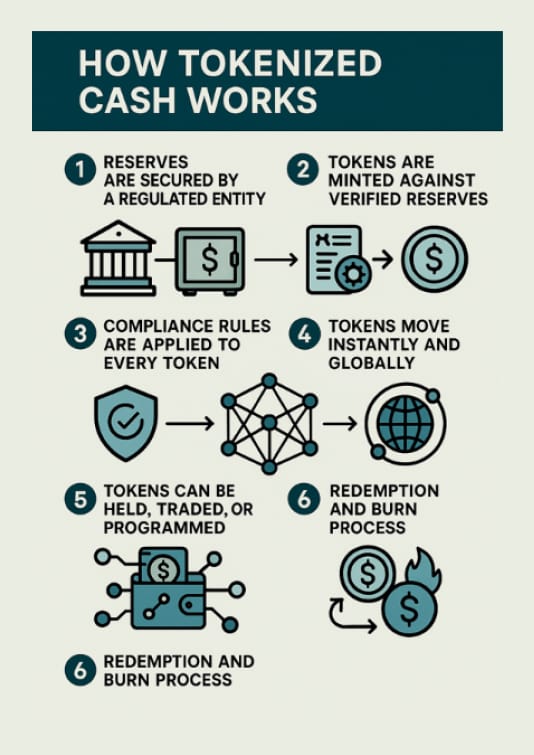
Platform Architecture Deep Dive: How Does the Tokenized Cash Work
A robust architecture forms the foundation of any tokenized money platform. It delivers the trust, auditability, and scalability that enterprises require when managing real-world assets under regulatory oversight. Below is a clear breakdown of the key components required to build an institutional-grade infrastructure for Real-time payments with tokenized cash.
1. Reserve Management Layer
This layer ensures every token aligns exactly 1:1 with real-world assets, held in segregated, audited accounts by regulated custodians. The system continuously reconciles token supply with reserve holdings. The automated dashboards on the platform for Tokenized money for enterprises and on-chain oracles provide real-time proof-of-reserves. The Tokenized Cash Platforms instill institutional confidence and eliminate solvency risk, critical for treasury and payment systems.
2. Mint/Burn Engine (Smart Contracts)
Smart contracts issue and redeem tokens strictly based on verified reserves. This layer removes manual tasks, prevents errors, and guarantees that token supply mirrors actual financial backing, essential for regulatory compliance and operational integrity.
3. Compliance & Identity Module
Regulatory outlook on tokenized money modules embeds compliance directly into the token process. It verifies user identities via KYC/AML, enforces jurisdiction-based restrictions, and automatically blocks risky or sanctioned transactions. By controlling who can transact and where, platforms ensure real-time regulatory adherence, reduce onboarding friction, and enable secure cross-border flows for institutional users.
4. Settlement & Payment Rail (Real Time)
Built on high-throughput blockchains like Ethereum L2s, Solana, or Hedera, Cross-border payments with tokenized cash enable atomic, final settlement in seconds, without cutoffs or batch delays. It delivers irreversible, auditable transfers that operate globally. Enterprises gain liquidity and alignment between financial flows and real-world operations, a crucial advantage for banks, fintechs, and proptech firms.
5. Liquidity & Market Access Layer
This layer connects tokenized cash to both digital asset pools and fiat payment networks. It integrates with DEXs, institutional exchanges, and global fiat on/off ramps. Market-makers maintain deep liquidity and narrow spreads. APIs link to payment processors and remittance networks. Businesses and investors gain instant exit, collateral flexibility, and active capital utilization.
6. API & Integration Layer
This layer offers fast integration through REST/gRPC APIs and TypeScript or Python SDKs. Developers plug in using sandbox environments and well-documented endpoints. Webhooks trigger enterprise workflows, while dashboards give compliance teams visibility and control. The modular design minimizes integration effort and speeds growth for banks, fintechs, and platform providers.
7. Transaction Flow
Investor deposits fiat into a regulated reserve. The mint engine confirms the deposit and issues matching tokens. Compliance logic verifies identity and transaction permission, then tokens transfer instantly across blockchain rails. The recipient redeems tokens through the smart contract, which burns the token and releases fiat. APIs update enterprise ledgers and trigger downstream workflows automatically.
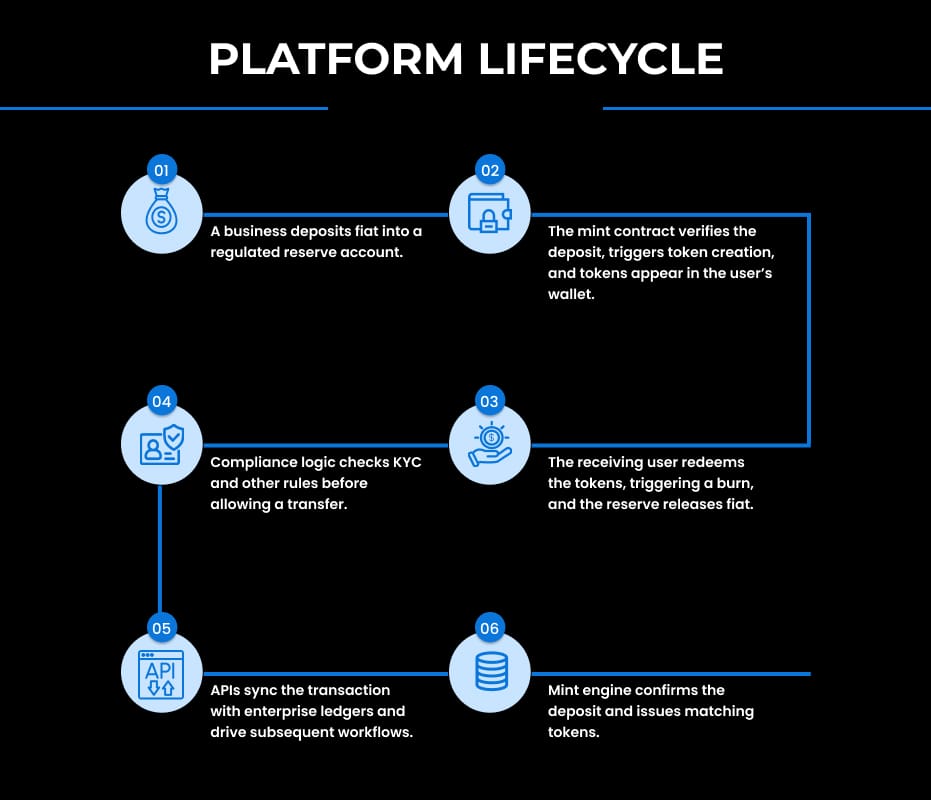
Mint engine confirms the deposit and issues matching tokens.
Benefits of Tokenized Cash Platforms for Businesses
Tokenized cash helps firms run leaner, move faster, and stay compliant to unlock new efficiencies across modern financial operations. Firms adopting tokenized cash platforms can see immediate and structural benefits:
1. Capital Efficiency
Instead of holding idle balances in non-yielding accounts, treasury teams can park funds in yield-bearing tokenized cash instruments like USYC. These tokens accrue interest while remaining liquid and fully redeemable, allowing firms to earn passive income on capital that would otherwise sit still. For real estate firms managing escrow or fintechs processing payouts, this means better returns without operational compromise.
2. Automated Risk and Collateral Management
Smart contracts replace manual processes for margin maintenance, liquidity coverage, or account top-ups. For banks and asset managers, this reduces counterparty risk and execution delays. If collateral falls short, the system responds automatically, reducing reliance on back-office intervention and increasing response time.
3. 24/7 Liquidity and Settlement
Tokenized cash settles instantly. Whether it’s a fintech issuing real-time payouts or a property platform handling buyer deposit, funds can move globally at any time, with no cutoffs, no waiting for T+1 or T+2. This enables faster deal execution and greater working capital agility.
4. On-Chain Transparency
Every transaction, reserve confirmation, and compliance check is verifiable on-chain. Auditors and regulators get real-time access to proofs, reducing overhead and increasing institutional trust, especially critical for licensed institutions and payment providers.
5. Global Interoperability
Cross-border transfers in Web3 payment infrastructure are faster, cheaper, and built with compliance logic baked in. For platforms operating across jurisdictions, whether a neobank or a global proptech startup, this removes friction without cutting corners.

Enterprise Use-Cases for Tokenized Cash Platforms
1. Corporate Treasury Optimization: Tokenized cash enables real-time intra-entity settlements, automated liquidity sweeps, and programmable cash positioning. Enterprises eliminate idle balances and reduce settlement friction. A global conglomerate using tokenized cash reported a 20% improvement in capital utilization by automating daily sweeps into yield-bearing instruments.
2. Global Payroll Execution: Cross-border payroll is traditionally slow and compliance-heavy. With a tokenized cash platform, salaries can be distributed instantly, across currencies, with full transparency. Enterprises manage taxation, benefits, and milestone-based bonuses through smart contracts. One tech firm achieved same-day payments to contractors in 12+ countries, reducing FX overhead and compliance risk.
3. Supply Chain Payments: Smart contracts allow automatic, event-driven settlements, triggered upon delivery confirmation or quality verification. This eliminates manual reconciliation, reduces payment cycles, and improves supplier liquidity. A manufacturing firm integrated tokenized payments into its ERP system, accelerating vendor payouts and strengthening procurement reliability.
Monetization Models: Fees, Subscriptions, and Value-Added Services
Web3 payment infrastructure can generate durable revenue across multiple streams, far beyond simple issuance.
- Issuance fees: Charge 0.1–0.5% on mint/redemption events.
- Assets Under Management (AUM) fees: Platforms like BUIDL’s fund structure extract 5–20 basis points on NAV—$630M and rising.
- Secondary trading spreads: Capture maker-taker fees or bonding-curve spreads via permissioned pools and DEX integrations.
- Compliance-as-a-Service: Monetize through SaaS licensing to custodians, funds, and platforms.
- Data APIs: Sell access to portfolio analytics, NAV snapshots, and ESG scoring.
Launch Checklist for Tokenized Cash Platforms
Launching a compliant, scalable tokenization platform? Every box here should be checked:
- Regulatory clearance: Select jurisdiction and secure legal opinions.
- Smart contracts: Deploy audited ERC-3643 with upgrade support.
- Identity layer: Integrate KYC/AML protocol.
- Issuer dashboard: Build tools for NAV uploads, dividend distributions, and cap table management.
- Liquidity connectivity: Link to permissioned pools, CEX-listed RWA pairs, or ATS platforms.
- Data oracles: Implement pricing, NAV, and proof-of-reserves feeds.
- Transparency: Publish reports and contract addresses publicly.
- Pilot rollout: Start with low-risk assets (e.g., T-bill tranche) before scaling.
Takeaway
Tokenized cash and yield-bearing funds are now moving to the global capitals. With regulatory frameworks, compliant infrastructure accessible, launching your own tokenized cash & collateral platform is both timely and viable.
Ready to Build Your Web3 Payment Infrastructure?
Partner with Antier to design, develop, and deploy Tokenized Cash Platform backed by smart contracts, regulatory readiness, and market access. Schedule a one-on-one demo call to know more.
Frequently Asked Questions
01. What is tokenized cash?
Tokenized cash is digital money that represents real fiat currency, such as USD, EUR, or GBP, on a blockchain, issued 1:1 by regulated financial institutions.
02. How does tokenized cash improve payment processes?
Tokenized cash enhances payment processes by providing instant and automated settlements, reducing friction errors, and enabling real-time payments with complete auditability.
03. Who benefits from tokenized cash platforms?
Banks benefit from improved settlement and risk management, fintechs gain real-time payouts and capital efficiency, and investors enjoy yield and 24/7 liquidity.