




✨ AI Summary
- The blog post discusses how Real-World Asset Tokenization is revolutionizing the financial services industry, allowing institutions to convert illiquid holdings into digital assets for global trade and settlements.
- Analysts project a $16 trillion tokenized asset market by 2030.
- Major banks like JPMorgan, BlackRock, Goldman Sachs, and Citi are leveraging tokenization to enhance liquidity, reduce costs, democratize access, ensure compliance, and improve operational efficiency.
- Through examples like JPMorgan's TCN and BlackRock's BUIDL fund, the post illustrates how tokenization platforms are transforming collateral management, settlement cycles, and global liquidity access.
- Regulatory clarity, interoperability, and growth opportunities in the tokenization space are also highlighted.
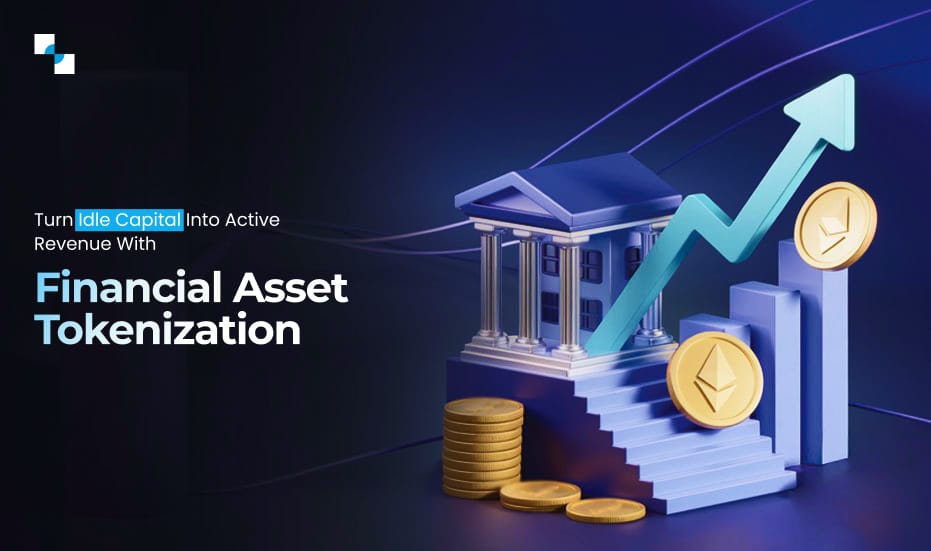
The financial services industry has witnessed the most significant infrastructure upgrade with Real-World Asset Tokenization. From JPMorgan to BlackRock, institutions are using tokenization platforms to convert their illiquid holdings and funds into programmable digital assets for global trade and easy settlements.
Analysts at Boston Consulting Group project that this transformation will unlock $16 trillion in tokenized assets by 2030. Credit goes to the Asset Tokenization Platform Development Services, which represents a once-in-a-generation opportunity to create the platforms, infrastructure, and tools that will power the new financial Internet.
This guide reveals how major banks are deploying tokenization and how these developments open direct revenue-generating opportunities for banks and Fintech companies.
The Current Scale of Institutional Tokenization
The tokenized real-world asset market had already surpassed $30 billion. Tokenized U.S. Treasuries alone accounted for over $7.4 billion in just a year. According to the World Economic Forum, tokenization could represent 10% of global GDP by 2027 and save the financial industry $15–20 billion annually through improved operational efficiency.
Unlike the early blockchain hype cycles of the past decade, these results are live and regulated:
- JPMorgan’s Kinexys (formerly Onyx) has processed over $1.5 trillion in notional value through its Tokenized Collateral Network (TCN), with $2+ billion in daily transaction volume.
- BlackRock’s BUIDL tokenized fund now manages $2.9 billion in AUM.
- Goldman Sachs, BNY Mellon, and Citi have each launched blockchain-based platforms managing real funds, payments, and collateral.
- DBS and Franklin Templeton continue to push tokenization of structured products and money market funds (MMFs), respectively, showing that Asia’s regulatory frameworks are just as ready as the West’s.
What Problems Asset Tokenization Helps Financial Institutions Solve That Legacy Systems Never Could

The asset tokenization platform development services help the financial institutions to address the following limitations in the traditional infrastructure:
Problem 1: Settlement Latency
Financial institutions still operate on isolated ledgers that can’t communicate in real time. Every trade requires reconciliation between multiple databases. Most securities still settle on T+1 or T+2, freezing trillions of dollars in motionless capital and exposing firms to counterparty risk.
Solution: Tokenization Unlocks Real-Time Settlement
By representing assets as on-chain tokens, transactions are finalized in seconds on a shared ledger accessible to all verified parties. This enables instant delivery-versus-payment (DvP), freeing liquidity, eliminating margin buffers, and directly improving capital efficiency. Institutions can redeploy funds immediately instead of waiting through legacy post-trade cycles.
Problem 2: High Operational Costs
The current financial infrastructure involves multiple intermediaries, each maintaining its own version of the truth. Every mismatch trigger manual reconciliation, costing the global industry tens of billions in back-office spend every year.
Solution: Tokenization Eliminates Reconciliation
A blockchain-based shared ledger creates a single, tamper-proof source of truth. Smart contracts automate corporate action without human intervention. For financial institutions, this translates to smaller reconciliation teams, faster reporting cycles, and measurable ROI through reduced overhead and improved operational precision.
Problem 3: Limited Accessibility
Traditional investment products are geographically and economically exclusive, restricted by ticket sizes, jurisdictions, and settlement systems. A $5 million structured note or a $50 million real estate fund is typically off-limits to smaller investors and foreign participants.
Solution: Tokenization Democratizes Access Through Fractional Ownership
Tokenization enables fractional ownership, dividing high-value assets into smaller, tradable units that comply with local regulations yet remain globally transferable. Investors can now hold fractional shares of tokenized Treasuries, commodities, or funds, settling across time zones in seconds. For institutions, this opens up new investor segments, cross-border distribution channels, and scalable AUM growth.
Problem 4: Compliance Complexity
In legacy systems, compliance functions like KYC, AML, and investor eligibility are handled off-chain and manually, often inconsistently across systems. This slows onboarding, increases risk, and exposes institutions to regulatory penalties.
Solution: Tokenization Embeds Compliance into the Asset Itself
With token standards such as ERC-3643, regulatory rules are coded directly at the token layer. Every transfer automatically validates investor eligibility, jurisdiction, and sanction status before execution.
This “compliance by design” model transforms manual screening into automated governance, reducing regulatory exposure, cutting compliance costs, and improving transparency. Financial institutions gain real-time regulatory assurance instead of reactive monitoring.
Problem 5: Inflexible Liquidity
Liquidity in traditional markets is trapped within silos. Assets held with one custodian can’t instantly serve as collateral or margin elsewhere, preventing firms from optimizing balance sheet usage or yield.
Solution: Tokenization Makes Liquidity Composable
Once tokenized, assets become interoperable and programmable. They can integrate seamlessly with institutional trading venues, DeFi protocols, and cross-chain liquidity networks. This composability turns static holdings into active capital, multiplying yield opportunities and enabling institutions to generate incremental revenue from assets that were previously idle.
For businesses building tokenization platforms, solving these problems means building systems that make assets fluid, compliant, and global, the three pillars of institutional grade blockchain adoption.
Build Institutional-Grade Tokenization Infrastructure with Custom Features
Business Opportunity for Financial Institutions to Unlock with Asset Tokenization Platforms
With Asset Tokenization Platform Development Services, banks and fintech firms can unlock new business models.
- Liquidity and Yield Enhancement: Tokenized assets can trade around the clock. This provides new secondary-market liquidity for assets that were once locked for years. For example, tokenized Treasuries are now being used as on-chain collateral for loans, swaps, and repo agreements, creating new yield streams and lending markets.
- Cost Reduction and Automation: Smart contracts automate settlement, dividends, and redemptions, reducing manual intervention.
- Market Expansion: Fractionalization democratizes access. Platforms can attract new retail, corporate, and institutional clients seeking exposure to once-inaccessible assets, growing AUM, and trading fees.
- Capital Efficiency: Tokenized collateral can be reused and rehypothecated in real time, unlocking liquidity that was previously trapped in settlement cycles. JPMorgan’s TCN already shows this impact, freeing billions in collateral by accelerating asset transfer from days to minutes.
- New Product Lines: Institutions can offer programmable instruments, tokenized funds with real-time yields, tokenized deposits with policy controls, or synthetic derivatives with embedded compliance logic.
With the Asset Tokenization Platform, every hour saved in settlement, every new investor onboarded globally, and every manual process replaced with automation, together create measurable operational and revenue gains.
How the Banks Are Doing It (And What You Can Learn)
1. JPMorgan’s Kinexys (Onyx): Collateral Tokenization
JPMorgan launched the Tokenized Collateral Network (TCN) to bring traditional assets, such as MMFs and bonds, onto the blockchain for instant collateral movement. This enables faster collateral cycles, freed liquidity, and reduced counterparty risk.. Major institutions like BlackRock and Barclays are now using these tokenized MMF shares for real collateral transfers, while Fidelity International has joined to tokenize its funds.
Business Takeaway: Banks and fintechs can build tokenization platforms that turn collateral into a real-time asset, improving liquidity management, risk efficiency, and capital utilization across global trading and lending operations.
2. Goldman Sachs’ GS DAP: Institutional Digital Infrastructure
Goldman Sachs developed the GS DAP platform on the Canton blockchain to handle the entire lifecycle of digital securities with privacy and compliance embedded into every transaction. The platform powered the European Investment Bank’s first €100 million digital bond, settling in under 60 seconds instead of the typical T+5. In 2025, it partnered with BNY Mellon to tokenize money market funds, bringing blockchain to mainstream U.S. fund management.
Business Takeaway: Financial institutions built a tokenization platform to compress settlement cycles, expand product reach, and automate compliance. This proves digital assets can deliver real-world ROI without sacrificing regulatory control.
3. Citigroup’s Token Services: Real-Time Global Settlement
Citi introduced Token Services for Cash, a blockchain-based system that enables 24/7 liquidity transfers across borders. Built on Hyperledger Besu, it connects over 250 banks and supports round-the-clock treasury movement.
The system is now being used by corporations to process payments globally without delays caused by holidays or time zones. Citi effectively created a real-time settlement layer for institutional cash management.
Business Takeaway: Banks and fintechs can deploy tokenized cash platforms to offer instant payments and liquidity access, removing settlement delays and unlocking continuous global operations for their clients.
4. BlackRock’s BUIDL Fund: Multi-Chain Tokenized Liquidity
BlackRock launched the BUIDL Fund, a tokenized U.S. Treasury-backed money market fund that pays a daily yield via smart contracts. It operates across seven blockchains, ensuring global reach and accessibility. With $2.9 billion in assets under management, BUIDL became the largest tokenized fund in the world. It proved that regulated, yield-bearing assets could thrive in a digital, multi-chain environment.
Business Takeaway: Financial institutions can create tokenized funds to merge regulatory trust with blockchain scalability, giving investors transparent, liquid, and yield-generating instruments that can settle and distribute returns automatically.
The Future: Regulation, Interoperability, and Growth
Regulatory clarity is fast catching up with technology:
- The U.S. GENIUS Act and Project Crypto frameworks are shaping bank-friendly tokenization.
- Singapore’s Project Guardian, the UK’s Digital Securities Sandbox, and Hong Kong’s Basel-compliant stablecoin frameworks are operationalizing digital asset regulation.
- Global initiatives are aligning around interoperability standards, ensuring tokenized assets can move safely across networks and jurisdictions.
Regulatory uncertainty, once the biggest barrier, is rapidly diminishing, paving the way for compliant institutional-scale tokenization.
The Builder’s Mandate: Turn Insight into Infrastructure
To build an institutional-grade asset tokenization platform:
- Start with compliance-first design. Embed KYC, AML, and jurisdictional logic in smart contracts.
- Prioritize interoperability. Design for multi-chain, multi-custody ecosystems.
- Automate lifecycle events. Payments, dividends, and redemptions must be deterministic.
- Deliver institutional controls. MPC custody, dual approval, audit-ready logs, and proof-of-reserves.
- Show ROI. Every feature should tie to cost savings, liquidity improvement, or yield enhancement.
Be the Bank That Leads the Tokenized Economy with Complaint Solution
Build the Infrastructure That Powers the $16 Trillion Future.
The tokenization of real-world assets marks the convergence of finance, compliance, and technology into one programmable ecosystem. The world’s largest banks have validated the model. To deliver the institutional grade tokenized financial services, built an asset tokenization platform that meets institutional standards, as that is all needed to unlock this rapidly growing market.
Launch Your Custom Tokenization Platform with Antier
Antier empowers banks and fintechs to move beyond experimentation and into execution. Our institutional-grade tokenization platforms are engineered for compliance, interoperability, and measurable ROI. From tokenized funds to real-time settlement systems, our Asset Tokenization Development Company can help you create infrastructure that meets global banking standards and scales with market demand. If you’re ready to lead in the $16 trillion tokenization revolution, get in touch with our experts and build what others only promise.
Frequently Asked Questions
01. What is Real-World Asset Tokenization in the financial services industry?
Real-World Asset Tokenization involves converting illiquid holdings and funds into programmable digital assets, enabling global trade and easier settlements, significantly upgrading the financial infrastructure.
02. How much value is projected to be unlocked through tokenization by 2030?
Analysts at Boston Consulting Group project that tokenization will unlock $16 trillion in assets by 2030, representing a major opportunity for financial institutions.
03. What are some benefits of asset tokenization for financial institutions?
Asset tokenization helps financial institutions reduce settlement latency, improve operational efficiency, and potentially save $15–20 billion annually, addressing limitations of traditional infrastructure.