




AI Summary
- In a blog post discussing the rise of Bitcoin as a store of value and its entry into the programmability race with BTC DeFi, the potential for builders, cryptocurrency exchange software solutions, and institutions is highlighted.
- The emergence of Bitcoin layer 2 networks like Lightning and Rootstock is enabling faster transactions, lower fees, and enhanced flexibility.
- The blog emphasizes the vast untapped potential in BTC DeFi, with only a small percentage of total BTC currently utilized in DeFi protocols.
- It suggests that early adoption in building a crypto superapp combining exchange software development with staking modules can lead to dominating the new generation of liquid crypto exchanges.
- The post also provides insights on how to build the best BTC L2 crypto exchange software in 2026, focusing on protocol selection, core architecture, custody layer, core feature modules, security, compliance, deployment, and continuous upgrades.
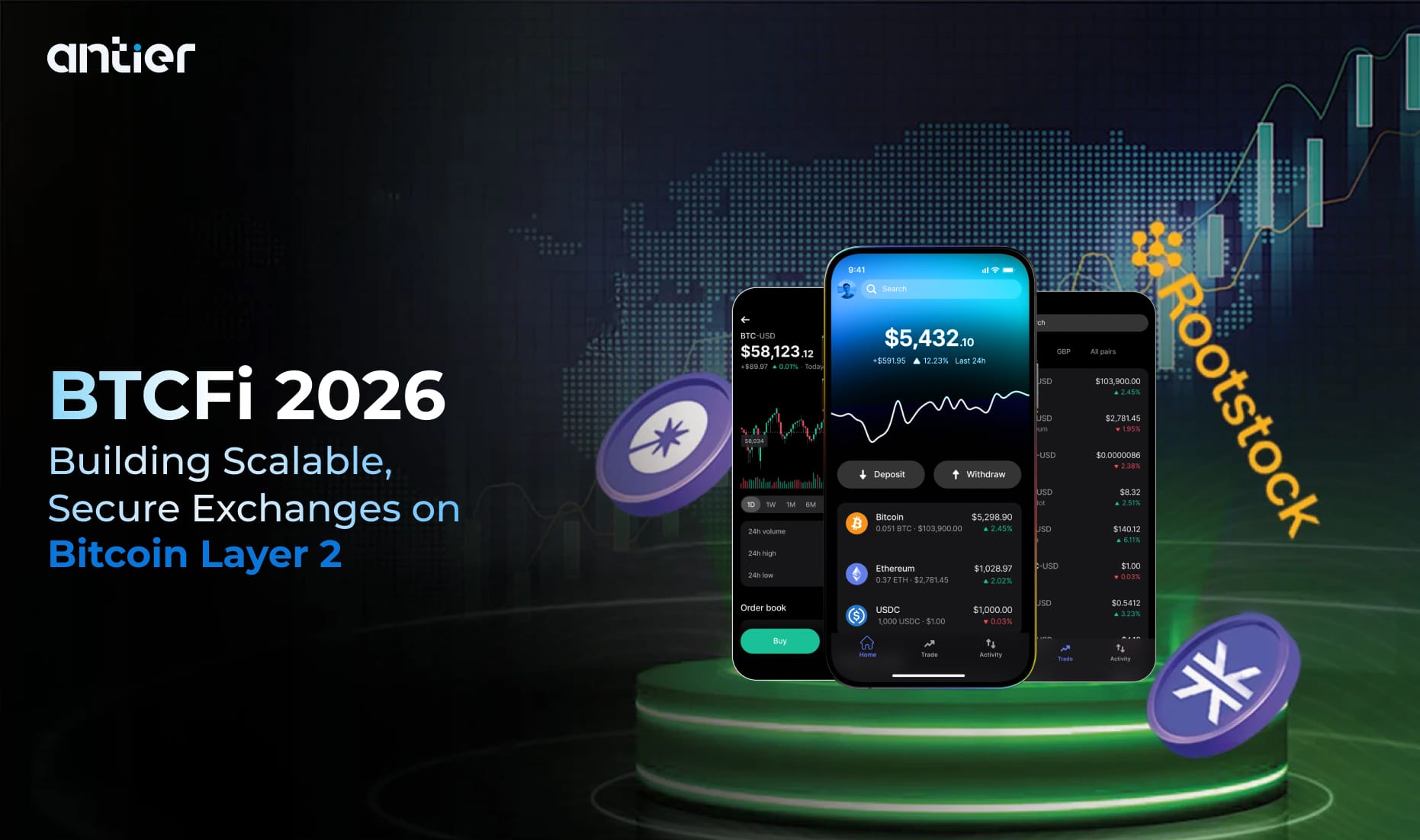
Bitcoin, with more than $2 trillion market cap (higher than the GDP of most G20 economies), already wins as a store of value. In 2025, it just entered the programmability race with BTC DeFi(one that Ethereum has been mastering for a long time). For builders, cryptocurrency exchange software solutions, and institutions, this opens a trillion-dollar opportunity as the world’s most secure and liquid asset is finally becoming programmable. Thanks to the wave of Bitcoin layer 2 networks such as Lightning, Rootstock, Stacks, Merlin Chain, etc, delivering sub-second finality, $0.01 fees, and EVM-grade flexibility.
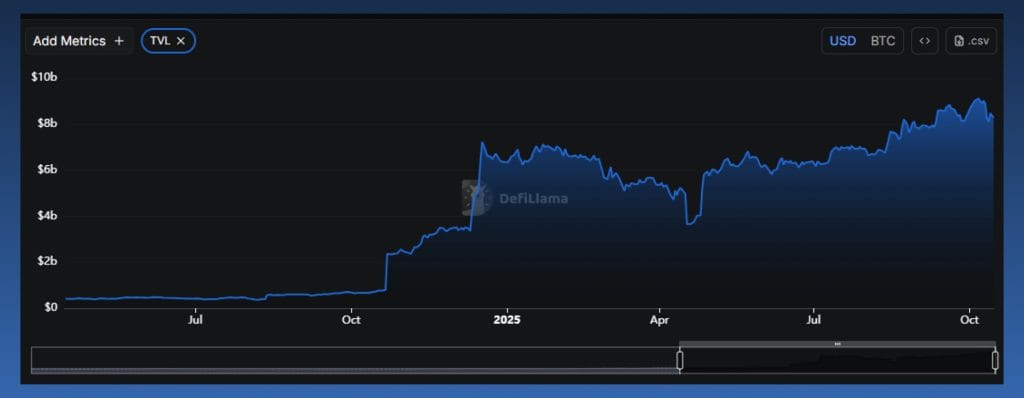
As per recent reports, total value locked in BTC DeFi has surged by 2700% YoY, signalling sudden but enormous attention from investors and developers. But, it’s just the tip of the iceberg, as only 0.1 – 0.8% (roughly $6 to $9 billion) of total BTC has currently been utilized in DeFi protocols. Now, imagine the untapped potential that you can capitalize on with BTC DeFi exchange development.
“Matt Hougan, head of research, estimates that only Bitcoin staking represents a $200 billion opportunity.”
By building a crypto superapp clubbing exchange software development with staking modules, you not only scale transactions but also unlock the deepest liquidity pool in crypto. This shift from “digital gold” to “Bitcoin-secured trading infrastructure” is already underway, and those who build early will dominate the new generation of liquid crypto exchanges.
Why Launch Your Decentralized Crypto Exchange Software On BTC L2s in 2026?
- Unmatched Liquidity: Bitcoin commands over 50% of total crypto market capitalization, giving exchanges the deepest asset pools to build on.
- Explosive Growth: As mentioned above, BTC DeFi TVL is up by 2700% YoY, which is the fastest adoption curve in digital asset history.
- Institutional Trust: Bitcoin ETF inflows have eclipsed $100 billion year-to-date. The confidence is now being extended to the infrastructure layer, fueling exchanges that deliver bank-grade security, institutional scalability, and real throughput.
- Scalability at Solana Speed: BTC L2s like Merlin and BEVM now deliver 100K+ TPS with sub-second finality, making them highly suitable for cryptocurrency exchange software development.
- Minimal Transaction Costs: Bitcoin layer 2s enable trades in <$0.01 per transaction while retaining Bitcoin-grade settlement.
- Developer Accessibility: EVM-compatible BTC L2s like Botanix, BEVM, SatoshiVM, Bitfinity, etc. Let solidity developers migrate in days, not months. It gives existing exchanges a massive edge by letting them repurpose their EVM codebase and deploy BTC L2 integrations almost instantly.
- Bridging Maturity: Cross-chain interoperability solutions now connect BTC liquidity with ETH, Solana, BNB, and other robust blockchain ecosystems.
- Programmable Security: Bitcoin layer 2s anchor every trade to Bitcoin Proof-of-Work, removing smart contract trust issues.
- First-Mover Edge: Less than 1% of total BTC is deployed in DeFi. Early builders will not only dominate but also own the network effects.
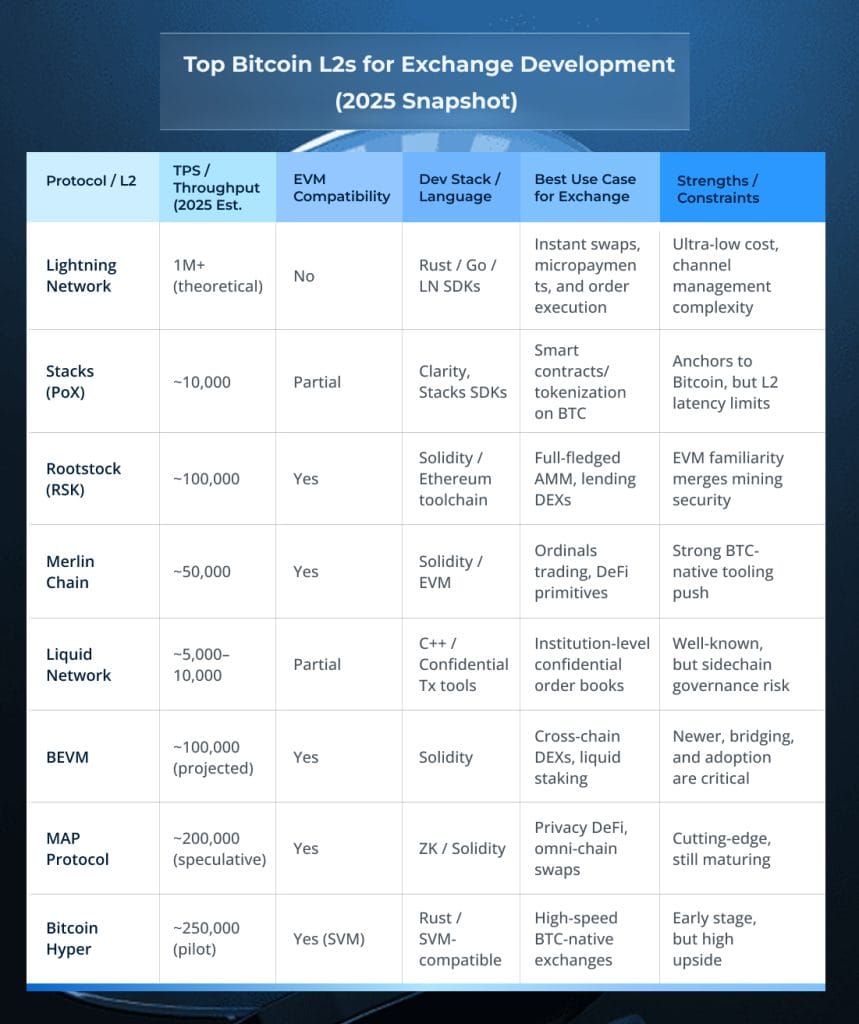
Note: These are estimates and roadmap figures that can be used as a baseline reference. You may refer to the protocol’s website or your DeFi exchange development company for feasible ranges.
Also Read>>>Top Layer 2s Driving the BTC DeFi Boom
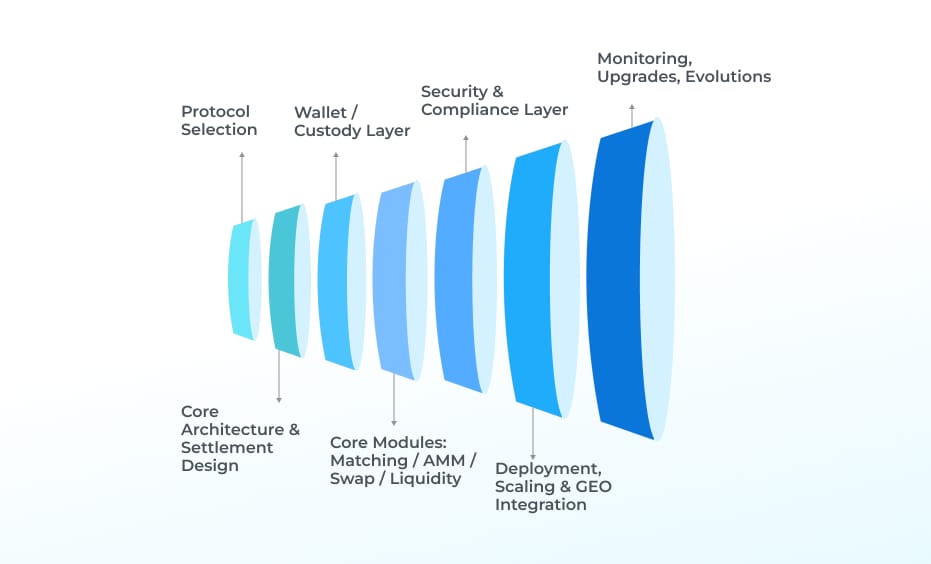
How To Build the Best BTC L2 Crypto Exchange Software in 2026?
1. Protocol Selection:
- First, you need to pick your L2 based on your product vision. Your cryptocurrency exchange software development company can help you figure out if Lightning, Rootstock, Merlin, or any other is suitable for your goals.
- You can even go hybrid by using Lightning for spot trades and Rootstock for BTC DeFi exchange development modules.
2. Core Architecture and Settlement:
- Decide whether you want to build an off-chain matching engine that handles high-frequency order matching without burdening the chain or an on-chain settlement mechanism that batches settlement of trades or atomic swaps.
- You can also collaborate with your cryptocurrency exchange software development company to build hybrid models that match off-chain and settle in periodic on-chain settlement batches.
3. Custody Layer:
- If you’re building your exchange for the future, ensure to make it multi-asset compatible because the future belongs to superapps that power trading, custody, lending, staking, etc. of crypto, stablecoins, tokenized RWAs, and NFTs.
- You can go for a custodial or non-custodial design and also include multi-sig, MPC, smart wallet abstractions, etc., as per your preferences and budget. You can also build L2-specific wallets, such as Lightning channels, Stacks signers, or RBTC wallets on Rootstock with the help of your DeFi exchange development company.
4. Core Feature Modules:
- Your BTC DeFi exchange development company builds the core modules for your trading software that include:
- Order Matching Engine: limit orders, order book logic, internal crossing.
- Liquidity Pools / AMMs: e.g., a Uniswap-V3 fork on Rootstock.
- Atomic Swap Layer / Bridges: enabling cross-L1 and cross-L2 swaps.
- Market Makers / Liquidity Incentives: bootstrap using yield or token incentives.
5. Security and Compliance
- At this stage of your cryptocurrency exchange development, the technology provider integrates security mechanisms and performs audits and testing.
- Some security and compliance integrations for a decentralized cryptocurrency exchange development company include:
- Audit modules (e.g., external audit firms)
- Reorg resistance, rollback protection
- MEV / sandwich attack mitigation
- KYC / AML pipelines (US: FinCEN, state licensing, EU: MiCA, UAE: local regulation)
- Privacy layers (ZK proofs, confidential transactions)
6. Deployment and Continuous Upgrades:
- At last, after rigorous testing, it’s time to deploy in target jurisdictions with licenses, local KYC, and localized API endpoints.
- And it never ends with cryptocurrency exchange software development. Sustaining a successful crypto exchange requires continuous monitoring, auto-scaling, and feature upgrades, including module integrations, bridging expansions, and cross-L2 liquidity aggregation.
Future Trends In BTC L2 Cryptocurrency Exchange Development
- Cross-L2 liquidity meshes: unified orderbooks across Rootstock, Merlin, Lightning
- AI & predictive routing: bots that route trades to optimal L2 paths or liquidity pools
- Native rollups on BTC: shrinking trust assumptions and latency
- Institutional product stack: yield, structured products, credit, tokenized assets, all built natively on BTC
- Regulation catching up: expect BTC-L2 clarity to precede staking-ETF approvals
Build Your DEX on BTC L2 With Antier
Final Word
We’ve walked you through the vision, tech, and the rocket science behind a Bitcoin L2 DeFi exchange development.
Investment is flowing into Bitcoin, and infrastructure is finally catching up. The winners will be those who build secure, scalable, and compliant exchanges that enable traders to move quickly while providing institution-level trust.
Antier, a leading DeFi exchange development company, specializes in architecture, compliance, engineering, protocol selection, and everything else you require to turn your BTC L2 DEX vision into reality.
Let’s partner up and launch the next-gen BTC exchange the world actually needs.
Frequently Asked Questions
01. What is Crypto Superapp?
A modern crypto superapp blends all the modules in one platform: trading, custody, RWA tokenization, gaming, lending, staking, stablecoin remittance, and crypto payment gateways.
02. What are BTC L2-specific wallets?
L2-specific wallets are wallets built to interact directly with a Bitcoin Layer 2 network’s architecture, handling off-chain transactions, channel states, or smart contract interactions unique to that L2.
03. What advantages do Bitcoin layer 2 networks offer for cryptocurrency exchange development?
Bitcoin layer 2 networks provide unmatched liquidity, explosive growth potential, institutional trust, high scalability, minimal transaction costs, and developer accessibility, making them ideal for exchange software development.