



AI Summary
- Dive into the blog post exploring the evolving realm of Bitcoin DeFi, where over $1.5 trillion in dormant liquidity is waiting for action.
- Witness the exponential growth of the Bitcoin DeFi ecosystem, with the total value locked soaring by 2,700% to $8.6B by Q2 2025.
- Discover the untapped potential of Bitcoin as a foundation for an enterprise-grade DeFi ecosystem, with only 0.8 BTC currently leveraged in DeFi development.
- Uncover the top Layer 2 architectures driving the BTC DeFi boom, from EVM-Compatible Sidechains to Smart-Contract Native Layer 2s.
- Explore the ideal DeFi use cases on Bitcoin L2s and learn how to mitigate risks associated with BTC DeFi development.
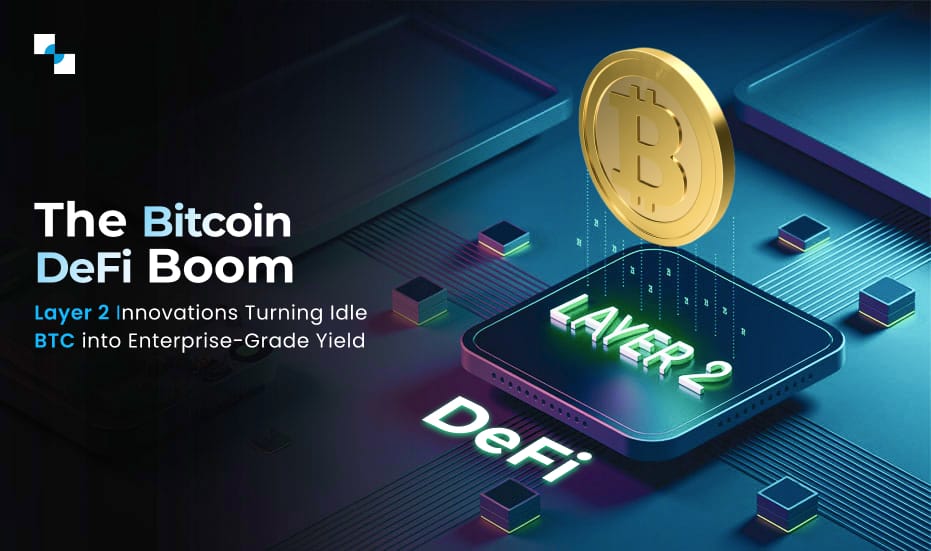
Bitcoin, enthroned at $2 trillion market capitalization, leads the crypto market. Yet over $1.5 trillion in liquidity lies dormant, earning nothing. With skyrocketing adoption of Bitcoin layer 2s, it’s changing fast. The total value locked in the Bitcoin DeFi ecosystem (often referred to as BTC DeFi) has expanded by 27 times (2,700%) from $307M in early 2024 to $8.6B by Q2 2025. It’s still a baby step from Bitcoin being a store of value towards a foundation for an enterprise-grade DeFi ecosystem, as only 0.8 BTC is being leveraged in DeFi development. Even a few more percent of Bitcoin’s supply put to work in DeFi would trigger a growth of 300X or beyond. The signal is clear: enterprises are finally realizing that Bitcoin’s inherent security and scale can back serious financial infrastructure, facilitating lending, staking, tokenized RWAs, and more.
“BTCFi isn’t hype — it’s the infrastructure shift turning Bitcoin from vault to velocity engine.”
How Big is the Opportunity Compared To Ethereum?
While Ethereum DeFi remains dominant, Bitcoin’s DeFi trajectory is steeper. Here’s a table for quick comparison between Bitcoin, the honeybadger of the crypto world, and Ethereum, the programmability master.
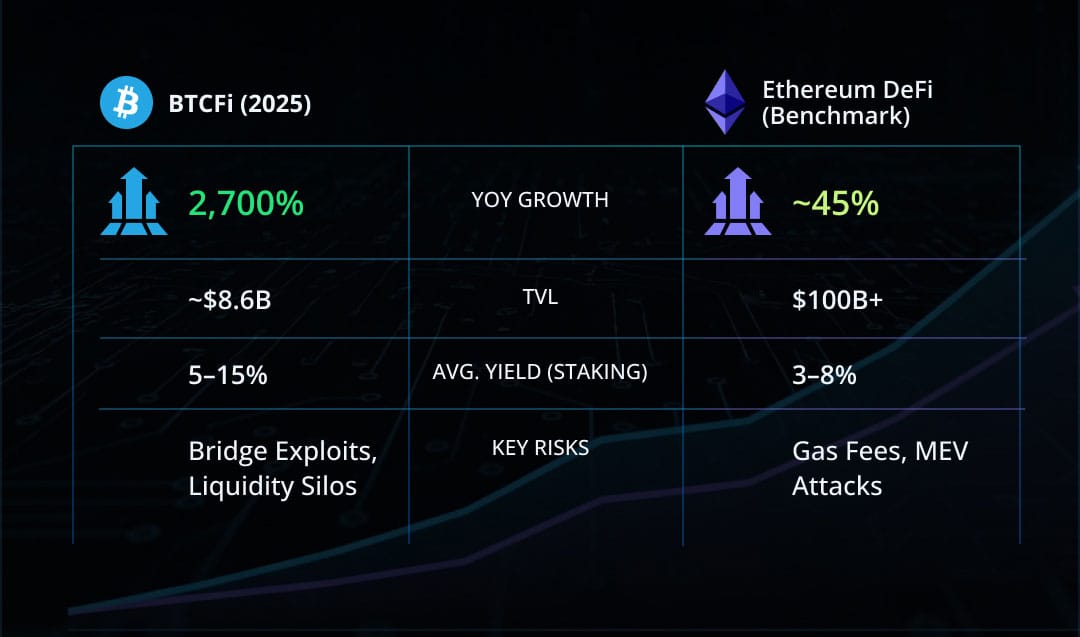
Takeaway:
- Ethereum’s DeFi is mature but crowded.
- Bitcoin DeFi is young, underdeveloped, and full of enterprise white space.
But here’s something you should know before you make your decision. Alexei Zamyatin, the mastermind behind BOB, a hybrid layer-2 protocol built on Bitcoin and Ethereum, said…
“We had a mission to really build a platform that acts as a gateway to Bitcoin DeFi, allowing Bitcoin holders to deploy their BTC into the DeFi ecosystem in a secure and transparent manner and get access to these DeFi opportunities with a single click.”
Yet he admitted that BTCFi is still emerging and is still stuck in first gear. To which he added:
“If you want to use Bitcoin in DeFi today, you have to wrap it to other chains, and you have to pick among 50 plus providers that are fragmented, and not super transparent.”
So, if you’re looking to capture that first-mover credibility on Bitcoin rails, partnering with a reliable DeFi development company can help you navigate the challenges of blazing the trail.
Top Layer 2s Driving the BTC DeFi Boom
Building on Bitcoin requires picking the right Layer 2 architecture that is going to back the smart contracts. Here are the major categories that the Bitcoin DeFi ecosystem is powering:
1. EVM-Compatible Sidechains
- Rootstock (RSK/RIF) brings EVM compatibility and merged mining, making it easy for Ethereum-native teams to migrate.
- Example: Avalon Labs deployed a lending infrastructure on Rootstock in 2025, boosting TVL by $750M within a few months.
- Ideal For: Enterprises wanting fast market entry, and existing Solidity code reuse can go for BTCDeFi development leveraging Rootstock technology. Similar lending or staking protocols can be launched with the help of top-notch Bitcoin DeFi development companies like Antier.
2. Smart-Contract Native Layer 2s
- Stacks (sBTC) leads here with Proof-of-Transfer (PoX) consensus and its Nakamoto upgrade, enabling faster blocks and 10X throughput.
- Merlin, Hemi, and B² Network are modular L2s gaining traction for institutional-grade scalability and real-world asset tokenization, and AI-driven yield models.
- Ideal For: Enterprises looking for true Bitcoin anchoring to tap into the network’s unparalleled security and decentralization.
3. Trust-Minimized Bridges and Interoperable Layers
- Union Protocol trailblazes, leveraging innovative bonding models to create near-trustless BTC bridges.
- BitVM and BATTLE bridges introduce dispute-resolution mechanisms to prevent bridge hacks.
- Portal Network, deployed on mainnet since Oct 2025, enables gasless cross-chain BTCDeFi development.
- Ideal For: Enterprises building multi-chain liquidity layers or cross-asset settlements into their dApps can leverage these technologies.
Other L2s: Liquid network for RWA issuance via federated models and Mintlayer that natively support security tokens.
Hire Antier For BTC DeFi Development
What DeFi Use Cases Make The Most Sense on Bitcoin L2s?
The Bitcoin DeFi ecosystem is emerging with more protocols and dApps leveraging the intense liquidity, scalability, and security. But let’s make it clear, it’s not just another blockchain network, but it comes with a whole different set of characteristics. Instead of cloning Ethereum DeFi Development, builders must focus on Bitcoin-native foundational components that solve real-world problems.
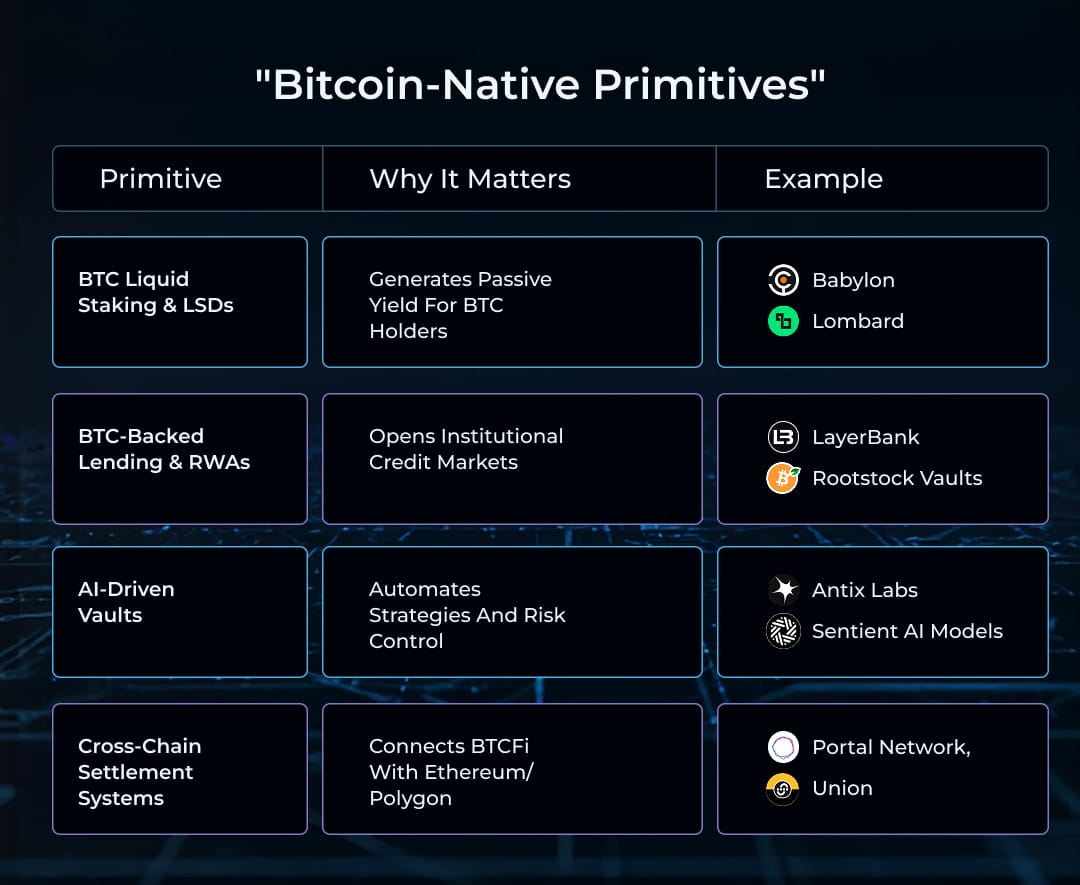
Tip: Start small with staking and lending, but architect with modular scalability so your protocol can expand into AI vaults, RWA tokenization, and trading later on.
Your Custom BTC DeFi Application Development Roadmap 2026
As concluded above, if you’re allocating your capital to BTCDeFi platform development, you must build a diversified ecosystem that must include:
- Liquid Staking: Investors who stake their BTC or derivatives token through Babylon, Lombard earn up to 10-15% annualized yield, depending on network conditions, validator rewards, or token incentives. Entrepreneurs looking to build similar BTC DeFi solutions can replicate such models with competitive rates and introduce new features.
- Lending, RWAs, and More: Those looking to build DeFi on the Bitcoin blockchain can leverage Rootstock for any type of dApp, such as lending, staking, exchange, wallet, or RWA tokenization. If you’re building a superapp, you can start with a module and scale later.
- AI-Driven DeFi Agents: The next generation of Web3 will be driven by agents that store, trade, stake, and secure the interactions on the blockchain. By collaborating with an experienced Bitcoin DeFi development company, builders can either leverage the Sentient or Antix twin models for automation or create something inspired by them.
- Cross-Chain Liquidity Pools For Institutional-Grade Swaps: Those interested in Custom BTCDeFi application development can build large liquidity vaults across multiple Bitcoin Layer 2s that enable BTC-stablecoin trading for enterprise users. The next evolution of enterprise-grade DeFi is building liquid pooling and multiple L2-vaults into superapps.
How to Mitigate Risks Associated With BTC DeFi Development
DeFi on the Bitcoin blockchain comes with a unique set of challenges and opportunities. Smart architectures built in partnership with a leading Bitcoin DeFi development company mitigate these risks while capitalizing on the opportunities.
- Bridge Security: Use multi-signature and zero-knowledge bridge layers (e.g., Union, BitVM)
- Oracle Reliability: Deploy multi-oracle aggregation to prevent manipulation.
- Liquidty Fragmentation: Implement multi-L2 liquidity routers and incentivized pools.
- Smart Contract Audits: Conduct Layer 2-specific security audits and formal verification.
- Regulatory Readiness: Integrate compliance modules (KYT, AML) early in architecture to support institutional access.
Antier’s enterprise DeFi frameworks already include pre-audited modules, oracle redundancy, and modular bridge integrations for BTC L2s.

Your Next Move: Partnering for Bitcoin DeFi Development
Swiss bank Sygnum recently introduced Bitcoin Yield funds as BTC DeFi demand increases. Bitcoin L2 ecosystems are entering their Ethereum 2019 era: early, volatile, but wildly asymmetric in upside. With institutional adoption accelerating, total value locked in BTC layer 2s will touch $50 billion by 2026, fueled by the adoption of L2 and BTC ETFs. If the bull market persists, it is even expected to touch $200B by 2027, triggered by AI-BTCFi convergence and institutional inflows.
Enterprises that build DeFi on the Bitcoin blockchain now won’t just ride the trend but define the BTCFi infrastructure of 2026 and beyond.
Schedule a strategy session with Antier to discuss your Bitcoin DeFi development roadmap.
Frequently Asked Questions
01. What is the current market capitalization of Bitcoin and how does it relate to its DeFi ecosystem?
Bitcoin has a market capitalization of $2 trillion, and its DeFi ecosystem has seen significant growth, expanding from $307 million in early 2024 to $8.6 billion by Q2 2025.
02. How does Bitcoin's DeFi development compare to Ethereum's?
While Ethereum's DeFi is mature and crowded, Bitcoin's DeFi is still young and underdeveloped, presenting significant opportunities for enterprise involvement.
03. What challenges do Bitcoin holders face when entering the DeFi space?
Bitcoin holders must wrap their BTC to use it in DeFi, navigating a fragmented landscape with over 50 providers that may lack transparency.