



✨ AI Summary
- The smart crypto wallet industry is losing billions due to the complexity of wallet setup, gas confusion, and unclear transaction flows, causing many users to abandon platforms early.
- This is a product architecture issue, not a user education problem.
- AI is seen as the solution to help users navigate the complex world of cryptocurrency.
- AI can turn a cryptocurrency wallet from a static tool to a smart guide, simplifying steps, explaining transactions, and flagging risky actions.
- With crypto becoming increasingly complex, trust and ease-of-use are becoming integral to the product.
Let us talk about the UX problem that is costing the smart crypto wallet industry billions!
Multiple market studies and wallet analytics reports suggest retention remains a major challenge in crypto, with many low-engagement users dropping off within the first few months. Research consistently shows onboarding friction remains one of the biggest barriers to DeFi adoption, with many first-time users abandoning platforms early due to wallet setup complexity, gas confusion, and unclear transaction flows. A user who cannot confidently execute a swap, interpret a gas fee, or identify whether a smart contract is safe will leave. And they will not come back. This is not a user education problem. It is a product architecture problem, and AI is the solution the industry has been building toward.
The AI in the fintech market is projected to reach $61.30 billion by 2031, growing at a CAGR of 22.5% from 2022 to 2031. Within that wave, AI-powered crypto wallet development sits at the highest-value intersection: the point where on-chain capability meets the usability gap driving institutional and retail users away from Web3 products entirely. Wallets that close this gap retain users. Wallets that do not are already losing them to products that have.
Let’s discuss some other aspects surrounding white label AI crypto wallet software.
Why AI Smart Crypto Wallets Matter Now?
Web3 crypto wallets have reached a point where complexity is no longer just a small inconvenience. It is now a real reason users drop off.
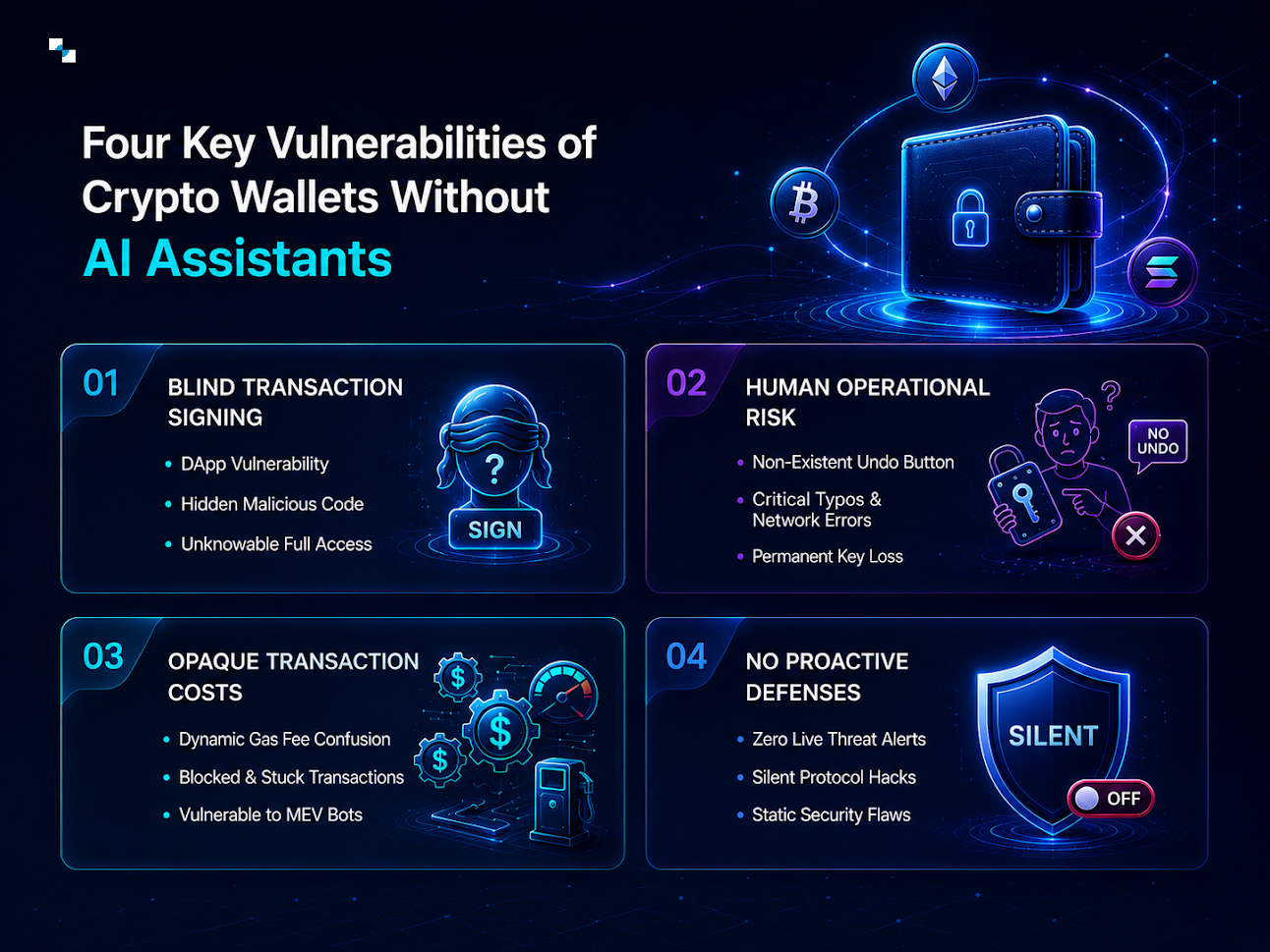
The truth is simple: most people do not leave because they hate crypto. They leave because using a wallet still feels too technical, too scattered, and too easy to get wrong. One wrong chain. One confusing gas fee. One risky approval. One unclear transaction. That is usually enough to lose a user.
That is exactly where AI starts to matter.
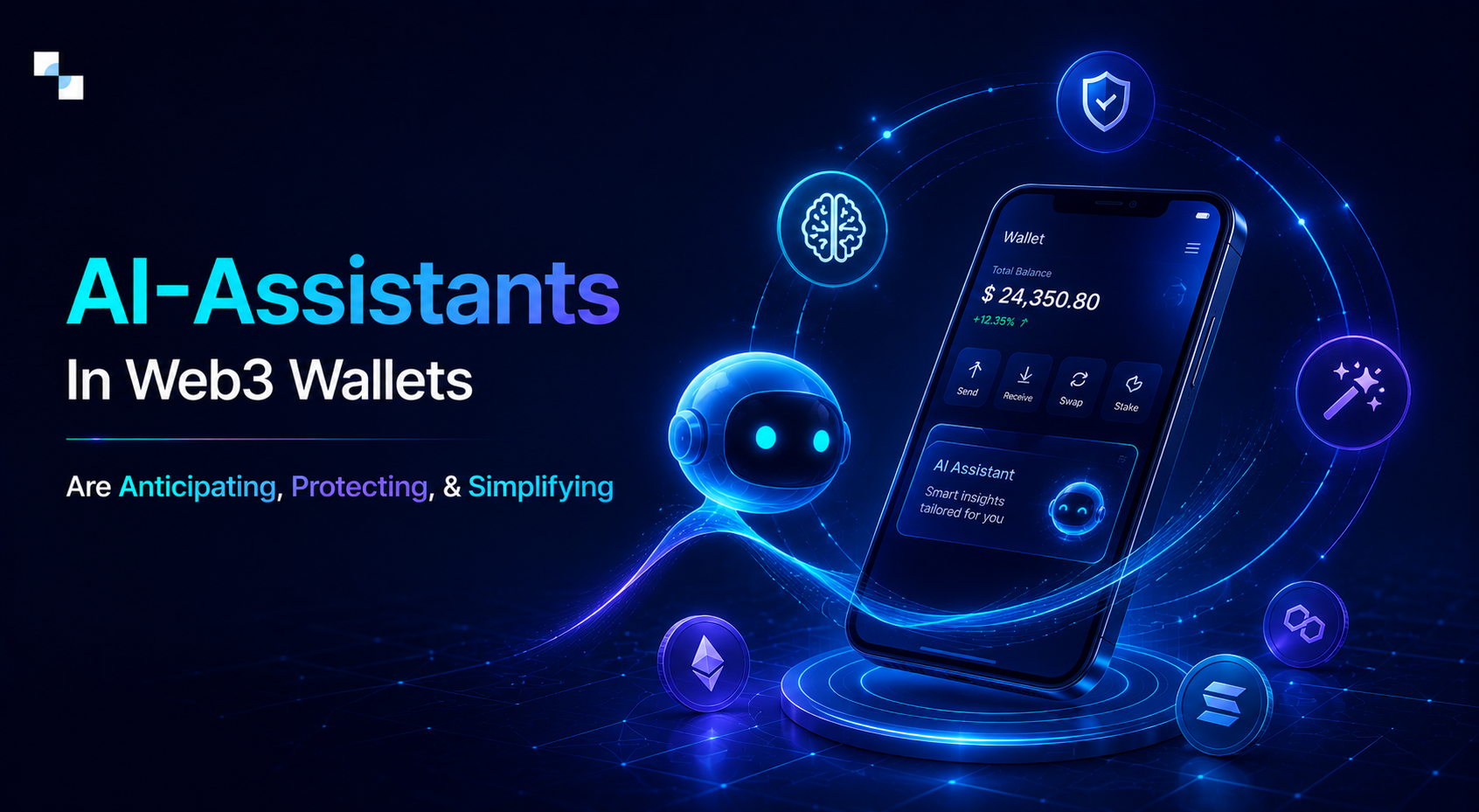
Instead of making the cryptocurrency wallet solution feel like a static tool, AI turns it into a smart guide. It can understand what the user is trying to do, simplify the steps, explain what is happening, and flag risky actions before the user signs anything. In a space where every extra step creates friction, that is a big shift.
This matters even more now because crypto is no longer single-chain or simple. Users are moving across multiple networks, handling DeFi positions, checking smart contracts, and reacting to market changes in real time. At the same time, scams and phishing attacks are becoming more convincing. So trust is no longer a nice-to-have. It is part of the product itself. For businesses and investors, the opportunity is clear. AI blockchain wallets are not just a feature trend. They are becoming the layer that makes Web3 easier to use, safer to trust, and more ready for mainstream adoption. In today’s market, that is not optional. It is becoming the standard.
Why AI Features in Blockchain Wallet Solutions Are No Longer a Differentiator?
The conversation around crypto wallets has changed.
A few years ago, adding AI to a wallet felt innovative. Today, it is quickly becoming the baseline.
Why? Because users no longer compare wallets only on security or token support. They compare them on clarity, speed, trust, and ease of use, and AI is increasingly shaping all four. Here is what the market already looks like:
- Coinbase Wallet integrated an AI transaction assistant in 2024.
- Phantom introduced AI-powered phishing warnings that screen smart contract interactions before signing.
- Trust Wallet deployed AI-based transaction explanations that translate raw call data into plain-language summaries.
- MetaMask launched AI-assisted security alerts through its Snaps ecosystem.
The pattern here is hard to ignore: leading crypto wallet development solutions are no longer treating AI as an experiment. They are using it to solve real user problems.
So, What Happens to Wallets That Do Not Adapt?
Let us be practical for a moment!
Most users do not leave a wallet because they dislike crypto. They leave because something feels confusing, risky, or difficult to trust. A failed transaction, an unclear approval request, or one phishing scare is often enough to push users elsewhere. That is exactly where AI starts changing the experience.
Instead of making users figure everything out on their own, AI helps explain transactions, flag suspicious activity, simplify decisions, and reduce avoidable mistakes before they happen.
And better experiences usually lead to stronger retention.
But have you wondered why this matters for business growth? Because retention is revenue.
A wallet that keeps users engaged over time naturally creates more transaction activity, stronger trust, and better monetization opportunities. Even reducing transaction friction can influence whether a user stays active or abandons the platform altogether.
In short: better wallet experiences create stronger business outcomes.
“But, Wait”
Build-vs-Buy Comparison: What Makes Sense for an AI Crypto Wallet Development?
| Factor | DIY In-House | Generic AI Wrapper | White label Development Partner |
|---|---|---|---|
| Launch Time | Slow (9–18+ months) | Fast (1–3 months) | Balanced (3–6 months) |
| Accuracy & Reliability | High (if skilled team exists) | Limited | Production-grade |
| Security & Compliance | Built internally | Basic | Built-in from day one |
| Multichain Readiness | Complex to manage | Limited support | Limited support |
| Scalability | Resource-heavy | Weak at scale | Enterprise-ready |
| Cost Efficiency | High long-term spend | Low upfront cost | Better long-term ROI |
| Best Fit | Enterprises with in-house AI/blockchain teams | MVPs & experimentation | Secure, scalable wallet products |
However, white label crypto wallet development is the fastest and smartest move. Instead of spending years building from scratch, enterprises can enter the market with a launch-ready, secure, and deeply customizable foundation built for scale. For businesses thinking beyond short-term wins, it creates room to move faster, adapt smarter, and focus on what truly matters: building stronger user trust, expanding product ecosystems, and staying ahead of an industry that rarely slows down.
What Does an AI Assistant Actually Do Inside a Web3 Wallet?
Before evaluating build approaches, it is worth being precise about what “AI assistant” means in a wallet context. The phrase is used loosely across the industry to describe everything from a customer support chatbot to a fully autonomous transaction agent. The version that actually moves the needle on wallet retention and revenue operates across five distinct technical functions.
Natural Language Transaction Processing
The user types: “Send 200 USDC to Daniel on Arbitrum.”
The AI assistant parses the intent, identifies the chain context (Arbitrum), resolves the recipient identifier (contact book, ENS record, or address book lookup), selects the correct token contract address for USDC on Arbitrum, calculates real-time gas estimates, constructs the full transaction object with validated parameters, and presents a pre-filled confirmation prompt.
The user reviews and signs. No manual address entry. No chain switching. No token contract lookup. No gas tab.
This sounds straightforward. The engineering behind it is not. On-chain intent parsing requires chain-specific context injection at inference time, a maintained contact and address resolution layer, real-time gas oracle integration, and a hallucination guard that validates every generated transaction parameter against live on-chain state before presenting it to the user. A generated address that looks correct but points to the wrong contract does not produce an error message; it produces an irreversible transaction to the wrong destination.
Gas Fee Prediction and Dynamic L2 Routing
Ethereum mainnet gas fees are unpredictable. During network congestion, fees spike from $1 to $40+ within minutes. Most wallets present a static estimate at transaction submission, which is either too high, eating user margin, or too low, causing the transaction to stall.
An AI layer trained on mempool patterns and historical gas data provides predictive estimates: “Current gas is elevated. Estimated 40% reduction if delayed by 22 minutes.” For non-urgent transactions, it is routed automatically to Layer 2 networks such as Arbitrum, Optimism, and Base, where the same operation costs 90–95% less while maintaining equivalent finality.
For a blockchain wallet app serving high-frequency DeFi users, this feature alone can save each active user $200–$800 annually in gas costs. That retention signal compounds directly into platform revenue.
Bring Intelligence Into Your Blockchain Wallet Solutions!
DeFi Position Monitoring and Risk Alerts
The majority of DeFi users do not actively monitor their open positions. A user who supplied ETH as collateral on Aave in January may not check their health factor again for weeks. If ETH drops 30% while they are inactive, their position faces liquidation -and the notification arrives after the loss, not before.
An AI assistant integrated with DeFi protocol APIs (Aave, Compound, MakerDAO, Curve, Convex) monitors open positions in real time and pushes alerts when a health factor crosses a configurable threshold, when a yield position drops below target APY, when a governance proposal targets a protocol the user is active in, or when a smart contract the user has approved receives a security flag. These are not generic price alerts. They are wallet-context-specific signals tied to the user’s actual on-chain exposure. Protocols that offer proactive position monitoring see higher user retention compared to those that do not. The AI layer is what makes that monitoring scalable across a full wallet product.
Fraud Detection and Smart Contract Risk Screening
Crypto scam losses exceeded billions years ago. The majority of those losses involved users signing transactions they did not fully understand, setApprovalForAll calls granting unlimited token access, phishing contracts mimicking legitimate protocols, and newly deployed contracts with no audit history.
An AI assistant integrated with on-chain risk databases screens every outgoing transaction destination before the signing prompt appears. It flags contracts deployed within the last 7 days, unverified source code, addresses tagged in phishing databases, and function calls that carry unusual risk parameters. The user sees a risk summary before they sign, not a transaction failure notification after the fact.
Multichain Intent Routing and Portfolio Intelligence
A user holding assets across Ethereum, Solana, BNB Chain, Polygon, and Tron manages five separate mental models for transaction formatting, fee structures, bridging options, and address formats. The cognitive overhead of multichain portfolio management is one of the primary retention blockers for non-technical users.
An AI layer with multichain awareness abstracts that complexity. It handles UTXO construction for Bitcoin transactions, nonce management, and EIP-1559 fee mechanics for Ethereum; priority fee calculation for Solana; and TRC-20 token routing for Tron—without exposing any chain-specific complexity to the user interface. Portfolio intelligence functions, tax lot tracking, performance attribution by chain and protocol, and rebalancing suggestions layer on top of the same multichain data infrastructure.
What to Look for in an AI Crypto Wallet Development Partner?
Not every blockchain wallet development company is equipped to deliver a production-grade AI wallet layer. These are the technical questions that separate capable partners from teams that will learn on your budget.
1. Demonstrated Production Deployments, Not Prototypes
Ask for on-chain transaction volume processed through their AI layer, documented hallucination rates in production, and chain coverage breadth. A portfolio of MVP demos with no live transaction history is not evidence of production capability.
2. Custom Model Fine-Tuning Capability
A partner that only wraps general-purpose APIs cannot deliver the on-chain accuracy or hallucination safety required for a wallet serving real assets. Ask specifically whether they fine-tune on wallet-specific transaction datasets and how frequently they retrain.
3. Documented Security Architecture for the AI Layer
The partner should provide explicit documentation covering how the AI layer is sandboxed from the key management system, how prompt injection attacks are mitigated, and what the full threat model for the AI layer looks like. If they cannot produce this document in the sales process, the architecture has not been designed with security as a first-order concern.
4. Compliance Integration in Prior Deliveries
Request named compliance integrations- Chainalysis, Elliptic, Sardine, or equivalent- in their delivery history. The compliance layer needs to be embedded in the AI’s transaction routing flow, not added as a separate module.
5. Multichain Coverage Across Both UTXO and Account Models
Confirm the cryptocurrency wallet development company’s AI layer handles Bitcoin (UTXO), Ethereum and EVM chains (account with EIP-1559 and EIP-712), Solana (account with instruction sets), and Tron. Single-chain-family expertise does not transfer cleanly to other models.
6. Post-Launch Retraining and Monitoring SLA
The AI layer degrades without active maintenance. The partner must offer a defined retraining cadence- quarterly at minimum- and an accuracy monitoring SLA that goes beyond infrastructure uptime to include model performance metrics.
7. Full Source Code Ownership on Delivery
Avoid delivery models that create ongoing licensing dependency for core AI wallet functionality. The engagement should deliver full source code, training data schemas, and deployment documentation as part of the handoff.
The Bottom Line
The Wallets Building AI-Native Infrastructure in 2025 and 2026 Set the Standard Their Competitors Will Chase for the Next Five Years. Antier has delivered production-grade crypto wallet infrastructure for exchanges, fintech platforms, and enterprise blockchain teams across the US, UK, UAE, and Australia. The development team now builds AI-native wallet systems, from on-chain intent parsing and natural language transaction composition to DeFi position monitoring, multichain routing, fraud screening, and embedded compliance. If your product roadmap includes a Web3 wallet with real AI capability built to production safety standards, the architecture, the security model, and the chain coverage all require specialist execution from a team that has built each component before and understands how they interact under load.
Antier Helps You Build Wallet Solutions That Think, Scale, & Adapt!
As users become more sophisticated and institutional participation accelerates, wallets are expected to do far more than facilitate transactions. They are expected to guide decisions, reduce risk, simplify interactions, and create confidence at every step of the user journey.
That is where building the right foundation starts to matter.
At Antier, the focus goes beyond simply cryptocurrency wallet development. The approach is centered on building resilient, AI-native wallet ecosystems that are engineered for scale, security, and long-term adaptability. Whether it is:
- Regulatory and compliance guidance
- Security architecture planning
- Multichain interoperability
- Third-party integrations
- Institutional-grade infrastructure, or
- Post-launch optimization
The emphasis remains on helping enterprises build products that are prepared for real market conditions, not just product demos.
Because in a space moving this fast, the real differentiator is not how quickly you launch. It is how intelligently you build, how confidently you scale, and how well your product holds its ground as market expectations continue to evolve. That is the kind of long-term thinking Antier brings to the table.
Frequently Asked Questions
01. What is the main UX problem affecting the smart crypto wallet industry?
The main UX problem is onboarding friction, which leads to low user retention as many first-time users abandon platforms due to wallet setup complexity, gas confusion, and unclear transaction flows.
02. How does AI contribute to improving user retention in crypto wallets?
AI enhances user retention by transforming cryptocurrency wallets into smart guides that simplify processes, explain actions, and flag risky transactions, thereby reducing friction and improving user confidence.
03. Why is the complexity of crypto wallets a significant issue for users?
The complexity of crypto wallets is a significant issue because it makes the experience feel too technical and scattered, leading to user drop-off when they encounter confusing elements like gas fees or risky approvals.