



✨ AI Summary
- Dubai is positioning itself at the forefront of the global tokenization race.
- Despite the buzz around digital assets, regulatory uncertainty has slowed institutional adoption.
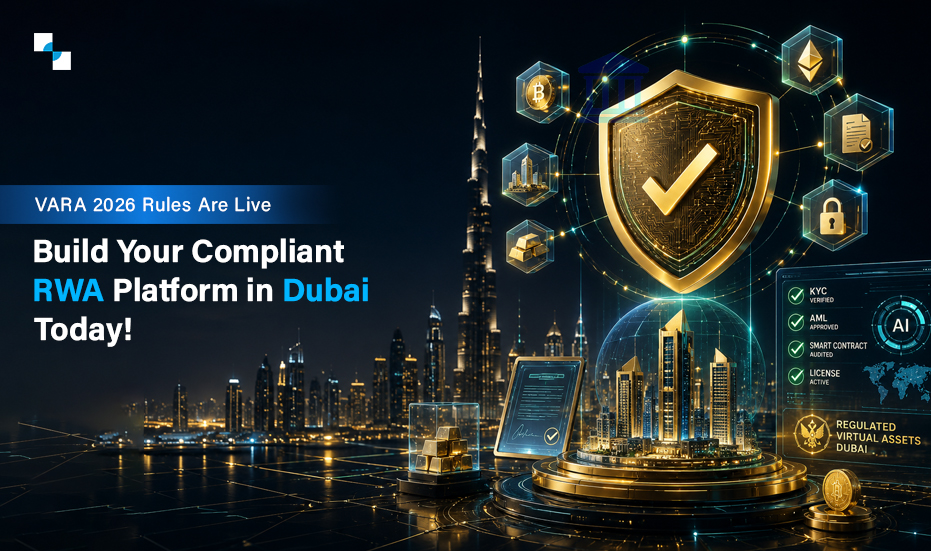
- However, VARA’s 2026 framework is set to change this, building a structured regulatory environment for compliant digital assets and real-world asset tokenization in the UAE.
- The future winners in tokenization will not simply be the fastest to launch tokens, but those who can create compliant, secure, and institution-ready infrastructure aligned with evolving regulatory standards.
- This blog post explores the requirements and challenges of developing a compliant tokenization platform and offers insights into VARA compliant RWA platform development.
The global tokenization race is entering a new phase, and Dubai is positioning itself at the center of it.
Over the last few years, enterprises across real estate, private equity, fintech, and alternative investments have explored tokenization as a mechanism for unlocking liquidity, fractional ownership, and global capital access. Yet despite the growing excitement around digital assets, one challenge continued to slow institutional adoption: regulatory uncertainty.
VARA’s 2026 framework changes that equation.
The UAE is now building one of the world’s most structured regulatory environments for compliant digital assets and real-world asset tokenization. More importantly, it is creating an ecosystem where regulated tokenized markets can scale with institutional participation rather than speculative retail activity alone.
For decision-makers, this signals a critical market transition.
The future winners in tokenization will not be the companies that launch tokens fastest. They will be the enterprises capable of building compliant, secure, and institution-ready infrastructure aligned with evolving regulatory standards.
This shift raises new questions for businesses entering the market:
- What does a compliant tokenization platform actually require?
- How should custody, governance, and compliance systems be structured?
- Which token standards support institutional adoption?
- How can enterprises align with Virtual Asset Regulation Compliance in Dubai?
- What operational layers are necessary to attract institutional investors?
The answers extend far beyond blockchain development.
Launching a scalable RWA tokenization platform in Dubai now requires coordination between legal structuring, compliance automation, smart contract engineering, banking integrations, investor onboarding, marketplace infrastructure, and governance intelligence.
This blog explores the complete architecture behind modern VARA compliant RWA platform development while outlining how enterprises can build scalable and regulation-ready digital asset ecosystems within the UAE.
Why Most Regulated Tokenization Platform Development Models Fail at Institutional Scale
The first wave of tokenization projects was largely driven by excitement around blockchain innovation, fractional ownership, and global accessibility. Businesses believed that converting real-world assets into digital tokens would automatically create liquidity, democratize investment access, and unlock institutional participation. However, the market has matured significantly, and investors are no longer evaluating projects solely on the basis of token issuance.
Today, the biggest differentiator is infrastructure maturity.
Institutional participants such as family offices, regulated investment firms, sovereign entities, and real estate groups are evaluating whether tokenization platforms can operate with the same operational discipline as regulated financial institutions. They are assessing:
- legal enforceability
- compliance readiness
- governance transparency
- custody security
- reporting infrastructure
- risk management capabilities
This is precisely where a large percentage of tokenization ventures fail.
Many projects still operate with fragmented architecture consisting of basic ERC-20 smart contracts, disconnected compliance systems, weak treasury controls, and limited investor protections. Such platforms may function during early pilot phases, but they struggle to scale once regulators, banking partners, or institutional investors begin deeper due diligence.
With the release of the latest framework from Dubai’s Virtual Assets Regulatory Authority, infrastructure gaps are becoming even more visible. The UAE market is rapidly transitioning toward institutional-grade tokenization ecosystems where compliance, governance, and operational resilience are becoming foundational requirements.
As a result, enterprises are increasingly engaging specialized partners offering end-to-end RWA tokenization development company services capable of building scalable, regulation-ready digital asset ecosystems.
The Hidden Infrastructure Challenges Behind Regulated Tokenization Platform Development
A major misconception in the market is that tokenization is primarily a blockchain challenge. In reality, blockchain is only one layer within a much larger institutional infrastructure stack.
Successful tokenization platforms require synchronization between:
- legal structuring
- compliance orchestration
- financial operations
- smart contract logic
- custody systems
- investor onboarding
- secondary trading infrastructure
Without these layers functioning together, platforms struggle to achieve long-term viability.
For example, a real estate developer may tokenize property ownership successfully on-chain. However, institutional investors will immediately evaluate additional questions:
- Are ownership rights legally enforceable?
- How are investor protections managed?
- What mechanisms exist for AML compliance?
- How are funds segregated and secured?
- What happens during disputes or redemption events?
- Is there transparency in revenue distribution?
If these operational layers are weak or undefined, tokenization becomes merely a digital wrapper around a traditional asset rather than a truly investable institutional product.
This is why modern regulated tokenization platform development is increasingly being viewed as financial infrastructure engineering rather than pure blockchain development.
VARA’s 2026 Rules Eliminating Weak Infrastructure Models
Dubai initially emerged as one of the world’s most attractive destinations for blockchain innovation because of its progressive stance toward virtual assets. However, the release of the updated 2026 framework signals a deeper transformation.
The UAE is no longer focused only on enabling digital asset experimentation. It is now building an institutional financial ecosystem where tokenized assets can coexist with regulated capital markets.
This shift changes the expectations placed on every enterprise entering the space.
Under the new direction of Virtual Asset Regulation Compliance in Dubai, regulators are prioritizing:
- investor protection
- operational transparency
- compliance enforcement
- financial accountability
- custody resilience
- anti-market manipulation controls
In practical terms, this means tokenization platforms are increasingly expected to function similarly to regulated financial institutions.
Businesses that previously relied on minimal compliance controls or loosely governed token economies may now face:
- licensing challenges
- banking restrictions
- institutional trust barriers
- operational scalability issues
For enterprises planning VARA compliant RWA platform development, infrastructure maturity is no longer optional. It is becoming the core requirement for market participation.
Launch Your RWA Tokenization Project in Dubai with Institutional – Grade Infrastructure
What the New Regulatory Direction Means for Enterprises
One of the most transformative shifts within Dubai’s evolving regulatory environment is the changing role of compliance.
Traditionally, compliance was treated as a standalone operational function handled separately from product architecture. Businesses would often develop tokenization platforms first and then integrate KYC or AML processes later.
That model is rapidly becoming obsolete.
Under the updated framework, compliance must now operate as an embedded infrastructure layer integrated directly into every component of the platform ecosystem.
This includes:
- onboarding workflows
- investor eligibility checks
- transaction approvals
- wallet screening
- smart contract permissions
- secondary trading restrictions
- treasury monitoring
- audit logging
For example, modern tokenization platforms may require smart contracts to automatically block transfers involving unauthorized jurisdictions or non-accredited investors. Similarly, marketplace systems may need to perform real-time transaction monitoring before settlements are finalized.
This level of integration requires significant coordination between:
- blockchain engineering teams
- legal advisors
- compliance experts
- financial infrastructure architects
As enterprises pursue compliant crypto platform development Dubai, the quality of compliance architecture increasingly influences:
- licensing potential
- banking relationships
- institutional partnerships
- investor confidence
The Complete Blueprint for Building a VARA-Compliant RWA Platform Development in Dubai
Layer 1 — Legal Structuring and Asset Origination
Every institutional tokenization ecosystem begins with legal clarity.
Before an asset can be represented digitally, enterprises must establish how ownership rights, investor entitlements, and revenue structures will be legally recognized within the applicable jurisdiction.
This process typically involves:
- SPV creation
- ownership mapping
- contractual structuring
- valuation frameworks
- investor rights definitions
- regulatory classification analysis
For example, within a tokenized real estate ecosystem, legal architecture must clearly define:
- who owns the underlying property
- how rental income is distributed
- how disputes are handled
- what rights token holders possess
- how redemption or exits occur
Without these foundational structures, tokenized assets may face serious enforceability issues during audits, investor disputes, or regulatory reviews.
This becomes especially critical for enterprises pursuing:
- real estate tokenization
- tokenized debt markets
- private investment funds
- infrastructure financing models
A strong legal foundation ensures that digital ownership remains tied to enforceable real-world rights rather than speculative blockchain records alone.
Layer 2 — Compliance and Identity Infrastructure
The Core Foundation of VARA Compliant RWA Platform Development
Compliance infrastructure is rapidly becoming the defining characteristic of institutional-grade tokenization ecosystems.
Modern platforms operating within the UAE must establish advanced identity and monitoring systems capable of supporting both regulatory requirements and institutional expectations.
These systems commonly include:
- KYC verification
- KYB onboarding
- AML transaction monitoring
- sanctions screening
- wallet intelligence
- politically exposed person checks
- investor risk scoring
However, institutional compliance extends far beyond onboarding.
Under evolving tokenization compliance checklist Dubai standards, enterprises are increasingly expected to maintain continuous compliance visibility across the entire lifecycle of investor activity.
- transaction behavior
- wallet interactions
- marketplace transfers
- treasury flows
- suspicious activity patterns
Additionally, all activities must remain audit-ready, traceable, and accessible during regulatory reviews.
This creates the need for intelligent compliance orchestration systems capable of integrating blockchain activity with traditional regulatory workflows.
Layer 3 — Smart Contracts and Institutional Tokenization Logic
Why ERC-20 Is No Longer Enough
The first generation of blockchain ecosystems relied heavily on ERC-20 tokens because of their simplicity and interoperability. However, institutional financial products require far more sophisticated functionality.
Regulated tokenized assets must support programmable compliance directly within smart contract logic.
This includes:
- transfer restrictions
- investor whitelisting
- holding limitations
- jurisdictional permissions
- automated compliance enforcement
- dividend distribution
- governance voting
This is why standards such as ERC-3643 and ERC-1400 are becoming increasingly important within institutional RWA infrastructure development.
ERC-3643, in particular, allows platforms to associate token ownership with verified investor identities. This enables enterprises to create permissioned ecosystems where transfers only occur between compliant participants.
Similarly, ERC-4626 is gaining importance for tokenized vaults, yield-bearing assets, and institutional investment structures.
For enterprises pursuing regulated tokenization platform development, smart contracts are no longer simple transactional tools. They are becoming automated governance and compliance engines.
Layer 4 — Custody and Banking Infrastructure
Institutional Capital Requires Institutional Safeguards
Custody has emerged as one of the most important pillars of institutional digital finance.
Sophisticated investors are not only evaluating tokenization models but also assessing how digital assets, treasury reserves, and investor funds are protected.
This is particularly relevant within the UAE, where large-scale tokenization projects increasingly involve:
- real estate portfolios
- infrastructure assets
- private investment funds
- regulated investment products
Modern custody architecture often includes:
- MPC wallet systems
- multi-signature authorization frameworks
- regulated custodians
- cold storage infrastructure
- treasury segregation systems
- fiat settlement rails
Banking integration is equally important.
Institutional investors require confidence that:
- funds are securely managed
- operational reserves are segregated
- settlements remain compliant
- reporting standards are transparent
For enterprises entering tokenized real estate platform development UAE, custody infrastructure plays a critical role in building investor trust and regulatory credibility.
Layer 5 — Secondary Marketplace and Liquidity Infrastructure
Liquidity Is the Real Promise of Tokenization
The true long-term value of tokenization lies not merely in digital ownership but in creating compliant liquidity opportunities around traditionally illiquid assets.
However, enabling liquidity within regulated ecosystems is significantly more complex than enabling peer-to-peer crypto trading.
Institutional marketplaces require sophisticated infrastructure capable of balancing:
- regulatory compliance
- investor protection
- transaction efficiency
- market integrity
This typically involves:
- investor whitelisting
- permissioned transfers
- automated settlement logic
- transfer approvals
- liquidity controls
- market surveillance tools
Additionally, marketplaces must implement mechanisms to prevent:
- wash trading
- insider activity
- price manipulation
- illicit fund movement
This operational complexity is one of the main reasons enterprises increasingly partner with specialized firms for compliant crypto platform development in Dubai instead of attempting fragmented in-house implementations.
Layer 6 — Reporting, Governance, and Audit Intelligence
Institutional Investors Demand Transparency
Institutional capital flows toward environments that provide visibility, accountability, and operational confidence.
As tokenized markets mature, reporting infrastructure is becoming one of the strongest competitive differentiators for digital asset platforms.
Investors increasingly expect:
- real-time portfolio visibility
- treasury analytics
- transaction histories
- governance transparency
- audit-ready reporting
- compliance exports
Platforms operating within Dubai virtual asset platform development ecosystems must therefore integrate sophisticated reporting and governance frameworks from the very beginning.
Transparent infrastructure helps enterprises:
- strengthen investor confidence
- improve operational oversight
- simplify regulatory interactions
- accelerate institutional onboarding
Ultimately, platforms capable of demonstrating operational maturity are significantly more likely to attract long-term institutional participation.
Build Secure Blockchain Asset Tokenization Solutions
The UAE’s Tokenization Economy Entering the Infrastructure Era
The UAE’s digital asset ecosystem is evolving far beyond early-stage crypto adoption and experimental blockchain initiatives. With the introduction of VARA’s 2026 framework, the market is now entering a new phase defined by institutional infrastructure, regulatory maturity, and operational scalability. Enterprises are no longer competing solely on tokenization concepts or speed-to-market.
Instead, regulators, investors, and financial institutions are evaluating the strength of the underlying ecosystem powering these platforms — including compliance architecture, custody systems, governance frameworks, reporting intelligence, banking integrations, and investor protection mechanisms. This transition signals a major opportunity for businesses looking to establish long-term positioning within regulated digital finance markets. As institutional participation accelerates across tokenized real estate, private assets, investment funds, and compliant digital securities, enterprises capable of building secure and regulation-aligned ecosystems will emerge as the next market leaders in the UAE’s evolving tokenization economy.
As an experienced RWA tokenization development company, Antier enables enterprises to build institutional-grade, VARA-aligned tokenization platforms designed for scalability, compliance, and long-term market credibility within the UAE’s rapidly expanding digital asset ecosystem.
Frequently Asked Questions
01. What is the significance of VARA's 2026 framework for tokenization in Dubai?
VARA's 2026 framework establishes a structured regulatory environment for compliant digital assets and real-world asset tokenization in Dubai, facilitating institutional participation and scaling regulated tokenized markets.
02. What are the key components required for a compliant tokenization platform?
A compliant tokenization platform requires coordination in legal structuring, compliance automation, smart contract engineering, banking integrations, investor onboarding, marketplace infrastructure, and governance intelligence.
03. How can enterprises ensure alignment with Virtual Asset Regulation Compliance in Dubai?
Enterprises can align with Virtual Asset Regulation Compliance in Dubai by building secure, compliant infrastructure that meets evolving regulatory standards and addresses custody, governance, and compliance systems effectively.