




Launching a blockchain platform in 2026 demands technical capabilities alongside clear budget planning. Blockchain technology has already revolutionized how companies operate across sectors like healthcare, supply chain, and real estate. Yet the question “how much does it cost” remains surprisingly difficult to answer without understanding the variables that shape every blockchain development project.
This guide breaks down the realistic costs, hidden expenses, and optimization strategies you need before engaging blockchain developers. Whether you’re exploring RWA tokenization, DeFi protocols, or enterprise-grade identity systems, you’ll walk away with concrete price ranges, timeline expectations, and actionable tactics to protect your development budget.
Key Takeaways
Most custom blockchain development projects in 2026 cost between $80,000 and $750,000+, with simple proof-of-concept builds starting around $40,000 and complex, regulated platforms exceeding $1 million. The cost of developing a blockchain application can range from $40,000 to $300,000 or more, depending on various factors such as complexity, features, and the type of blockchain solution required.
Here’s what shapes those numbers:
- Scope and complexity drive the largest cost variations. On-chain logic, integrations with existing systems, and UX requirements can swing budgets by 3-5x for projects with similar labels.
- Blockchain platform choice matters significantly: Ethereum, Polygon, Solana, and Hyperledger Fabric each carry different development costs, gas fees, and infrastructure requirements.
- Security and compliance requirements add substantial overhead for regulated industries, including third-party smart contract audits and documentation.
- Year-1 budgets must extend beyond build cost to include audits, infrastructure, and ongoing maintenance, often adding 20-40% to initial estimates.
- Agile development and milestone-based delivery help keep blockchain projects within 10-15% of agreed budgets through continuous scope validation.
By the end of this article, you’ll have concrete price ranges, timeline examples, and cost-optimization tactics to apply before talking to any blockchain development company.
What Is the Typical Cost of a Blockchain Development Project in 2026?
The answer to “how much does it cost” depends on functionality, risk profile, and scale, not just the project label. A “DeFi app” can mean a $60,000 staking interface or a $500,000 lending protocol with liquidation mechanics and governance. Context determines everything.
Here are concrete cost bands based on 2026 market data:
- $40,000–$120,000: Simple MVPs including single-chain dApps, basic NFT marketplace implementations, straightforward token deployments with simple web interfaces
- $120,000–$350,000: Mid-complexity platforms such as RWA tokenization pilots, DeFi pools with moderate features, multi-feature wallet solutions, and gaming economies with blockchain integration
- $350,000–$1,000,000: Enterprise-grade, regulated solutions including asset management platforms, institutional custody systems, banking-adjacent digital asset infrastructure, and complex identity management systems
These ranges assume hiring a professional blockchain development agency with blended rates of roughly $40–$90 per hour, depending on region and specialist mix. The average hourly rate for hiring a blockchain development agency ranges from $25 to $49, which can impact the overall project budget based on the total hours required for development.
Timeline expectations map directly to these ranges:
- Simple MVPs: 3–4 months
- Mid-complexity platforms: 6–9 months
- Large enterprise builds: 9–14 months
Build Cost-Efficient Blockchain Applications
Core Factors That Shape Blockchain Development Costs

Two projects labeled “a DeFi app” can differ by 3-5x in cost due to decisions made in early scoping. This section walks through the key factors: scope and features, blockchain platform choice, integrations, security and compliance, and team structure. The goal is to give non-technical decision-makers enough clarity to understand why two quotes for similar-sounding projects may differ by hundreds of thousands of dollars.
1. Scope, Features, and Functional Complexity
The number of user roles (admin, issuer, investor, auditor), screens, and custom workflows directly expands development hours and extensive testing efforts. Smart contracts are self-executing contracts with the terms of the agreement directly written into code, enabling automated and trustless transactions on the blockchain, but each additional feature compounds complexity.
Consider the contrast:
- A basic ERC-20 token dashboard with balance displays and transfer functions
- A full on-chain lending protocol with collateral management, automated liquidations, governance voting, and risk parameters
These represent entirely different engineering undertakings despite both being “DeFi.”
Adding conditional business logic, KYC gating, jurisdiction-based rules for digital assets, tiered user permissions, or complex state transitions raises both smart contract development and backend development complexity significantly.
2. Blockchain Network and Platform Choice
Choosing between public networks (Ethereum, Polygon, Solana), enterprise platforms (Hyperledger Fabric, Quorum, Corda), and private blockchain configurations affects cost across development, testing, and operations.
Key considerations:
- EVM-compatible chains (Ethereum, Polygon, BNB Chain, Binance Smart Chain) offer rich tooling, reusable components, and lower development time compared to niche ecosystems
- Private blockchain networks involve more upfront architecture and DevOps work (nodes, consensus mechanisms, identity), but can reduce gas fees and compliance risks in enterprise settings
- Different blockchain platforms carry different transaction costs: Ethereum mainnet ($5-$50 per transaction), Polygon ($0.01-$0.50), Solana (~$0.00025)
Choosing the right blockchain platform that aligns with the project’s scope and budget can significantly lower development costs compared to building a blockchain from scratch. Public blockchains often require gas fee optimization, while private/consortium networks entail higher initial infrastructure setup costs.
3. Integrations and External Dependencies
Common integrations in blockchain apps include:
- KYC/AML providers
- Payment gateways
- Custodians (Fireblocks, BitGo)
- Oracle services (Chainlink, Oracle blockchain platform connections)
- Analytics dashboards
- Legacy ERP/CRM systems and existing enterprise systems
Each integration requires design, API work, error handling, and long-term maintenance, adding 10-30% to development costs depending on the number of external systems.
Example: A tokenization platform needing bank API integration for fiat on/off-ramps and identity provider integration for investor onboarding can add $50,000-$100,000 to baseline development.
4. Security, Compliance, and Risk Level
Systems that touch real funds, securities, or identity data (RWA platforms, custody, DeFi protocols) demand stronger security engineering and formal automated testing. Higher security standards, compliance audits, and advanced encryption techniques can significantly increase blockchain development costs.
Regulated industries (banking, securities, healthcare) must factor in compliance frameworks:
- KYC/AML procedures
- FATF guidance
- GDPR and HIPAA requirements
- Local VASP regulations
- Regulatory compliance documentation
Third-party security audits typically range from $10,000 for basic ERC-20 contracts to $150,000+ for complex DeFi or RWA protocols, and these costs are rarely included in basic development quotes.
5. Team Composition and Engagement Model
The cost and risk profile differ significantly across engagement models:
| Model | Blended Rate Range | Risk Profile |
| Freelancers | $25-$50/hour | Higher risk of delays, quality issues |
| Specialized blockchain development company | $40-$90/hour | Established processes, lower failure risk |
| Large consulting firms | $100-$200+/hour | Comprehensive but expensive |
Involving specialists (experienced blockchain developers, DevOps, security researchers, product owners) raises hourly rates but reduces the probability of critical mistakes requiring expensive rework.
Outsourcing app development to mid-sized, experienced agencies can offer high-quality services at reasonable rates, balancing cost-efficiency with the expertise required to build secure and scalable blockchain applications.
Regional rate ranges in 2026:
- Eastern Europe/India: $40-$70/hour
- Western Europe/USA: $80-$150/hour
Blockchain Development Cost Breakdown by Project Stage
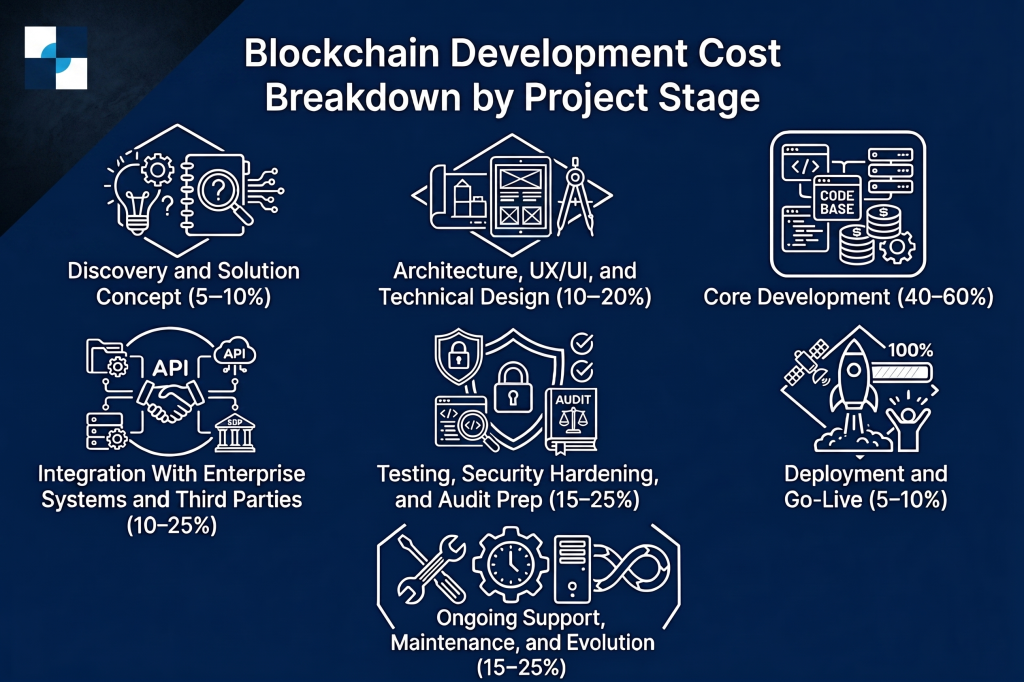
Discovery and Solution Concept (5–10% of Budget)
Activities include business analysis workshops, requirements gathering, user journey mapping, regulatory and risk analysis, and basic technical feasibility checks. Initial planning and technical design in blockchain projects typically cost between $10,000 and $60,000. For a $250,000 blockchain development project, this stage typically consumes $12,500-$25,000 over 3-5 weeks.
Architecture, UX/UI, and Technical Design (10–20%)
This stage covers:
– Blockchain network selection
– On-chain vs. off-chain architecture decisions
– Data models and smart contract boundaries
– API design specifications
– Initial UX wireframes
Good design decisions here can reduce later development and infrastructure costs by 2-3x, especially for multi-chain or high-volume systems. For a mid-size build of $300,000, expect $30,000-$60,000 across 4-8 weeks. Include at least one iteration loop with stakeholders to refine flows for key roles (issuer, investor, admin) before coding starts.
Core Development (40–60%)
This is where smart contracts, backend services, APIs, frontends, and blockchain integration are implemented. Decentralized applications (dApps) operate on a peer-to-peer network rather than being hosted on centralized servers, enhancing security and reducing the risk of downtime.
Components include:
– Smart contract development (tokens, NFTs, staking, governance)
– Backend development (business logic, KYC flows, user management)
– Frontend (web/app interfaces)
– DevOps (testnets, CI/CD pipelines)
For many blockchain platforms, this phase alone ranges from $80,000-$450,000+, depending on scope.
Integration With Enterprise Systems and Third Parties (10–25%)
Integration work spans connecting the blockchain system with CRM/ERP, payment providers, custodians, KYC/AML services, and external data feeds. Heavily integrated enterprise blockchain solutions may see this stage grow to 20-25% of the budget.
Real example: Connecting to multiple custodians and a banking core added roughly $70,000 to a 2025 digital asset platform project.
Underestimating this phase is a chronic reason real blockchain projects exceed initial cost estimates.
Testing, Security Hardening, and Audit Prep (15–25%)
Testing types include:
– Unit testing and functional testing
– Integration testing across blockchain and backend
– Performance and load testing
– Security testing for smart contracts and key management
– UX validation
Regular testing and real-time monitoring are essential for strengthening blockchain applications against vulnerabilities and ensuring reliable operations. This phase commonly represents 15-25% of the total build cost, especially when financial transactions or identity data are involved.
External audits (code review by third-party firms) are separate cost items but must be planned in both the schedule and the development budget.
Deployment and Go-Live (5–10%)
Deployment includes:
– Configuring production blockchain nodes or managed services
– Setting up monitoring and alerting
– Migrating initial data
– Performing staged rollouts
For public blockchain deployments, on-chain contract deployment and initial transactions incur gas fees budgeted separately. For a $200,000 project, typical deployment efforts fall between $10,000-$20,000.
Ongoing Support, Maintenance, and Evolution (15–25% Annually)
After launch, ongoing support costs include:
– Bug fixes and smart contract upgrades (where governance allows)
– API changes and feature evolution
– Adapting to new regulatory requirements
– Supporting new wallets or different blockchain networks
Post-launch costs in blockchain development are often underestimated and typically account for 15-25% of the initial build cost annually. For a $300,000 build, expect $45,000-$75,000 per year.
Ongoing maintenance and security monitoring typically cost $5,000–$20,000 per month after the initial build. Additional recurring costs include hosting, managed node providers, observability tools, and cloud services.
Talk to our experts to get a custom Blockchain cost breakdown
Hidden and Often Overlooked Blockchain Development Costs
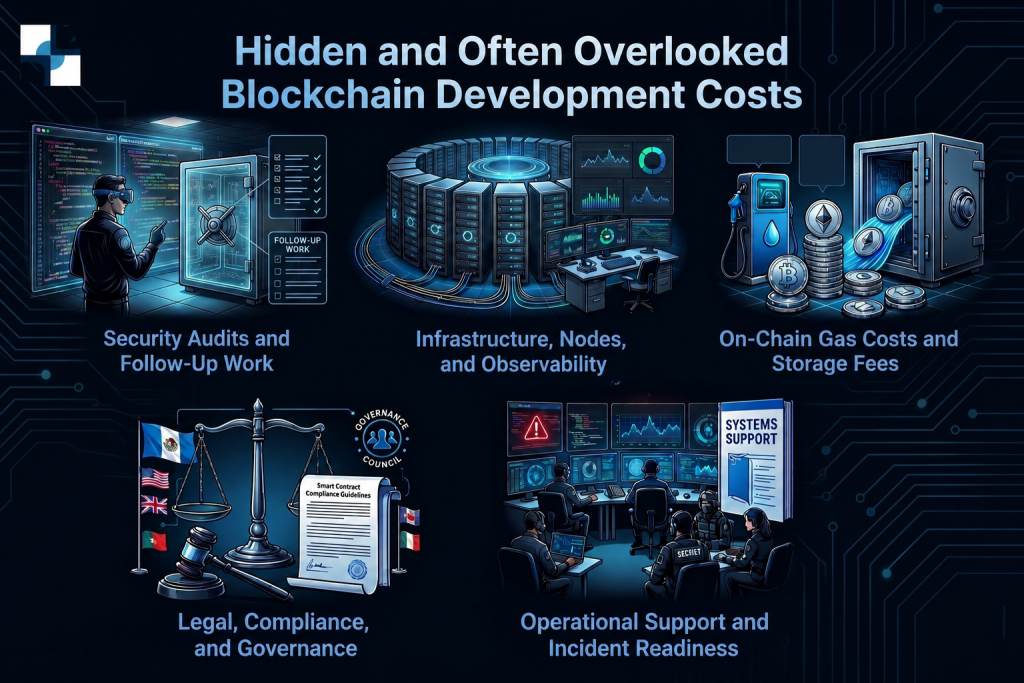
Many early-stage budgets ignore key cost categories beyond core development, leading to 2-3x overruns after launch. Treat these items as separate budget lines when planning your blockchain development project.
Security Audits and Follow-Up Work
Security audits in blockchain development can range from $5,000 to $100,000+, depending on the lines of code and risk profile. Complex smart contracts for DeFi or RWA protocols regularly command $150,000+ per audit cycle.
Critical considerations:
– Fixing audit-discovered issues often requires 10-30% additional development time
– Re-audits or follow-up reviews add further cost
– Institutional partners and decentralized exchanges often won’t integrate without an audited report
Infrastructure, Nodes, and Observability
Common infrastructure elements include:
– RPC endpoints for blockchain interaction
– Dedicated blockchain nodes
– Block explorers
– Indexing services (The Graph, custom indexers)
– Logging and monitoring stacks
Realistic 2026 monthly ranges:
- Low-volume MVPs on shared infrastructure: $200-$500/month
- High-throughput production systems with dedicated nodes: $5,000-$20,000+/month
Regulated enterprises often prefer private blockchain networks where they must run their own nodes, increasing DevOps and hosting costs. Ask potential blockchain development services providers for a separate, itemized infrastructure estimate for Year-1 operation.
On-Chain Gas Costs and Storage Fees
While using distributed ledger systems like Ethereum, Polygon, or BNB Chain involves no licensing fees, every on-chain transaction and decentralized storage update incurs gas fees.
Indicative figures:
– Standard Ethereum smart contract deployments: $100-$10,000+ depending on complexity and network conditions
– High-frequency platforms (gaming, DeFi) may need gasless relayers or account abstraction, adding operational costs
Include a flexible, usage-based budget for gas fees, particularly during launch campaigns or user acquisition pushes.
Legal, Compliance, and Governance
Common legal work includes:
– Token classification opinions (utility vs. security)
– KYC/AML policy design
– Data protection advice
– Contractual arrangements with custodians or banking partners
Realistic annual ranges: $20,000-$100,000+ in legal/compliance costs for asset-linked or financial blockchain platforms.
Some jurisdictions (EU MiCA, US state-by-state regimes, UAE ADGM/VARA) require documented policies and periodic reviews affecting both budget and timeline.
Operational Support and Incident Readiness
Live blockchain platforms benefit from 24/7 monitoring and on-call arrangements, especially when handling high-value digital assets.
Operations budgets (monitoring tools, on-call staff, incident management) range from $2,000-$15,000+ per month depending on scale and SLAs.
Proper incident readiness (runbooks, rollback strategies, governance procedures) adds upfront cost but significantly reduces the financial and reputational impact of outages.
How to Optimize Blockchain Development Costs Without Compromising Security
Cost optimization means making smarter design and scope decisions, not cutting corners on security or compliance. These strategies help CIOs and product leads protect their development budget while building secure blockchain-based solutions.

1. Start With a Well-Defined MVP
Prioritizing core features by launching a Minimum Viable Product (MVP) allows businesses to enter the market faster and validate their ideas before investing in advanced functionalities. Focus the first release on 2-3 critical user journeys instead of full feature parity with long-term vision.
“Minimum Viable” in blockchain may still require strong security, but can limit integrations, advanced analytics, or multi-chain support initially.
Example: Narrowing the scope reduced one projected budget from ~$600,000 to ~$250,000 by postponing non-essential modules to later phases.
Map an explicit Phase-1/Phase-2 roadmap to align product ambition with available capital.
2. Choose a Cost-Efficient Blockchain Platform
Using EVM-compatible networks (Polygon, BNB Chain, Avalanche) or enterprise frameworks like Hyperledger Fabric when they match use-case requirements reduces development time through mature tooling and blockchain ecosystem support.
Trade-offs to consider:
- High-fee but highly secure L1s (Ethereum mainnet) vs. lower-cost L2s
- Different blockchain networks carry different per-transaction operational costs
- Decentralized network requirements vs. permissioned control
Avoid prematurely building a custom Layer-1 chain unless you have a clear need and budget; this significantly raises development and maintenance costs.
3. Reuse Proven Components and Templates
Leveraging pre-built components, open-source libraries, and readily available APIs can reduce development hours, minimizing the need to build every functionality from the ground up, thus lowering both time and cost.
Recommended approaches:
- Use audited token standards (ERC-20, ERC-721, ERC-1155)
- Leverage battle-tested contracts (OpenZeppelin)
- Implement pre-built identity or KYC modules
Reusing components can cut engineering effort by 20-40% and reduce security risks since common logic is already vetted. Antier Solutions maintains internal libraries for wallets, tokenization, identity, and dashboard analytics.
Customize only where your business truly differentiates, governance, pricing models, instead of re-inventing commodity features.
4. Adopt Agile Development and Incremental Releases
Using agile development methodologies helps manage budgets better by breaking the project into smaller, manageable sprints, allowing for continuous review and adjustment based on real-time feedback.
Best practices:
- Organize work into short sprints with clearly defined deliverables
- Conduct regular demos and cost reporting for budget visibility
- Include regular backlog grooming to de-prioritize low-value features when pressures appear
Antier Solutions typically defines a “discovery + three-sprint” pilot as a low-risk way to refine scope and validate assumptions.
5. Plan for Gradual Scalability Instead of Overbuilding
Start with a permissioned or limited-access blockchain network and modest infrastructure footprint, scaling nodes and regions as adoption grows. This avoids paying for underused capacity in the first 6-12 months.
Design architecture with horizontal scalability in mind (microservices, modular smart contracts), even if the initial load is small. Antier Solutions models 12-24 month adoption scenarios to size infrastructure and avoid wasteful over-provisioning.
Looking to develop a secure blockchain platform?
Industry-Specific Blockchain Development Cost Considerations
While core cost drivers remain similar, industry context significantly affects both scope and compliance requirements. Blockchain development costs can vary significantly by industry, influenced by factors such as the complexity of the decentralized application (dApp), the number of stakeholders, and industry-specific compliance requirements.
Industries that can benefit from blockchain technology include finance, government, healthcare, manufacturing, telecom, retail, media, real estate, insurance, travel, education, and IoT.

Financial Services, RWA Tokenization, and Digital Asset Platforms
Projects in banking, asset management, and RWA tokenization must handle KYC/AML, reporting, and often securities regulations (MiFID II, MiCA, SEC rules). Tokenization is the process of converting real-world assets into digital tokens on a blockchain, allowing for fractional ownership and easier transferability of assets.
Key cost drivers:
– Integrations with custodians, core banking, payment rails, and market data providers
– Compliance documentation and audit requirements
– Complex financial transactions logic
Typical custom blockchain development in this vertical starts around $250,000 and can exceed $1 million for institution-grade platforms. Antier Solutions’ focus on compliant tokenization and multi-chain operations aligns particularly with this segment.
Supply Chain, Manufacturing, and Logistics
Blockchain solutions here emphasize supply chain management, traceability, provenance verification, and multi-party workflows across suppliers, logistics providers, and regulators.
Primary cost drivers:
– Integration with existing ERPs, warehouse systems, and IoT devices
– Multi-party coordination across distributed ledger systems
– Data validation and transaction history tracking
Blockchain technology provides a transparent and immutable record of all transactions, making it easier to confirm the authenticity of data, which is crucial for industries like supply chain management and auditing financial transactions.
Pilot projects range from $120,000-$300,000, while global rollouts with dozens of partners climb substantially higher. Permissioned blockchain networks (Hyperledger Fabric) are often chosen to control membership and data visibility.
Healthcare and Identity Management
Blockchain projects in healthcare (EHR interoperability, consent management) and identity (self-sovereign identity, KYC credentials) must address strict privacy regimes like HIPAA and GDPR.
Much complexity lies in off-chain data handling, encryption, and consent flows rather than heavy on-chain computation. Production-ready solutions typically start from $200,000 due to compliance and integration with hospital or government systems.
Gaming, Metaverse, and Consumer Web3 Experiences
Gaming and metaverse projects prioritize UX, performance, and multi-chain NFT or token support, with heavy emphasis on front-end and 3D experiences.
Cost considerations:
– Lower regulatory overhead than finance
– Scale and user volume drive infrastructure costs rapidly
– Multiple computers and devices accessing blockchain apps simultaneously
Web3 gaming MVPs may start around $150,000, with richer metaverse platforms and marketplaces climbing to $500,000+, depending on art and game design scope.
How Antier Approaches Blockchain Development Costs
Antier operates as a Blockchain and AI technology partner providing end-to-end blockchain development services. Typical engagement includes discovery workshops, phased roadmaps, agile sprints, and transparent cost tracking, designed to help clients control development costs and risks rather than simply accepting vendor-driven estimates.
1. Discovery and Roadmapping That Protects Your Budget
Antier runs structured discovery sprints (2-4 weeks) to define use cases, regulatory constraints, and priority features before committing to final estimates.
Deliverables include:
- High-level architecture
- Risk register
- Phased roadmap with rough cost bands per phase
This step often reveals opportunities to shrink or reorder scope, avoiding over-investment in low-value features. Discovery is priced as a fixed price model, limited engagement, making it accessible for early-stage initiatives.
2. Reusable Components and Multi-Chain Expertise
Antier’s internal libraries cover common components:
- Token contracts across different blockchain platforms
- Wallet modules for multiple computers and devices
- RWA issuance flows
- Identity/KYC integration
- Analytics dashboards
These modules have been vetted across Ethereum, Polygon, BNB Chain, and Hyperledger Fabric, reducing both build time and risk. Multi-chain experience enables Antier to recommend cost-efficient blockchain combinations (L1 + L2 stacks) for clients’ digital assets.
Reuse and cross-chain expertise can cut engineering timelines by 20-35% compared to greenfield custom blockchain development.
3. Integrated Web3 & AI Development
Antier combines blockchain with AI agents and intelligent document processing to automate KYC, compliance checks, and data workflows—reducing manual operational costs after launch.
Examples include:
- AI copilots for compliance teams reviewing on-chain activities
- Automated document extraction feeding RWA tokenization logic
- Intelligent monitoring of blockchain applications for anomalies
This integrated technology stack lowers long-term total cost of ownership by reducing manual verification and reporting effort.
4. Transparent Cost Tracking and Ongoing Support
Antier uses agile metrics (burn-down charts, sprint reviews, cost vs. scope tracking) to give clients visibility into development budget utilization.
Support options include:
- Infrastructure management
- Security monitoring
- Feature evolution
- Change management
Support contracts are structured with clear SLAs and predictable monthly fees to avoid surprise expenses. Contact Antier Solutions for a no-obligation discussion about your blockchain development project and potential budget structures.
Need clarity on our blockchain development timelines, costs, and architecture?
Frequently Asked Questions
01. How long does it typically take to build a blockchain platform in 2026?
Simple pilots and MVPs (single-chain dApps, basic NFT systems) usually take 8-14 weeks from discovery to launch, assuming focused scope.
Mid-complexity platforms with integrations (RWA tokenization pilots, DeFi pools, gaming economies) often require 4-8 months.
Enterprise-grade solutions in regulated sectors, with robust security and compliance, commonly require 9-14 months including audits and user acceptance testing.
Timelines correlate strongly with decision speed and scope stability, changes mid-project extend delivery and increase development costs.
02. Can I build a meaningful blockchain MVP with a budget under $50,000?
Sub-$50,000 budgets can support very narrow proofs of concept (single smart contract with simple web UI) or technical experiments, but not full production platforms.
Focus on 1-2 critical flows and avoid heavy integrations, advanced UX, or complex compliance at this budget level.
For businesses seeking external users, auditors, or investors, a more realistic MVP budget is $80,000-$150,000. Antier can help define a scoped-down POC that fits tighter budgets while producing reusable assets for later phases.
03. Is it cheaper to build an in-house blockchain team than to hire an external agency?
Building in-house teams can be cost-effective for long-term product companies but involves significant hiring blockchain developers overhead, onboarding, and management costs.
A typical in-house squad (blockchain devs, backend, frontend, DevOps, product, QA) can easily cost $40,000-$100,000+ per month in salaries alone in major markets.
External agencies allow clients to pay for focused project time without long-term HR liabilities and can scale development teams up or down between phases. Many organizations start with an external blockchain development partner like Antier, then gradually internalize specific roles once product and roadmap stabilize.
04. How do I know if my blockchain budget is realistic before talking to vendors?
Prepare three items:
Target user group and region
Concrete user journeys (3-5 main flows)
All must-have integrations (payments, KYC, custodians)
Use this article’s rough cost bands and percentages to assemble a preliminary Year-1 budget including build, audits, infrastructure, and maintenance.
Contact 1-3 experienced blockchain companies with this structured brief to validate assumptions and refine estimates. Antier often runs a 30-60 minute cost and scope workshop to sanity-check budgets before formal proposals, providing a tailored estimate based on your specific requirements.
05. What should I prioritize if my budget is limited but I need strong security?
When forced to choose, reduce feature scope rather than compromising on security engineering or smart contract audits.
Recommended approaches:
Use simpler, well-tested token and contract patterns
Focus on clear user journeys
Defer complex governance or exotic DeFi logic
Select an EVM-compatible blockchain ecosystem with mature tooling
Antier can help design a minimal yet secure architecture that fits within constrained budgets while leaving room for future expansion across your blockchain implementation.