




✨ AI Summary
- The rise of real-world asset (RWA) tokenization is reshaping ownership, liquidity, and capital formation across global markets.
- Enterprises use blockchain to convert illiquid assets into programmable digital instruments.
- However, many initiatives fail due to the complexity of coordinating legal structuring, smart contract architecture, investor onboarding, custody infrastructure, and liquidity planning.
- A well-structured Minimum Viable Product (MVP) can help businesses test investor demand, streamline operational workflows, and establish a scalable tokenization framework.
- This article presents a 90-day roadmap to build an RWA tokenization MVP, addressing common pitfalls and explaining what constitutes a successful MVP.
The rapid institutionalization of real-world asset (RWA) tokenization is transforming how ownership, liquidity, and capital formation are managed across global markets. From real estate and commodities to treasury products and private credit, enterprises are increasingly leveraging blockchain infrastructure to fractionalize traditionally illiquid assets into programmable digital instruments.
However, while the market opportunity continues to expand, most tokenization initiatives struggle to move beyond the planning phase. The challenge is no longer limited to blockchain development alone. Modern tokenization ecosystems require seamless coordination between legal structuring, smart contract architecture, investor onboarding, custody infrastructure, and liquidity planning.
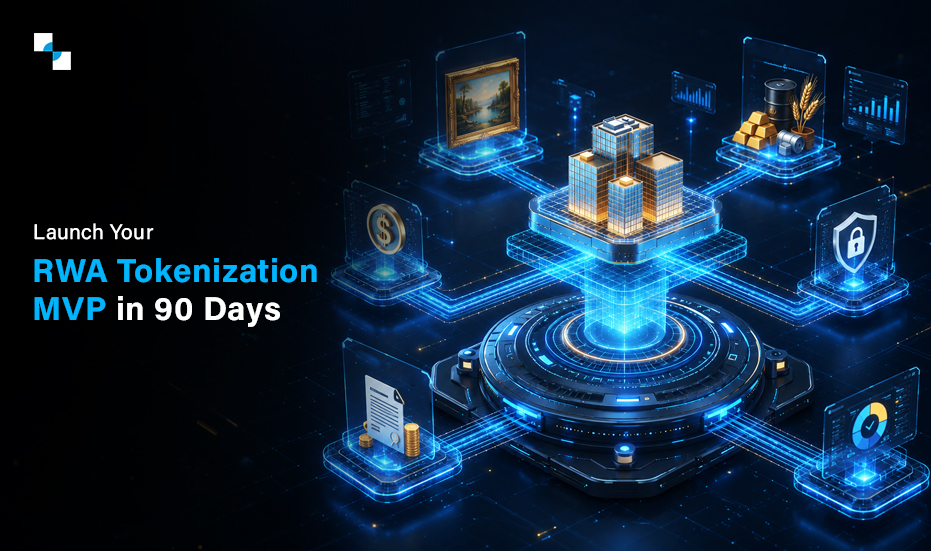
This is why enterprises are increasingly prioritizing a lean yet scalable RWA tokenization MVP strategy before committing to full-scale deployment. A well-structured MVP allows businesses to validate compliance, test investor demand, streamline operational workflows, and establish a scalable tokenization framework within a controlled timeline.
This guide outlines a detailed 90-day roadmap explaining how to build RWA tokenization MVP infrastructure capable of supporting real asset issuance, investor participation, and future institutional scalability.
Why Most RWA Tokenization Projects Fail Before Reaching MVP
The majority of tokenization initiatives fail before launch because businesses underestimate the operational dependencies involved in building regulated digital asset ecosystems. Many startups focus heavily on blockchain deployment while delaying critical decisions related to jurisdictional compliance, investor eligibility, asset custody, and transfer governance. As a result, projects often encounter architectural rebuilds, legal bottlenecks, delayed audits, and fragmented investor experiences midway through development. A specialized RWA development company can help enterprises avoid these execution gaps by aligning technical architecture with legal and asset-layer requirements from the beginning.
The Real Challenge Lies in Coordinating Technology, Compliance, and Asset Strategy
Unlike traditional SaaS platforms, RWA ecosystems operate across interconnected legal, financial, and blockchain environments. Every layer must function cohesively to ensure that tokenized ownership remains enforceable, transferable, and compliant.
Common Reasons Why RWA MVPs Fail
- Undefined asset ownership and governance structure
- Delayed legal and securities compliance validation
- Lack of secondary liquidity planning
- Over-engineered MVP scope and infrastructure
- Weak custody and asset verification mechanisms
- Poor investor onboarding workflows
- Smart contracts developed without compliance automation
- Fragmented coordination between legal and development teams
Critical Operational Challenges Enterprises Face
- Mapping real-world ownership rights onto blockchain logic
- Managing regulated investor participation
- Integrating KYC/AML infrastructure
- Enforcing transfer restrictions across jurisdictions
- Maintaining auditability and reporting transparency
- Building scalable issuance and redemption workflows
Projects that attempt to scale before validating these operational foundations often experience significant delays, increased compliance exposure, and poor investor adoption.
What a “Successful MVP” Looks Like in RWA Tokenization
A successful MVP is not measured by the number of features deployed—it is measured by the platform’s ability to validate the core tokenization business model under real operating conditions. The primary objective is to prove that real-world assets can be securely issued, managed, traded, and monitored through blockchain infrastructure while remaining compliant with regulatory frameworks. Effective Tokenization development services focus on validating functionality, compliance, and investor usability before expanding into larger institutional ecosystems.
Core Characteristics of a Successful RWA MVP
Operational Validation
The platform should successfully handle:
- Asset issuance
- Investor onboarding
- Token transfers
- Ownership tracking
- Reporting workflows
Compliance Readiness
The MVP must support:
- KYC/AML verification
- Whitelisting mechanisms
- Jurisdiction-based access control
- Transfer restrictions
- Investor accreditation checks
Secure Technical Infrastructure
A stable MVP should include:
- Audited smart contracts
- Wallet integration
- Secure custody mechanisms
- Transaction monitoring systems
- Blockchain scalability readiness
Investor Accessibility
The onboarding experience should support:
- Simple registration workflows
- Fiat and crypto payments
- Portfolio visibility
- Secure transaction execution
Scalable Architecture
The infrastructure should allow future integration of:
- Secondary marketplaces
- Institutional custody
- Multi-asset tokenization
- Cross-chain interoperability
- Yield and dividend distribution systems
A lean MVP focused on these operational priorities enables enterprises to validate the market before scaling liquidity and infrastructure investments.
Get a Customized RWA MVP Development Roadmap
Core Building Blocks of an RWA MVP
Building institutional-grade tokenization infrastructure requires a modular architecture where each layer contributes to compliance, asset governance, and investor participation. Enterprises looking to build RWA tokenization platform ecosystems must structure their MVP across five critical layers to ensure long-term scalability and operational resilience.
Asset Layer
The asset layer defines the real-world asset being tokenized and establishes ownership legitimacy.
Key Components
- Asset valuation and due diligence
- Ownership verification
- Custody and reserve management
- Fractionalization structure
- Asset documentation and auditability
Typical Asset Categories
- Real estate
- Commodities
- Treasury products
- Private equity
- Intellectual property assets
This layer determines liquidity potential, investor accessibility, and compliance exposure.
Legal Layer
The legal layer establishes the regulatory enforceability of tokenized ownership.
Core Legal Components
- SPV/entity formation
- Securities compliance mapping
- Investor eligibility frameworks
- Taxation and reporting structures
- KYC/AML implementation
Why This Layer Is Critical
It governs:
- Investor access rules
- Transfer restrictions
- Redemption rights
- Asset ownership enforceability
- Cross-border participation limitations
Without strong legal architecture, even technically advanced platforms remain commercially vulnerable.
Token Layer
The token layer transforms asset ownership into programmable blockchain-based instruments.
Core Tokenization Components
- Token issuance logic
- Ownership tracking
- Compliance automation
- Dividend/yield distribution
- Burn and mint functions
Common Standards Used
- ERC-20
- ERC-3643
- ERC-1400
- ERC-721
This layer forms the programmable backbone of the tokenized asset ecosystem.
Platform Layer
The platform layer delivers the operational interface connecting investors, administrators, and blockchain infrastructure.
Core Platform Features
- Investor dashboards
- Asset issuance modules
- Transaction monitoring
- Reporting and analytics
- Admin management systems
Key Integrations
- Wallet infrastructure
- KYC/AML APIs
- Custody providers
- Fiat payment gateways
- Smart contract deployment systems
Strong RWA MVP development strategies prioritize usability, modularity, and secure transaction execution over excessive feature expansion.
Liquidity Layer
Liquidity determines whether tokenized assets can achieve sustainable investor participation and trading activity.
Key Liquidity Components
- Primary issuance workflows
- Secondary trading readiness
- Transfer restriction engines
- Compliance-based whitelisting
- Redemption mechanisms
Strategic Considerations
Enterprises must define:
- Who can trade assets
- Where transactions occur
- How transfers are monitored
- What restrictions govern liquidity
Liquidity planning should begin during the MVP stage—not after launch.
Week-by-Week Breakdown of the 90-Day MVP Journey
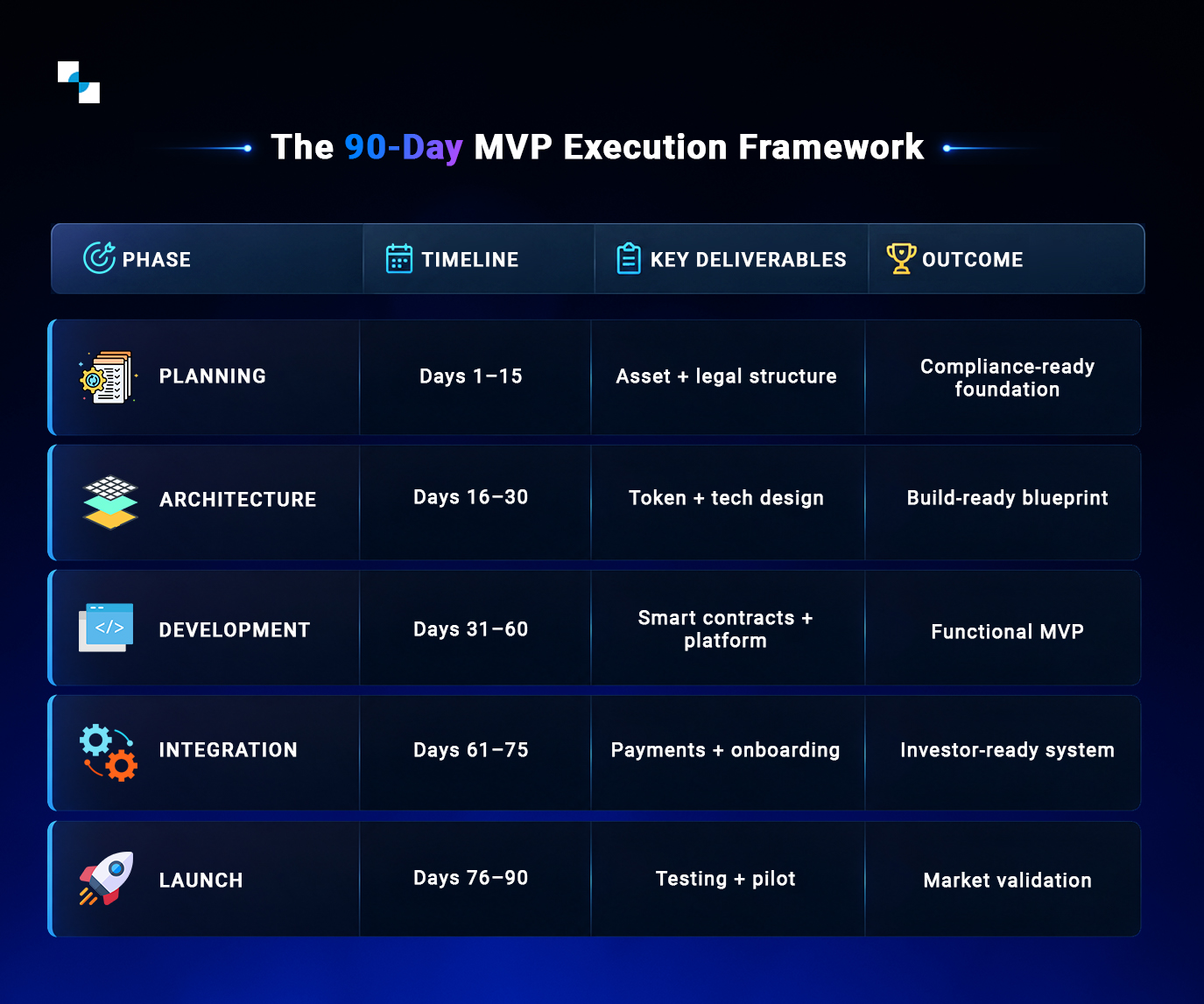
A structured development roadmap significantly reduces operational friction and accelerates market validation. This RWA MVP development roadmap 90 days framework enables founders to prioritize compliance, infrastructure, and investor readiness simultaneously.
Weeks 1–2
Asset Finalization and Legal Structuring
Planning | Days 1–15 | Asset + Legal Structure
The initial phase focuses on establishing the legal and operational foundation of the tokenization ecosystem.
Primary Objectives
- Finalize asset category and valuation
- Conduct ownership verification
- Establish SPV/legal entity structure
- Define securities compliance framework
- Select issuance jurisdiction
Key Deliverables
- Asset documentation
- Legal agreements
- Compliance architecture
- Investor eligibility structure
- Custody planning framework
This stage determines whether the proposed Asset tokenization MVP is commercially and legally viable.
Weeks 3–4
Token Design and Smart Contract Planning
Architecture | Days 16–30 | Token + Tech Design
This phase focuses on designing the token economy and blockchain architecture.
Key Activities
- Select blockchain network
- Define token standards
- Design ownership logic
- Plan compliance automation
- Structure smart contract workflows
Critical Technical Decisions
- Public vs permissioned blockchain
- Fractional ownership structure
- Whitelisting architecture
- Yield distribution model
- Transfer governance rules
Founders building an MVP for asset tokenization startup ecosystems should focus on scalable and modular smart contract design.
Weeks 5–8
Platform Development and Integration
Development | Days 31–60 | Smart Contracts + Platform
This stage focuses on developing the functional MVP infrastructure.
Core Development Priorities
- Investor onboarding system
- Asset issuance dashboard
- Wallet integration
- Transaction management engine
- Reporting infrastructure
Backend Integrations
- KYC/AML APIs
- Payment gateways
- Blockchain deployment systems
- Custody infrastructure
- Analytics and monitoring tools
Strong Tokenization platform development strategies emphasize interoperability, security, and operational efficiency.
Weeks 9–10
Investor Onboarding and Payment Integration
Integration | Days 61–75 | Payments + Onboarding
The platform now becomes operational for controlled investor participation.
Primary Objectives
- Enable investor registration
- Implement KYC/AML verification
- Integrate fiat and crypto payment rails
- Validate transaction workflows
- Test token issuance lifecycle
Key Success Metrics
- Seamless onboarding experience
- Secure payment execution
- Low transaction failure rates
- Real-time portfolio visibility
- Efficient token allocation workflows
At this stage, the MVP begins functioning as a live investment environment.
Weeks 11–12
Testing, Security, and Launch
Launch | Days 76–90 | Testing + Pilot
The final phase validates platform stability, compliance readiness, and launch execution.
Critical Activities
- Smart contract auditing
- Penetration testing
- Compliance verification
- User acceptance testing
- Infrastructure optimization
Launch Readiness Checklist
- Validate investor workflows
- Finalize legal disclosures
- Confirm custody integration
- Monitor transaction stability
- Conduct pilot investor launch
A successful launch demonstrates that the platform is capable of supporting real-world asset issuance under live operating conditions.
Build Institutional-Grade RWA Infrastructure
Launching Scalable RWA Ecosystems Starts with the Right MVP
The future of asset ownership is increasingly becoming programmable, fractionalized, and globally accessible. However, enterprises entering this market cannot afford fragmented execution strategies or prolonged development cycles. A structured MVP approach enables businesses to validate investor demand, ensure compliance readiness, and establish scalable digital asset infrastructure within a controlled timeframe.
Successful tokenization ecosystems are built through the alignment of:
- Legal architecture
- Smart contract infrastructure
- Asset governance frameworks
- Investor onboarding systems
- Liquidity planning mechanisms
As institutional adoption accelerates, enterprises that deploy lean yet scalable MVPs will be better positioned to capitalize on the growing digital asset economy.
With extensive expertise in blockchain engineering, compliance-driven asset frameworks, smart contract development, and enterprise-grade Tokenization development services, Antier helps enterprises accelerate secure and scalable RWA adoption. From designing compliant issuance models to delivering end-to-end RWA MVP development infrastructure, Antier empowers startups, enterprises, and financial innovators to launch future-ready tokenization ecosystems with confidence.
Frequently Asked Questions
01. What is RWA tokenization and why is it important?
RWA tokenization refers to the process of converting real-world assets into programmable digital instruments using blockchain technology, which enhances ownership, liquidity, and capital formation across global markets.
02. What are the main challenges faced by RWA tokenization initiatives?
Many RWA tokenization initiatives struggle due to underestimating operational dependencies, such as legal compliance, investor onboarding, and asset custody, which can lead to project delays and failures before reaching the minimum viable product (MVP) stage.
03. How can enterprises successfully implement an RWA tokenization MVP strategy?
Enterprises can successfully implement an RWA tokenization MVP strategy by prioritizing a lean and scalable approach that validates compliance, tests investor demand, and streamlines operational workflows within a controlled timeline.