




✨ AI Summary
- Mobile gaming is shifting from hypercasual games, characterized by quick launches and ad-driven monetization, to hybrid casual games, which focus on in-depth player engagement.
- As user acquisition costs rise and player expectations change, hybrid games have become more popular.
- These games combine simple mechanics with layered progression systems, allowing for longer gaming sessions and sustained participation.
- This blog post compares the core design, involvement, and revenue strategies of both models, highlighting the clear transition in the gaming industry.
- The post also discusses retention benchmarks in 2026, emphasizing the importance of player retention and engagement for sustainable growth.
Mobile gaming is entering a phase where depth matters as much as reach. For years, hypercasual game development thrived on velocity: rapid launches, minimal mechanics, and ad-driven monetization. That approach built massive portfolios and delivered unprecedented install volumes across global markets.
Today, the same ecosystem reflects a clear transition. As user acquisition costs rise and player expectations evolve, hybrid casual games have gained traction by emphasizing depth of engagement as a key driver of competitive performance.
The market trajectory is clear:
According to market projections by Mordor Intelligence
- Hybrid monetization models are projected to grow at 5.89% CAGR through 2031
- Top-performing hybrid titles generated higher monthly revenue in 2025 versus the prior year
- Android contributes 57% of global ad revenue, while iOS delivers 43% with significantly higher revenue per user
This analysis examines how hybrid games compare with hypercasual benchmarks across retention curves, lifetime value expansion, and revenue performance, while also exploring the monetization strategies shaping sustainable growth in 2026.
Hybrid Casual Games vs Hypercasual: A Comparative View
Let’s get directly into the differences. The comparison below highlights how hypercasual and hybrid casual games vary across core design, involvement, and revenue strategy.
| Dimension | Hypercasual Game Development | Hybrid Casual Games |
|---|---|---|
| Core Design Approach | Focus on instant gameplay and simplicity | Combines simple mechanics with layered progression systems |
| Player Onboarding | Immediate interaction with minimal instruction | Quick entry with gradual introduction of features and depth |
| Gameplay Structure | Single-loop gameplay focused on repetition | Multi-layered loops including core gameplay, progression, and long-term goals |
| Session Behavior | Short, high-frequency sessions | Longer sessions with sustained participation |
| Retention Design | Driven by accessibility and ease of play | Driven by progression, rewards, and player investment |
| Monetization Model | Primarily ad-based (IAA) | Hybrid monetization models combining ads and in-app purchases |
| Revenue Generation | Volume-driven through a large user base | Value-driven through the extended player lifecycle |
| User Acquisition Alignment | Optimized for rapid scale and creative testing | Balanced between acquisition efficiency and user quality |
| Content Evolution | Frequent new titles and iterations | Continuous updates, features, and live operations |
| Player Experience | Focus on quick entertainment cycles | Focus on progression, goals, and engagement continuity |
This comparison highlights how both models operate with distinct priorities, setting the stage for a deeper look at how retention, LTV, and revenue evolve across each approach.
Retention Benchmarks in 2026: What Drives Sustained Engagement
Retention has become one of the clearest indicators of how well a game aligns with player expectations. In 2026, performance is increasingly shaped by how consistently players return, engage, and progress over time.
Recent benchmarks set a clear reference point for scalable growth:
- Day 1 retention typically ranges between 30% and 35%, with leading iOS titles reaching 35% to 40%
- Day 7 retention exceeds 15% to 18% for games that sustain early participation
- Day 30 retention for high-performing hybrid casual games ranges from 5% to 7.5%, reflecting continued player engagement beyond initial sessions.
Another important factor influencing retention is how players distribute their time. Reports from Business Of Apps indicate that social and messaging platforms now account for over 60% of total mobile screen time, which raises the bar for interactive experiences that aim to hold attention across multiple sessions.
Hypercasual formats create strong initial interaction through simplicity and immediacy. This makes them highly effective at onboarding and early participation. Hybrid casual games extend this foundation by introducing systems that encourage players to return and progress over time.
Turn player engagement into scalable long-term revenue and growth.
To understand how retention evolves across these models, it is useful to look at how player behavior and engagement patterns are shaped.
Players engage for immediate interaction as well as for progression, achievement, and continuity. As players return more frequently and engage over longer durations, the opportunity to expand LTV increases.
For a deeper look into hybrid casual game design and monetization, explore the detailed guide.
The next section explores how this shift in retention translates into measurable gains in LTV and revenue.
LTV Across Hypercasual and Hybrid Casual Models: From Engagement to Revenue
Retention creates the conditions for value creation. LTV reflects how effectively player participation translates into revenue across the lifecycle.
In hypercasual formats, value builds through accessibility, quick entry, repeated sessions, and consistent ad exposure. Hybrid casual games extend this by introducing progression and continuity, allowing value to grow across multiple stages of the player journey. In fact, hybrid casual In-App Purchase (IAP) revenue surged by 37% in recent 2026 market tracking, proving the financial viability of this deeper engagement.
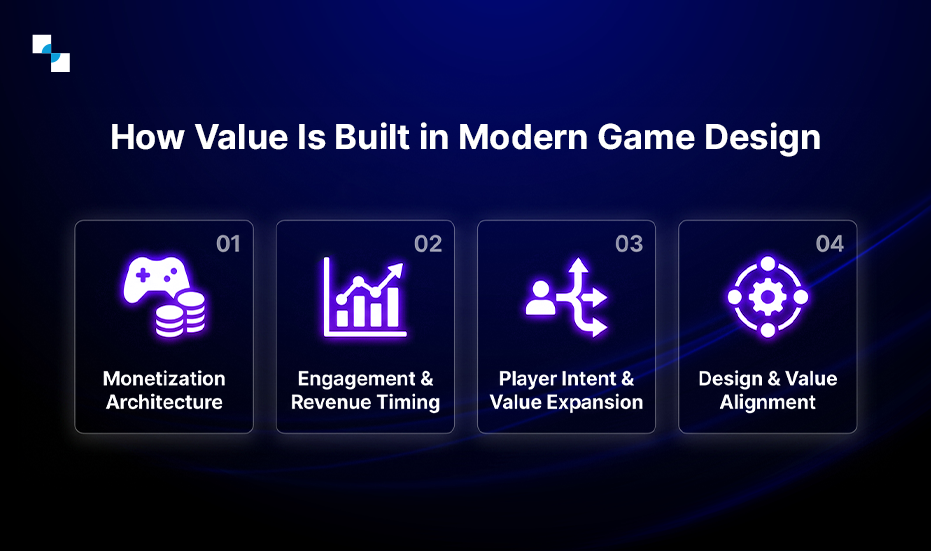
1. Monetization Architecture
The difference between the two models becomes more visible in how value capture is structured.
Hypercasual games rely on a streamlined approach where ad placements are integrated into short gameplay loops. This supports consistent LTV across a broad audience.
Hybrid casual games operate with a broader architecture. Overall industry adoption of this dual In-App Advertising (IAA) and IAP approach has surged to 43%. Revenue architecture is distributed across:
- gameplay progression
- feature unlocks
- customization elements
- optional upgrades
This allows LTV to grow through multiple interaction points rather than within a single loop.
2. Engagement and Revenue Timing
Another distinction lies in how value unfolds over time.
Hypercasual formats generate early LTV through instant interaction. Built around short play cycles (5–10 minutes, ~4 sessions/day), they enable early income generation but face sharp drop-offs, with Day 7 retention around 8–12%.
Hybrid casual games extend this timeline. As players progress, new systems, features, and goals introduce additional opportunities for participation and value exchange. LTV builds progressively as the player journey expands.
3. Player Intent and Value Expansion
Player behavior also shapes how LTV develops.
In hypercasual environments, participation is driven by ease of access and quick interaction, supporting broad participation.
Hybrid casual games deepen involvement through progression and layered gameplay, strengthening the link between player intent and LTV. By 2026, actions per player hit 642.2 (+30% YoY), reflecting this shift.
4. Design and Value Alignment
LTV reflects how closely game design aligns with player behavior.
Hypercasual design prioritizes immediacy and repetition. Hybrid casual design introduces structure, continuity, and progression.
Both approaches operate effectively within their respective frameworks. Hybrid models extend LTV potential by aligning participation with longer gameplay cycles.
As LTV evolves across these models, user acquisition strategies align more closely with usage depth and lifecycle potential.
User Acquisition Economics in 2026: CPI, ROAS, and Value Alignment
Revenue in the mobile games market worldwide is projected to reach US$134.22bn in 2026, and performance is increasingly shaped by how effectively player activity translates into long-term value.
Earlier approaches focused on maximizing installs through creative scale and rapid testing. Today, acquisition strategies are more closely aligned with retention patterns and value generation across the player lifecycle.
- Cost Per Install & Value Expectations
Cost per install reflects the entry point of a player into the ecosystem. Variations across game formats influence how acquisition strategies are structured.
Hypercasual games typically operate with lower acquisition costs, supported by simple gameplay and broad audience appeal. This allows for rapid scaling across large user segments.
Hybrid casual games operate within a wider cost range, facing noticeably higher CPI averages, typically $2.50–$6.00 in Tier 1 markets (such as the US and UK) and $0.80–$2.50 in Tier 2/3 markets. However, developers offset these upfront acquisition costs by structuring diverse commercialization avenues. The expanded LTV comfortably absorbs the higher acquisition spend by integrating tiered IAPs, battle passes, and high-value rewarded video placements alongside standard interstitial ads. This creates a stronger connection between acquisition investment and long-term value generation, making the Return on Ad Spend (ROAS) highly sustainable over a 30- to 90-day window.
- Return on Ad Spend & Performance Signals
Return on ad spend reflects how efficiently acquisition converts into revenue over time. Performance trends show that platforms and player behavior influence outcomes:
- iOS environments tend to generate higher revenue per user
- Android environments support scale and a broader reach.
Hybrid casual models align with both environments by combining scalable acquisition with richer interaction depth. These titles achieve superior Day 7 retention (16%) compared to traditional hyper-casual games. By layering IAP over ads, hybrid-puzzles and similar sub-genres have seen market share surges of over 240% in high-intent markets like the US.
- Creative Strategy & User Quality
Creative strategy plays a central role in acquisition performance. In 2026, creative cycles are faster, with shorter lifespans across competitive markets. High-performing creatives closely match gameplay to ensure user alignment. Leading studios now produce around 123 creatives per month, with 58% being new assets to counter ad fatigue.
In 2026, creative cycles move rapidly, with shorter lifespans across competitive markets. High-performing creatives align closely with actual gameplay, ensuring that acquired users match the intended experience.
Hypercasual formats benefit from rapid creative iteration and broad appeal. Hybrid casual games extend this by attracting users who engage with progression systems and longer gameplay cycles.
- Aligning Acquisition with Engagement Depth
The relationship between acquisition and player interaction has become more tightly integrated.
When acquisition aligns with gameplay depth and retention systems, it supports:
- More predictable player behavior trends
- Stronger revenue optimization opportunities
- Improved efficiency across the player lifecycle.
Benchmark your game against the top 2026 performance metrics today.
Top 5 Hypercasual and Hybrid Casual Games
The following titles highlight how gameplay structure and engagement systems are applied across both formats to understand how these models operate in practice:
Top 5 Hypercasual Games (2026)
| Game | Core Gameplay | Engagement Pattern |
|---|---|---|
| Block Blast! | Puzzle-based logic gameplay | Fast, repeatable sessions with instant feedback |
| Pizza Ready! | Idle/tycoon simulation | Continuous interaction through accumulation loops |
| Subway Surfers City | Endless runner with objectives | Short sessions with light progression |
| Block Crush! | Block-matching gameplay | Broad accessibility with quick play cycles |
| Jigsolitaire | Mixed puzzle and card mechanics | Retention driven by novelty and variation |
Top 5 Hybrid Casual Games (2026)
| Game | Core Gameplay | Engagement Pattern |
|---|---|---|
| Monopoly GO! | Social board gameplay with events | Event-led loops & social competition |
| Last War: Survival | Shooter combined with strategy systems | Layered systems, deeper progression |
| Whiteout Survival | Survival and resource management | Long-cycle retention design |
| Gossip Harbor | Merge gameplay with narrative | Story-led across sessions |
| Royal Kingdom | Match-3 with competitive elements | Progression combined with competitive play |
These titles reflect how different design approaches shape player behavior patterns and value creation across the lifecycle. What stands out is not the genre, but how each system is structured to build value over time.
From event-led competition to progression depth and narrative continuity, each model creates a distinct pathway from first interaction to sustained value capture. This is where the shift becomes clear. And where the strategic differences start to matter.
Strategic Takeaways for 2026
- If your UA is scaling but revenue is not, your early gameplay is misaligned with LTV drivers: Fix onboarding to qualify high-intent players, not just maximize installs.
- Hybrid is not a format shift; it is a revenue architecture: Use hypercasual loops to acquire cheaply, then convert through layered progression that builds spend intent over time.
- Monetization timing defines player quality: Pushing ads or IAP too early caps long-term value, while delayed, progression-linked triggers increase ARPDAU and payer depth.
- Retention comes from system design, not features: Events, progression, rewards, and social loops must reinforce each other to sustain return behavior at scale.
- Your UA creatives are already shaping your product outcomes: If creatives promise speed but gameplay demands depth, expect high churn and low LTV. Alignment is non-negotiable.
- Complexity only works when it compounds value: Every new layer should increase player commitment and monetization potential; it becomes friction.
In 2026, performance will not be won by the cheapest installs or the highest short-term returns. It will be won by how well acquisition, design, and profit model reinforce each other across the player lifecycle. That is where long-term value is created and captured.
Wrapping up
Mobile gaming in 2026 is defined by how effectively games connect accessibility with sustained player retention. Hypercasual and hybrid casual models continue to operate across the ecosystem, each aligned with different design priorities and player behaviors. As interaction systems evolve, progression, continuity, and monetization increasingly work together to support consistent performance across the player journey. This creates a clearer direction for teams building or scaling games.
Across hypercasual and hybrid models, combining accessible gameplay with structured progression systems supports deeper player investment and sustained value creation. For teams looking to translate these principles into scalable game experiences, Antier, a renowned hybrid and hyper casual game development company, offers expertise in designing and developing solutions aligned with modern engagement and revenue architecture approaches.
Frequently Asked Questions
01. What is the main difference between hypercasual and hybrid casual games?
Hypercasual games focus on instant gameplay and simplicity, while hybrid casual games combine simple mechanics with layered progression systems, offering deeper engagement.
02. How are monetization strategies different between hypercasual and hybrid casual games?
Hypercasual games primarily rely on ad-based monetization, whereas hybrid casual games utilize a hybrid model that combines ads with in-app purchases for revenue generation.
03. What trends are projected for hybrid monetization models in the coming years?
Hybrid monetization models are projected to grow at a CAGR of 5.89% through 2031, indicating a shift towards more sustainable revenue strategies in the gaming industry.