


✨ AI Summary
- The blog post discusses the rising interest in Real World Assets (RWA) in the cryptocurrency sector.
- The author clarifies the difference between Tokenized RWAs and RWA Perpetuals, two fundamentally different products often mistaken as variations of the same offering.
- Tokenized RWAs are blockchain-issued tokens that represent ownership rights to real-world assets, while RWA Perpetuals are synthetic instruments that offer price exposure to underlying assets without altering ownership.
- The post emphasizes the importance for exchange development teams to understand the distinctions between the two, as they cater to different user needs and risk profiles.
- The author further breaks down the architectural requirements for building exchanges for both RWA products and highlights the Oracle challenges faced in RWA Perpetuals exchange development.
RWA, like AI, is something that everyone’s building, but only a few are actually clear about what they’re building.
The real world asset narrative has become one of the most crowded spaces in crypto infrastructure. Cryptocurrency exchanges are rushing to offer RWA products, and investors are asking for RWA exposure. But the commonly used catch-all terms blur the lines between the tokenized RWAs and RWA perpetuals, which are fundamentally
- different products
- built on a different infrastructure
- serving users with entirely different needs and risk profiles
The assumption that these two can be treated as a variation of the same offering is where most crypto exchange development teams go wrong. The architecture decisions, user acquisition strategy, oracle design, and compliance posture vary significantly for the two. The exchange development teams that build without a focused strategy and clear vision will likely execute neither efficiently.
This post constitutes the infrastructure realities, cost and benefit picture, Oracle challenges, etc., for product leads deciding which path to take to tap into the burning RWA demand.
What Tokenized RWAs and RWA Perps Actually Are
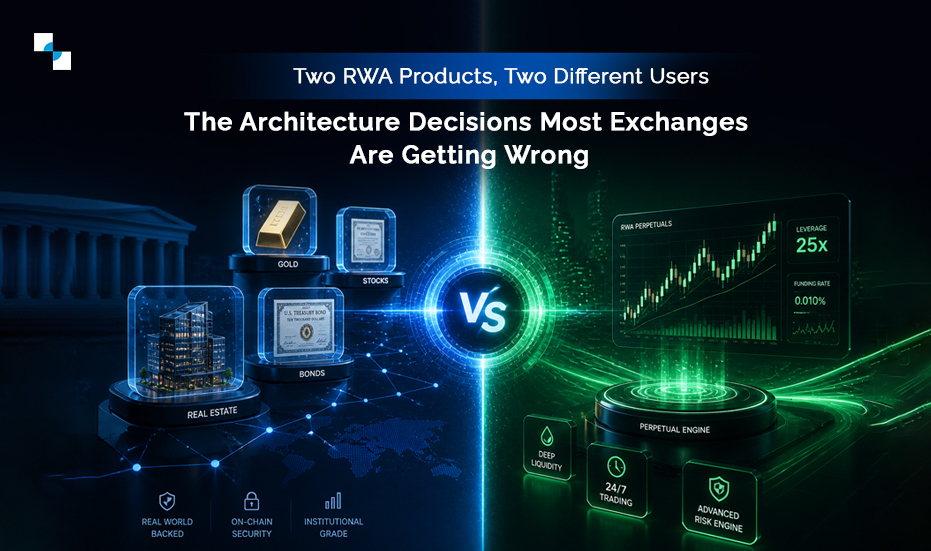
Tokenized RWAs are digital tokens issued on a blockchain that represent ownership and contractual rights to bonds, fund units, real estate, or a commodity. These blockchained real world assets can be managed and traded on a digital ledger. The product is yield-generated and intended for users who want regulated, institutional-grade exposure to the asset and blockchain-enabled settlement.
RWA perpetuals, by contrast, are synthetic instruments offering exposure to the price of the underlying asset without altering its ownership. The trader gains directional, leveraged exposure to the price of gold, oil, a stock, an index, or an FX pair, without owning the asset. There is no expiry date, no delivery mechanism, and no KYC required for permissionless perpetual futures trading platforms. The product is built for speculation, hedging, and 24/7 access.
Before launching any of the RWA products on a crypto exchange software, development teams and cryptopreneurs must understand the difference between the two.
| Dimension | Tokenized RWAs | RWA Perpetuals |
|---|---|---|
| Asset ownership | Direct or indirect claim on the underlying asset | No ownership, synthetic price exposure only |
| Settlement mechanism | On-chain settlement of real asset ownership; often T+0 vs traditional T+2 | Continuous mark-to-market; no physical or cash settlement of underlying |
| Custody model | Custodian holds the underlying asset; the token represents a claim | Self-custodial; collateral held in a smart contract |
| Access model | Permissioned; KYC/AML required; often jurisdiction-restricted | Permissionless; wallet connection sufficient for most perpetual DEX platforms |
| Regulatory profile | High securities law, custody regulation, and transfer restrictions | Low to moderate; varies by jurisdiction; derivative rules may apply |
| Leverage availability | Typically, none; long-only fractional ownership | Core feature; 2x to 50x+ depending on platform |
| Market hours | Constrained by the underlying asset market hours for pricing | 24/7; core value proposition, enabled by Oracle design |
| User intent | Yield, diversification, institutional portfolio allocation | Directional trading, macro hedging, leveraged speculation |
| Infrastructure complexity | Compliance layer, custody integration, smart contract standards, legal wrappers | Oracle design, liquidation engine, funding rate mechanism, 24/7 uptime |
| Typical user profile | Asset managers, hedge funds, institutional allocators, and accredited investors | Retail traders, crypto-native speculators, and non-crypto users seeking macro exposure |
| Revenue model for exchange | Management fees, spread, issuance fees, AUM-based revenue | Trading fees, funding rate capture, and liquidation fees |
| Time to revenue | Slower; compliance build-out, institutional sales cycles | Faster; retail onboarding, volume-driven, immediate fee generation |
RWA perpetuals and tokenized RWAs can be traded on a cryptocurrency exchange, but the crypto exchange developers must be aware of the ICPs they’re building for.
Two Products, Two Completely Different Target ICPs
The institutional user accessing tokenized RWAs comes from a world of intermediaries and compliance departments that invest as per their quarterly reporting cycles. They understand custody risk, want yield, and will accept friction arising from KYC queues, jurisdiction checks, accreditation verification, etc., if the product fits their criteria. The user is primarily here for faster settlement, programmable compliance, and fractional access to the previously illiquid assets.
The retail user, drawn to RWA perps, has an entirely different calculus. They may have never held a traditional brokerage account, but are very familiar with self-custody and liquidation mechanics in crypto trading. They won’t wait for traditional markets to open and would require instant exposure to macro assets such as gold or oil during a geopolitical shock or supply disruption. Permissionless access and 24/7 availability are the most critical features for these users.
The critical mistakes that crypto exchange development teams make here include:
- Building a unified onboarding flow
- A shared liquidity pool
- A single compliance posture
For both the RWA products and user types. This shakes institutional users’ trust in the tokenized RWA trading platform since they find it underpowered. The retail user also faces heavy compliance obligations during the onboarding process and therefore finds the RWA perps inaccessible.
The crypto exchange software, therefore, ends up with two audiences, each partially served and never retained.
The Architectural Requirements Behind Building RWA Perpetual and Tokenized RWA Exchanges
Tokenized RWA Trading Infrastructure
Tokenized RWA exchange development requires putting together a compliance stack before writing even a single line of smart contract. Crypto exchange software development teams need
- a custody integration with a regulated custodian
- a KYC/AML provider
- a legal wrapper that connects the token to the RWA ownership claim
- smart contracts that enforce transfer restrictions across jurisdictions
Standards like ERC-1400 or ERC-3643 are commonly used for permissioned token behavior.
Apart from the above requirements, the ongoing maintenance burden for RWA exchange development is quite significant. Cryptocurrency exchange software that tokenizes RWAs cannot overlook regulatory reporting, whitelist management, jurisdictional updates, and constant coordination with custodians.
RWA perpetuals trading infrastructure
RWA perpetual exchange development requires a different stack with the following core components:
- An oracle system at its core that prices traditional assets around the clock.
- a liquidation engine that acts on stale or gapped prices without destroying user collateral
- a funding rate mechanism that keeps the RWA perpetual price anchored to the underlying asset
- a simpler smart contract layer from a compliance perspective, but complex in terms of real-time accuracy and uptime guarantees.
In RWA perpetual exchange development, the oracle problem is the hardest to decode.
What Are the Oracle-Related Challenges For RWA Perpetuals Exchange Development?
1. After-Hours Pricing Gaps
Traditional price feeds assume markets are open when you need a price. For crypto assets, this is trivially satisfied since markets never close. For traditional assets like gold, crude oil, equity indices, and FX pairs, whose markets operate 08:00-21:00 UTC Monday to Friday, the assumption breaks immediately since there is no live regulated reference price. Oracle must construct a defensible mark price by aggregating available data, including OTC quotes, futures premiums, related instrument spreads, etc., during such times, or the entire product collapses. A poor implementation here creates arbitrage opportunities against your liquidity providers and exposes users to unfair liquidations.
2. Futures Roll Management
Commodity perpetual like crude oil, or Brent reference futures contracts that expire. When the front-month contract rolls to the next, the reference price jumps discontinuously. The oracle must be able to manage roll timing, basis adjustments, and the transition between contract months without creating a liquidation cascade or a funding rate spike.
3. Opening Gap Risk
Traditional markets open with gaps when significant news has broken overnight. A gold perpetual trading at $2400 on your crypto exchange software at market close may open at $2,450 in the morning. Positions that were solvent at midnight might change drastically at 9:31 am in the morning. The liquidation engine must handle this scenario without wiping out users who had an adequate margin for normal market conditions.
How Are Leading RWA Platforms Addressing Oracle-Related Challenges With RWA Perps Offerings
1. Ostium+ Stork Network
Uses a custom oracle that aggregates market data and bid/ask spreads and publishes the prices on-chain only at trade execution. This minimizes gas spend and reduces the attack surface for oracle manipulation. Liquidations and limit orders are handled by an automated execution layer known as Gelato functions. The users, in this pricing mechanism, can model their liquidation risk with reasonable confidence even during the after-hours periods.
2. Trade.xyz-Dual Mode
This mechanism operates with two oracle modes. One of them is for open market hours that uses live regulated feeds, while the other is for closed market hours that uses a constructed reference price. Both models feed into the funding rate calculation and mark price, based on what’s continuously available. This ensures that the platform never goes into a reduced-functionality state. The tradeoff is that the closed-market oracle introduces more basis risk and requires sophisticated users to understand the price regime they’re operating in.
If you’re building an RWA perpetual crypto exchange for retail traders, you don’t need to build oracle infra from scratch. You just need to understand it well enough to
- Evaluate what you’re integrating into your cryptocurrency exchange software
- Negotiate SLAs with Oracle providers
- Make an informed choice between capital security and continuous availability
That decision shapes the entire product architecture and your risk disclosures. The oracle challenges will, however, disappear as NYSE and ICE move towards their 24/7 regulated market execution.
Tokenized RWAs Vs RWA Perpetuals: Cost and Benefit Analysis For Builders
| Category | Tokenized RWAs | RWA Perpetuals |
|---|---|---|
| Build costs : | ||
| Infrastructure | Regulated custodian integration and legal structuring | Oracle integration and custom feed configuration |
| Compliance | KYC/AML provider and compliance infrastructure | Smart contract audits since perps carry a higher exploit surface |
| Smart contracts | Permissioned token standards (ERC-1400, ERC-3643); two audit rounds minimum | Liquidation engine development and stress testing; funding rate mechanism design |
| Legal | Jurisdictional legal opinions per target market | Regulatory counsel on derivatives classification per jurisdiction |
| Ops infrastructure | Whitelist and transfer restriction tooling | 24/7 uptime infrastructure, alerting, and on-call engineering setup |
| Ongoing costs : | ||
| Compliance ops | KYC/AML renewal, monitoring, and regulatory reporting cycles | Continuous parameter tuning — funding rates, margin tiers, insurance fund |
| Third-party fees | Custodian fees, typically AUM-based and recurring | Oracle feed SLAs and provider maintenance contracts |
| Market ops | Whitelist and transfer restriction maintenance as the user base grows | Market maker incentive programs and after-hours risk management |
| Legal | Ongoing legal counsel as regulations evolve across jurisdictions | Evolving derivatives regulation, monitoring, and adaptation |
| Benefits : | ||
| Revenue profile | Higher ACV per institutional client; management fees and spread revenue | High trading volume with immediate fee and funding rate revenue |
| User scale | Smaller addressable market — thousands of qualified institutional users | Retail scale; millions of potential users globally, including non-crypto natives |
| Revenue stability | Lower volatility; yield products are sticky, AUM-based fees are predictable | Volume-driven; high upside during macro events, variable during quiet periods |
| Strategic value | Regulatory goodwill, license defensibility, and institutional distribution access | First-mover window before regulated 24/7 markets from NYSE/ICE closes the gap |
| Time to revenue | Slower since institutional sales cycles are long; 12–18 months is realistic | Faster, as retail onboarding is immediate; fee revenue starts with the first trade |
Picking Your RWA Strategy: A Checklist For Crypto Exchange Development Teams
Before committing to your crypto exchange software development roadmap, work through these four questions:
- Who Are You Primarily Building For?
As stated earlier:
- If your target audience is institutional allocators and asset managers, tokenized RWAs align with their compliance expectations and yield requirements.
- If your target is retail traders and crypto-native speculators, RWA perps offer the leverage and 24/7 access they are looking for.
If the answer is “both,” you must define the primary user first, and the secondary product can follow once the core crypto exchange software is built well for the primary users.
- What Is Your Compliance Appetite and Jurisdiction?
Tokenized RWAs require sustained legal investment across every jurisdiction you serve. For that case:
- Do you have in-house counsel or an established legal partner?
- Do you have clarity on your regulatory status in target markets?
If the answer is no, the compliance overhead of tokenized RWAs may delay your cryptocurrency exchange software launch by 12-18 months.
RWA perps on permissionless infrastructure carry lower regulatory friction, but the regulatory landscape around RWA perps is evolving. So, anyone must build with regulatory optionality and changes in mind.
- Whether to build or integrate Oracle, Liquidation, and Custody?
For RWA perps exchange software development:
- Do you have an Oracle provider evaluated and contracted?
- Have you stress-tested your liquidation engine against opening gap scenarios and futures roll events?
For tokenized RWA exchange development:
- Do you have a custodian partner confirmed and a smart contract standard selected?
Building from scratch in either category adds 6-12 months to the crypto exchange development timeline. Integrating oracles requires deep evaluation of what you are integrating, since not all providers handle after-hours pricing with equal competence.
- Are You Building To Compliment TradFi or Offering Permissionless-First Replacement?
Tokenized RWAs are most coherent as a complement to traditional finance since they offer faster settlement, programmable compliance, and fractional access, which is a great add-on to tradFi services.
RWA perps are most coherent as a replacement for users who are excluded from or underserved by traditional derivatives markets.
Knowing which thesis you are following for your crypto exchange development changes your go-to-market, your partnership strategy, and your messaging to users and investors.
Your RWA Strategy Is Ultimately A User Strategy
The perpification of real-world assets is not a niche trend. HIP-3 markets have already exceeded $10 billion in cumulative volume as of December 2025. By 2026, the cumulative volumes had reached $25 billion, with the user base reaching 1.4 million active users, and open interest hitting ATHs of $1.2 billion in March 2026. The infrastructure is maturing, the demand is skyrocketing, and the user base is expanding beyond web3 geeks.
Just before the NYSE and ICE build their 24/7 markets, your RWA exchange still has a chance to grab the competitive advantage. With a differentiated yet targeted RWA-perps or tokenized RWA exchange development approach, you can win.
At Antier, our team works with crypto exchange developers on oracle evaluation, architecture design, and go-to-market strategy.
Get in touch today!