




✨ AI Summary
- Businesses are shifting focus from efficiency to execution, realizing the limitations of automation in handling complexity and real-time decision-making.
- The OpenClaw platform introduces a breakthrough in AI execution systems, moving beyond workflow automation to intelligently executing, adapting, and optimizing entire business operations.
- OpenClaw operates as a dynamic execution layer, translating high-level business goals into actionable workflows and continuously learning to optimize outcomes.
- Its core philosophy focuses on automating outcomes, not just tasks, aligning execution with business objectives.
- By leveraging AI agents and intelligent decision-making, OpenClaw transforms sales, customer support, marketing, operations, finance, and HR functions into autonomous, outcome-driven operations.
For more than a decade, businesses have invested heavily in business process automation AI to improve efficiency and streamline operations. But today, a bigger problem has emerged execution. According to McKinsey & Company, more than 50% of organizations have already adopted AI in at least one business function. This highlights how rapidly enterprises are moving toward AI-driven operations.
From CRM systems to advanced enterprise AI tools, the focus has always been on optimizing workflows. However, as organizations scale, a critical limitation becomes clear – automation alone cannot handle complexity, unpredictability, and real-time decision-making.
In 2026, the competitive advantage has shifted from efficiency to execution. Businesses no longer struggle with speed; they struggle with consistently achieving the right outcomes. This is where the OpenClaw platform emerges as a breakthrough – introducing AI execution systems like OpenClaw that don’t just automate tasks but intelligently execute, adapt, and continuously optimize entire business operations.
Source link:
https://www.mckinsey.com/capabilities/quantumblack/our-insights/the-state-of-ai
OpenClaw Platform Explained: The Engine Behind Autonomous Business Execution
The OpenClaw platform represents a fundamental shift in how modern enterprises operate. It is not just another addition to the landscape of enterprise AI tools similar to OpenClaw; it is an intelligent execution system designed to run business operations autonomously.
While most AI workflow automation tools for finance teams and marketing platforms depend on predefined rules and static workflows, OpenClaw operates as a dynamic execution layer that sits across your entire organization. It doesn’t just automate processes; it understands objectives, makes decisions, and drives outcomes in real time.
Core Capabilities of OpenClaw AI Workflow Capabilities
- Translates high-level business goals into fully executable, multi-step workflows
- Deploys advanced AI agent development services for business to manage and execute operations autonomously
- Integrates seamlessly across enterprise systems, eliminating data silos
- Continuously learns from performance data to optimize and improve outcomes
What Makes OpenClaw Fundamentally Different
- Traditional automation → Executes predefined tasks
- AI copilots → Assist human decision-making
- OpenClaw → Owns execution and delivers outcomes
This evolution marks the rise of intelligent business operations software for enterprises, where businesses no longer manage workflows; they orchestrate results through AI-driven execution.
Why Traditional Business Process Automation AI Falls Short ?
Even the most advanced AI automation tools for customer support workflows face structural limitations:
1. Static Rule Dependency
Automation relies on predefined triggers, making it ineffective in dynamic environments.
2. Siloed Systems
Modern organizations operate across disconnected tools, creating inefficiencies and delays.
3. Lack of Strategic Intelligence
Traditional systems execute instructions but lack the ability to interpret intent or optimize outcomes.
4. Continuous Human Oversight
Businesses still depend heavily on human intervention for monitoring, corrections, and decisions.
This is why many organizations experience automation fatigue; they have tools, but not true operational transformation.
OpenClaw’s Core Philosophy: Automating Outcomes, Not Tasks
The defining innovation of the OpenClaw platform lies in its outcome-first approach. Instead of focusing on individual activities, OpenClaw aligns execution with business objectives.
Traditional Approach
- Execute predefined steps
- Focus on task completion
- Measure efficiency
OpenClaw Approach
- Define desired outcomes
- Execute adaptive strategies
- Measure business impact
This approach is at the heart of AI execution systems like OpenClaw and signals the future of AI-powered workflows.
Want to See How OpenClaw Can Run Your Business Workflows?
Deep Dive: How OpenClaw Actually Works ?
To understand the real power of the OpenClaw platform, it’s essential to explore the architecture that enables it to move beyond traditional enterprise AI tools. OpenClaw is built as an intelligent execution system, where multiple layers work together to interpret goals, make decisions, execute workflows, and continuously improve outcomes.
1. AI Agent Layer: Autonomous Digital Workforce
At the core of OpenClaw are advanced AI agents for business that function as a self-operating digital workforce. These agents are designed to take ownership of business objectives rather than simply executing instructions.
They begin by interpreting high-level goals, such as improving conversion rates or reducing operational delays, and then break them down into structured, multi-step workflows. From there, they coordinate actions across different tools, teams, and systems to ensure seamless execution. As conditions change, these agents continuously adjust their strategies in real time.
This layer enables businesses to shift from manual oversight to AI-driven execution powered by digital workforce AI.
2. Context & Intelligence Engine: Real-Time Decision Core
The Context and Intelligence Engine acts as the decision-making core of OpenClaw, ensuring that every action is guided by data, context, and business objectives. It brings together multiple data streams to create a unified understanding of the operating environment.
This includes analyzing historical performance trends, real-time behavioral signals, market dynamics, and customer interactions across channels. By combining these inputs, the system can evaluate what actions will generate the best outcomes in any given moment.
Unlike traditional systems that rely on static rules, this layer enables context-aware, adaptive decision-making, making OpenClaw a true AI execution system.
3. Execution Engine: Dynamic Workflow Orchestration
The Execution Engine is responsible for translating decisions into real-time actions across the organization. It ensures that strategies created by the intelligence layer are executed efficiently and accurately.
This involves triggering workflows, managing communication between platforms such as CRM, ERP, marketing, and analytics systems, and executing tasks across multiple environments simultaneously. The engine operates with high precision, ensuring that all systems remain synchronized.
What sets it apart from traditional business process automation AI is its ability to dynamically adjust execution based on performance data, ensuring that workflows remain aligned with desired outcomes.
4. Continuous Learning Loop: Self-Optimizing Intelligence
The Continuous Learning Loop ensures that OpenClaw evolves and improves with every action it takes. Instead of operating on fixed logic, the system continuously refines its performance through feedback and analysis.
It evaluates outcomes against expected results, identifies patterns in performance, and uncovers opportunities for optimization. These insights are then used to enhance future decision-making and execution strategies.
Over time, this creates a system that becomes increasingly accurate, efficient, and aligned with business goals. This layer is what enables self-improving intelligent business operations, a key characteristic of modern intelligent business operations software for enterprises.
How It All Comes Together
Each of these layers works in harmony to create a unified system where decisions, execution, and learning are tightly integrated. The AI agents drive action, the intelligence engine guides decisions, the execution engine delivers results, and the learning loop ensures continuous improvement.
Together, they form a powerful AI execution system like OpenClaw; one that doesn’t just automate workflows but actively runs, adapts, and optimizes business operations in real time.
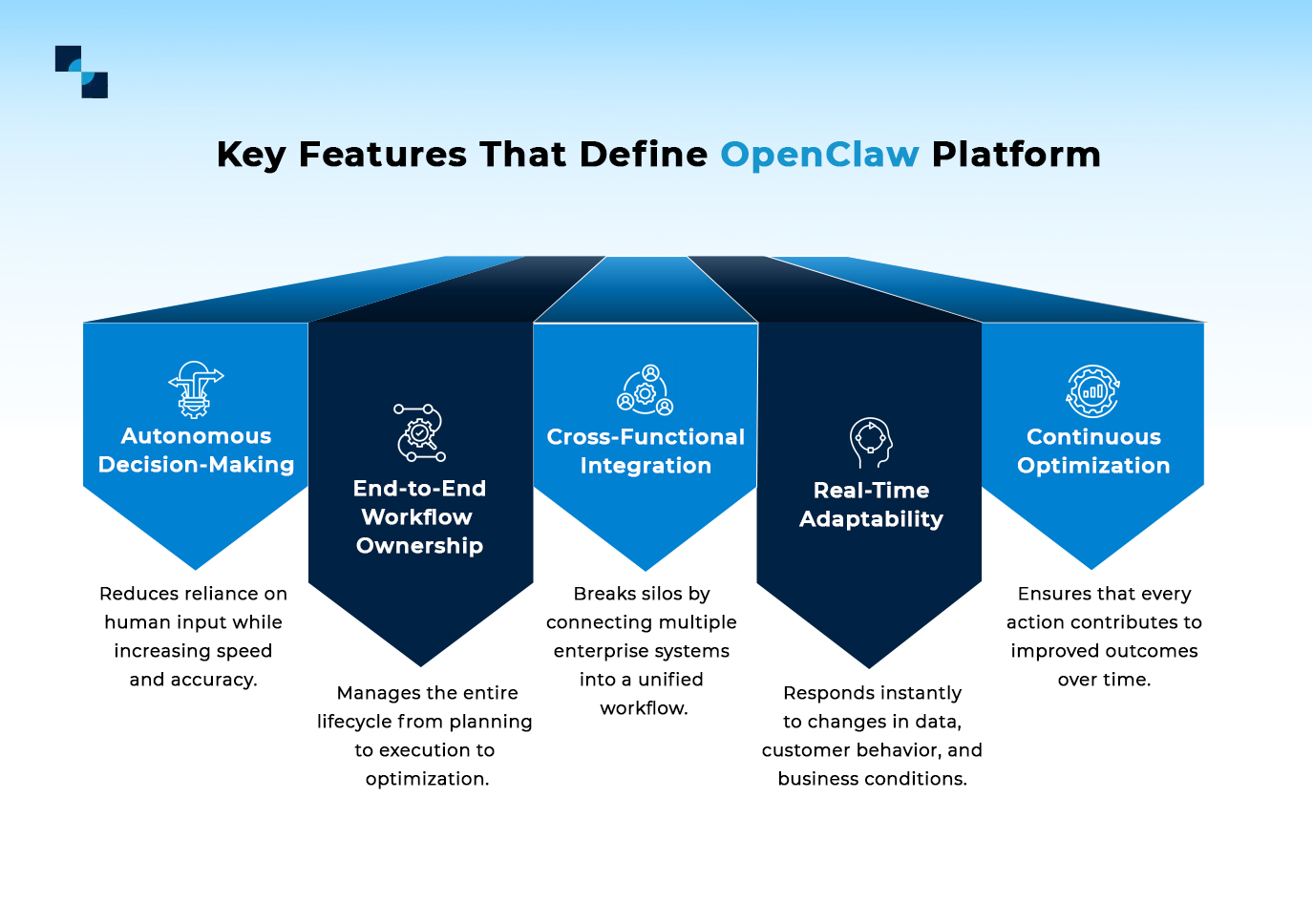
Key Features That Define OpenClaw Platform
1. Autonomous Decision-Making
Reduces reliance on human input while increasing speed and accuracy.
2. End-to-End Workflow Ownership
Manages the entire lifecycle from planning to execution to optimization.
3. Cross-Functional Integration
Breaks silos by connecting multiple enterprise systems into a unified workflow.
4. Real-Time Adaptability
Responds instantly to changes in data, customer behavior, and business conditions.
5. Continuous Optimization
Ensures that every action contributes to improved outcomes over time.
 Real-World Use Cases of OpenClaw
 Real-World Use Cases of OpenClaw
The true power of the OpenClaw platform lies in its ability to transform how different business functions operate. By leveraging AI execution systems like OpenClaw and advanced AI agents for business, organizations can move from fragmented workflows to fully autonomous, outcome-driven operations.
1. Sales: Autonomous Revenue Execution Systems
OpenClaw redefines sales by turning traditional pipelines into autonomous revenue engines powered by AI business automation.
It analyzes behavioral data, historical interactions, and intent signals to automatically qualify leads with high precision. The platform then personalizes outreach at scale, tailoring messaging based on customer profiles and engagement patterns. It also manages follow-ups intelligently, ensuring no opportunity is missed.
Most importantly, OpenClaw continuously optimizes deal strategies by learning what drives conversions, enabling sales teams to close deals faster and more efficiently.
2. Customer Support: Intelligent Experience Automation
With AI automation tools for customer support workflows, OpenClaw shifts support from reactive to proactive and intelligent.
It enables instant query resolution by understanding customer intent and context in real time. For complex issues, it uses smart escalation logic to route queries to the right agents or systems without delays. Responses are not just automated but personalized, improving customer satisfaction and engagement.
Over time, the system learns from interactions, reducing resolution time and creating a more seamless and consistent support experience.
3. Marketing: Self-Optimizing Growth Engines
OpenClaw transforms marketing into a continuous, self-optimizing system rather than a campaign-based function.
Using real-time data and performance insights, it dynamically adjusts campaigns across channels to maximize impact. It refines audience targeting by identifying high-intent segments and reallocating resources accordingly. Messaging and creatives are continuously optimized based on engagement patterns.
This results in improved ROI, better customer acquisition strategies, and a marketing function that evolves automatically through AI-powered workflows.
4. Operations: Autonomous Process Orchestration
In operations, OpenClaw acts as a centralized execution layer that eliminates inefficiencies caused by disconnected systems.
It automates routine processes such as approvals, task assignments, and workflow coordination across departments. By integrating multiple enterprise tools, it ensures smooth communication and execution without manual intervention.
This reduces delays, minimizes errors, and creates a more agile operational environment, making it a powerful solution for intelligent business operations software for enterprises.
5. Finance: Intelligent Workflow Automation
For finance teams, OpenClaw enhances traditional AI workflow automation tools for finance teams by introducing intelligence and adaptability.
It automates processes like invoice handling, approvals, compliance checks, and financial reporting with high accuracy. The system continuously monitors transactions and identifies anomalies or risks in real time.
By reducing manual effort and improving accuracy, OpenClaw enables finance teams to focus on strategic planning while maintaining strong control over financial operations.
6. HR & Talent Management: Smart Workforce Operations
OpenClaw extends its capabilities to HR by enabling intelligent workforce management through automation and AI-driven insights.
It streamlines recruitment by screening candidates, scheduling interviews, and managing communication. Employee onboarding and internal workflows are automated to ensure consistency and efficiency.
Additionally, it analyzes employee data to improve engagement, retention, and performance strategies, creating a more responsive and data-driven HR function.
OpenClaw vs Traditional Enterprise AI Tools
| Feature | Traditional Tools | OpenClaw Platform |
| Execution | Task-based | Outcome-driven |
| Intelligence | Rule-based | Context-aware |
| Adaptability | Limited | Real-time |
| Role | Assistant | Autonomous operator |
| Impact | Efficiency | Business transformation |
Business Impact: Measurable Transformation
Organizations adopting OpenClaw for intelligent business operations experience:
1. Faster Execution Cycles
Reduced turnaround times across workflows.
2. Cost Optimization
Lower operational expenses due to reduced manual effort.
3. Increased Accuracy
AI-driven decision-making minimizes errors.
4. Scalability Without Complexity
Businesses scale operations without increasing workforce.
5. Strategic Focus
Teams focus on innovation and growth rather than execution.
Ready to Move from Automation to Execution?
OpenClaw Platform Review for Business Owners
For leaders evaluating enterprise AI tools similar to OpenClaw, the platform represents a fundamental shift in business infrastructure.
It aligns with:
- The growing demand for AI execution systems
- The rise of AI agents for business
- The evolution of digital workforce AI
OpenClaw is not just a tool; it is a strategic advantage.
Challenges and Considerations
While the OpenClaw platform unlocks powerful capabilities, adopting AI execution systems like OpenClaw requires thoughtful planning and organizational readiness. Businesses must address a few key considerations to ensure successful implementation and long-term value.
1. Organizational Change: From Control to Collaboration with AI
Transitioning to AI-led execution is not just a technological shift—it’s a cultural one. Teams need to move from managing tasks manually to trusting AI systems to drive outcomes. This requires redefining roles, upskilling employees, and fostering a mindset where humans focus on strategy while AI handles execution. Without proper change management, even the most advanced systems may face resistance or underutilization.
2. Integration Complexity: Aligning Fragmented Ecosystems
Most enterprises operate on a mix of legacy systems, modern SaaS tools, and disconnected data sources. Integrating OpenClaw into this environment requires aligning workflows, ensuring data consistency, and enabling seamless communication between systems. While the initial setup may require effort, this step is critical to unlock the full potential of intelligent business operations software for enterprises.
3. Trust, Governance & Accountability: Building Confidence in AI Decisions
As AI takes on a more autonomous role, businesses must establish clear governance frameworks to ensure transparency, accountability, and compliance. This includes defining decision boundaries, monitoring AI actions, and maintaining audit trails. Building trust in AI agents for business is essential—not just for leadership, but across the organization—so teams feel confident relying on AI-driven outcomes.
How to Get Started with OpenClaw?
Adopting the OpenClaw platform doesn’t require a complete overhaul from day one. A structured, phased approach can help organizations gradually transition into AI-powered execution systems while minimizing risk.
1. Identify High-Impact Workflows
Start by focusing on areas where inefficiencies, delays, or manual dependencies are highest such as sales, customer support, or finance. These functions often deliver the quickest and most visible impact when automated through AI business automation.
2. Define Clear, Measurable Outcomes
Shift your mindset from task completion to outcome achievement. Instead of automating individual actions, define what success looks like—whether it’s increasing conversions, reducing response time, or improving operational efficiency.
3. Integrate Systems and Data Sources
Connect your existing tools, platforms, and data pipelines to create a unified ecosystem. This step ensures that OpenClaw has access to the context it needs to operate effectively and deliver context-aware execution.
4. Deploy AI Agents Strategically
Introduce AI agents for business in controlled environments or specific workflows. Start small, monitor performance, and refine execution strategies before expanding to more complex operations.
5. Scale Across Departments
Once proven, extend OpenClaw’s capabilities across multiple business functions. This creates a connected, organization-wide system powered by AI execution systems like OpenClaw, enabling true operational transformation.
What OpenClaw Reveals About the Future of AI in Business?
The emergence of the OpenClaw platform signals a broader shift in how enterprises will operate in the coming years. It reflects the evolution of AI from a supporting tool to a core execution engine.
A Defining Shift in Enterprise AI
- From automation → Execution-driven systems
- From disconnected tools → Unified intelligent systems
- From human dependency → Autonomous operations powered by AI agents
This transformation defines the next era of enterprise AI tools, where businesses are no longer limited by manual processes or static workflows. Instead, they are powered by adaptive, intelligent systems capable of driving outcomes at scale.
OpenClaw is not just a product innovation; it represents a shift toward intelligent, self-operating enterprises. Organizations that embrace this change early will be better positioned to compete in a future where speed, adaptability, and execution define success.
The Rise of Autonomous Business Execution
OpenClaw is redefining how modern enterprises operate by moving beyond traditional business process automation AI toward fully autonomous AI execution systems. The OpenClaw platform empowers organizations to leverage advanced AI agents for business, transforming fragmented workflows into intelligent, outcome-driven operations. As workflow automation tools 2026 evolve, businesses adopting AI execution systems like OpenClaw gain speed, precision, and scalability. This marks a critical shift in the future of AI in business, where enterprise AI tools enable real-time decision-making and continuous optimization. At the forefront, Antier delivers cutting-edge AI business automation and intelligent execution capabilities, helping enterprises adopt OpenClaw AI workflow capabilities and build truly autonomous, data-driven operations.
Frequently Asked Questions
01. What is the OpenClaw platform and how does it work?
The OpenClaw platform is an advanced AI execution system designed to run business operations autonomously. It works by understanding high-level business goals, breaking them into executable workflows, and deploying AI agents for business to manage and execute tasks across systems. Unlike traditional tools, it continuously learns from outcomes and optimizes performance in real time.
02. How is OpenClaw different from traditional automation tools?
Traditional business process automation AI focuses on executing predefined tasks based on rules. OpenClaw, on the other hand, is outcome-driven. It doesn’t just follow instructions; it understands context, makes decisions, and adapts dynamically. This makes it a true AI execution system, rather than just a workflow automation tool.
03. What are the key benefits of using OpenClaw for businesses?
OpenClaw enables faster execution, reduces operational costs, improves accuracy, and allows businesses to scale without increasing complexity. By using AI agents for business, it automates decision-making and execution, allowing teams to focus on strategy and growth instead of manual processes.
04. Is OpenClaw suitable for all types of enterprises?
Yes, OpenClaw is designed for modern enterprises looking to adopt intelligent business operations software for enterprises. It can be applied across industries and departments, including sales, marketing, customer support, finance, and operations.
05. How does OpenClaw support intelligent business operations?
OpenClaw acts as a unified execution layer that integrates with existing enterprise AI tools and systems. It enables context-aware decision-making, real-time execution, and continuous optimization, making it ideal for businesses aiming to transition toward AI-powered workflows and autonomous operations.
06. What does OpenClaw reveal about the future of AI in business?
OpenClaw reflects a major shift from automation to execution. It highlights how businesses are moving toward AI execution systems like OpenClaw, where intelligent agents take ownership of outcomes. This marks the evolution toward fully autonomous enterprises powered by adaptive, self-learning systems.
07. What is the primary focus of the OpenClaw platform?
The OpenClaw platform focuses on intelligent execution, allowing businesses to autonomously manage operations by understanding objectives, making decisions, and driving outcomes in real time.
08. How does OpenClaw differ from traditional automation tools?
Unlike traditional automation tools that execute predefined tasks, OpenClaw owns execution and delivers outcomes by dynamically adapting to business goals and continuously optimizing workflows.