



✨ AI Summary
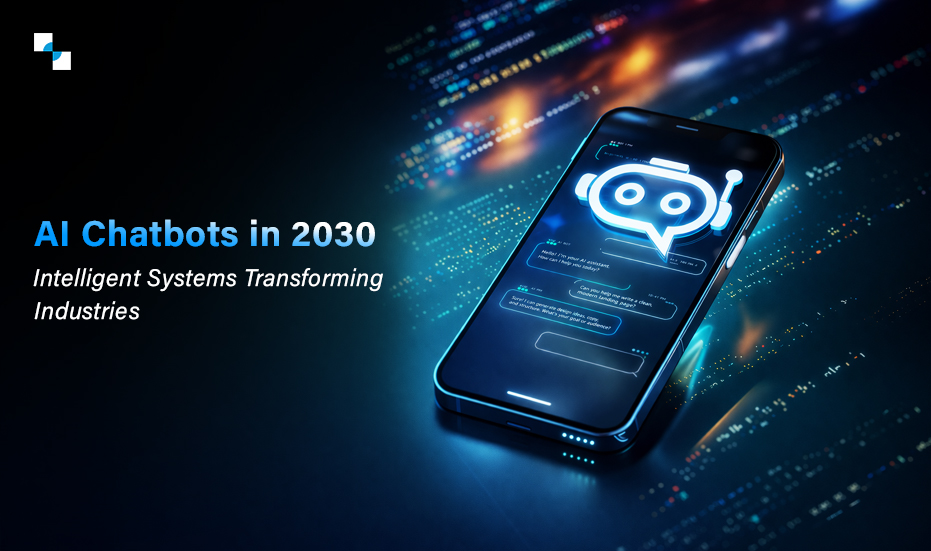
- In the blog post, it's highlighted that AI chatbots are evolving into embedded intelligence layers across enterprise ecosystems by 2030.
- Businesses are increasingly integrating AI into operations, customer experience, and decision-making processes, with a significant focus on scalable AI chatbot development services.
- The transformation journey of AI chatbots, from rule-based systems to autonomous decision-making engines, is reshaping industries.
- Despite widespread adoption, many chatbot AI solutions still struggle to deliver real business impact due to challenges like disconnected systems and limited contextual understanding.
- By 2030, chatbots will evolve into systems that proactively act, engage in multi-agent intelligence, make real-time decisions at scale, and have multimodal interactions.
AI chatbots are no longer evolving as standalone tools; they are becoming embedded intelligence layers across enterprise ecosystems. In 2025, global AI investment and adoption accelerated significantly, with businesses integrating AI into operations, customer experience, and decision-making processes. According to an IBM report, AI investment is expected to grow rapidly, with over 61% of CEOs already adopting or planning to scale AI agents across their organizations.
By 2030, this shift will redefine how industries operate. Modern ai chatbot systems, powered by real-time data and generative AI, are evolving into decision-making engines; driving outcomes rather than just conversations. Businesses investing in scalable ai chatbot development services today are building the foundation for intelligent, autonomous systems.
The Evolution Journey of AI Chatbots
To understand where AI chatbots are heading, it’s important to look at their transformation:
Rule-Based Systems: Predefined, static responses
NLP Chatbots: Basic intent recognition
AI Assistants: Context-aware and task execution
Agentic AI Systems: Autonomous decision-making and execution
Autonomous Enterprises: AI managing workflows and operations end-to-end
This evolution marks a shift from reactive tools to proactive intelligent systems.
The Current Gap: Why Most Chatbots Still Fail
Despite widespread adoption, most chatbot ai solutions fail to deliver real business impact.
Core Challenges
- Disconnected systems across departments
- Limited contextual understanding
- Inability to execute complex workflows
- Lack of real-time data integration
According to IBM, 50% of CEOs report disconnected technology environments due to rapid AI adoption, which limits the effectiveness of AI systems.
Additionally, many organizations are still in early adoption stages, with a significant gap between experimentation and scaled implementation.
Conversational AI Evolution: What Will Change by 2030
1. Autonomous Execution Over Passive Responses
Future chatbots will not wait for user prompts; they will act proactively.
- Identifying risks before they escalate
- Triggering workflows automatically
- Delivering recommendations and executing actions automatically
Research from Deloitte highlights the rise of decision intelligence, where AI systems independently manage operational tasks.
2. Multi-Agent Intelligence Systems
Instead of a single chatbot, businesses will deploy coordinated AI agents.
- Behavioral analysis agents
- Customer interaction agents
- Workflow execution agents
According to Capgemini, this shift toward agent-based systems is already reshaping enterprise AI strategies.
3. Real-Time Decision-Making at Scale
AI chatbots will evolve into systems that:
- Continuously process live data
- Adapt to changing conditions instantly
- Optimize outcomes without human intervention
Insights from IBM indicate that businesses leveraging real-time AI will outperform traditional models in speed and accuracy.
4. Multimodal Interactions
By 2030, chatbots will engage across:
- Voice
- Text
- Visual inputs
- Video interfaces
Advancements from Google demonstrate how multimodal AI will enable richer and more intuitive user experiences.
Architecture Behind AI Chatbots in 2030
To enable autonomy and scalability, future AI chatbots will rely on advanced architectures:
1. Large Language Models (LLMs)
Models like GPT-4 will power:
- Deep contextual understanding
- Natural language generation
- Complex reasoning
2. Vector Databases
- Semantic search
- Real-time context retrieval
- Structured + unstructured data handling
3. Memory Layers
- Persistent user context
- Behavioral learning
- Personalization at scale
4. Orchestration Frameworks
- Multi-agent coordination
- Task distribution
- Autonomous workflow execution
5. APIs & System Integrations
- CRM & ERP connectivity
- External tools
- Unified ecosystems
This architecture enables agentic AI systems to function as execution engines, operate as core components of enterprise decision and execution systems.
Industry Transformation: Where AI Chatbots Will Create Impact
Healthcare: Predictive and Continuous Care
AI chatbots will:
- Monitor patient health data continuously
- Predict potential medical risks
- Assist in treatment planning
According to IBM, AI will enable a shift toward preventive healthcare models.
Outcome: Improved patient outcomes and reduced operational strain.
Finance: Intelligent and Autonomous Operations
In finance, chatbots will:
- Analyze market trends in real time
- Automate trading and portfolio adjustments
- Detect anomalies and fraud instantly
Reports covered by Cointelegraph show growing adoption of AI in decentralized and automated financial systems.
Outcome: Faster, more accurate financial decision-making.
Retail & E-commerce: Hyper-Personalized Experiences
AI chatbots will:
- Anticipate customer preferences
- Deliver personalized recommendations instantly
- Optimize inventory and logistics
Insights from The Economic Times highlight increasing adoption of AI-driven personalization in global and Indian markets.
Outcome: Higher conversions and improved customer retention.
Enterprise Operations: Intelligent Workflow Automation
AI chatbots will act as:
- Digital copilots for employees
- Process automation engines
- Decision support systems
Microsoft is already embedding AI into enterprise workflows through its Copilot ecosystem.
Outcome: Enhanced productivity and reduced operational costs.
Customer Experience: Predictive Engagement
Future chatbots will:
- Understand user intent and emotion
- Resolve issues before escalation
- Deliver highly contextual interactions
Advancements from Google emphasize the importance of context-aware AI systems.
Outcome: Seamless and frictionless customer journeys.
Core Technologies Powering AI Chatbots in 2030
Generative AI Integration
- Real-time content and response generation
- Context-aware, adaptive conversations
- Continuous learning from interactions
Forms the foundation of agentic AI systems that can reason and act autonomously
Deep System Connectivity
- Seamless CRM and ERP integrations
- API-driven orchestration across tools
- Unified data flow between systems
Enables chatbots to move beyond conversations and execute business workflows end-to-end
Continuous Learning Models
- Self-improving systems through feedback loops
- Dynamic optimization based on real-time data
- Ongoing refinement of accuracy and performance
Ensures AI systems evolve continuously and improve decision-making over time
Ethical and Explainable AI
- Transparent and auditable decision-making
- Responsible AI frameworks and governance
- Compliance with global data regulations
Builds trust and ensures safe deployment of autonomous AI systems
Integrated Data Architecture
- Consolidation of structured and unstructured data
- Real-time data availability across systems
- Strong data governance and quality management
Without unified data, AI systems cannot deliver meaningful, context-driven outcomes at scale
Why Many Businesses Will Struggle to Scale AI Chatbots
Despite increasing investments in AI, a significant number of organizations will face challenges in turning experimentation into real business impact. The gap is no longer about access to AI; it’s about execution, integration, and scalability.
Key Barriers Slowing Down AI Adoption
1. Shortage of Skilled AI Talent
Building and scaling intelligent systems requires expertise in machine learning, data engineering, and AI architecture. However, most enterprises lack in-house capabilities to design and manage advanced ai chatbot ecosystems, leading to stalled or underperforming implementations.
2. Data Complexity and Fragmentation
AI systems are only as effective as the data they rely on. Many organizations operate with siloed, inconsistent, or unstructured data, making it difficult for chatbot ai systems to generate accurate, real-time insights.
3. Integration with Legacy Systems
Existing enterprise infrastructure is often not designed for AI. Integrating modern ai powered chatbot platform solutions with legacy CRM, ERP, and backend systems becomes a major bottleneck, limiting automation and scalability.
4. Governance, Compliance, and Trust
As AI systems become more autonomous, concerns around data privacy, transparency, and ethical decision-making increase. Businesses must ensure that AI outputs are explainable, compliant, and aligned with regulatory standards.
What Industry Research Reveals
According to IBM, the most critical barriers to AI adoption include:
- Persistent skill gaps across technical teams
- Challenges in managing and integrating enterprise data
- Growing concerns around ethics, trust, and governance
- Difficulty in aligning AI initiatives with business strategy
The Real Reason AI Projects Fail
The core issue is not technology; it’s lack of a scalable AI strategy. Many organizations:
- Treat AI as a one-time implementation instead of a long-term capability
- Focus on features rather than measurable business outcomes
- Fail to build integrated, AI-first ecosystems
As a result, AI initiatives remain stuck in pilot phases and fail to deliver meaningful ROI.
What This Means for Businesses
To succeed in the next wave of AI chatbots future, companies must move beyond experimentation and focus on:
- Building strong data foundations
- Investing in scalable ai software development services
- Aligning AI with core business objectives
This is because in the coming years, success won’t depend on who adopts AI first but on who scales it effectively.
How to Build Future-Ready AI Chatbot Systems
1. Adopt an AI-First Approach
Shift from using AI as a tool to embedding it into core business processes.
2. Invest in Scalable Infrastructure
Build systems that support:
- Real-time processing
- Multi-agent architectures
- Continuous learning
3. Focus on Measurable Outcomes
Define success metrics such as:
- Conversion rates
- Customer retention
- Operational efficiency
4. Partner with Experts
Collaborating with a reliable AI Chatbot Development Company ensures:
- Strategic alignment
- Seamless integration
- Long-term scalability
The Future of AI-Powered Business Solutions
By 2030, AI-powered business solutions will move from being a competitive advantage to a core business necessity. Organizations will no longer differentiate based on whether they use AI but on how deeply AI is embedded into their operations and decision-making.
Businesses leveraging advanced ai chatbot systems and intelligent platforms will be able to:
- Deliver hyper-personalized experiences at scale
Moving beyond basic segmentation to real-time, context-aware interactions tailored to individual user behavior - Automate end-to-end workflows
From customer onboarding to backend operations, reducing manual intervention and increasing efficiency - Enable real-time, data-driven decision-making
Turning live data streams into immediate actions that improve outcomes across functions - Continuously learn and optimize performance
Systems that evolve with every interaction, improving accuracy, efficiency, and business impact over time
According to IBM, enterprises are rapidly shifting toward AI embedded across all functions, signaling a move from isolated use cases to enterprise-wide intelligent ecosystems.
The Era of Intelligent Systems Has Already Begun
AI chatbots are rapidly evolving into intelligent systems that drive execution and measurable business impact. By 2030, these systems will play a central role in how businesses operate, compete, and scale across industries. From predictive healthcare to autonomous finance and hyper-personalized retail, AI chatbots will become deeply integrated into core operations, enabling faster decisions and smarter workflows. Organizations that invest in advanced AI powered chatbot platform capabilities and scalable AI development services today will gain a lasting competitive edge.
The future is not about adopting AI, but about building systems that continuously learn, adapt, and deliver value at scale. As a leading AI Chatbot Development Company, Antier empowers enterprises to build intelligent, scalable AI systems. With deep expertise in generative AI, Antier helps transform AI strategies into high-impact business solutions.
Frequently Asked Questions
01. How are AI chatbots evolving in enterprise ecosystems?
AI chatbots are transitioning from standalone tools to embedded intelligence layers within enterprise ecosystems, integrating into operations, customer experience, and decision-making processes.
02. What are the main challenges faced by current AI chatbot solutions?
Current AI chatbot solutions often fail due to disconnected systems across departments, limited contextual understanding, inability to execute complex workflows, and lack of real-time data integration.
03. What changes can we expect in chatbot functionality by 2030?
By 2030, chatbots are expected to execute tasks autonomously, proactively identifying risks, triggering workflows, and delivering recommendations without waiting for user prompts.
04. Are AI chatbots replacing human roles by 2030?
No. AI chatbots will handle repetitive tasks, while humans will focus on strategy and complex decisions.
05. What makes an AI-powered chatbot platform scalable?
Scalability depends on real-time data integration, system connectivity (CRM/ERP), and continuous learning capabilities.
06. How do AI chatbots ensure data privacy and compliance?
They use encryption, access controls, and follow regulations like GDPR, along with transparent and auditable AI systems.
07. What is the biggest mistake in adopting AI chatbots?
Treating chatbots as standalone tools instead of integrating them into core business workflows.
08. How long does it take to see results from AI chatbots?
Basic improvements are quick, but full ROI typically takes a few months with proper optimization.