




✨ AI Summary
- The blog post delves into the evolving landscape of smart contract security, particularly the role of AI-powered tools in audits.
- While AI excels at detecting known vulnerabilities in smart contracts by analyzing code patterns, it falls short in identifying context-dependent or novel attack vectors.
- The post outlines the limitations of AI in auditing, such as the lack of contextual understanding and the inability to model attacker behavior accurately.
- It emphasizes the risks of relying solely on AI for audits, including a false sense of security and missed critical vulnerabilities.
- The future of smart contract auditing is seen as a hybrid model where AI complements human auditors, with AI handling repetitive tasks and humans focusing on complex reasoning and risk evaluation.
Smart contract security remains a major concern across the blockchain ecosystem. Despite multiple audit layers, protocols continue to face exploits that lead to significant financial losses. According to Immunefi, vulnerabilities in smart contracts are among the leading causes of these incidents.
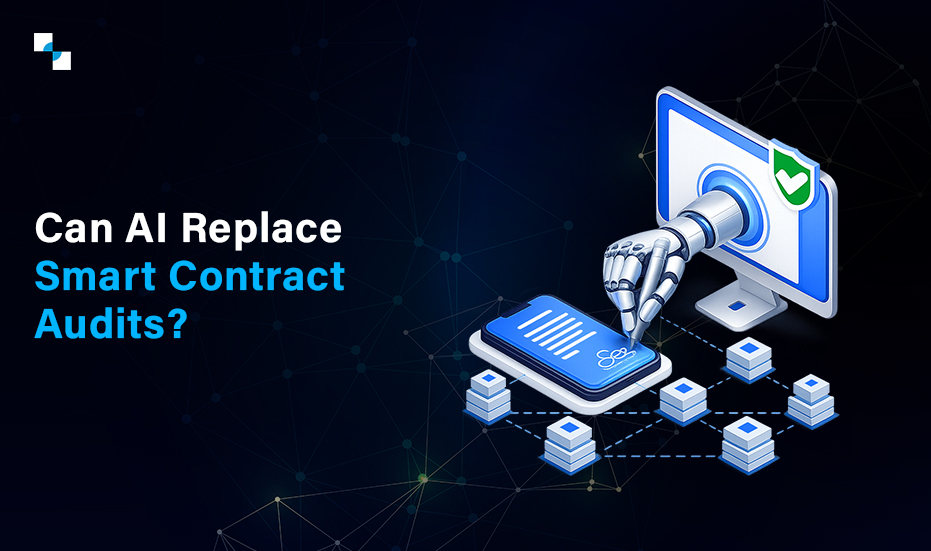
The rise of AI-powered audit tools has introduced a new approach to security analysis. This raises a critical question: can AI replace traditional smart contract audits?
This question is gaining attention as AI tools begin to automate vulnerability detection across blockchain systems. AI can detect known issues and improve analysis speed, but it cannot fully secure smart contracts against complex and evolving attack strategies.
This blog breaks down where AI adds value, where it fails, and what this means for smart contract security in 2026.
What Can AI Detect in Smart Contract Audits?
AI-powered tools are effective at identifying vulnerabilities that follow known patterns and have been observed in past exploits. These systems analyze code structure, execution paths, and predefined risk signatures to flag potential issues. AI can effectively detect:
- Reentrancy vulnerabilities
Repeated external calls that can lead to unauthorized fund withdrawals - Integer overflows and underflows
Arithmetic errors that can alter balances or bypass checks - Access control issues
Missing or incorrect permission checks that expose critical functions - Unchecked external calls
Calls that fail silently and create inconsistent contract states - Known vulnerability patterns
Issues previously identified in exploited contracts and security databases
How AI identifies these issues
AI systems rely on static analysis and pattern matching to scan smart contract code. They compare contract logic against known vulnerability signatures and detect deviations that match historical exploit patterns. This allows AI to process large volumes of code quickly and flag risks that follow repeatable structures.
AI performs best when vulnerabilities are predictable and pattern-based. It is highly effective for early-stage scanning and identifying common security issues before manual review.
Security tools and research platforms such as OpenZeppelin and ConsenSys have documented that many recurring vulnerabilities, including reentrancy and access control flaws, can be detected through automated analysis tools.
What AI Cannot Detect in Smart Contracts?
AI cannot reliably detect vulnerabilities that depend on context, intent, or complex system behavior. AI struggles to detect:
Business logic flaws
Errors in how a contract is designed or intended to function. These do not break code rules but can still be exploited
Economic attack vectors
Exploits such as flash loan attacks that manipulate market conditions rather than code structure
Cross-contract interaction risks
Vulnerabilities that arise when multiple contracts interact across protocols
Governance vulnerabilities
Weaknesses in voting, proposal mechanisms, or permission structures
Zero-day vulnerabilities
New and previously unseen attack patterns that are not part of existing datasets
Why AI Fails in Smart Contract Auditing
AI struggles in smart contract auditing because security risks are not limited to code structure. Many vulnerabilities emerge from how contracts behave in dynamic environments, how users interact with them, and how attackers exploit system-level weaknesses.Here are some core limitations behind AI failures
- Lack of contextual understanding
AI analyzes code syntax and patterns but does not understand the intent behind contract logic or how it is meant to function in practice - Inability to model attacker behavior
Real-world exploits often involve creative strategies, including multi-step attacks and economic manipulation, which AI cannot reliably simulate - Dependence on historical data
AI systems learn from past vulnerabilities, which limits their ability to identify new or evolving exploit techniques - Limited reasoning across systems
Many vulnerabilities arise from interactions between multiple contracts, protocols, or external systems, which are difficult for AI to evaluate holistically
Risks of Relying Only on AI for Smart Contract Audits
Relying only on AI for smart contract audits can expose protocols to critical vulnerabilities that are not detected through automated analysis. Here are some key risks of AI-only audits:
- False sense of security
Automated reports may suggest that a contract is secure, even when critical logic flaws remain undetected - Missed high-impact vulnerabilities
Issues related to business logic, token economics, and contract interactions can go unnoticed - Over-reliance on automation
Teams may skip deeper manual reviews, assuming AI coverage is sufficient - Increased risk in complex DeFi systems
Protocols with multiple contracts and integrations face higher exposure when audits lack human reasoning - Limited accountability
AI tools do not provide responsibility or judgment in the way human auditors do
Human vs AI Smart Contract Auditing
AI and human auditors serve different roles in smart contract security. AI focuses on speed and pattern detection, while human auditors focus on reasoning, context, and identifying complex vulnerabilities.
Comparison of capabilities
| Capability | AI Tools | Human Auditors | |
|---|---|---|---|
| Pattern-based vulnerability detection | High | Medium | |
| Code analysis speed | High | Medium | |
| Business logic evaluation | Low | High | |
| Detection of novel exploits | Low | High | |
| Understanding of contract intent | Low | High | |
| Cross-contract reasoning | Limited | strong | |
| Accountability and judgment | None | Present |
Will AI replace smart contract auditors in the future?
AI is not expected to replace smart contract auditors. The direction of the industry points toward a hybrid approach where AI supports human auditors by handling repetitive analysis while humans focus on complex reasoning and risk evaluation.
The emerging hybrid audit model
- AI as the first layer
Automated tools scan code for known vulnerabilities and flag potential issues early - Human auditors as the final layer
Experts review logic, validate assumptions, and assess real-world attack scenarios - Continuous monitoring with AI
Deployed contracts are tracked over time to detect anomalies and emerging risks - Periodic manual audits
Contracts undergo deeper reviews during upgrades, integrations, or major changes
Secure Your Smart Contracts with a Proven Audit Approach
How Antier Approaches Smart Contract Auditing
Antier follows a hybrid auditing approach that combines automated analysis with expert-led manual reviews to secure smart contracts across blockchain ecosystems. This approach reflects current industry practices where AI supports early detection, while human auditors validate complex logic and system behavior.
- AI-assisted vulnerability scanning
Automated tools are used to detect known vulnerabilities and perform large-scale code analysis - Manual code review by security experts
Auditors evaluate contract logic, edge cases, and intended behavior - Multi-layered testing
Contracts are tested across different scenarios, including interaction with external systems - Focus on business logic and economic risks
Special attention is given to areas where automated tools have limitations - Continuous security support
Monitoring and re-auditing are performed after upgrades or changes
Frequently Asked Questions
01. Are AI-powered smart contract audit tools reliable?
AI-powered tools are reliable for detecting common vulnerabilities and performing large-scale code analysis. They should be used as a support layer, as they cannot replace manual audits for complex or high-value smart contracts.
02. Can AI reduce the cost of smart contract audits?
AI can reduce audit costs by automating initial scans and identifying common issues early in the process. Full audits still require human expertise, especially for complex contracts, which limits the overall cost reduction.
03. What is the safest approach to smart contract auditing?
The safest approach is a combination of AI-assisted analysis and manual auditing by experienced security professionals. This method improves coverage while ensuring that complex vulnerabilities are properly evaluated.
04. Can AI prevent smart contract hacks?
AI can help reduce the risk of smart contract hacks by identifying known vulnerabilities early. It cannot fully prevent attacks, especially those involving logic flaws or novel exploit strategies.
05. Do all blockchain projects need manual audits?
Most production-level blockchain projects benefit from manual audits, especially those handling user funds or complex logic. Automated tools alone are not sufficient for securing high-risk smart contracts.