




✨ AI Summary
- In 2026, the DeFi landscape has evolved, demanding a strategic approach to development.
- The blog explores key elements of building a production-grade DeFi platform, focusing on architecture design, security, scalability, and execution strategy.
- It emphasizes the importance of selecting a reliable DeFi development company for success.
- The post highlights common reasons for DeFi project failures, such as poor smart contract design and lack of scalability planning.
- It provides a step-by-step framework for building a DeFi platform, from defining the use case to launching with a structured go-to-market plan.
DeFi has matured significantly. What worked in earlier cycles, rapid launches, experimental protocols, and iterative fixes, no longer holds in 2026.
Today’s environment is defined by:
- Higher user expectations
- Institutional participation
- Zero tolerance for security failures
- Increasing competition across chains
For founders, this creates a different kind of challenge. You are not simply building a DeFi product. You are designing a financial system that must operate securely, scale efficiently, and gain trust from day one. This is where DeFi development becomes a strategic function. The difference between success and failure is no longer the idea, but the quality of execution and the capability of your development partner.
This blog provides a comprehensive breakdown of building a production-grade DeFi platform in 2026, including architecture design, security frameworks, scalability planning, and execution strategy, along with key considerations for selecting a reliable DeFi development company.
What DeFi Development Means in 2026
Modern DeFi development services encompass the design and implementation of a complete decentralized financial infrastructure.
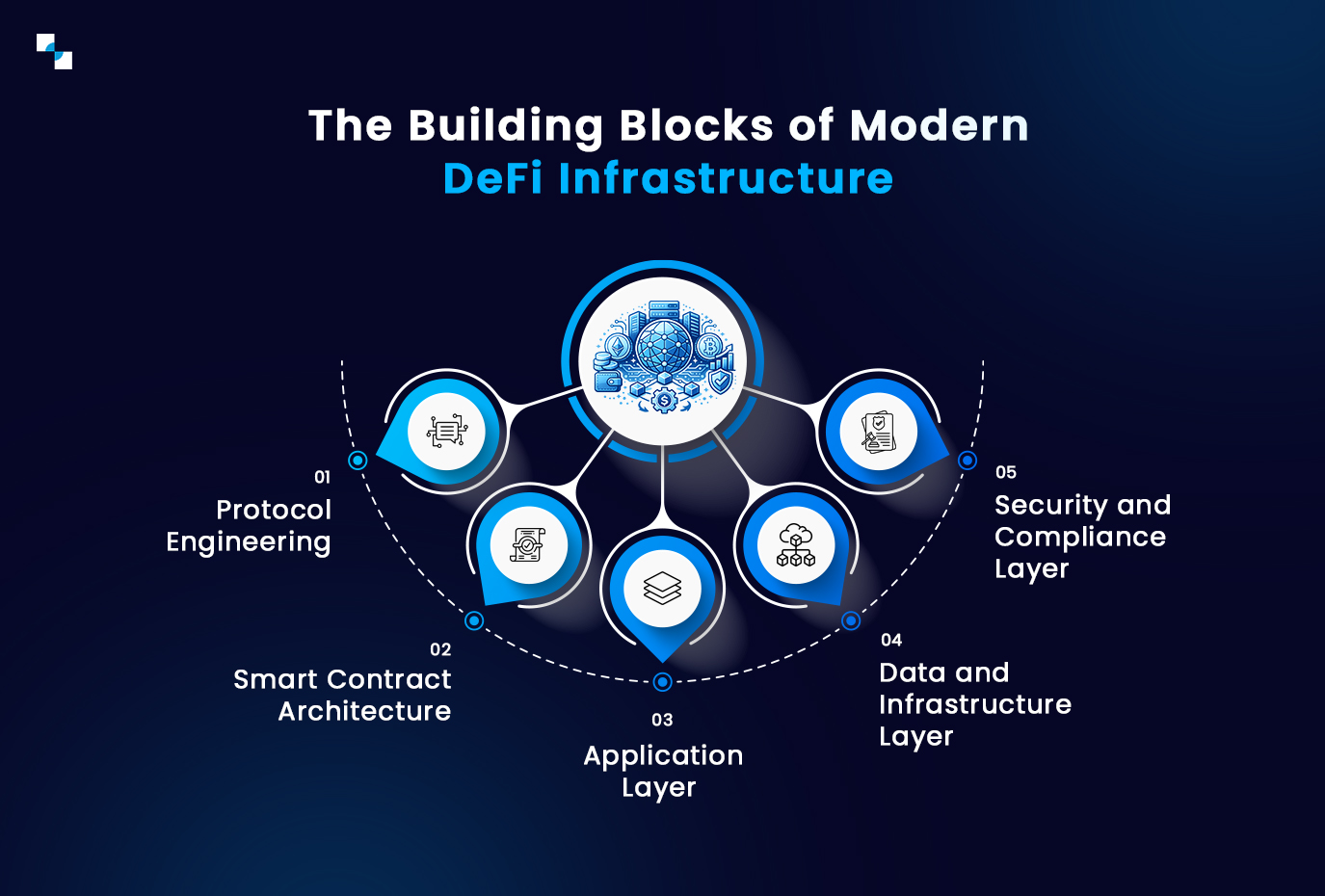
- Protocol Engineering
This is the core layer where financial logic is defined:
- Automated market makers (AMMs)
- Lending and borrowing mechanisms
- Yield strategies and staking logic
- Derivatives and synthetic assets
This layer must be deterministic, secure, and optimized for cost and performance.
- Smart Contract Architecture
Beyond functionality, architecture determines long-term viability:
- Modular contract design
- Upgradeability patterns, such as proxy contracts
- Role-based access control
- Fail-safe and emergency mechanisms
A weak architecture often leads to expensive rebuilds and long-term limitations.
- Application Layer (Frontend and Web3 Integration)
User interaction with the protocol depends on:
- Wallet connectivity
- Clear and predictable transaction flows
- Accurate gas estimation and confirmation handling
- Real-time feedback systems
In 2026, usability directly drives user adoption and retention.
- Data and Infrastructure Layer
DeFi platforms rely on robust off-chain systems to ensure performance:
- Indexing solutions for blockchain data
- Backend APIs for faster data access
- Analytics dashboards for insights
- Monitoring systems for reliability
This layer ensures stability and responsiveness under real-world conditions.
- Security and Compliance Layer
Security must be integrated across every stage of development:
- Internal testing frameworks
- Third-party audits
- Continuous monitoring and threat detection
- Compliance-aware design based on jurisdiction
In mature DeFi markets, security is not a differentiator. It is a baseline requirement.
Need Help with DeFi Development? Validate your idea and move faster.
Why Most DeFi Projects Fail Despite Better Tooling
Despite the availability of advanced frameworks and infrastructure, many DeFi projects still fail. The primary reason is not the lack of tools, but gaps in execution, architecture, and strategic planning.
- Inadequate Smart Contract Design: Even minor vulnerabilities in smart contracts can lead to major exploits. Poorly structured logic introduces systemic risks that are difficult to detect and even harder to fix post-deployment.
- Lack of Scalability Planning: Protocols that perform well in controlled environments often struggle under real-world conditions. Without proper scalability planning, platforms fail to handle increased user activity and liquidity growth.
- Fragmented Development Approach: Relying on multiple disconnected teams for different components often results in integration challenges. This leads to inconsistencies across the system and delays in development.
- Security Treated as a Final Step: When security is addressed only at the end of the development cycle, it exposes deeper architectural flaws. Fixing these issues late increases both cost and risk.
- Overcomplication at Launch: Attempting to launch with too many features from the outset slows down development and increases the chances of failure. A lack of focus on core functionality often delays time-to-market.
These challenges highlight why founders increasingly choose to work with a DeFi development company that brings structured execution, architectural expertise, and a security-first approach to building production-grade systems.
Step-by-Step Framework to Build a DeFi Platform in 2026
- Step 1: Define the Use Case and Economic Model
The starting point is clarity. Common DeFi models include:
- Decentralized exchanges
- Lending and borrowing platforms
- Yield aggregation protocols
- Derivatives and perpetual trading systems
- Real-world asset (RWA) protocols
Alongside the use case, define:
- Revenue model
- Liquidity strategy
- Incentive mechanisms
This foundation influences every technical decision.
- Step 2: Select the Right Blockchain and Deployment Strategy
In 2026, the decision is not limited to a single chain. Key considerations:
- Security and decentralization
- Transaction costs
- Ecosystem maturity
- Developer tooling
- Cross-chain compatibility
Many projects adopt:
- Multi-chain deployment
- Layer 2-first strategies
- Cross-chain bridges or messaging protocols
Choosing incorrectly can limit scalability or adoption.
- Step 3: Design Robust Smart Contract Systems
This is the most critical stage in DeFi development. Focus areas:
- Separation of concerns (modular design)
- Upgradeability without compromising security
- Precise financial logic implementation
- Gas efficiency
Every contract should be designed with long-term maintainability in mind.
- Step 4: Build Scalable Infrastructure
Despite being decentralized, DeFi platforms still rely on off-chain components to maintain performance. This includes:
- Blockchain data indexing
- API layers for frontend interaction
- Event processing systems
- Analytics and reporting tools
A well-designed infrastructure layer ensures smooth operation under load.
- Step 5: Integrate Security Throughout the Lifecycle
Security must be continuous, not sequential. Recommended approach:
- Code reviews at every stage
- Automated testing frameworks
- Third-party audits before launch
- Bug bounty programs post-launch
In 2026, security directly impacts user trust and liquidity inflow.
- Step 6: Develop User-Centric Interfaces
Technical excellence alone is insufficient. The interface must:
- Simplify complex financial actions
- Provide transparency in transactions
- Offer intuitive navigation
- Deliver consistent performance
User experience is now a primary driver of adoption.
- Step 7: Launch with a Structured Go-to-Market Plan
A successful launch involves:
- Initial liquidity provisioning
- Community onboarding
- Strategic partnerships
- Monitoring system performance
Post-launch iterations should be planned.
See How Your DeFi Platform Can Be Built. Get clarity before you start.
How to Evaluate a DeFi Development Company
Selecting the right DeFi development company is a strategic decision that directly affects your platform’s security, scalability, and long-term success.
- Technical Depth in DeFi Protocols
A reliable partner should have proven experience building DeFi systems, including decentralized exchanges, lending platforms, and staking protocols. A general understanding of blockchain is not enough. DeFi development requires expertise in financial logic, liquidity mechanisms, and real-world protocol behavior.
- End-to-End Capability
The team should be able to handle the complete development lifecycle:
- Architecture design
- Development and integration
- Testing and deployment
- Post-launch support
Managing everything under one team ensures consistency and reduces the risks associated with fragmented execution.
- Security Expertise
Security should be a core focus throughout development. Look for teams that follow secure coding practices, prepare systems for audits, and proactively identify vulnerabilities. A strong security approach helps prevent costly issues after launch.
- Structured Development Process
A clear and structured workflow ensures smooth execution. This includes defined milestones, transparent communication, and predictable timelines. A disciplined process reduces delays and keeps the project aligned with its goals.
- Advisory Capability
An effective development partner goes beyond execution and provides strategic input. This includes guidance on architecture, technology choices, and scalability planning, helping founders make informed decisions throughout the development process.
Why Timing and Execution Define Success in 2026
In 2026, success in DeFi is closely tied to how quickly and effectively a project is executed. The market consistently rewards teams that move early, make strong architectural decisions, and deliver secure, reliable platforms from the outset. These factors not only accelerate adoption but also help establish long-term credibility. On the other hand, projects that delay their launch or compromise on quality often struggle to gain traction, face reduced user adoption, lose potential liquidity, and encounter stronger competitive pressure. Timing, therefore, is not just about speed. It is about launching with a solid foundation that can support growth, security, and sustained performance.
Common Mistakes to Avoid in DeFi Development
- Prioritizing cost over expertise often leads to weak architecture, security gaps, and expensive rework later.
- Ignoring security until late stages increases the risk of critical vulnerabilities and costly fixes
- Building too many features before launch slows development and adds unnecessary complexity.
- Underestimating infrastructure requirements can lead to poor performance and an unreliable user experience.
- Delaying launch due to over-optimization causes missed market opportunities and loss of early traction.
Execution discipline, clarity of scope, and partnering with an experienced DeFi development company are far more important than feature breadth.
Conclusion: Build It Right the First Time
In 2026, DeFi leaves little room for error. There are no second chances after launch. Security flaws, scalability limitations, or weak execution can erode user trust and limit growth from the very beginning. The projects that succeed are the ones that:
- Build with a security-first approach
- Design systems that scale with demand
- Execute with experienced and reliable partners
Working with a proven partner like Antier ensures your DeFi platform is built with the right architecture, robust security standards, and a clear path to launch and scale. The real question is not whether you can build a DeFi platform, but whether you are building one that is ready to perform, scale, and lead in a competitive market.
Frequently Asked Questions
01. What are the key challenges in DeFi development in 2026?
The key challenges include higher user expectations, institutional participation, zero tolerance for security failures, and increasing competition across chains.
02. What are the essential components of a production-grade DeFi platform?
Essential components include protocol engineering, smart contract architecture, application layer for user interaction, data and infrastructure layer, and a strong focus on security and compliance.
03. Why is the quality of execution important in DeFi development today?
The quality of execution is crucial because the difference between success and failure now lies in the execution capabilities and the reliability of the development partner, rather than just the initial idea.