





✨ AI Summary
- In 2026, Artificial Intelligence (AI) has become a transformative force in real estate investment, moving from experimental to essential.
- AI and machine learning are revolutionizing how firms operate by enabling data-driven strategies, faster decision-making, and scalable automation.
- Key areas impacted include predictive analytics for smarter investments, AI-powered valuation and underwriting, and generative AI for investment insights.
- Real estate firms are now integrating AI across workflows from deal sourcing to tenant engagement, driving measurable outcomes such as ROI and operational efficiency.
- By following a structured approach of aligning strategic objectives, selecting appropriate AI development services, building a unified data foundation, developing tailored AI models, and scaling AI across workflows, organizations can harness AI for sustained performance and competitive advantage.
Artificial Intelligence is no longer an emerging trend in real estate; it is a defining force reshaping how the industry operates. In 2026, AI in real estate investment has evolved from experimental use cases into a core business capability driving measurable performance, efficiency, and competitive advantage.
From predictive analytics to autonomous decision-making systems, AI and machine learning in real estate investment are enabling firms to move beyond intuition and toward data-driven strategies. What once required weeks of manual analysis can now be executed in minutes using intelligent algorithms and AI-powered platforms.
However, the real shift in 2026 is not just about adopting AI – it’s about reimagining workflows, operations, and investment strategies from the ground up. With the rise of AI applications in real estate investment firms, organizations are now redesigning how deals are sourced, evaluated, and managed at scale.
AI in Real Estate Investment: From Hype to Real Business Impact
Over the past few years, the real estate industry has witnessed a rapid surge in AI adoption, with organizations exploring a wide range of use cases from data analysis to process automation. During this phase, many firms focused on integrating AI into specific functions to enhance efficiency and stay competitive. However, in 2026, the conversation has evolved significantly. Real estate leaders are no longer evaluating AI based on isolated capabilities – they are focusing on how AI can drive measurable business outcomes at scale. This includes:
- Measurable ROI
- Faster deal execution
- Scalable, end-to-end automation
- Accurate, data-driven investment insights
This shift reflects a broader transition from early-stage AI adoption to AI as a business-critical capability. With the support of advanced AI development services, firms are now building integrated systems that go beyond standalone tools, embedding AI directly into investment and operational workflows. As a result, AI is becoming a core enabler of performance, efficiency, and long-term competitive advantage in real estate.
How AI and Machine Learning in Real Estate Investment Are Transforming Decision-Making
The integration of AI and machine learning in real estate investment is fundamentally transforming how investment decisions are made, shifting the industry from intuition-based strategies to data-driven intelligence. At the core of this transformation is AI’s ability to process massive volumes of structured and unstructured data in real time, delivering actionable insights that were previously impossible to uncover. Today, AI in real estate investing enables firms to evaluate opportunities faster, reduce uncertainty, and make highly informed investment decisions at scale.
Predictive Analytics for Smarter Investments Using AI in Real Estate Investing
One of the most powerful AI applications in real estate investment firms is predictive analytics. By leveraging AI and machine learning in real estate investment, firms can analyze:
- Real-time and historical market trends
- Property performance data across multiple asset classes
- Demographic shifts and population growth patterns
- Macroeconomic indicators such as interest rates, inflation, and employment trends
These AI-driven insights enable investors to:
- Accurately forecast property appreciation and rental yields
- Identify emerging high-growth markets before competitors
- Optimize portfolio allocation based on data-backed predictions
- Develop risk-adjusted investment strategies aligned with market dynamics
As a result, AI in real estate investment is empowering firms to move from reactive decision-making to proactive, predictive investment strategies.
AI-Powered Valuation and Underwriting in Real Estate Investment
Another critical advancement in AI in real estate investment is the evolution of valuation and underwriting processes. Traditional valuation methods, often manual, time-consuming, and prone to bias, are rapidly being replaced by AI-driven systems built using advanced AI software development services.
These AI-powered systems can:
- Deliver real-time, data-driven property valuations using Automated Valuation Models (AVMs)
- Continuously update pricing based on live market data and comparable transactions
- Automate underwriting processes by analyzing financial, legal, and operational data
- Simulate multiple investment scenarios to evaluate potential risks and returns
This transformation significantly enhances:
- Speed: Reducing valuation and underwriting timelines from weeks to minutes
- Accuracy: Minimizing human error and bias through data-driven models
- Confidence: Enabling investors to make decisions backed by predictive intelligence
Ultimately, AI and machine learning in real estate investment are redefining how investors assess opportunities, making decision-making faster, smarter, and more scalable than ever before.
AI Applications in Real Estate Investment Firms: Key Use Cases in 2026
In 2026, AI applications in real estate investment firms are evolving beyond isolated tools into integrated, workflow-driven systems. Instead of focusing on individual capabilities, organizations are embedding AI in real estate investment across the entire lifecycle, from opportunity identification to asset optimization and tenant engagement. With the support of advanced AI development services, these applications are delivering measurable business outcomes by improving speed, precision, and scalability.
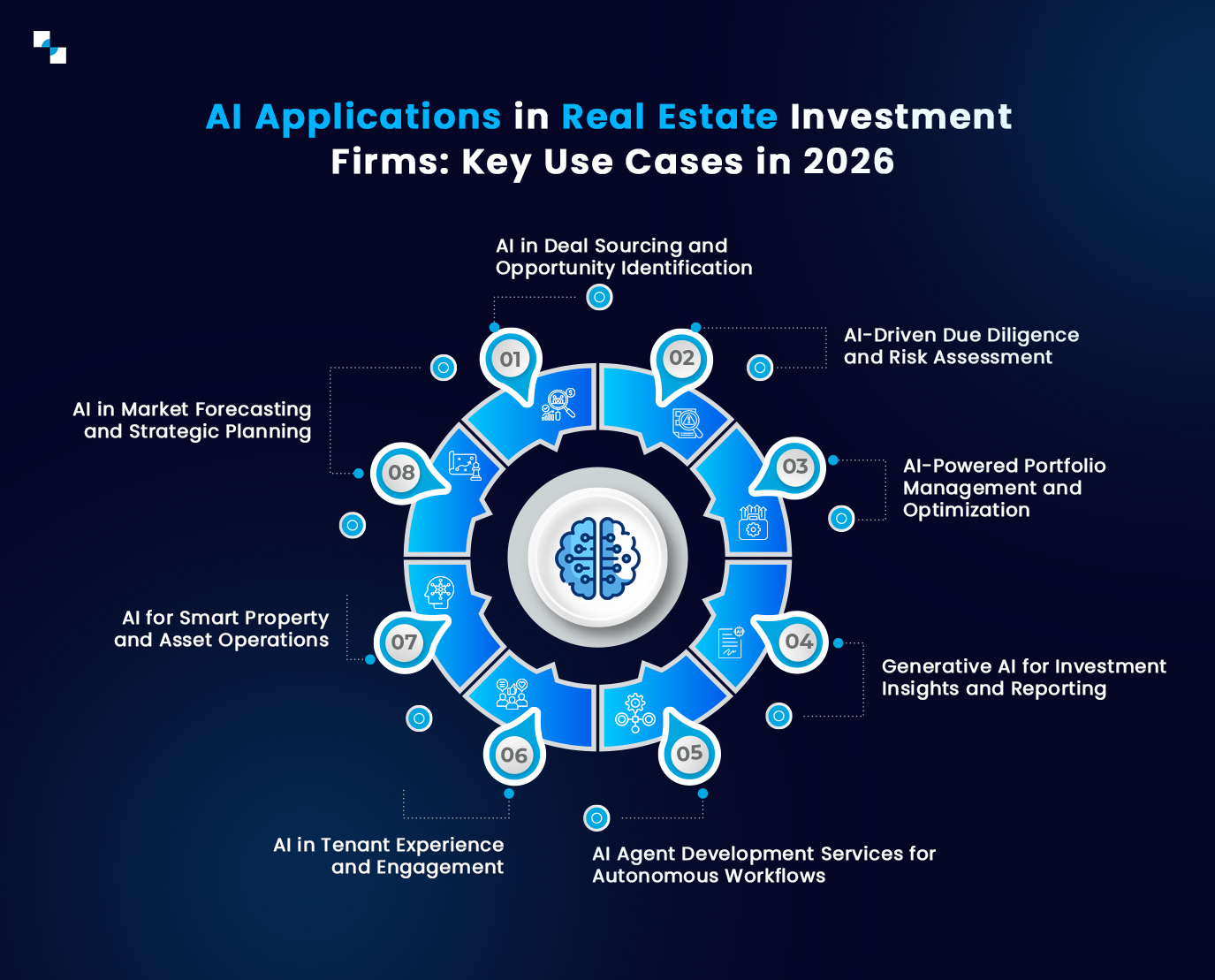
Below are the most impactful and clearly differentiated use cases shaping the industry:
1. AI in Deal Sourcing and Opportunity Identification
Identifying high-potential investment opportunities is becoming faster and more data-driven with AI in real estate investing. AI systems continuously scan large datasets, including listings, infrastructure developments, and economic indicators, to surface opportunities that may not be visible through traditional methods.
By leveraging AI and machine learning in real estate investment, firms can detect emerging investment zones, uncover undervalued assets, and prioritize deals based on future growth potential, creating a strong first-mover advantage.
2. AI-Driven Due Diligence and Risk Assessment
Due diligence is being transformed into a faster, more structured process through AI applications in real estate investment firms. AI models analyze contracts, leases, financial records, and compliance data to identify risks, inconsistencies, and performance gaps.
This reduces manual effort while improving the depth and reliability of analysis, enabling more informed investment decisions and minimizing exposure to legal and financial risks.
3. AI-Powered Portfolio Management and Optimization
Managing portfolios at scale requires continuous performance tracking and strategic adjustments. AI in real estate investment enables dynamic portfolio management by monitoring asset-level data and identifying optimization opportunities in real time.
Using predictive models, firms can evaluate asset performance, rebalance portfolios, and make data-backed buy, hold, or sell decisions, thus ensuring long-term value creation.
4. Generative AI for Investment Insights and Reporting
The rise of generative AI development services is transforming how real estate firms interpret and communicate data. Generative AI can convert complex datasets into structured reports, investment summaries, and market insights.
This enhances decision-making by making information more accessible, reducing reliance on manual reporting, and improving the speed and consistency of internal and external communication.
5. AI Agent Development Services for Autonomous Workflows
A key 2026 trend is the adoption of AI agent development services to enable agentic workflows. These systems are designed to execute multi-step processes such as opportunity analysis, preliminary underwriting, and workflow coordination with minimal human input.
By integrating AI and machine learning in real estate investment, agentic systems introduce a new level of operational efficiency, where workflows are not just automated but continuously optimized over time.
6. AI in Tenant Experience and Engagement
Tenant experience is becoming a critical driver of asset performance. By combining AI chatbot development services with advanced analytics, firms can deliver more responsive and personalized interactions across the tenant lifecycle.
These systems support real-time query resolution, automated communication, and tailored property recommendations, while also analyzing tenant behavior to improve retention and satisfaction.
7. AI for Smart Property and Asset Operations
Operational efficiency is being enhanced through AI-driven property management systems that focus on real-time performance and sustainability. AI models analyze building data to optimize maintenance schedules, energy usage, and overall asset efficiency.
This results in reduced operational costs, improved asset longevity, and better alignment with modern “smart building” expectations in real estate.
8. AI in Market Forecasting and Strategic Planning
Strategic decision-making is increasingly guided by AI-powered forecasting models. By analyzing macroeconomic indicators, demand patterns, and market cycles, AI in real estate investment provides forward-looking insights that support long-term planning.
This allows firms to anticipate market shifts, adapt investment strategies proactively, and maintain resilience in changing economic conditions.
The role of AI applications in real estate investment firms in 2026 is no longer limited to improving individual tasks. Instead, AI is being integrated into core workflows, reshaping how investments are sourced, evaluated, managed, and optimized.
By leveraging the right combination of AI development services, generative AI development services, and AI agent development services, firms can build intelligent systems that deliver sustained performance, operational efficiency, and competitive advantage.
How to Use AI in Real Estate Investing: A Practical Framework
For organizations exploring how to use AI in real estate investing, success depends on a structured, outcome-driven approach. In 2026, leading firms are not just adopting AI; they are systematically integrating AI in real estate investment into core business functions to drive measurable performance. Rather than focusing on isolated use cases, the emphasis is on aligning AI and machine learning in real estate investment with strategic objectives, data ecosystems, and execution workflows.
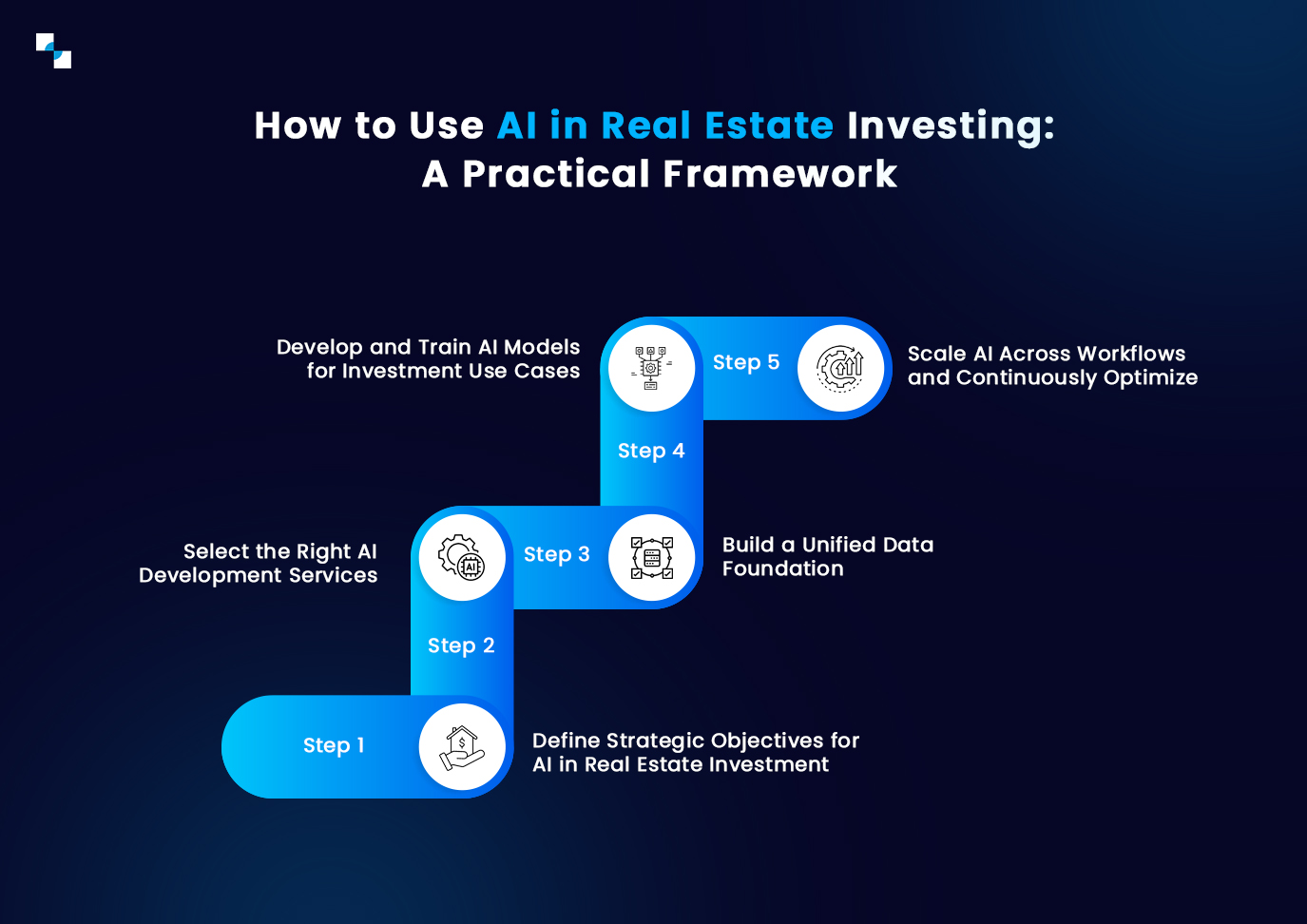
Step 1: Define Strategic Objectives for AI in Real Estate Investment
The foundation of successful AI adoption lies in clearly identifying where it can create the most value. Without a focused direction, AI initiatives risk becoming fragmented and underutilized.
Organizations should prioritize key areas such as:
- Investment intelligence: Enhancing deal sourcing, forecasting, and risk evaluation
- Operational performance: Improving efficiency across asset and portfolio management
- Customer experience: Strengthening tenant engagement and retention strategies
Defining these priorities ensures that AI initiatives are aligned with measurable outcomes such as ROI, speed of execution, and portfolio growth.
Step 2: Select the Right AI Development Services
Choosing the appropriate capabilities is critical to translating strategy into execution. Based on business goals, firms should leverage specialized AI development services to address specific needs across the investment lifecycle.
This may include:
- AI application development services for data analysis and decision support
- Generative AI development services for insights, reporting, and knowledge extraction
- AI chatbot development services for improving customer interaction and responsiveness
- AI agent development services for enabling intelligent, multi-step workflow execution
Selecting the right combination ensures flexibility, scalability, and long-term alignment with business strategy.
Step 3: Build a Unified Data Foundation
Data is the backbone of AI in real estate investment. To generate meaningful insights, organizations must bring together diverse data sources into a cohesive structure.
This includes:
- Internal data such as transaction history, financial performance, and tenant behavior
- External data such as market trends, economic indicators, and location intelligence
A unified data foundation allows AI and machine learning in real estate investment to uncover patterns, improve forecasting accuracy, and support more informed decision-making.
Step 4: Develop and Train AI Models for Investment Use Cases
Once the data foundation is established, the next step is to build AI models tailored to specific investment objectives. These models are designed to interpret data, identify patterns, and generate actionable recommendations.
Key use cases include:
- Forecasting property values and rental demand
- Evaluating investment risks and return scenarios
- Identifying portfolio optimization opportunities
Over time, these models improve through continuous learning, enabling more precise and reliable decision-making.
Step 5: Scale AI Across Workflows and Continuously Optimize
The final stage involves expanding AI adoption beyond initial use cases and embedding it into broader business workflows. In 2026, the real impact of AI in real estate investing comes from scaling its application across interconnected processes.
This requires:
- Continuous performance monitoring and refinement
- Incorporation of feedback loops to improve accuracy
- Alignment of AI outputs with business decision-making processes
By scaling effectively, organizations can achieve sustained improvements in efficiency, execution speed, and overall investment performance.
A structured approach to how to use AI in real estate investing ensures that AI is not treated as a standalone capability but as a core driver of business transformation. By aligning strategy, data, and the right AI development services, firms can unlock the full potential of AI and machine learning in real estate investment and build a foundation for long-term growth.
AI-Powered Real Estate Solutions
Generative AI in Real Estate: Turning Complex Data into Actionable Intelligence
In 2026, generative AI development services are playing a pivotal role in advancing AI in real estate investment by transforming how information is processed and presented. Instead of manually analyzing large volumes of data, firms are leveraging generative AI to convert complex inputs into structured, decision-ready outputs.
Within AI applications in real estate investment firms, generative AI is increasingly used to streamline knowledge-intensive tasks such as generating investment summaries, reports, and market insights from raw datasets. It also helps in summarizing leases, contracts, and due diligence documents into key highlights, reducing the time spent on manual review.
In addition, generative AI supports the creation of property descriptions, marketing content, and investor presentations aligned with market demand. It can also translate complex financial and operational data into clear, actionable narratives, making insights more accessible across teams.
As a result, generative AI is becoming an essential layer in managing the growing complexity of real estate data, enabling faster interpretation and more consistent communication.
AI Agent Development Services: Enabling Autonomous Workflows in Real Estate
While generative AI focuses on insights and content, AI agent development services represent the next stage of evolution in AI in real estate investment, enabling systems that can execute multi-step workflows across the investment lifecycle.
In 2026, AI applications in real estate investment firms are increasingly built around agentic systems that operate with defined goals, coordinating activities that traditionally required manual intervention across teams.
These systems can identify and shortlist investment opportunities based on real-time data, perform initial financial analysis, and coordinate due diligence processes. They can also suggest next steps aligned with predefined investment strategies, ensuring a more structured approach to execution.
Unlike traditional automation, agentic AI operates across interconnected processes rather than isolated tasks. This creates a continuous execution model where workflows are managed end-to-end and refined over time through feedback and data.
Examples include autonomous deal sourcing agents that continuously monitor and prioritize opportunities, AI-driven portfolio systems that track asset performance and recommend strategic adjustments, and intelligent tenant interaction systems that manage communication across the lifecycle.
Generative AI vs Agentic AI in Real Estate Investment
Understanding the distinction between these two approaches is critical for real estate firms adopting AI and machine learning in real estate investment.
- Generative AI focuses on creating structured insights, reports, and content from complex data
- Agentic AI focuses on executing workflows and managing multi-step processes across operations
Together, they form a complementary system where generative AI produces intelligence, and agentic AI ensures that intelligence is applied effectively across real-world real estate workflows.
AI Software Development Services for Intelligent Real Estate Platforms
To scale AI in real estate investment, organizations are increasingly relying on AI software development services to build robust, integrated digital infrastructures that support end-to-end investment and operational workflows.
Unlike standalone tools, these systems are designed to unify data, models, and processes into a single architecture, enabling consistent execution across the real estate lifecycle.
With advanced AI software development services, firms can develop:
- Centralized data pipelines that aggregate and standardize data from multiple internal and external sources
- Model orchestration layers that deploy and manage machine learning models for valuation, forecasting, and risk analysis
Real-time analytics engines that process continuous data streams for timely insights - Integration frameworks that connect AI systems with existing enterprise tools, financial systems, and third-party data providers
This platform-centric approach ensures that AI and machine learning in real estate investment are not implemented in isolation but embedded into the core technology stack. As a result, firms can maintain consistency, scalability, and reliability across all investment and operational processes.
AI Chatbot Development Services in Real Estate Operations
AI chatbot development services are being widely adopted to streamline communication and handle high-frequency interactions across real estate operations.
These systems handle:
- Respond to property-related queries in real time
- Provide information on pricing, availability, and specifications
- Assist with scheduling visits and managing inquiries
- Guide users through property discovery based on preferences
By integrating conversational AI into digital channels, firms can standardize communication and ensure consistent responsiveness across customer touchpoints.
AI Application Development Services for Targeted Real Estate Use Cases
AI application development services focus on building purpose-driven solutions tailored to specific real estate functions within the broader investment ecosystem. These applications are typically designed to:
- Support data analysis and scenario evaluation for investment teams
- Enable structured workflows for internal decision processes
- Deliver role-specific insights for stakeholders across functions
Rather than acting as standalone systems, these applications operate as focused components within a larger AI-driven environment, supporting specific tasks without duplicating capabilities already embedded in core platforms.
The AI Disconnect: Why Early AI Investments Didn’t Translate into ROI
Despite the rapid adoption of AI in real estate investment, many organizations initially struggled to realize meaningful financial returns. This challenge can be described as the AI Disconnect, a gap between widespread implementation and measurable business outcomes.
This disconnect typically emerged when:
- AI was introduced into isolated tasks rather than embedded across end-to-end workflows
- Existing processes remained unchanged, limiting the overall impact of AI capabilities
- Outcomes were incremental, without influencing core investment or operational performance
In many cases, early implementations of AI and machine learning in real estate investment focused on improving specific activities such as reporting or data analysis. While these enhancements added value at a functional level, they did not significantly impact overall business performance.
In 2026, this approach is being replaced by a more integrated strategy. Instead of layering AI onto existing systems, firms are redesigning workflows to fully incorporate AI into decision-making and execution processes. By aligning AI initiatives with core business functions and leveraging advanced AI development services, organizations are now closing the gap, moving from limited improvements to measurable, enterprise-level outcomes.
AI is Redefining Real Estate as a Product
One of the most significant shifts in 2026 is the evolution of real estate from a static asset class to a dynamic, performance-driven product. With the rise of AI in real estate investment, success is no longer defined solely by acquisition and valuation, but by how effectively assets perform over time. This transformation reflects a broader shift from passive ownership to active performance management, where real estate is continuously monitored, evaluated, and refined to deliver better outcomes. As part of this shift, firms are increasingly focused on:
- Continuous enhancement of asset performance through real-time insights
- Elevating tenant experience as a core driver of value
- Making informed decisions using AI and machine learning in real estate investment
By adopting this approach, organizations are moving toward a more proactive model where assets are treated as evolving products rather than fixed investments. This enables more consistent performance, stronger differentiation, and the ability to respond quickly to changing market and tenant expectations.
Learn How to Optimize Real Estate Operations with AI
Future Trends of AI in Real Estate Investment (2026-2030)
As AI in real estate investment continues to mature, the next phase of innovation will be defined not just by adoption, but by transformation at scale. Between 2026 and 2030, the industry is expected to shift toward fully integrated, intelligent ecosystems powered by AI and machine learning in real estate investment, agentic systems, and advanced data infrastructure. Below are the most impactful trends shaping the future of real estate:
1. Rise of Agentic AI as Digital Workforce
One of the most significant trends is the emergence of agentic AI as a core operational layer in real estate. Unlike traditional AI tools, agentic systems act as autonomous digital teammates, capable of executing multi-step workflows with minimal human input.
From deal sourcing and underwriting to portfolio monitoring and tenant management, these systems will manage end-to-end processes rather than isolated tasks.
As adoption grows, real estate firms will increasingly rely on AI agent development services to build self-operating systems that continuously optimize performance and execution.
2. End-to-End Workflow Redesign with AI
The next wave of transformation will come from redesigning entire workflows rather than inserting AI into existing processes. In 2026, industry leaders are already shifting toward end-to-end AI-driven operating models to unlock real performance gains.
This means investment, asset management, and operations will function as connected, intelligent pipelines, where data flows seamlessly, and decisions are executed in real time.
Over the next few years, firms that fully redesign workflows around AI will outperform those relying on fragmented implementations.
3. AI-Driven Demand Shaping Real Estate Markets
AI is not only transforming internal operations; it is also reshaping external market dynamics. The rapid growth of AI-driven companies is creating new demand for specialized real estate infrastructure, including office, R&D, and data-centric spaces.
By 2030, AI-related companies are expected to occupy significant commercial space, influencing leasing patterns, asset design, and location strategies.
This trend positions AI in real estate investing as both a tool for decision-making and a driver of market demand itself.
4. Digital Twins and Physical AI for Smart Assets
The integration of digital twins and “physical AI” is set to redefine property management and asset optimization. These technologies create real-time virtual replicas of physical assets, enabling continuous monitoring, simulation, and optimization.
With support from AI application development services, real estate firms will be able to:
- Simulate asset performance before making investment decisions
- Optimize energy usage and operational efficiency
- Predict and respond to maintenance issues in real time
This will transform buildings into intelligent, self-optimizing environments.
5. Hyper-Personalization in Tenant and Investor Experience
AI is driving a shift toward highly personalized experiences across the real estate lifecycle. From property recommendations to leasing interactions, AI systems will tailor experiences based on user behavior, preferences, and intent.
For firms leveraging AI chatbot development services and advanced analytics, this means:
- More targeted tenant engagement strategies
- Improved retention through personalized services
- Enhanced investor communication with tailored insights
- Personalization will become a key differentiator in both residential and commercial real estate.
6. AI-Native Real Estate Platforms and Ecosystems
The future of real estate lies in AI-native platforms that integrate data, analytics, and execution into a unified system. Instead of relying on disconnected tools, firms will adopt platforms built from the ground up using AI software development services.
These platforms will:
- Centralize data across investment and operations
- Enable real-time decision-making
- Automate complex workflows across the asset lifecycle
As a result, real estate organizations will evolve into intelligent, platform-driven enterprises.
7. Shift Toward Smaller, High-Impact Teams
AI is enabling a new operating model where smaller teams can manage larger portfolios and execute complex strategies. With AI handling data processing, analysis, and workflow execution, organizations can achieve higher output with fewer resources.
This trend reflects a broader industry shift toward lean, AI-augmented teams, where human expertise is focused on strategy, relationships, and decision oversight.
8. From Data-Driven to Decision-Automated Real Estate
The industry is moving beyond data-driven insights toward decision automation. AI systems are increasingly capable of not only analyzing data but also recommending and executing actions.
This evolution will redefine how to use AI in real estate investing, shifting the focus from supporting decisions to actively driving them.
Over time, this will lead to:
- Faster execution cycles
- Reduced operational friction
- More consistent investment outcomes
The future of AI in real estate investment will be defined by integration, autonomy, and continuous optimization. Firms that invest early in AI development services, redesign workflows, and build intelligent platforms will be best positioned to lead this transformation.
Between 2026 and 2030, the competitive edge will not come from adopting AI, but from how effectively it is embedded into the core of real estate operations and decision-making.
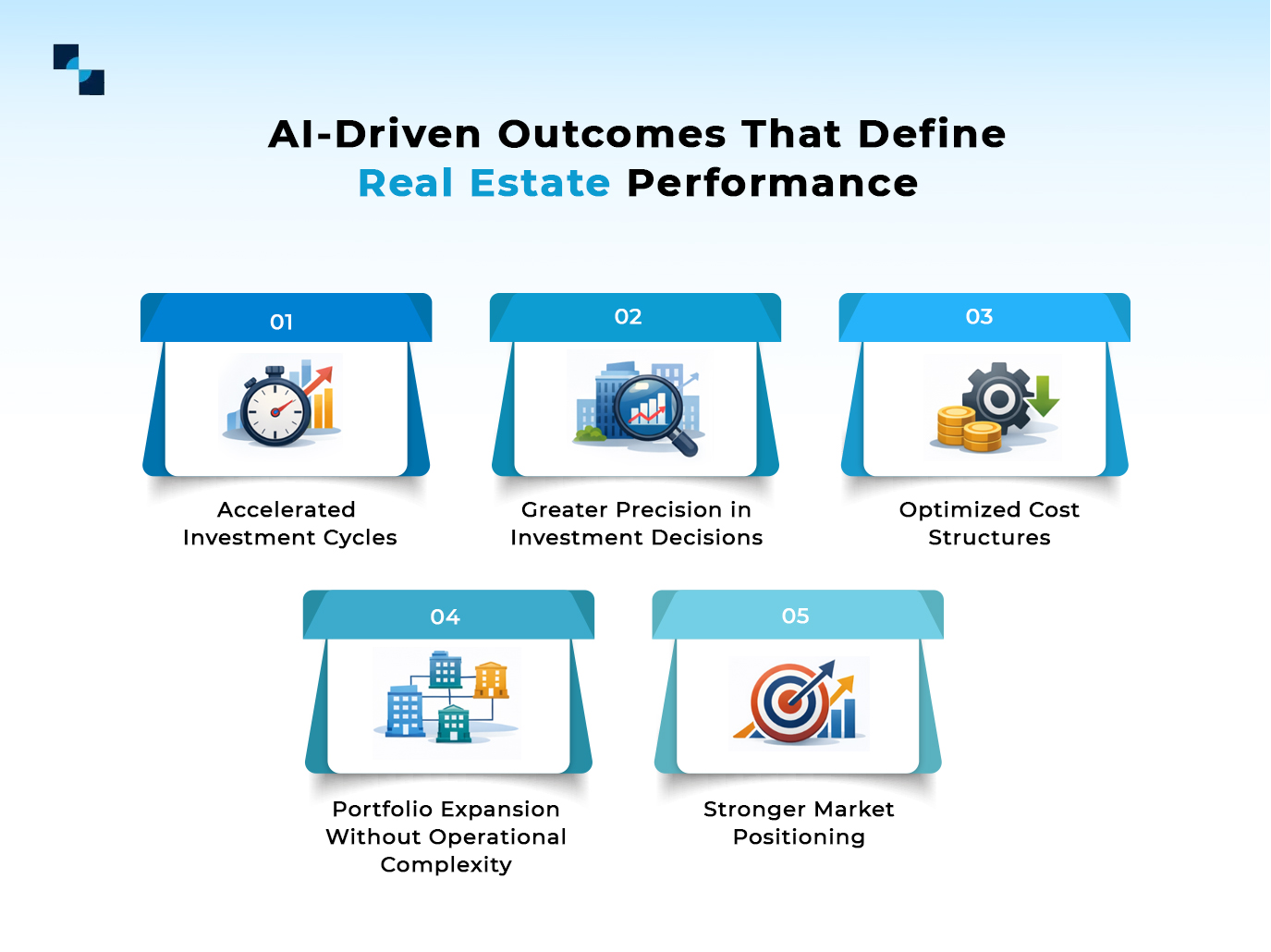
The adoption of AI in real estate investment is driving measurable outcomes that directly impact performance, scalability, and long-term value creation.
1. Accelerated Investment Cycles
AI enables faster evaluation of opportunities by processing large datasets in real time. This reduces the time required to move from analysis to execution. As a result, firms can act on opportunities with greater speed in competitive markets.
2. Greater Precision in Investment Decisions
With AI and machine learning in real estate investment, decisions are based on structured data models rather than assumptions. This improves the reliability of valuations, risk assessments, and forecasts. It also ensures more consistent decision-making across teams and portfolios.
3. Optimized Cost Structures
AI-driven systems reduce reliance on manual processes across operations and analysis. This leads to more efficient resource utilization and lower operational overhead. Over time, firms can maintain performance while operating with leaner teams.
4. Portfolio Expansion Without Operational Complexity
AI in real estate investing allows firms to manage larger and more diverse portfolios effectively. Centralized intelligence supports better coordination across assets. This enables growth without a proportional increase in operational effort.
5. Stronger Market Positioning
Organizations leveraging AI in real estate investment are better equipped to identify emerging opportunities. They can respond more effectively to market shifts and evolving tenant expectations. This creates a clear differentiation in an increasingly competitive landscape.
Building the Next Era of Real Estate with AI
The future of real estate is no longer defined by static assets or traditional management models. It is being shaped by intelligent systems that continuously evaluate, adapt, and execute across the entire lifecycle of an asset.
As AI in real estate investing becomes deeply embedded into core strategies, the industry is moving toward a model where performance is driven by precision, speed, and continuous evolution. The shift is no longer about adopting technology; it is about redefining how real estate operates at its core. The future of real estate will not be managed; it will be intelligently operated.
At Antier, our AI development services empower forward-thinking organizations to build scalable, AI-driven solutions tailored to modern real estate challenges. From strategy to execution, we transform complex processes into intelligent systems that deliver measurable business impact.